A falling hydroponic reservoir level does not automatically tell you what to add. Plants remove water and nutrients at different rates, evaporation removes water but leaves ions behind, and source water adds its own mineral load. A full-strength nutrient top-up can push EC too high, while repeated plain-water top-ups can leave an old solution chemically unbalanced even if the reservoir looks full.
The practical answer is to measure water level, EC, pH, temperature, and solution history before choosing water, dilute nutrient solution, or a complete replacement. This guide turns those observations into a repeatable top-up routine for DWC, NFT, drip, ebb-and-flow, and Kratky systems.
Top-up and solution replacement are different jobs
A top-up restores working volume lost through plant uptake, evaporation, sampling, and small operational losses. It does not reset the ratios of individual nutrients or remove unwanted ions.
A solution replacement removes part or all of the old solution and introduces a freshly mixed batch. Replacement is appropriate when composition is uncertain, contamination occurred, unwanted ions may have accumulated, or repeated adjustments no longer behave predictably.
Oklahoma State University Extension notes that water may need to be added daily depending on reservoir size, but also warns that nutrient ratios can move beyond their desired limits over time. Treat top-up as short-term volume management, not permanent nutrient renewal.
Measure before you pour
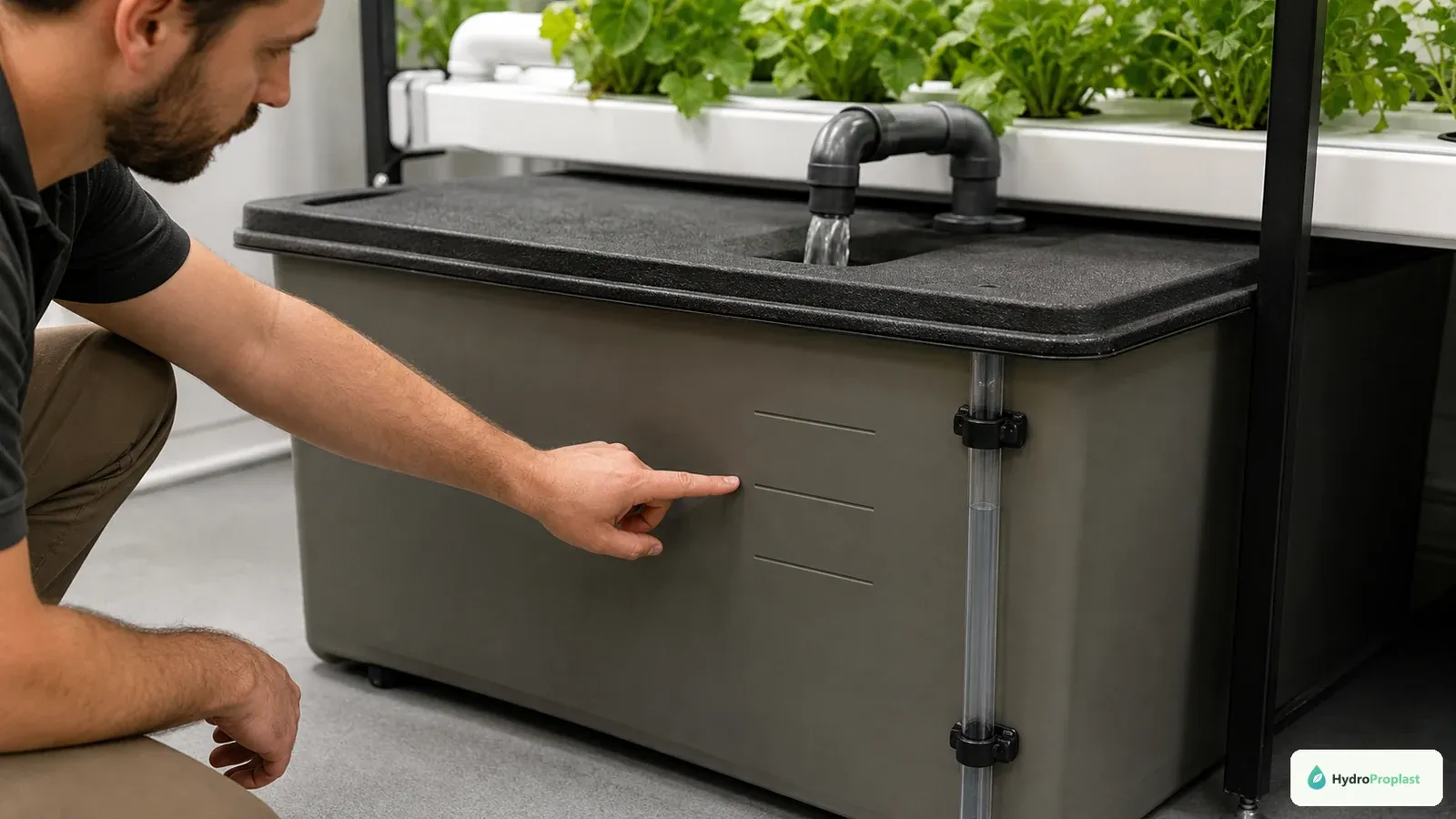
Measure the reservoir in the same system state each time and retain enough empty volume for all return flow and drain-back.
Use a marked working-volume range on the reservoir. Measure at a consistent time, ideally before the day’s normal top-up and after the solution has circulated. Record:
- current water level or estimated working volume
- EC and solution temperature
- pH
- source-water EC
- crop and growth stage
- what was added during previous top-ups
- solution age and last full replacement
- unusual heat, leaks, runoff loss, or maintenance
Rinse and calibrate meters according to their manufacturers. A drifting meter can turn a sensible top-up into a concentration problem. The pH and EC meter guide covers consistent sampling and calibration.
Read EC together with water level
EC estimates the total concentration of dissolved ions. It cannot identify individual nutrients, but its direction helps choose the next check.
| Reservoir change | What it may mean | Conservative next step |
|---|---|---|
| Level falls and EC rises | Water loss exceeded ion removal | Add measured appropriate water, mix, and recheck |
| Level falls and EC is near target | Water and total ions changed at similar proportions | Add a measured top-up selected from crop plan and recent history |
| Level falls and EC falls | Nutrient uptake, dilution, leakage, or measurement error may be involved | Verify meter and leaks; use a measured nutrient correction only if supported |
| Level changes unexpectedly fast | Leak, overflow, pump spray, heavy crop demand, or heat | Find the physical cause before routine adjustment |
| EC behaves unpredictably after repeated top-ups | Ratios or unwanted ions may have drifted | Consider a partial or complete solution replacement |
These are interpretations, not automatic dosing commands. EC does not reveal whether sodium, calcium, nitrate, or another ion caused the reading. Use crop- and stage-specific targets from a credible program and follow the nutrient manufacturer’s mixing instructions.
When plain water is the better top-up
Plain source water or appropriately treated water is often the logical choice when the level has fallen and EC has risen above the intended range. Evaporation is a common reason: water leaves the reservoir while salts remain.
Measure the amount added rather than filling to the brim. Add gradually, allow the reservoir to circulate, and recheck EC and temperature. If source-water EC is already high, adding it also adds dissolved minerals; “plain” does not mean ion-free.
Do not adjust pH in a small top-up container with an unmeasured amount of concentrated acid or alkali. Mix into the working volume using products intended for hydroponics and follow their safety instructions.
When nutrient solution may be appropriate
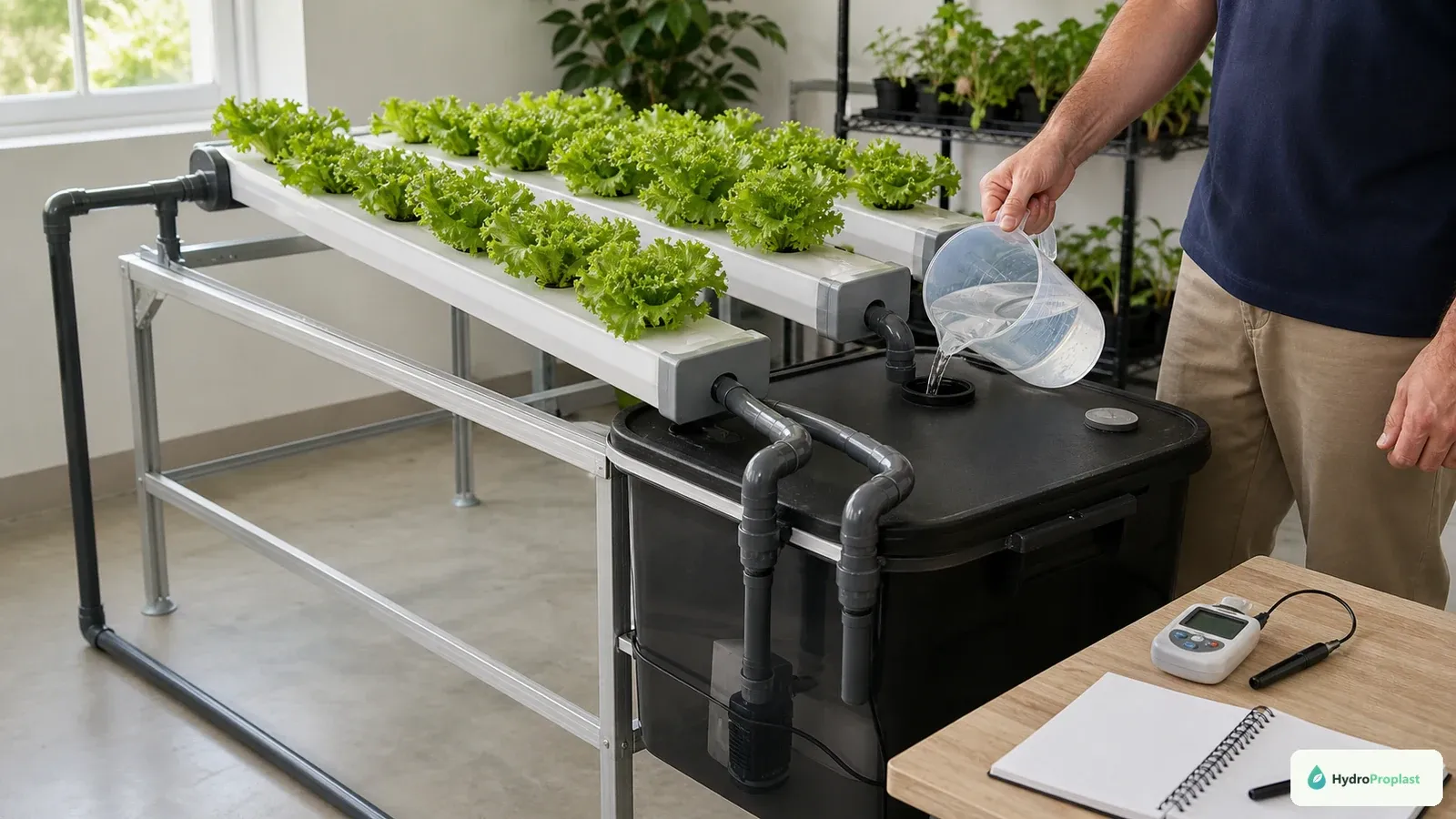
A measured nutrient top-up may be appropriate when water level and EC have both fallen, the meter is trustworthy, delivery is not leaking, and the crop plan supports replenishment. Use a separately mixed solution at a known concentration rather than pouring concentrate directly into the reservoir.
Virginia Cooperative Extension explains that DWC strength can be adjusted by adding stock fertilizer solution or water based on the EC reading. This does not mean dosing to EC alone is indefinitely reliable. Plants use individual nutrients at different rates, so periodic replacement and water analysis remain important.
Add each part to the full mixing water separately and stir between additions. Never combine concentrated Part A and Part B directly. Measure the final mixed top-up, add it slowly to a circulating reservoir, and recheck EC before adjusting pH.
Why “always top up with full strength” can fail
If plants are taking proportionally more water than nutrients, full-strength top-ups can ratchet EC upward. Unwanted source-water ions can also accumulate with each addition. High total concentration can restrict water uptake and injure roots.
The opposite rule—always use only water—can also fail. A rapidly growing crop in a small reservoir may remove substantial nutrients. Repeated dilution without a replacement plan can leave the solution weak or imbalanced.
The correct top-up changes with crop stage, environment, reservoir size, water quality, and system losses. A log is what turns that changing answer into a manageable process.
Top up a DWC reservoir without flooding crowns
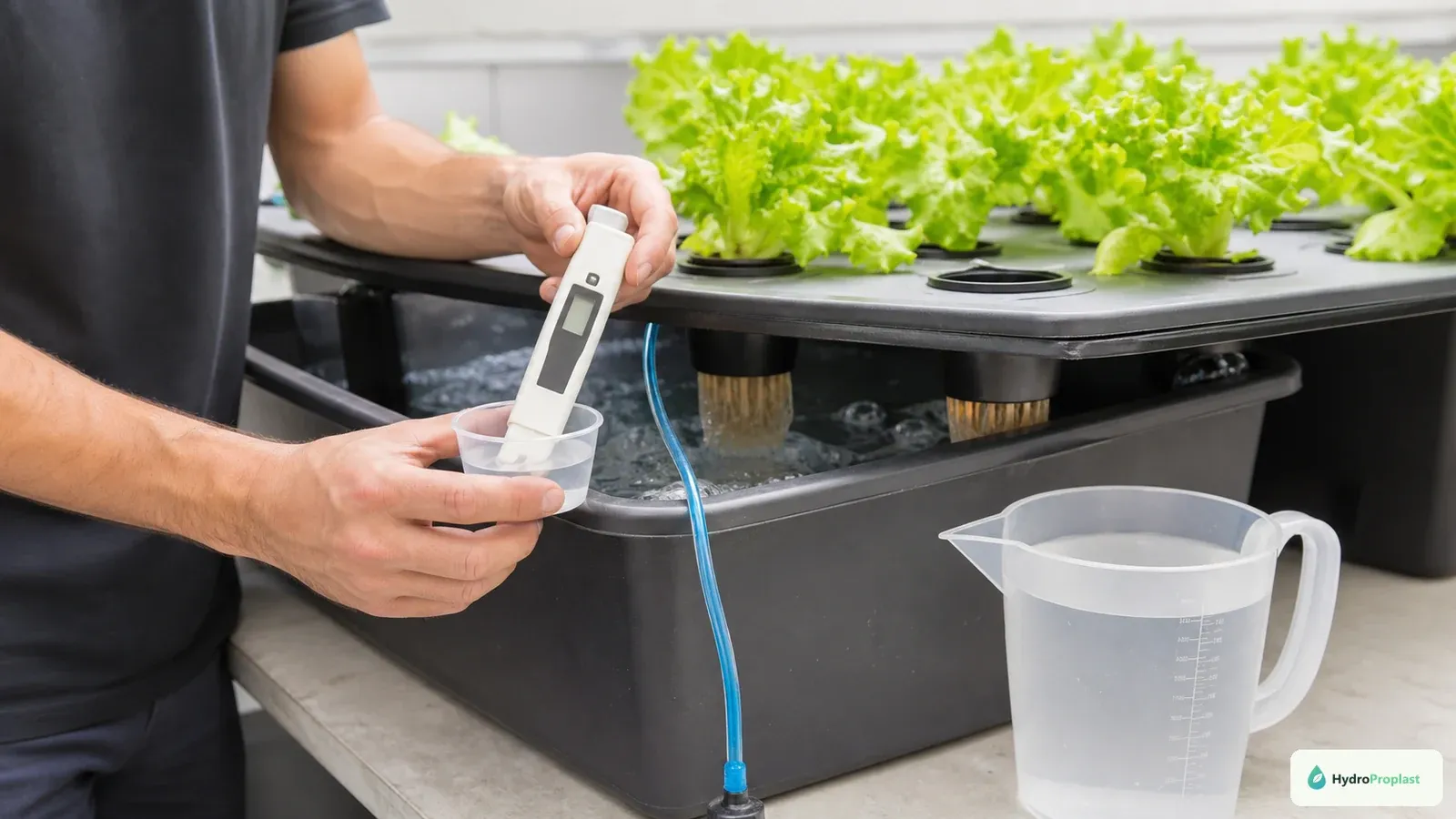
Measure before the top-up, add a known volume, circulate completely, and recheck before making another correction.
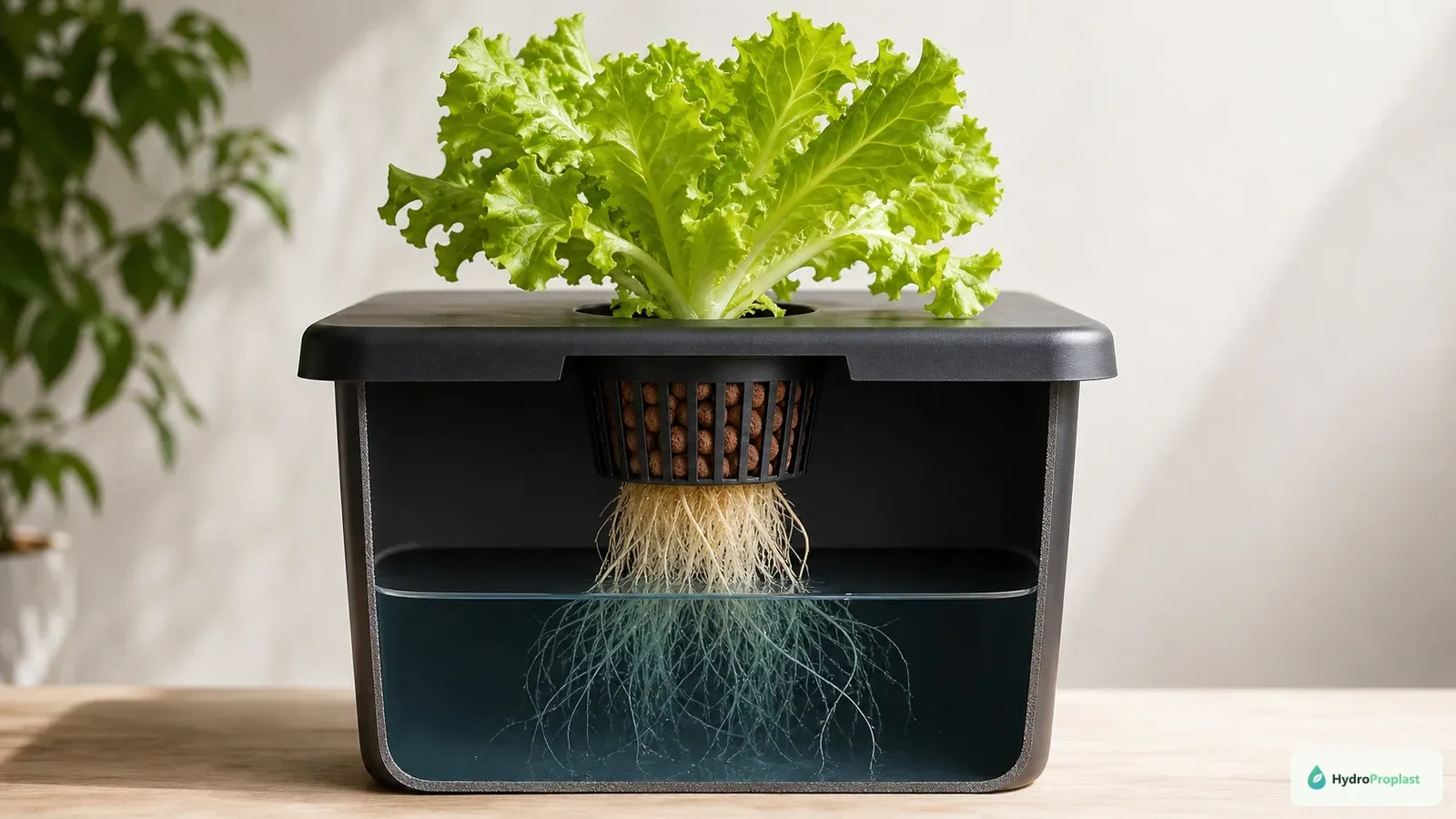
In DWC, maintain the water level required by the system while preserving oxygen around roots and avoiding prolonged saturation of the stem base or crown. Add top-up solution away from roots when possible and allow circulation or gentle mixing before measuring again.
Keep the air pump operating during routine top-up. Check that air lines and diffusers remain submerged and producing even bubbles. A large cold or warm addition can shock roots, so match temperature reasonably.
As roots expand, the true working volume changes. A reservoir labeled 40 liters may not hold 40 liters of solution when baskets, pumps, and roots displace space. The reservoir-size guide explains nominal versus working volume.
Top up NFT without overfilling the return loop
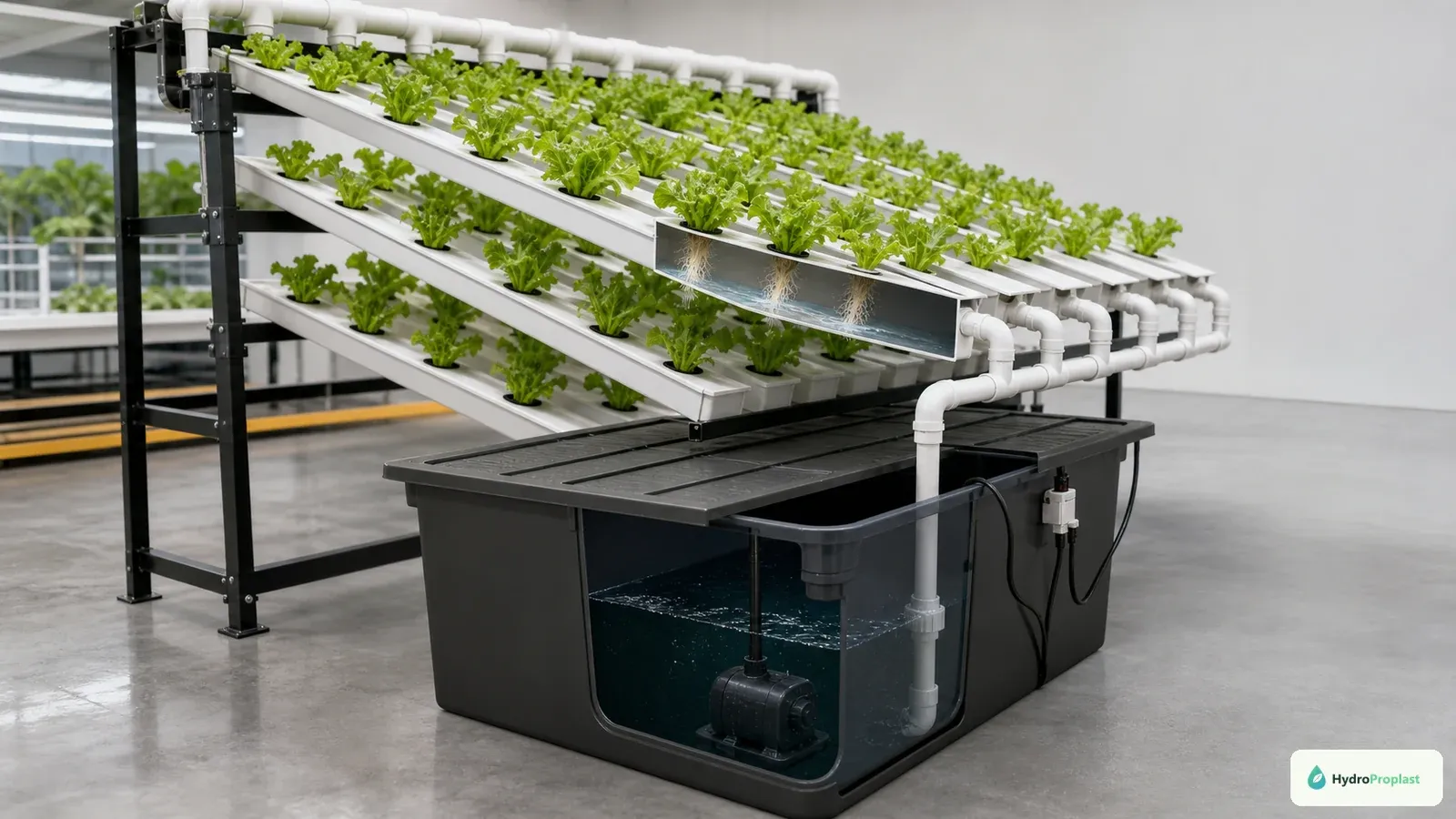
NFT needs enough reservoir volume to keep the pump submerged and supply a continuous shallow film through every channel. Before topping up, inspect the farthest channel and the return. A low reservoir may be caused by a leak, blocked return, splash, or overflow rather than normal crop use.
Add a measured amount while the system circulates. Stay below the maximum level that allows solution from all channels to drain back safely when the pump stops. Overfilling can cause overflow during drain-back or submerge plumbing that was designed to remain above the water line.
After mixing, verify flow at the first and last channel, then recheck EC and pH. The NFT pros and cons guide explains why continuous shallow flow and pump reliability matter.
Top up drip and ebb-and-flow systems after accounting for drain-back
In recirculating drip and ebb-and-flow systems, reservoir level changes during irrigation cycles. Measuring mid-cycle can make a normal temporary drop look like a shortage.
Choose a repeatable system state—often after all solution has returned—to mark and measure the normal working level. Check for solution retained in pots, trays, filters, and lines. Leave enough empty reservoir volume to receive drain-back without overflowing.
If the system is drain-to-waste, top-up logic belongs in the mixing tank rather than a recirculating return reservoir. Track delivered volume, runoff, feed EC, and runoff EC. Do not reuse runoff unless the system is designed and managed for recirculation.
Preserve the Kratky air gap
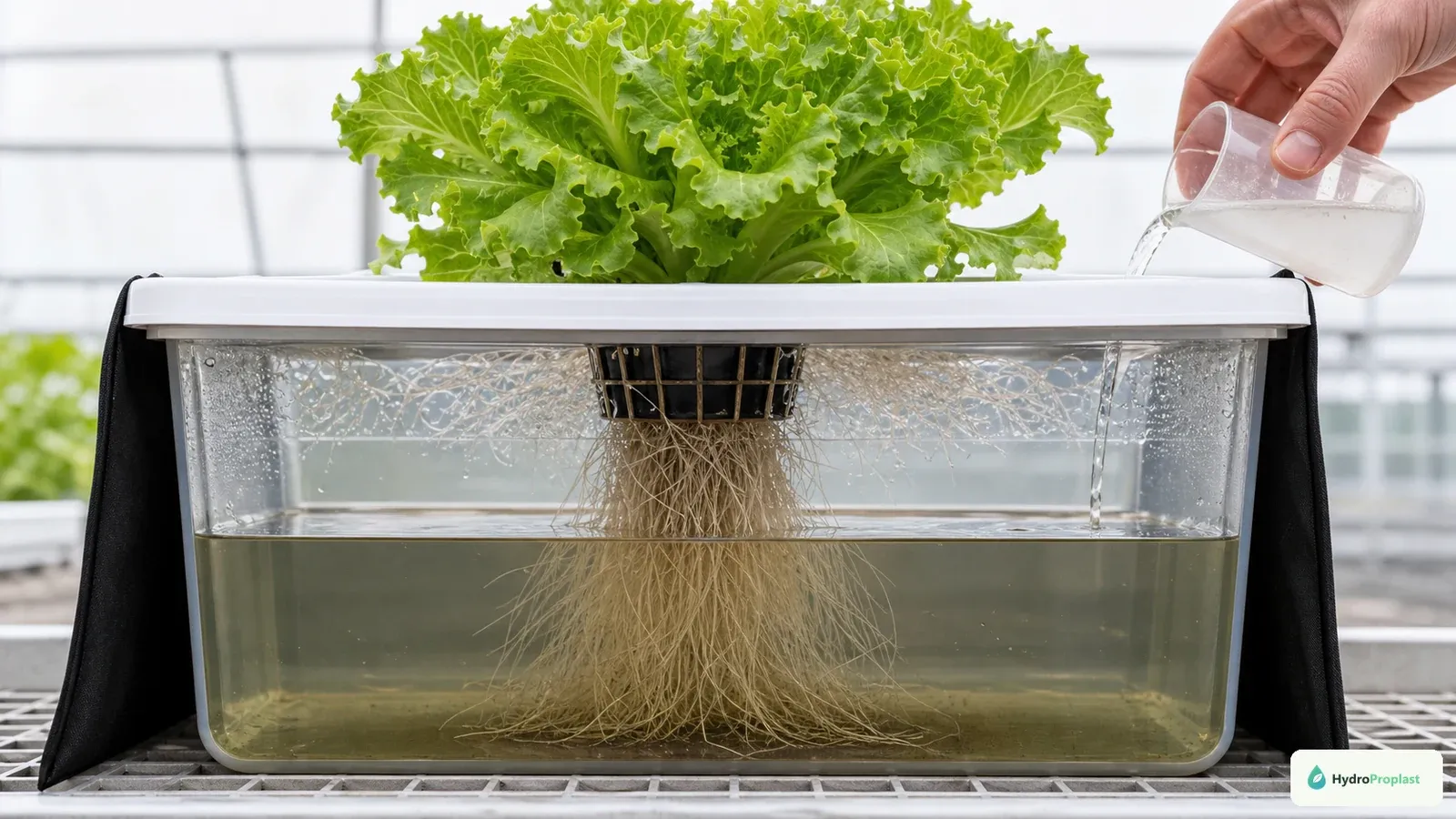
An established Kratky container must retain its air gap; refilling to the original level can submerge air-adapted upper roots.
A Kratky container begins with solution touching or nearly touching the young plug so roots can establish. As the plant grows and the level falls, upper roots adapt to the humid air space while lower roots remain in solution.
Do not refill an established Kratky container to its original level and submerge those air-adapted roots. Top up only according to a crop- and container-specific plan that preserves the necessary air gap. If the level fell because of a leak, repair the container before adding solution.
Kratky is not simply DWC without an air pump. Its root-zone architecture is part of the method. The Kratky versus DWC guide explains the difference between passive air-gap management and active aeration.
Use a measured top-up container
Keep a clean, food-safe container dedicated to hydroponic mixing. Mark volume graduations or weigh water when appropriate. Record the starting water, nutrients added, final EC, temperature, and volume transferred.
For multi-part products:
- fill the container with most or all of the required water
- add Part A at the label rate and mix thoroughly
- add Part B separately and mix again
- add any other components only in the specified order
- verify final volume and EC
- add to the reservoir gradually while it circulates
- recheck EC, then pH, after complete mixing
Never pour two concentrates together. Insoluble precipitates can form, removing nutrients from availability and creating sediment.
Avoid top-up shock
A large addition can change temperature, EC, pH, alkalinity, and dissolved oxygen rapidly. Add in controlled stages when the crop is sensitive or the top-up is a large fraction of the working volume.
Do not compensate for a small reservoir by making large concentrated corrections. A larger correctly sized reservoir often changes more slowly and leaves more time to respond. Keep it covered to reduce evaporation and light entry while maintaining access for inspection and cleaning.
If pH moves sharply after adding source water, investigate alkalinity rather than using increasingly large correction doses. The pH-drift guide explains why pH can rebound after adjustment.
Know when to stop topping up and replace
Choose a partial or complete replacement when:
- the original mix or top-up history is unknown
- the wrong nutrient or dose entered the reservoir
- EC repeatedly rebounds without a clear physical cause
- source-water ions may have accumulated
- roots, debris, algae, or a cleaning chemical contaminated the solution
- feed and runoff behavior suggests severe media salt buildup
- crop-stage guidance calls for a new formulation
- the reservoir has been corrected repeatedly but plant response remains poor
Prepare the new solution from measured water and a verified recipe. Clean equipment as needed, restore circulation, and verify EC and pH before returning to routine operation. See the water-change guide for replacement timing and safe disposal.
Build a top-up record that answers future questions
A simple table is more useful than memory:
| Date/time | Level before | EC before | Water added | Nutrient added | EC after mixing | pH after mixing | Notes |
|---|---|---|---|---|---|---|---|
| Example | Measured mark | Meter reading | Measured volume | Product and dose | Meter reading | Meter reading | Heat, crop stage, leak check |
Review the trend weekly. If top-up volume rises suddenly, inspect for leaks and weather changes. If the same water addition causes larger EC shifts, confirm working volume and meter calibration. If pH correction demand changes, review source water, alkalinity, root activity, and solution age.
Common questions
Should I top up before or after measuring EC?
Measure before top-up to understand what changed. Then add the measured top-up, circulate thoroughly, and measure again to confirm the result.
Can I add nutrient concentrate directly to a low reservoir?
No. Dilute and mix it according to the manufacturer in a separate volume of water, then add gradually. Direct concentrate can expose roots to extreme local concentration and can precipitate with other components.
Why did EC fall after I added water?
Water diluted the total concentration of ions. Whether that is desirable depends on the EC before top-up, source-water EC, crop target, and solution history.
Why does pH change after every top-up?
Source-water alkalinity and pH, nutrient chemistry, temperature, root activity, and reservoir buffering all contribute. Measure source water and adjust only after the reservoir is fully mixed.
Can an automatic float valve solve top-ups?
It can maintain level, but it does not diagnose EC, nutrient ratios, leaks, or source-water quality. Use a correctly installed valve with overflow protection and continue monitoring the solution.
Sources and further reading
- Electrical Conductivity and pH Guide for Hydroponics — Oklahoma State University Extension
- Hydroponic Production of Edible Crops: Deep Water Culture Systems — Virginia Cooperative Extension
- Nutrient Uptake and Management in Recirculating Hydroponics — University of Arkansas
- Water and Nutrient Management for Greenhouse Hydroponic Vegetables — University of Florida IFAS Extension
The best top-up is not defined by a fixed bottle dose. It is a measured response to working volume, EC direction, pH, temperature, crop stage, source water, and solution history. Restore the level deliberately, mix completely, verify the result, and replace old solution when top-ups can no longer describe its chemistry.