Most growers need pH testing; EC becomes valuable quickly
You need a dependable way to test pH in almost every hydroponic system because pH influences nutrient availability. An EC meter is strongly useful when you mix nutrients, operate a recirculating reservoir, top up repeatedly, or grow beyond a tiny one-crop experiment. Neither instrument tells you whether roots are healthy or which individual nutrient is missing.
A small Kratky jar can begin with a quality color pH test and careful label-rate mixing. A DWC bucket, NFT channel, drip reservoir, or longer fruiting crop benefits from calibrated digital pH and EC meters because the solution changes over time. Buy instruments you will calibrate, rinse, store, and verify—not the most feature-rich display.
Oklahoma State University’s EC and pH guide treats pH, EC, alkalinity, and nutrient balance as core parts of soilless nutrient management. Measurement is useful only when connected to water level, crop stage, temperature, and plant observations.
What a pH reading tells you
pH describes the acid-base condition of the solution on a logarithmic scale. It helps you judge whether the root environment is within a crop-appropriate range for nutrient availability. It does not measure the amount of fertilizer in the water.
A reading outside the target range can justify a gradual correction after the meter is verified and the complete nutrient is mixed. A suitable reading does not prove every nutrient is balanced, the solution is clean, or roots have enough oxygen.
The instrument also cannot explain why pH moved. Source-water alkalinity, nutrient form, plant uptake, roots, media, algae, top-ups, and measurement error can all contribute. Use Why Hydroponic pH Keeps Drifting when repeated correction is required.
What EC tells you—and what it hides
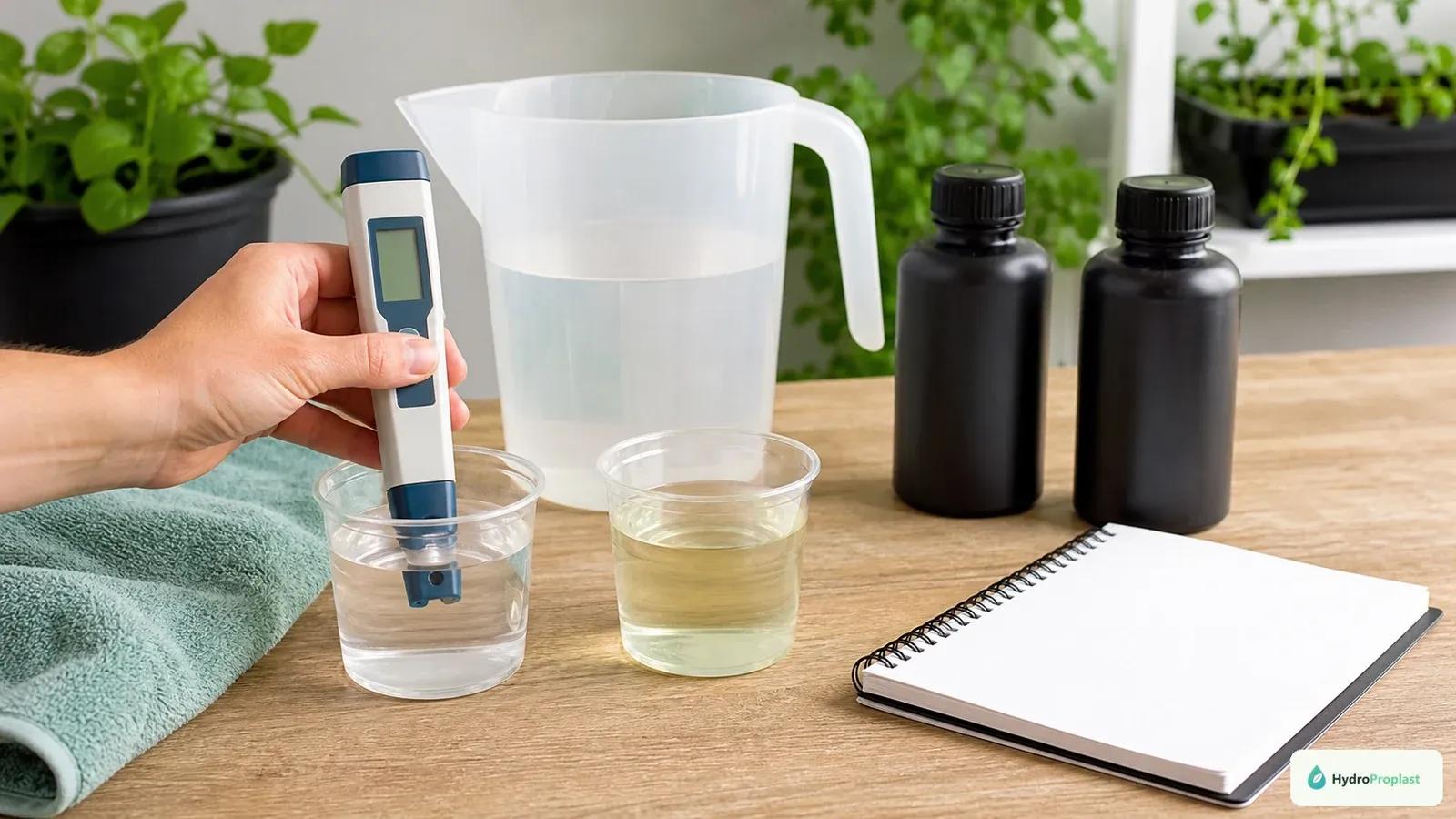
EC tracks overall ionic concentration; it does not identify individual nutrients or prove that roots can absorb them normally.
Electrical conductivity measures how readily solution conducts electricity. Dissolved fertilizer salts separate into ions that increase conductivity, so EC is a practical proxy for total ionic concentration.
EC cannot identify individual nutrients. Sodium or chloride in source water contributes to the reading without providing the intended crop balance. After plants remove ions selectively, a reservoir can show the target EC while one nutrient has accumulated and another has declined.
Read EC as a trend. If water level falls while EC rises, water may be disappearing faster than ions. If EC falls, plants may be taking up ions or top-up water may have diluted the solution. Temperature, crop stage, and source-water baseline affect interpretation.
The University of Minnesota Extension explicitly notes that EC does not reveal individual nutrient or micronutrient concentrations. It remains useful because it catches broad concentration changes that label-rate mixing alone cannot show.
When a color pH test is enough
Liquid drops or fresh test paper can be suitable for a small beginner system when the expected range is readable, water color does not obscure the result, and adjustment does not require narrow precision. They need no calibration or electrode storage.
Color tests become difficult when nutrient dyes, lighting, color vision, or a narrow target makes comparison ambiguous. They also produce fewer convenient numeric records. Do not assume a cheap digital pen is automatically more accurate; an uncalibrated or dry probe can give a precise-looking wrong number.
Keep the test sealed, dry where required, and within its stated shelf conditions. Compare under neutral consistent light. Never return the test sample to the reservoir.
Choosing a pH meter
Look for calibration at two or more relevant points, replaceable or well-supported calibration buffers, clear storage instructions, resolution appropriate to hydroponics, and a manufacturer that publishes care and replacement information. Waterproofing is useful around reservoirs, but it does not make the probe indestructible.
Automatic temperature compensation adjusts electrode response; it does not correct plant stress caused by warm solution. A replaceable electrode can extend the life of a more expensive meter, while a low-cost pen may be replaced as a unit.
Budget for buffer and storage solution, not only the meter. Verify whether the electrode must remain wet and which storage fluid is required. Never store a pH electrode in distilled water unless its manufacturer explicitly directs that practice.
Choosing an EC meter without unit confusion
EC may be displayed in microsiemens per centimeter, millisiemens per centimeter, or related conductivity units. Some meters show “ppm” using a conversion scale. Different ppm scales can display different numbers for the same conductivity.
Prefer recording the native EC unit used by your crop reference. Confirm the range covers source water and nutrient solution, and buy the correct calibration standard. Temperature compensation is useful, but readings should still be taken consistently.
Avoid converting between scales from memory. Write the unit beside every log value. A target of “1.6” is meaningless without knowing whether it is mS/cm, dS/m, or another display mode.
Calibration is part of measurement
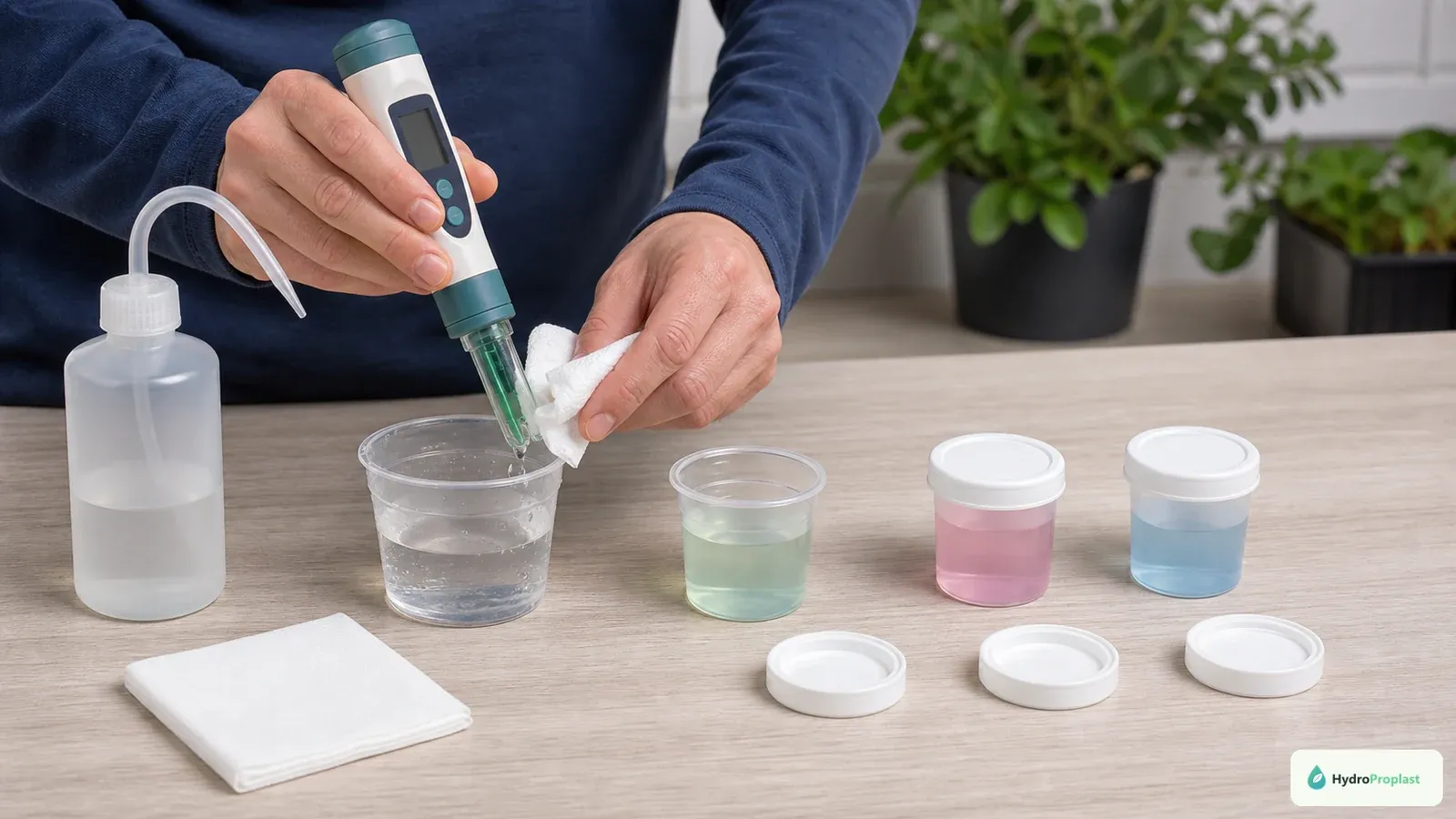
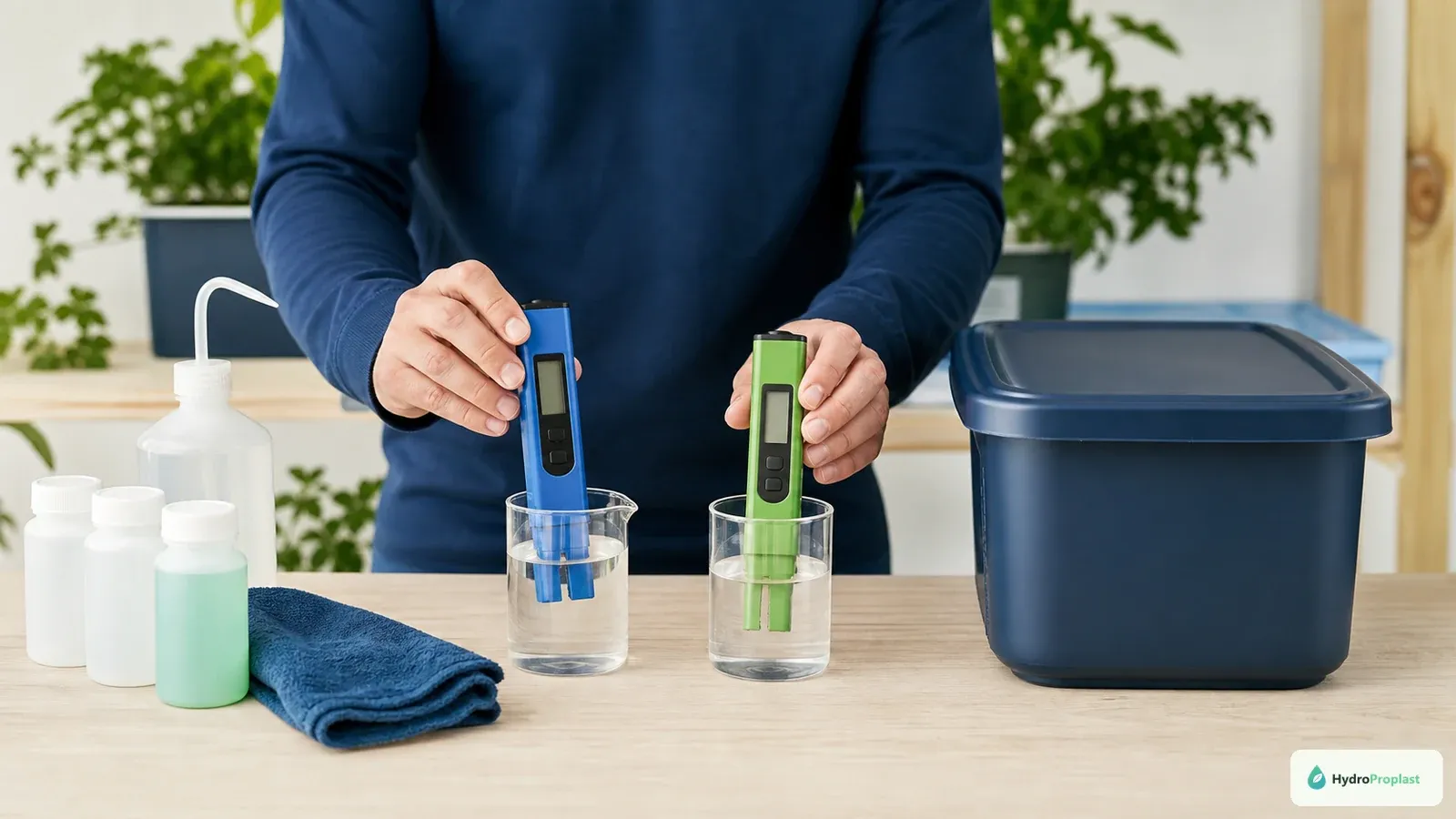
Calibration needs fresh buffers, a rinsed probe, gentle blotting, and clean separate cups; do not return used buffer to its storage bottle.
Use fresh, uncontaminated standards and follow the meter’s procedure. Pour a small amount into a clean cup rather than inserting the probe into the stock bottle. Discard the used portion so reservoir residue does not contaminate the standard.
Calibrate at the frequency specified by the manufacturer, after storage, when a reading is surprising, and before decisions with high consequences. Check a standard after calibration to confirm the meter returns close to the expected value.
Rinse between pH buffer, EC standard, source water, and nutrient samples. Blot or shake gently according to guidance; wiping a sensitive pH bulb may create static or damage. Label opened standards with dates and store them properly.
A consistent sampling procedure
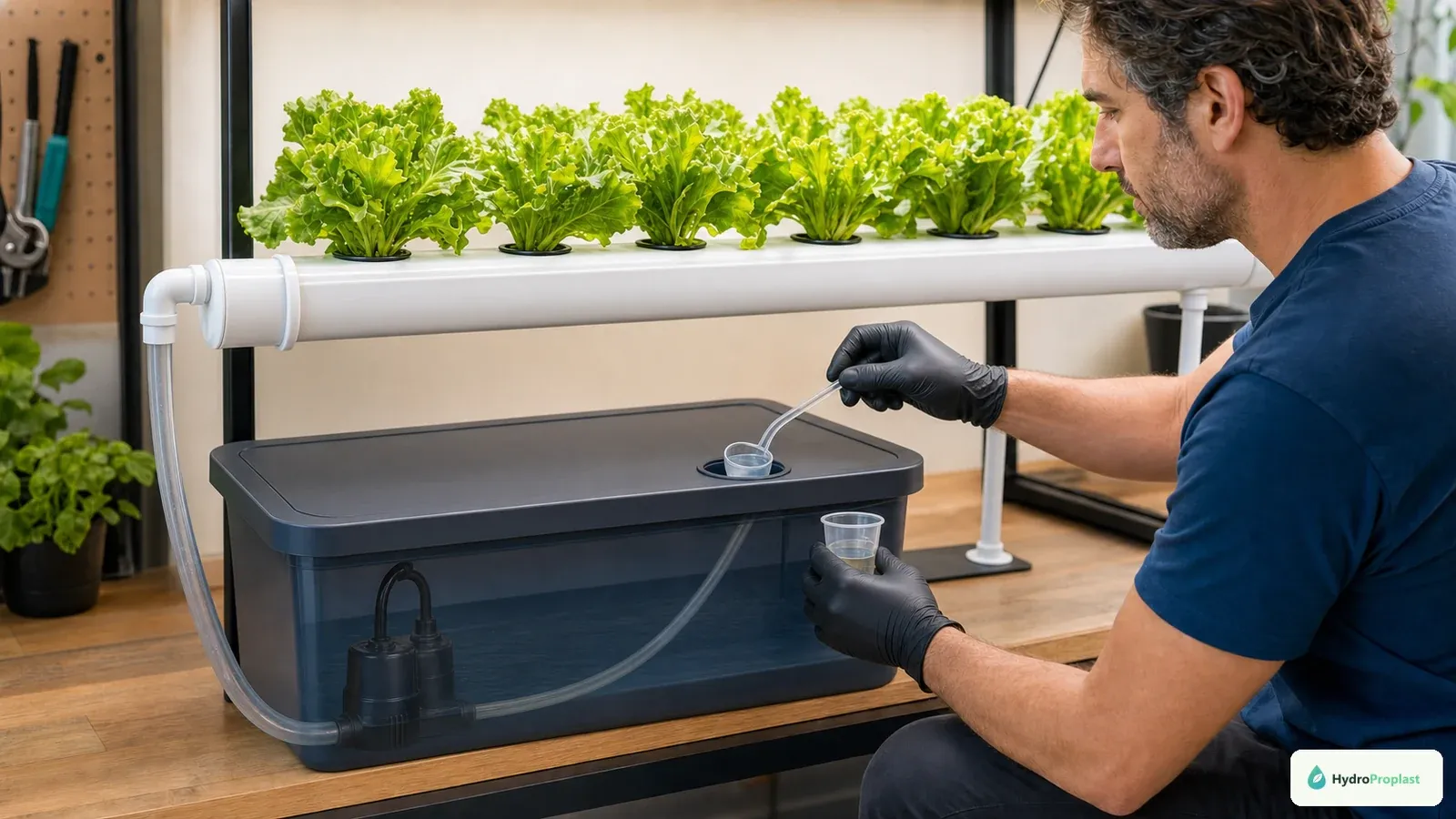
Sample from the same calm, well-mixed location each time rather than directly in return splash or immediately after adding concentrates.
Mix the complete nutrient first and let the solution circulate. Measure EC, make any concentration decision, then measure pH. Adjust pH last because nutrient additions alter it.
Sample from the same representative location, away from a fresh concentrate or adjustment dose. Use a clean cup, allow readings to stabilize, and note solution temperature. In long recirculating loops, reservoir and return samples may differ; define which one your log uses.
Record time, pH, EC, water level, temperature, crop, stage, and recent additions. Testing at roughly the same time makes trends more comparable.
How often should you measure?
Frequency depends on system volume, crop demand, water alkalinity, temperature, and how recently the system changed. A new small reservoir with mature plants deserves closer observation than a stable large tank with young lettuce.
Measure when mixing, after major top-ups or solution replacement, after sufficient circulation following an adjustment, and when plants or roots change. Daily measurements during a commissioning week reveal the normal direction. Later frequency can be reduced only when stability is understood.
Commercial recommendations may call for frequent or automated monitoring because crop value and reservoir scale differ. Home growers should not copy automation setpoints without understanding manual sampling.
Turn readings into decisions
If pH is outside the crop range, confirm calibration, mixing, and sampling. Then correct gradually using a labeled hydroponic food-crop product. The pH adjustment guide covers order and safety.
If EC is high and water level is low, adding appropriately prepared water may be indicated. If EC is low, review crop uptake, top-ups, and product guidance before adding concentrate. Never add undiluted nutrient directly onto roots.
If both values are acceptable but plants decline, inspect root oxygen, temperature, light, pests, delivery, and nutrient age. Instruments narrow questions; they do not replace plant diagnosis.
Common false confidence
A meter with two decimal places is not necessarily accurate to two decimals. Resolution and accuracy are different.
Green roots or bad odor cannot be cleared by a good EC number. Chemistry and root health are separate observations.
Correct EC does not prove nutrient ratios remain correct after many top-ups. Periodic replacement or analysis may still be needed.
Correct pH at one moment does not prove stability. Review the trend and alkalinity.
A “calibrated” icon does not mean standards remain fresh or the probe was stored correctly.
An automatic doser is not safer if its probe drifts or its concentrate supply is unlimited.
Keep a verification kit
Store fresh pH buffers, EC standard, clean sample cups, rinse water, storage solution, a log, and a secondary pH test. A thermometer helps distinguish meter compensation from actual root-zone temperature.
Label each meter and standard so units and expiry or opened dates remain visible. Keep probes away from nutrient concentrates and adjustment chemicals. If two instruments disagree, test both in a standard before changing the reservoir.
For important crops, a spare meter or color test prevents one failed probe from forcing a guess. The backup should be maintained, not left dry in a drawer.
A beginner purchase sequence
First buy a dependable pH method. Next choose an EC meter when the system recirculates, crop lasts beyond a short passive cycle, source water is mineral-rich, or nutrient concentration will be adjusted from trends. Add laboratory water analysis when alkalinity, sodium, or repeated unexplained drift matters.
Do not buy dissolved-oxygen, oxidation-reduction, or automatic dosing equipment before mastering pH, EC, temperature, water level, and root inspection. More sensors create more calibration and interpretation work.
Pair the instruments with Hydroponic Nutrients for Beginners so readings connect to correct mixing and top-ups.
Decide based on the cost of being wrong
For one inexpensive lettuce, a quality color pH test and label-rate nutrient may be proportionate. For a shared reservoir supporting many plants, the cost of one mixing error makes reliable EC and pH meters easier to justify. Fruiting crops accumulate more time and input before harvest, increasing the value of records.
Buy the simplest instruments that meet that risk, then maintain them. A calibrated modest meter with fresh standards is more useful than an advanced meter whose probe care is ignored.
The goal is not to collect numbers. It is to notice a meaningful change early, confirm it, and make one measured correction while the plants remain healthy.
Before trusting a purchase, simulate the complete routine. Price the meter, standards, storage solution, replacement probe or expected service life, sample cups, and a backup test. Read the official manual to confirm calibration points and storage conditions are practical in your location. A meter whose consumables are unavailable is not a dependable bargain.
Run a one-week comparison after purchase. Test the same well-mixed sample at a consistent temperature each day, verify against standards, and compare pH with the backup method. Record how long stabilization takes. For EC, test source water and a repeatable nutrient batch to confirm the unit and scale.
Create decision bands rather than reacting to noise: an observation band inside the crop range, a retest threshold, and an action threshold after verification. This prevents every minor digit change from triggering chemical additions.
At the end of the crop, review which readings led to useful action. If no EC measurement changed a decision in a tiny passive setup, the meter may remain optional there. If one high-EC event prevented overfeeding a shared reservoir, its value is clear. Equipment should earn its place through better decisions, not the number of values displayed.
Before storing the meters, export or photograph the crop log and note the calibration standard lot and date. That small handoff preserves the meaning of the readings for the next crop. If a replacement meter later disagrees, test both in the same fresh standards and mixed sample before deciding that the reservoir changed.