Change solution when evidence says the mix is no longer trustworthy
There is no single correct number of days for every hydroponic reservoir. A practical beginner baseline is to inspect frequently, top up deliberately, and plan periodic complete replacement, then shorten or extend the interval using crop demand, reservoir size, source water, EC and pH trends, root health, and accumulated additions.
Replace immediately after a serious mixing error, confirmed contamination, failed sanitation, extreme unresolved pH or EC, or root-zone event that makes the solution unsafe to trust. Do not wait for a calendar when roots smell bad or the wrong concentrate was added.
Conversely, clear solution at day fourteen is not automatically balanced. Plants remove individual nutrients at different rates, and EC cannot show each ion. A replacement schedule is a risk-management tool, not proof of freshness.
What changes between fresh mix and replacement
Plants remove water and ions. Evaporation removes water but leaves salts. Top-ups dilute or add ions. Source-water minerals accumulate. pH adjustment contributes additional ions. Roots release compounds, microbes act on organic material, and debris enters the reservoir.
The original nutrient ratio gradually becomes less certain even if EC returns to target. Sodium or chloride can accumulate while an essential element declines. That is why indefinitely “steering” one batch with EC and pH is not the same as restoring a complete formula.
Oklahoma State University’s EC and pH guide discusses refreshing nutrient solution because ratios can move beyond desired limits over time. Treat its schedule examples in the context of system and crop rather than as an immutable rule.
Top-up and full change solve different problems
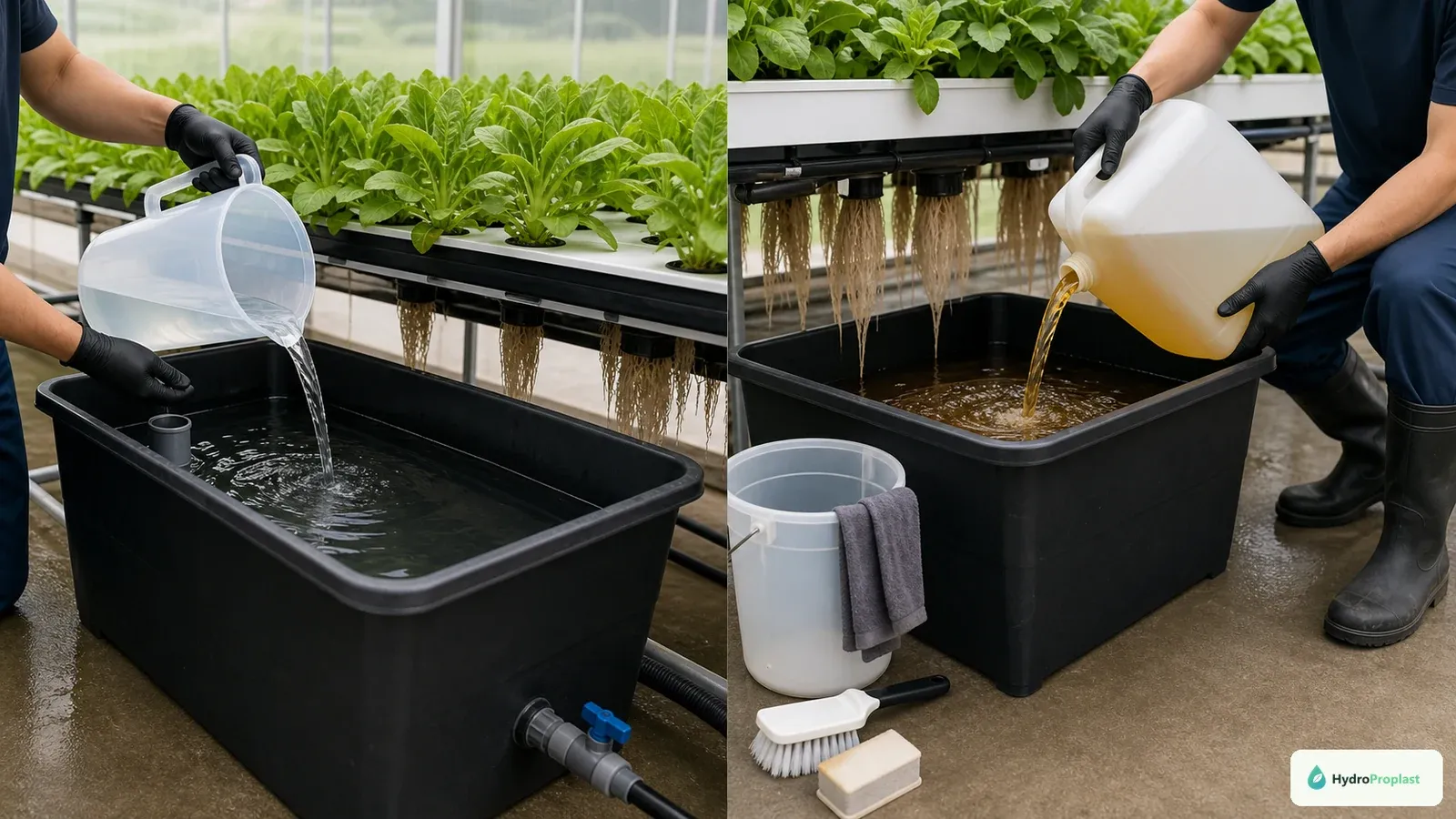
A top-up restores water level; a full change resets the nutrient mixture and removes accumulated residues.
A top-up restores volume. Plain water generally lowers EC; prepared nutrient solution may maintain or raise it. The correct choice depends on water level, EC trend, crop stage, and source water.
A full change removes the old solution and replaces it with a known complete mix. It resets broad uncertainty but costs water, nutrient, and labor. It does not sanitize dirty roots, repair a pump, or correct a light leak.
Record every top-up. Once cumulative additions become large relative to working volume, the reservoir has effectively been transformed even if it never ran empty. That history can justify replacement before visible symptoms.
Factors that shorten the interval
Small reservoirs change faster because each plant and addition represents a larger fraction of volume. Mature fruiting crops remove more water and nutrients than seedlings. High temperature and strong light can increase water use and root stress.
Mineral-rich source water can accumulate unwanted ions. Repeated pH correction adds more material. A shared recirculating loop spreads root debris and biological problems. Large differences between input and runoff in media systems suggest imbalance or salt accumulation.
Recent disease, algae, pump failure, or dead roots lowers confidence. A crop transition is also a natural point to drain, clean, and remix rather than carrying an uncertain solution into new seedlings.
Factors that may support a longer interval
A larger well-managed reservoir changes slowly. Compatible crops of one age, clean roots, stable temperature, measured top-ups, acceptable source water, and coherent pH and EC trends increase confidence.
Laboratory or more detailed nutrient analysis can support precise management at commercial scale, but home growers usually do not know individual ion concentrations. Do not infer that stable EC proves no replacement is needed.
Any longer interval should be earned by records from a healthy crop and easy cleaning access. “The water looks clear” and “nutrient is expensive” are not evidence.
Watch trends, not isolated numbers
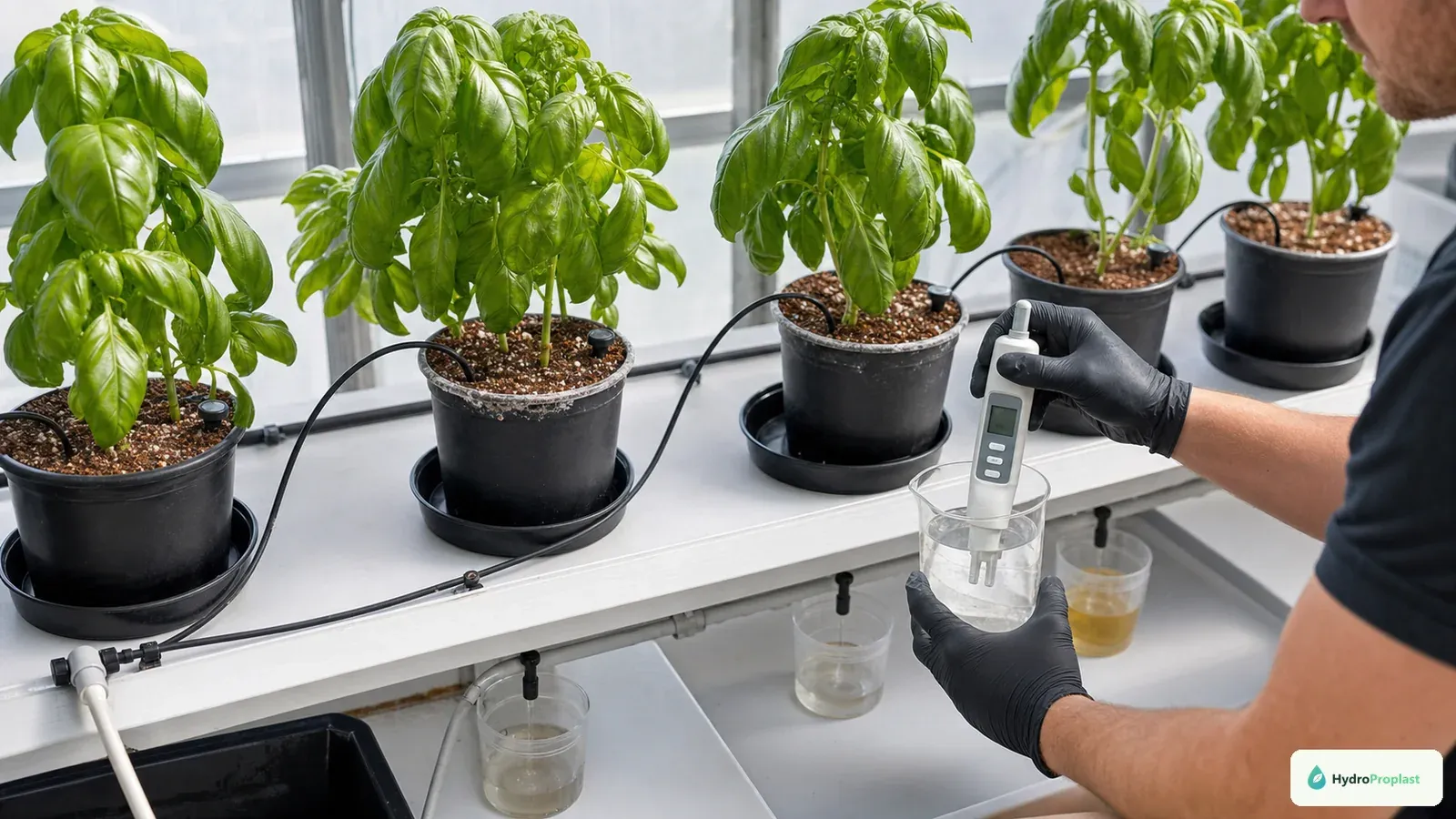
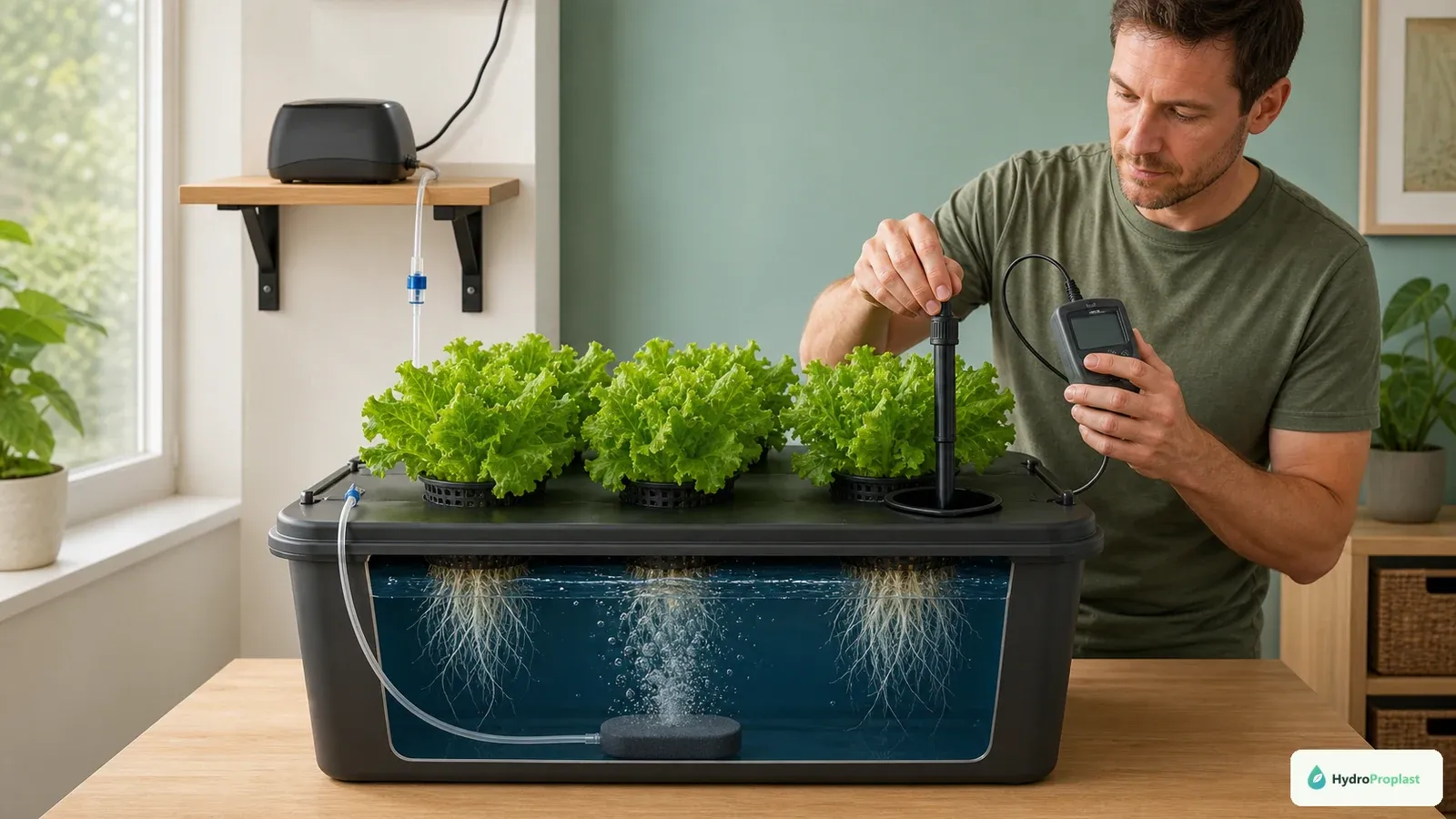
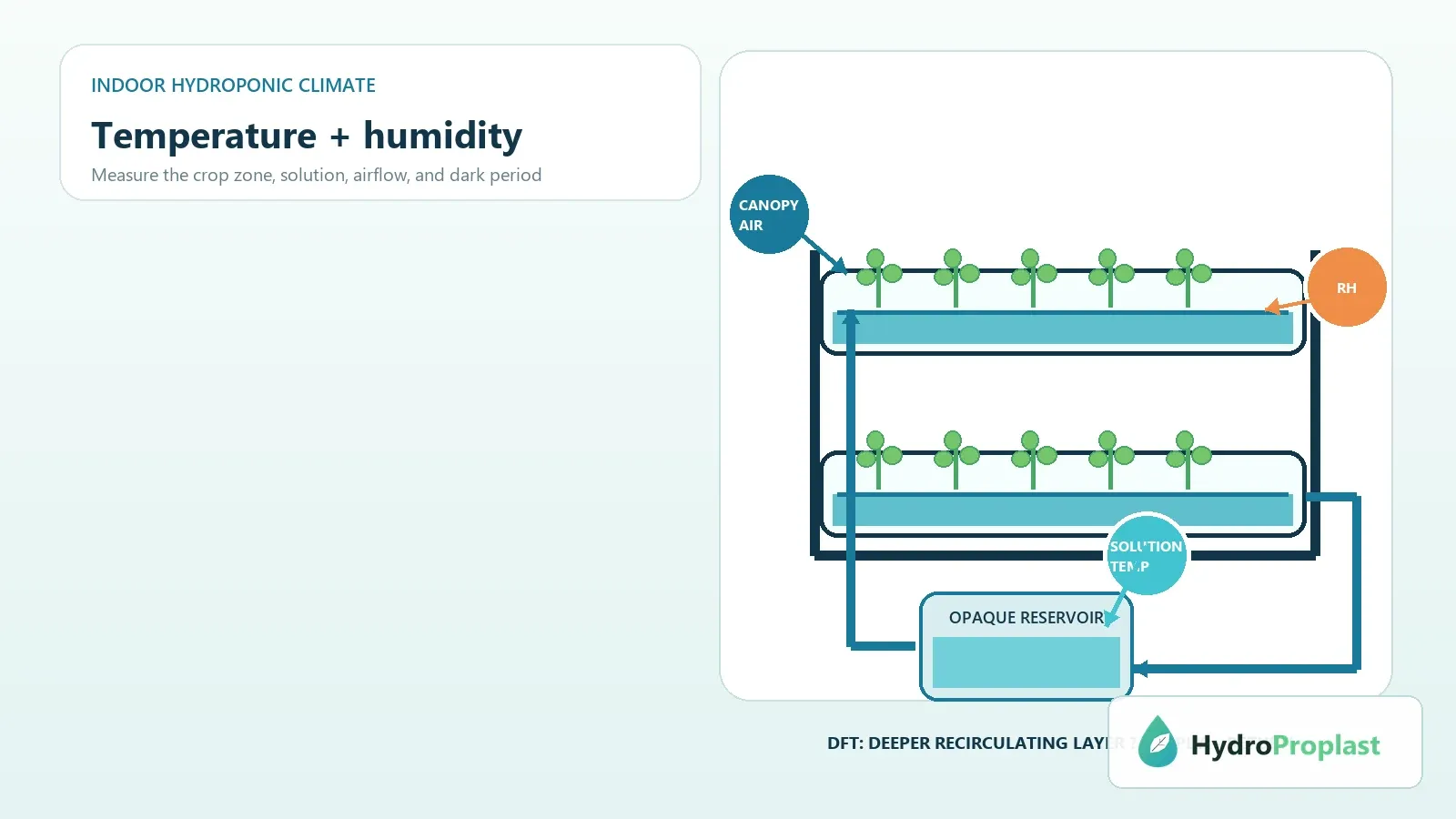
Measure pH, EC, water level, and temperature at consistent times. Record additions and plant stage. Inspect roots for color, firmness, odor, and new growth. Note pump or aeration interruptions.
If pH requires frequent opposing corrections, EC behaves unpredictably, or plants decline across the shared system, verify instruments and mixing, then consider replacement. If values move gradually within crop ranges and roots remain healthy, there may be no emergency.
The University of Minnesota Extension explains EC’s usefulness and limitation: it gauges overall concentration but not individual nutrients. This is the central reason trend monitoring cannot preserve one batch forever.
Crop stage changes the decision
Young seedlings use little solution and can be sensitive to strong nutrients. A reservoir mixed for established plants may not suit them. Rapid vegetative growth and fruiting increase uptake and change nutrient proportions.
If several crop ages share a tank, one replacement formula may be a compromise. Better planning groups compatible plants. At harvest, roots and debris should be removed and the system reset before the next cohort.
Repeated harvesting of basil or lettuce extends the crop beyond a one-cut schedule. Count operating history and cumulative top-ups, not only days since transplant.
Replace early after a mixing mistake
If a concentrate was doubled, a component omitted, pH product overshot severely, or an unknown chemical entered the tank, do not attempt endless counter-adjustment. Confirm the error, protect the plants, and prepare a fresh correctly measured solution.
Adding the opposite chemical may return a number to range while leaving excessive salts. Dilution can help in some verified cases, but a fresh batch is more interpretable for a small home reservoir.
Document the mistake so it is not repeated. Mark working volume, use a checklist, and separate measuring tools.
Root disease changes the task from changing to cleaning
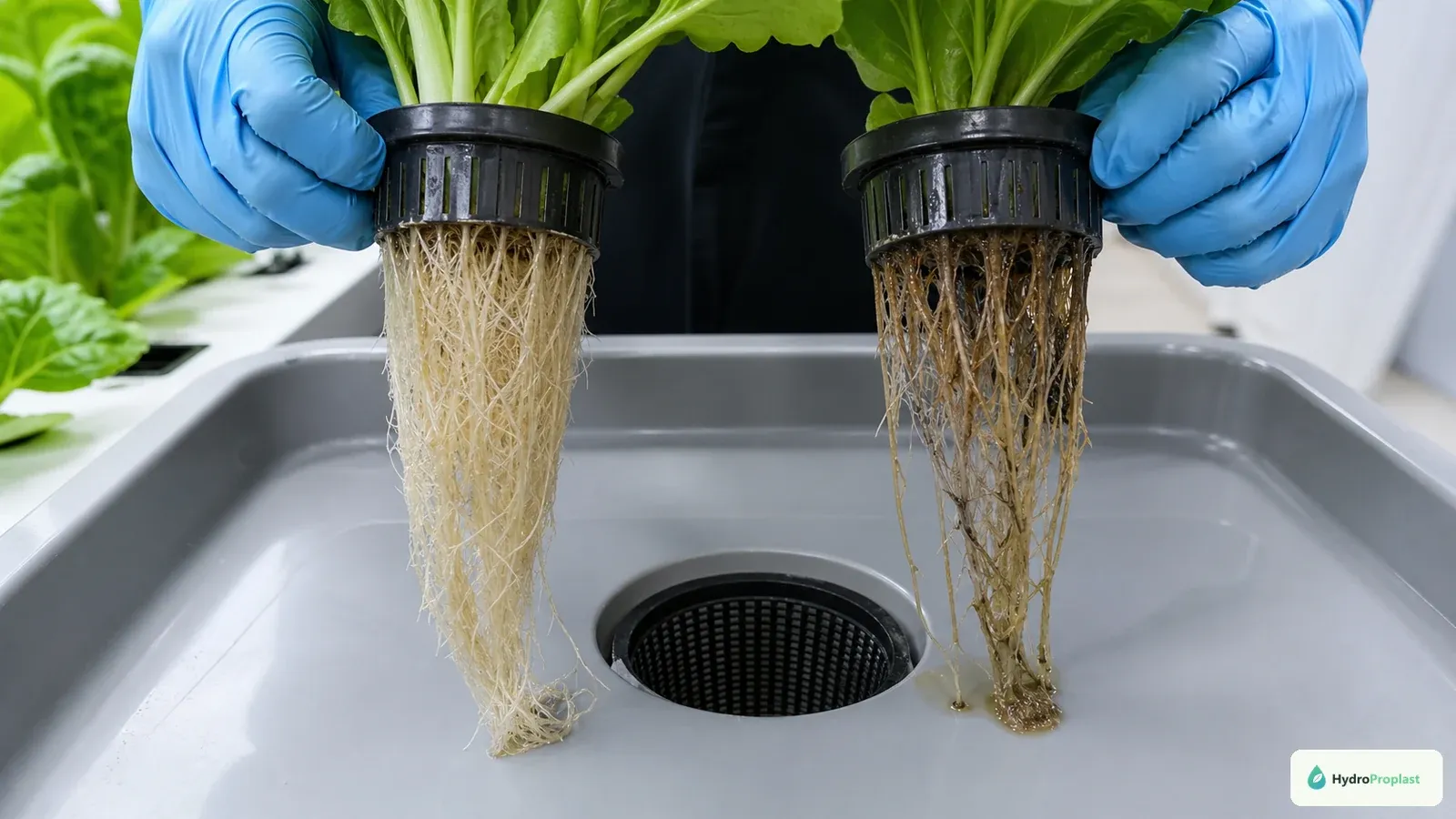
Inspect roots before refilling because root disease requires cleaning and sanitation, not only fresh solution.
Brown or soft roots, unpleasant odor, widespread wilt, and biofilm require inspection of temperature, oxygen, sanitation, and pathogens. Simply pumping out water and refilling the dirty system may carry the problem forward.
Remove dead material, isolate affected plants when appropriate, clean equipment using crop-safe validated procedures, and correct the environmental cause. Do not improvise disinfectant doses in a planted reservoir.
Our root-rot guide covers root-zone causes, while the water-temperature guide explains the connection between heat and oxygen availability.
A safe change procedure
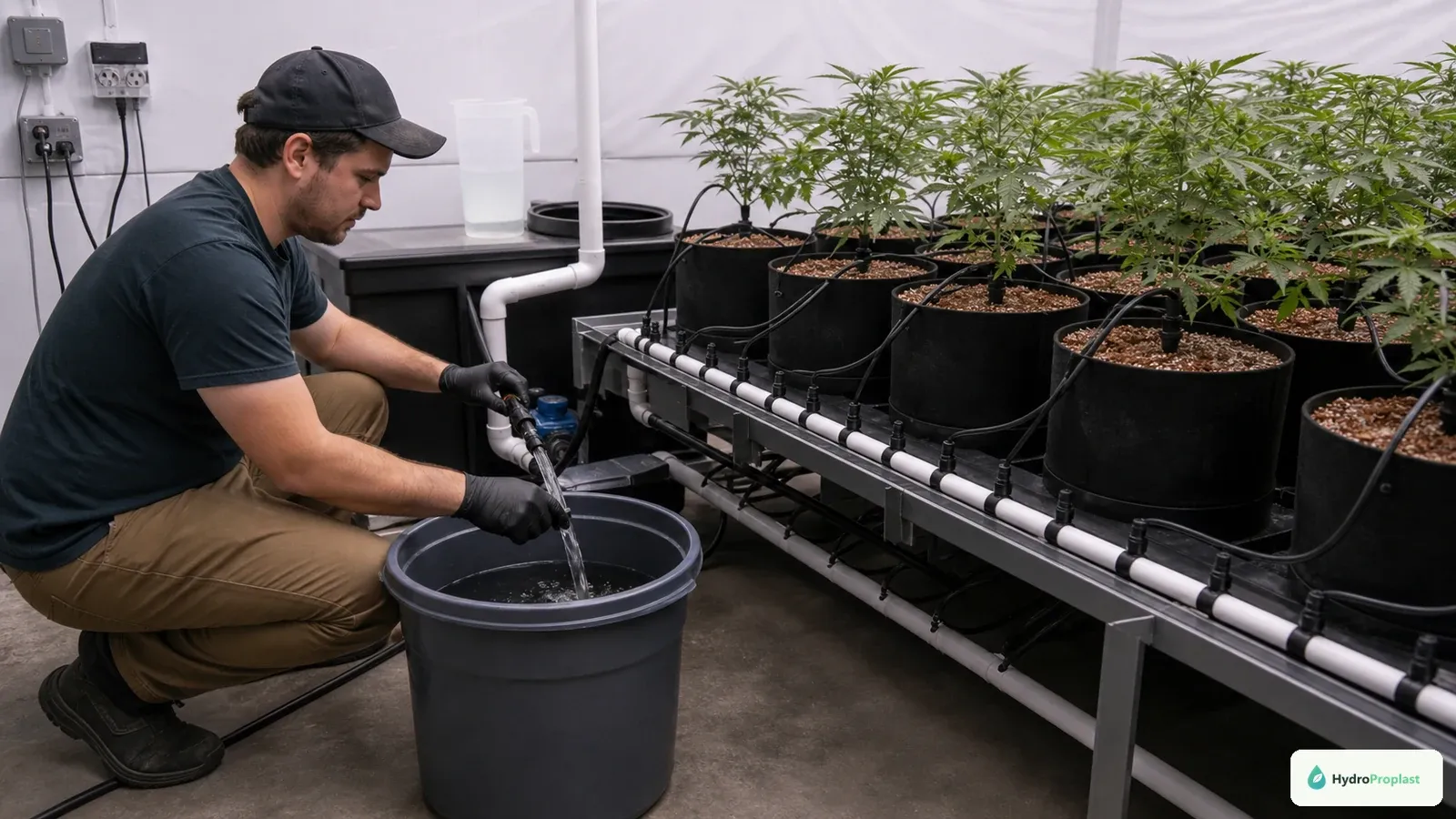
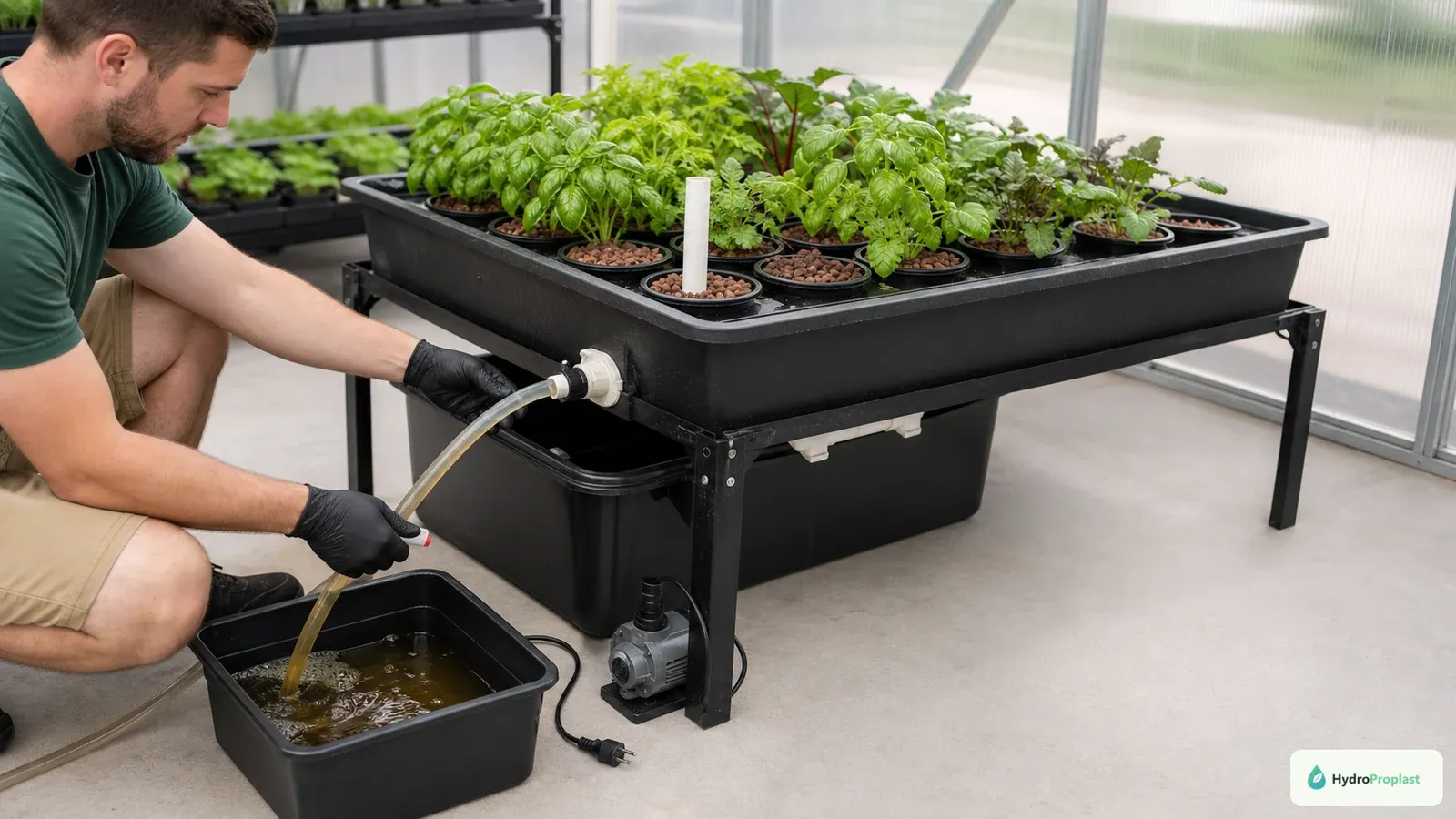
Plan the drain and refill path before switching the pump off so roots stay protected and old solution is contained.
Prepare enough clean replacement solution before roots are left unsupported. Measure water, add complete nutrient parts separately in their labeled order, mix, check EC, then pH. Bring temperature reasonably close to the operating root zone without unsafe improvised heating or cooling.
Turn off and isolate electrical equipment as required. Drain to a suitable collection point. Keep roots moist and supported according to the system; avoid exposing a mature root mass longer than necessary.
Remove debris, inspect pump and air delivery, clean accessible surfaces when the crop and procedure allow, then refill. Restart circulation or aeration and verify every plant receives solution. Recheck after stabilization.
Disposal is part of the schedule
Spent nutrient contains fertilizer salts. Do not discharge concentrated solution into storm drains, streams, or other waterways. Follow local rules and extension guidance.
Depending on composition, salinity, crop safety, and local guidance, diluted spent solution may sometimes be applied to compatible soil-grown ornamental plants. Do not assume it is suitable for every garden, septic system, or food crop.
Frequent unnecessary changes increase disposal burden. Better measurement and appropriate reservoir sizing reduce waste without extending an unreliable batch.
Passive and active systems differ
Classic short-crop Kratky may begin with one batch intended to decline until harvest. Treating it like DWC by repeatedly restoring the original level can remove the air gap. The crop may finish before a routine change, but only under a correctly sized validated design.
DWC supports topping up and replacement while active aeration continues. NFT and recirculating drip share solution across plants, increasing the value of a known reservoir and the consequence of contamination. Ebb and flow also returns root-zone solution to a common tank.
Match the procedure to the system. Kratky versus DWC explains why their refill strategies differ.
Avoid calendar-only mistakes
Changing every few days without evidence wastes inputs and repeatedly disturbs roots. Never changing because EC is adjustable allows unknown ion balance and contaminants to accumulate.
Waiting for smell or visible sludge is too late; replacing perfectly managed solution because a social post gave one number may be too early. Use a planned maximum interval as a guardrail, then override it for evidence.
Do not change nutrient strength, brand, source water, and cleaning chemical at the same time. If plants respond, you will not know why.
Build your own interval from one crop
Start with authoritative product and crop guidance and a conservative planned replacement point. Log daily or frequent pH, EC, water level, temperature, top-ups, roots, and plant response. Note cumulative added volume.
At the planned change, inspect the old solution and system, prepare a correct fresh batch, and observe whether new growth or stability changes. For the next crop, adjust the interval modestly based on evidence rather than doubling it.
A reservoir-size review may show that frequent emergency changes are actually caused by insufficient volume.
A practical decision checklist:
Change now if the solution is known to be mixed incorrectly, contaminated, extremely out of range after verified testing, associated with root decline, or impossible to interpret after repeated additions.
Plan a change soon if cumulative top-ups are large, pH and EC need increasingly frequent correction, source-water salts are accumulating, or the crop is ending.
Continue monitoring if the batch is within the planned interval, roots and new growth are healthy, readings are coherent, and additions are documented.
The objective is not maximum days per reservoir. It is a known, healthy root environment with the least responsible waste—and a complete reset before uncertainty becomes crop damage.
Use a side-by-side baseline when the interval remains uncertain. At a planned midpoint, collect a clean sample of the operating solution and prepare a fresh batch from the same water and nutrient. Compare pH, EC, appearance, odor, and—where appropriate—plant response after the full scheduled change. Do not interpret color or smell as nutrient analysis; they are additional observations.
For media systems, inspect or measure representative drainage as well as the central tank. Root-zone salts can accumulate even when reservoir EC appears acceptable. In separate DWC buckets, one plant’s root problem may justify changing and cleaning that bucket without discarding every independent reservoir.
Calculate the real cost of a change: measured nutrient, water, labor, and disposal. Then calculate the risk cost of extending an uncertain batch across all connected plants. This discourages both wasteful weekly dumping and false economy.
Keep the replacement procedure repeatable. Use the same verified volume, source water, mixing order, instruments, and sampling time. When the new batch behaves differently, you can attribute the change more confidently.
A schedule is mature when it states both a planned latest change and early-change triggers. Write those triggers beside the log so a caretaker can act on contamination, mixing error, root decline, or extreme verified readings without waiting for a date.
When comparing intervals, keep one variable stable across crops: same cultivar, reservoir working volume, source water, nutrient product, and measurement routine. Seasonal temperature and light should be recorded because they can change uptake even with identical equipment. If the interval works only when frequent undocumented corrections are made, it is not truly validated.
For a shared reservoir, set the early-change threshold conservatively because one uncertain batch affects every plant. Independent buckets can be evaluated separately, but that does not justify moving tools or solution between healthy and suspect roots. Label containers and keep drainage records distinct.
At crop turnover, audit the old system before cleaning: photograph roots, note deposits at the normal waterline, inspect pump and air delivery, and measure remaining volume. These observations reveal whether the next improvement should be interval, reservoir size, aeration, temperature, or light exclusion—not merely fresher nutrient.