Nutrient film technique can grow orderly rows of lettuce and herbs with one recirculating reservoir, but its shallow moving film leaves little buffer when flow stops. A dependable NFT system needs controlled channel slope, balanced inlets, an unobstructed return, visible flow, and a recovery plan for pump or power failure.
NFT is efficient when continuous flow is reliable
Nutrient film technique (NFT) sends a shallow, continuous stream of nutrient solution along a slightly sloped channel. Plant roots spread across the channel floor, taking up water and minerals from the moving film while much of the root mass remains exposed to humid air. Excess solution drains back to a reservoir and recirculates.
NFT is a strong choice for rows of lettuce, basil, and other compact crops when you want a shared reservoir, clean working height, and efficient use of floor area. It is a poor choice when power is unreliable, channels cannot be leveled precisely, daily flow checks are unrealistic, or the crop will develop a large root mass or heavy fruit load.
Its biggest advantage and weakness are the same: little solution sits in the channel. Roots receive fresh solution and oxygen without being deeply submerged, but they have little reserve when the pump stops or flow is blocked. A good NFT design therefore prioritizes uniform flow, drainage, access, and recovery from failure—not only the number of planting holes.
What the “film” should accomplish
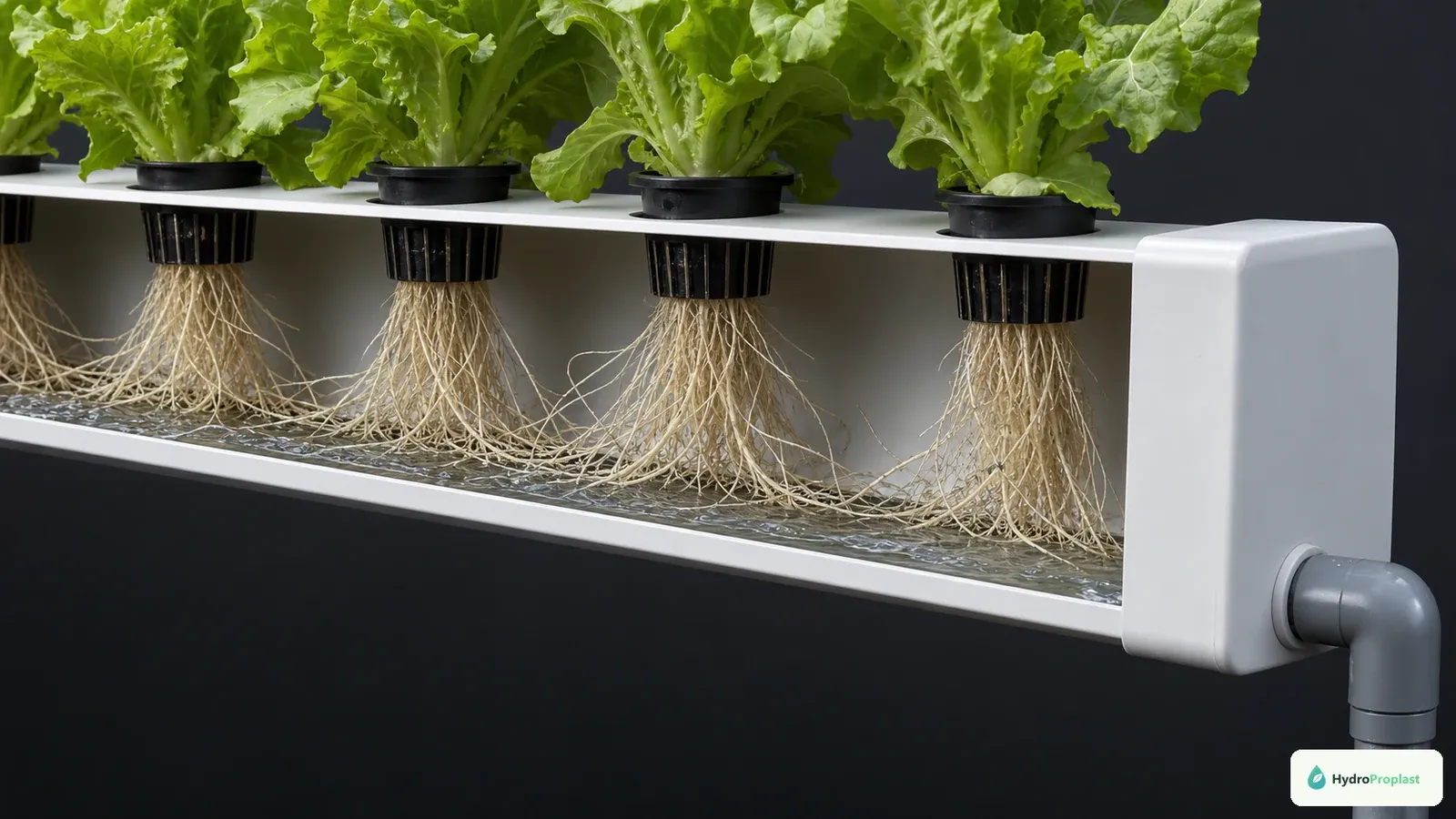
A true nutrient film wets the lower roots while preserving humid air space above; a deep channel pool is not NFT.
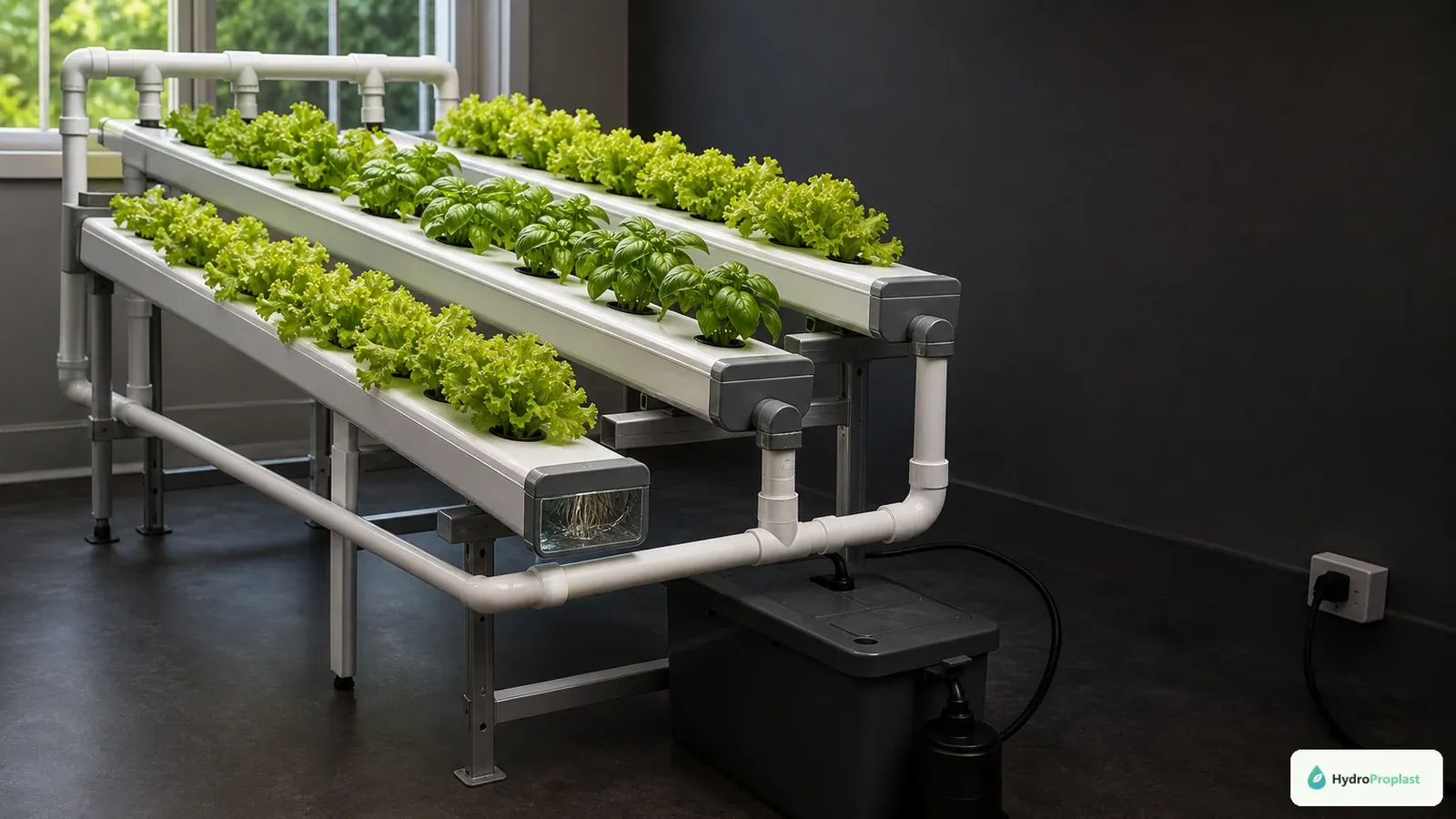
The term nutrient film describes a thin moving layer, not a channel filled like a pipe. A pump lifts solution from the reservoir to the high end. Gravity carries it past the roots and back through a return line. Channel slope, inlet delivery, root growth, and return capacity determine whether all plants receive flow.
Oklahoma State University’s hydroponics overview distinguishes NFT by its constant nutrient flow rather than timer-controlled irrigation. The USDA Economic Research Service also includes NFT among major controlled-environment hydroponic systems.
“Thin” does not mean one universal flow depth or pump rate. Commercial recommendations vary with channel geometry, length, crop, root mass, and equipment. Copying a pump specification without accounting for lift height and plumbing losses can produce uneven delivery. The operational test is whether every channel receives stable flow without pooling, dry sections, or an overwhelmed return.
Where NFT performs well
NFT uses one reservoir to feed many planting positions. Channels can be mounted at an accessible height and arranged in rows, making inspection and harvest orderly. Because only a shallow film is lifted, channels do not carry the weight of a full water column.
Leafy greens and compact herbs fit the method particularly well. They have relatively short cycles and do not require the trellising, large root volume, or long-term support of tomatoes and cucumbers. Successive planting can turn an NFT row into a regular harvest rather than one crowded batch.
Recirculation allows water and unused nutrients to return to the reservoir. That can improve input efficiency when leaks, excessive cleaning losses, and careless disposal are controlled. Central measurement is convenient: the grower checks one reservoir rather than many individual buckets.
The open air space around roots can support oxygen access without an air stone in every channel. Reservoir aeration or return agitation may still be useful depending on design and temperature; do not assume motion anywhere in the system guarantees adequate oxygen everywhere.
The disadvantages beginners underestimate
Pump dependence is immediate. In DWC, a large aerated reservoir may retain water around roots during a short interruption. In NFT, roots in a shallow channel can dry rapidly, particularly under strong light, heat, low humidity, or a large canopy. A power outage, failed pump, disconnected hose, or empty reservoir can affect the entire row.
Roots change the plumbing. A channel that flows evenly with small seedlings may develop dams as roots expand. Water can back up, bypass some roots, or overflow at lids and joints. Root fragments can enter the return or pump. Plant spacing must account for mature roots as well as leaves.
Shared solution spreads mistakes. An incorrect nutrient mix, pH correction, contamination event, or disease can reach every connected plant. Centralization saves work only when the reservoir is managed carefully.
Finally, NFT construction is less forgiving than a bucket. A stand must maintain a consistent slope while carrying plants, channels, and wet roots. The return must handle maximum flow. Access caps and joints must resist leaks yet remain cleanable.
Crop selection and spacing
Choose lettuce, many Asian greens, and manageable herbs for a first NFT crop. Basil can become broad and root-dense, so provide more spacing than a seedling photo suggests. Mint can spread aggressively. Fast crops reduce the period during which roots occupy the channel.
Avoid treating small net pots as proof that large fruiting plants belong in the system. Tomatoes, peppers, and cucumbers need structural support independent of the channel, stronger light, long-duration nutrition, and substantial root space. Specialized NFT-like commercial systems exist, but a beginner’s narrow home channel is usually a poor match.
Staggering crop ages can smooth harvests, but older roots upstream may influence flow to younger plants downstream. Maintain access for removing an entire root mat without damaging neighbors. If your crop needs individual containers or media volume, drip hydroponics may be a better delivery method.
Channel, reservoir, and pump decisions
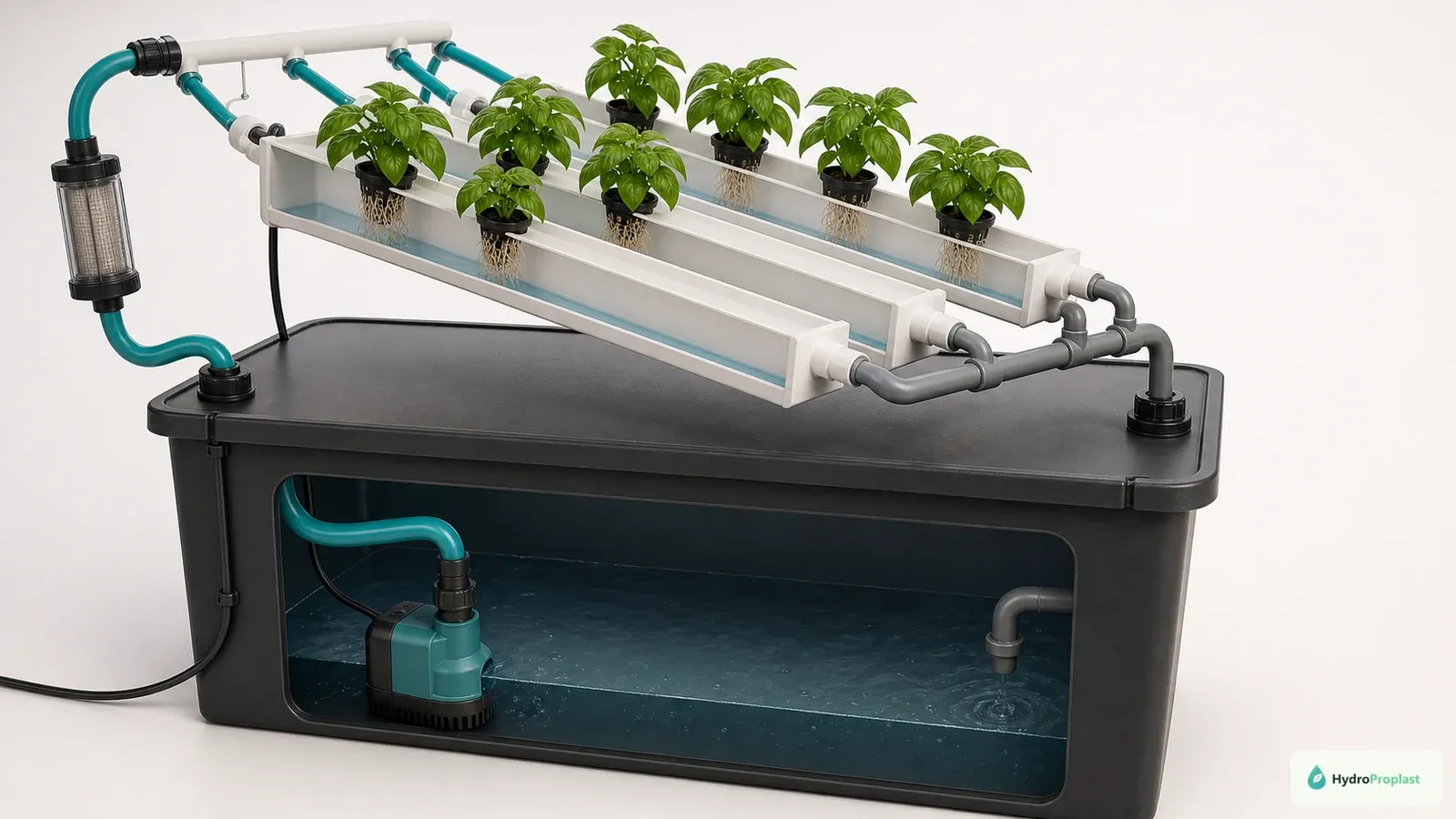
The pump lifts solution to controlled inlets, and gravity carries it through each channel into a separate unobstructed return.
Use channels designed or safely adapted for plant production, with opaque surfaces and removable access. Flat-bottomed profiles generally offer a more predictable film than round pipe, where water may run through a narrow center and roots collect unpredictably. Avoid materials with unknown prior use.
Keep runs short enough to inspect and balance. Every channel needs controlled inlet flow and an unobstructed drain. Design the return so roots cannot easily enter, and add a screen only if it can be checked and cleaned without silently becoming the blockage.
Size the reservoir for all channels, plant uptake, pump operating depth, and freeboard when drainage returns after shutdown. A reservoir can overflow if the system holds more water during operation than anticipated. Mark minimum and working levels.
Select a pump using required flow at actual vertical head, not the unrestricted rating printed on the box. Include a valve or manifold for balancing, but never restrict a pump in a way its manufacturer prohibits. Keep a compatible spare if one pump supports valuable crops.
Flow checks are more useful than a copied number
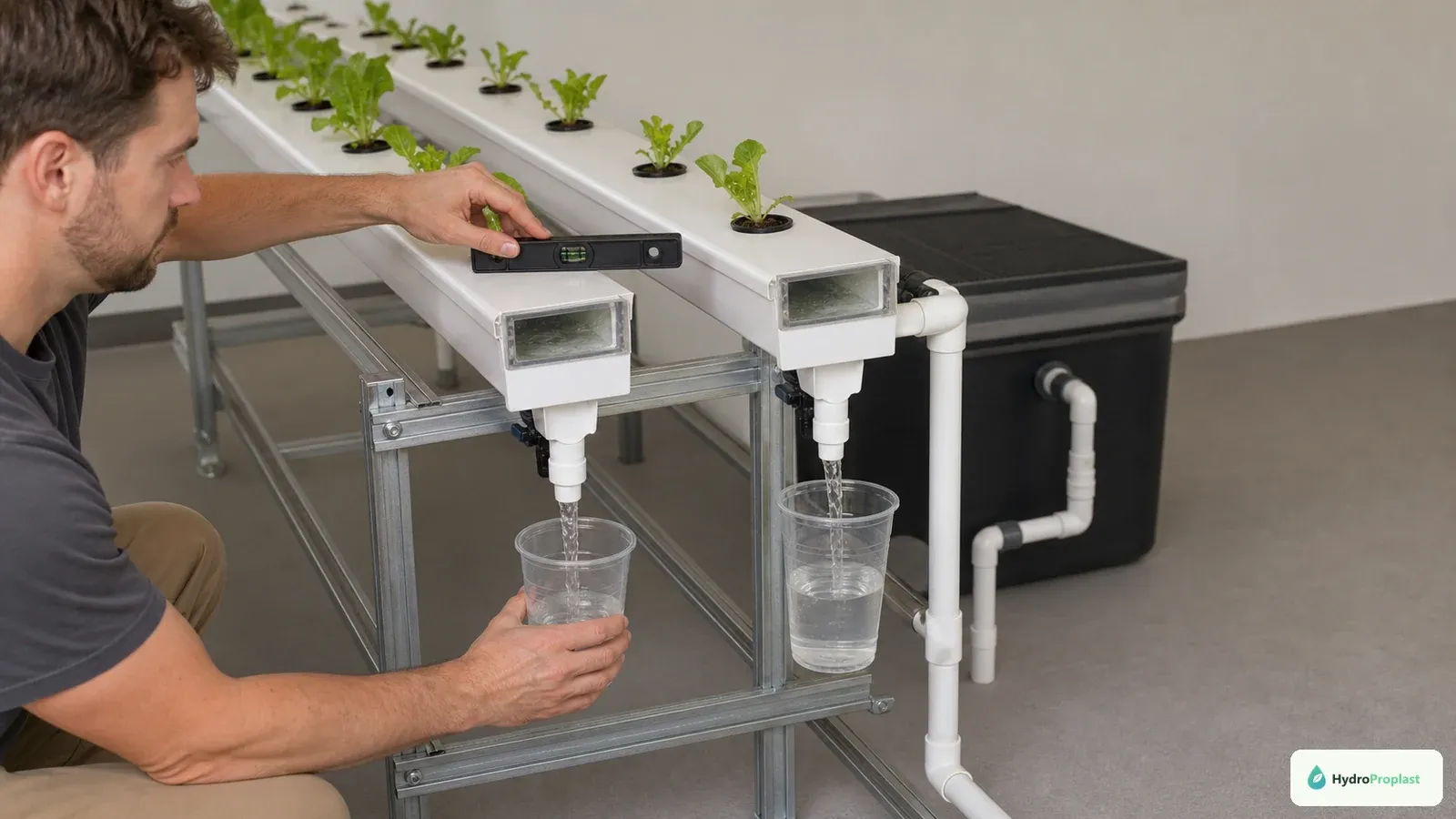
Check channel slope and compare outlet flow during commissioning, then repeat as roots grow and begin to change hydraulic resistance.
Before planting, run the system with plain water. Confirm that flow reaches every inlet, spreads across each channel, and returns without pooling or splashing. Stop the pump and watch where water drains. Check whether the reservoir rises safely and whether channels retain stagnant pockets.
Repeat checks with starter plugs installed, then as roots grow. A quick view of water leaving each channel can reveal unequal flow, but inspect upstream roots and channel bottoms periodically. Pump sound alone does not prove delivery.
Do not compensate for poor slope with excessive flow. Deep fast water can reduce the air space, overflow openings, and waste pump capacity. Conversely, a barely wet channel provides little safety margin against small debris. Correct the structure and distribution rather than chasing one symptom.
Reservoir management in a shared loop
Mix a complete hydroponic nutrient for the measured system volume. Monitor pH, EC, temperature, water level, root condition, and crop response. EC indicates overall dissolved-ion concentration, not the amount of each nutrient remaining. Top-up decisions should use trends and crop stage rather than a fixed recipe.
Keep light out of the reservoir, inlets, channels, and planting holes to discourage algae. Algae can consume oxygen, create slippery biofilm, and obstruct flow. Cover unused holes and repair light leaks instead of relying on repeated treatments.
Warm water and dense roots narrow the margin during pump interruptions. Address room and light heat, maintain circulation, and avoid locating a reservoir where sunlight heats it directly. Our hydroponic water-temperature guide explains why temperature control is connected to root oxygen and disease risk.
Failure planning belongs in the design
Make the pump, filter, inlets, and returns visible and serviceable. Keep a spare pump, tubing, and connectors when replacements are not locally available. Use a water alarm or overflow tray where a leak could damage property. Keep electrical connections above water with drip loops.
For outages, know how long conditions allow roots to remain safe and how you would supply temporary flow. The answer varies with temperature, crop, root moisture, and channel design; avoid a universal survival promise. A backup power source must be correctly rated and used according to its safety instructions.
Divide very large systems into independent loops. Losing one pump should not necessarily threaten every plant. A beginner learns more safely from one short channel than from a decorative wall supplied by one hidden pump.
Cleaning an NFT system
After harvest, remove root mats completely. Open channels, scrub accessible surfaces, clean reservoir and pump components, and flush inlets and returns. Inspect fittings and stands before replanting. Follow cleaning-product directions, use suitable protection, rinse thoroughly, and never mix chemicals.
During a crop, remove dead roots and leaves without tearing healthy root masses unnecessarily. Clean screens before their flow is reduced. If one channel shows disease or unexplained decline, avoid moving tools and solution carelessly between systems.
Design determines whether cleaning happens. Glued channels with inaccessible corners may be cheap to assemble and expensive to maintain. Removable lids, unions, and reachable returns justify their cost.
Decide if NFT matches your first goal
Choose NFT when you want multiple compact leafy plants, have reliable electricity, can build level supports and controlled slope, will inspect flow daily, and value one recirculating reservoir. It can be an excellent second project after learning nutrient and pH management in a simpler container.
Choose DWC or Kratky when you want one to six plants with fewer plumbing variables. Compare those two in Kratky Method vs Deep Water Culture. Choose ebb and flow when media-filled pots and intermittent irrigation fit the crop better; see Ebb and Flow Hydroponics Explained.
If NFT still fits, build one accessible run, water-test it, transplant evenly sized seedlings, and record flow and reservoir changes. Expansion should follow a successful crop and cleaning cycle—not the first day the pump turns on.
Commission the system before trusting it with a crop
A useful commissioning test lasts longer than a few minutes. Fill with plain water, mark the reservoir level, and run every channel through a normal day. Measure discharge from each return over the same interval, then compare results. Stop and restart the pump several times, including after disconnecting power, to confirm that siphoning, controller behavior, and drain-back remain safe.
Next, partially restrict one inlet and watch whether the problem is visible before a plant would wilt. Place clean temporary material in the root zone to simulate resistance without risking loose debris in the pump. Verify that the overflow path contains the maximum credible flow.
Document valve positions, pump model, working water level, and photographs of normal inlet and return flow. These become diagnostic baselines after roots obscure the channel. A system that passes this test is not guaranteed to grow well, but it has removed several preventable hydraulic failures before seedlings become dependent on it.