Hydroponic pH is best managed as a crop-specific range, not a single magic number. The useful band depends on the crop, nutrient formula, source water, growing medium, and the place where you sample. Your goal is a stable root zone in which nutrients remain available—not a meter that reads 5.8 for one minute.
This guide explains how to choose a starting range, measure accurately, adjust safely, and decide whether a changing reading is normal plant activity or evidence of a larger problem. It also separates pH from EC and alkalinity, three measurements that are often confused.
The short answer: use a range, not a magic decimal
pH describes how acidic or basic a solution is. The scale is logarithmic, so a change of one whole unit is chemically much larger than a change of 0.1. In hydroponics, pH matters because nutrient forms and root chemistry change as the solution becomes more acidic or basic.
Many hydroponic crops are managed in a mildly acidic range, but published crop targets are not identical. Choose an authoritative range for the crop and system, mix the complete nutrient solution, and begin near the middle of that band. Correct a sustained departure from the range; do not react to every tiny movement.
The Oklahoma State University Extension EC and pH guide explains nutrient-solution management and provides crop-specific values. The ranges below are selected examples from that table, not universal prescriptions.
| Crop | Example pH range | Example EC range (mS/cm) |
|---|---|---|
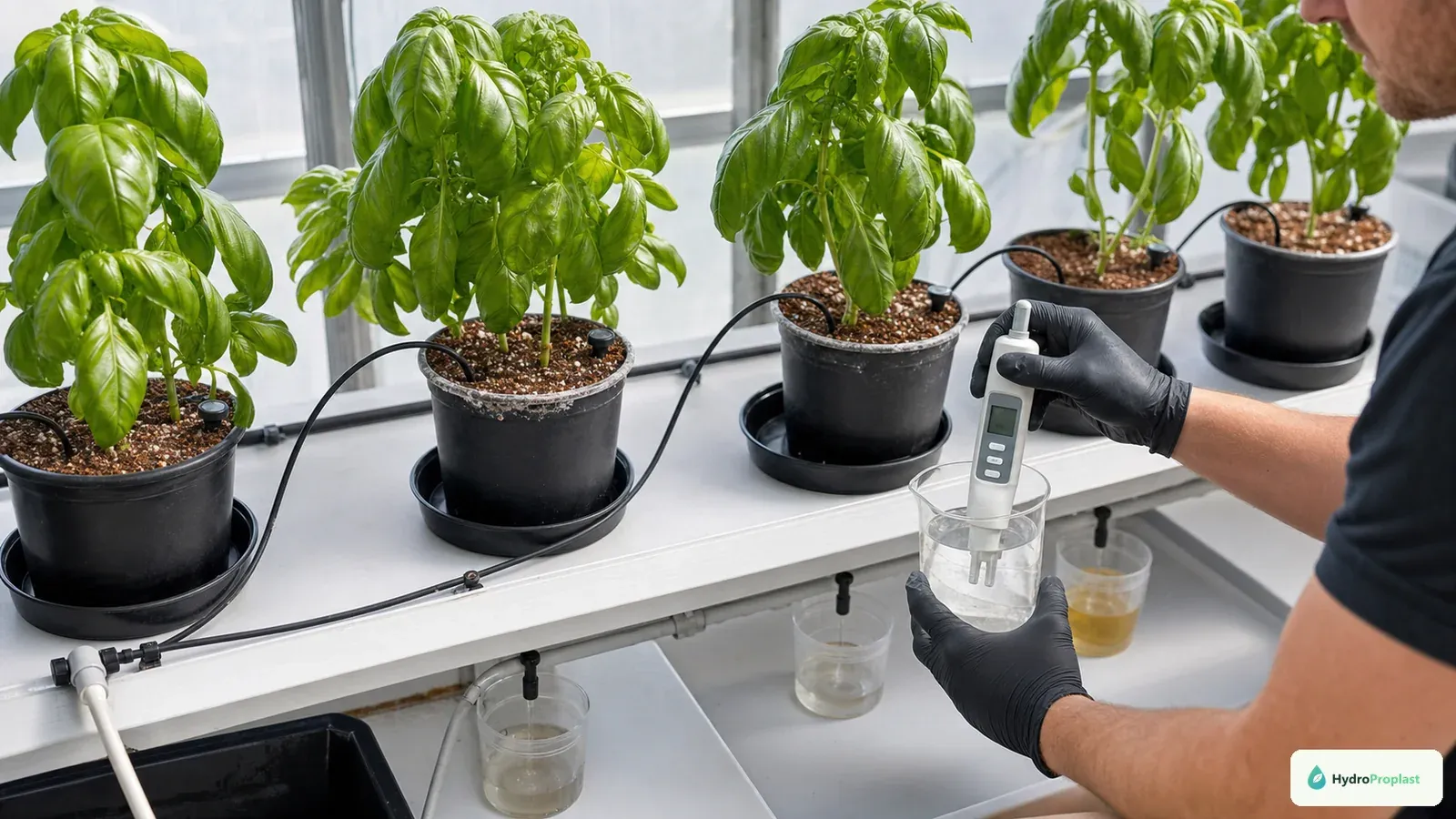
| Basil | 5.5–6.0 | 1.0–1.6 |
| Cucumber | 5.0–5.5 | 1.7–2.0 |
| Lettuce | 6.0–7.0 | 1.2–1.8 |
| Peppers | 5.5–6.0 | 0.8–1.8 |
| Tomato | 6.0–6.5 | 2.0–4.0 |
Different references may give somewhat different bands because cultivars, growth stages, formulations, climates, and production methods differ. Record the source you selected. If several crops share one reservoir, combine only crops with compatible pH and nutrient requirements.
pH and EC answer different questions
pH describes acid–base conditions. EC, or electrical conductivity, estimates the total concentration of dissolved ions. A reservoir can have suitable pH and excessive EC, or suitable EC and unsuitable pH. EC also does not tell you the concentration of each individual nutrient.
Treat the two readings as partners rather than substitutes. If leaves look stressed, check pH, EC, water temperature, water level, roots, and delivery before adding more fertilizer. Correcting only pH cannot fix a pump failure, oxygen-poor water, or an imbalanced nutrient formula.
If you are still separating the basic system components, start with what hydroponics is and how it works.
Why pH changes nutrient access
Plants absorb nutrients as ions in solution. As pH changes, some elements become less soluble or less available, while others may become more available than intended. A plant can therefore show deficiency-like symptoms even when the fertilizer contains the element.
This is often called nutrient lockout, but the phrase can hide several causes. A high or low pH may be part of the problem; precipitation, excessive EC, damaged roots, poor aeration, or an incorrect mixing order can produce similar results. Measure the root-zone conditions before diagnosing from leaf color alone.
Source-water pH is not the same as alkalinity
Source-water pH is only a snapshot of acidity or basicity. Alkalinity describes the water’s resistance to acidification and is commonly associated with bicarbonate and carbonate. Two water sources can begin at the same pH yet require very different amounts of pH-down and drift differently after mixing.
Both Oklahoma State and the University of Minnesota Extension small-scale hydroponics guide note that high alkalinity can push nutrient-solution pH upward. If pH repeatedly rebounds, white mineral deposits form, or the source EC is high, a water analysis is more useful than repeatedly adding larger doses.
Measure source water to establish a baseline, but make the final pH decision only after all nutrient parts have been added in the specified order and fully mixed. Fertilizer can shift pH substantially.
Calibrate and measure consistently
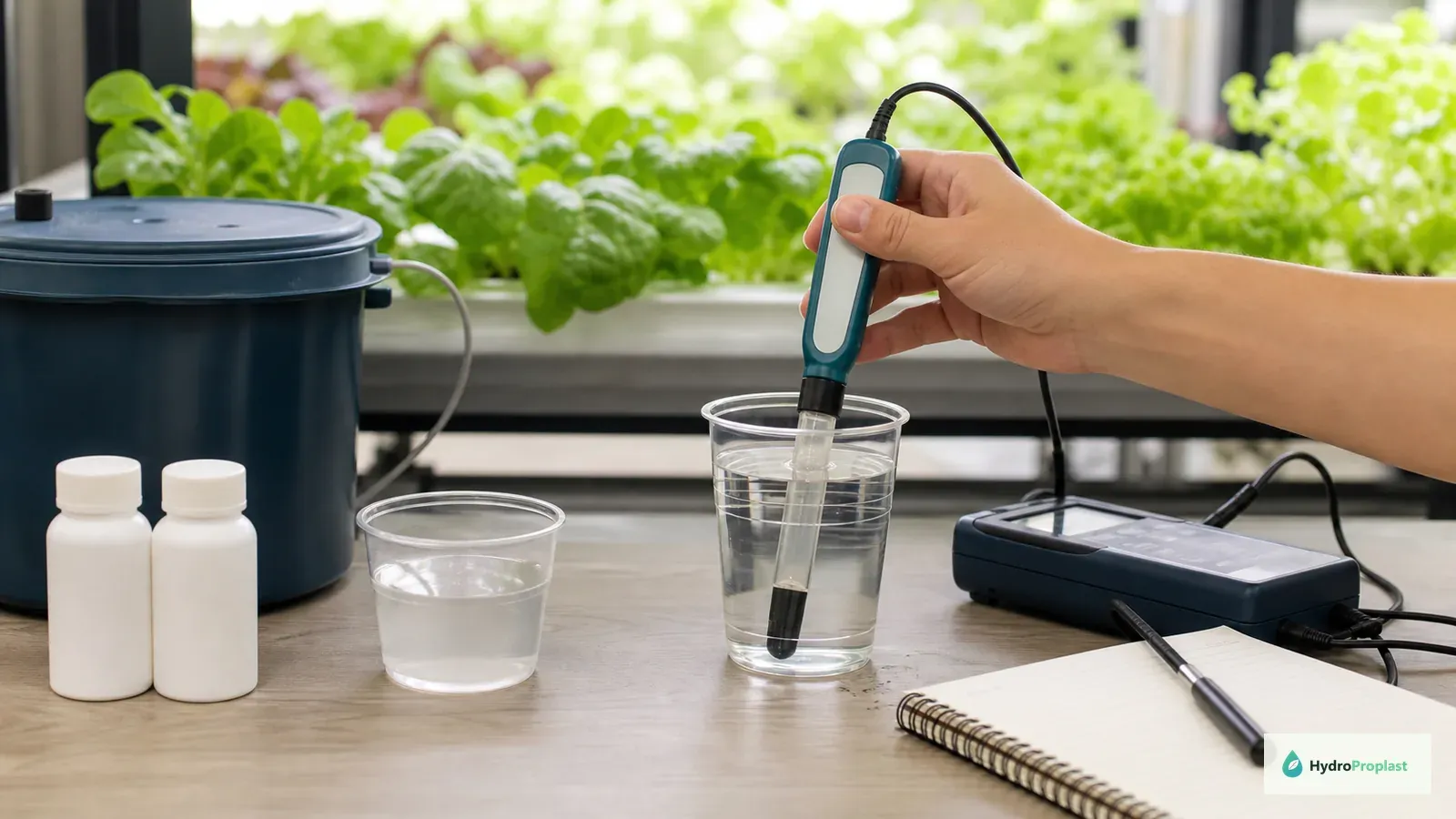
A pH meter is only useful when the probe, buffers, storage, and sampling routine are sound. Follow the meter manufacturer’s calibration schedule and use fresh buffer solutions that bracket the expected working range. Never pour used buffer back into its bottle.
- Rinse the probe with clean water and gently blot it as directed; do not scrub the sensing bulb.
- Calibrate with separate clean portions of buffer and allow each reading to stabilize.
- Store the probe in the manufacturer-recommended storage solution; many pH electrodes are damaged by drying.
- Take nutrient solution into a clean sample cup instead of returning the tested sample to the reservoir.
- Sample from the same location and at a similar time so trends are comparable.
- Check a surprising reading against fresh buffer before adding adjustment product.
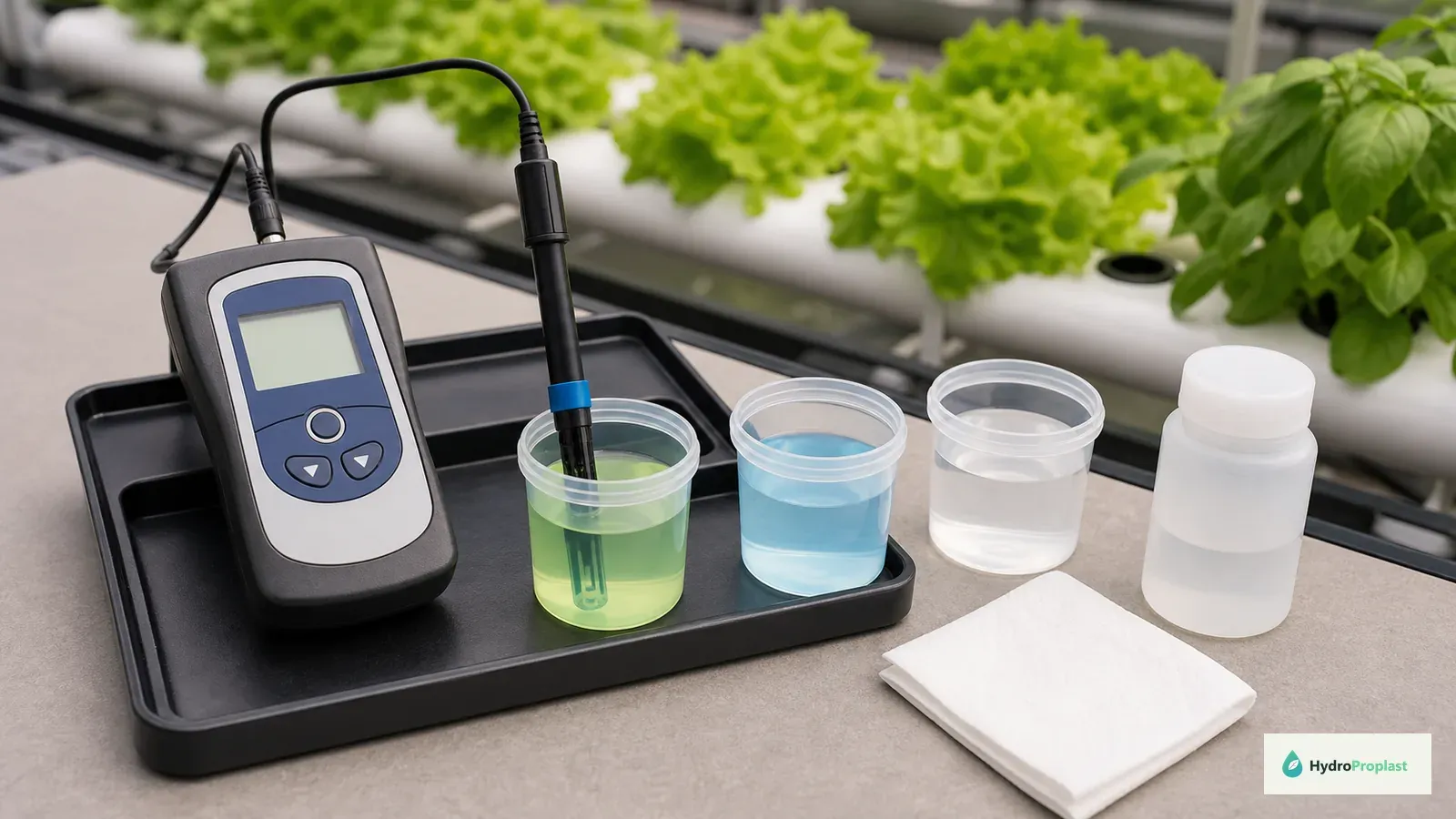
Temperature, bubbles on the probe, residue from calibration solution, and measuring immediately after a top-up can all create misleading readings. Let a freshly mixed or corrected reservoir circulate before testing, then record pH together with EC, solution temperature, water level, and recent additions.
Adjust pH safely and in the right order
The order matters because nutrient concentrate changes both EC and pH. Fill the reservoir with a measured volume, add each nutrient part separately according to its label, mix completely, set the intended nutrient strength, and only then evaluate pH.
- Confirm the real working volume of the reservoir.
- Mix the complete nutrient formula and allow it to circulate.
- Measure EC and correct concentration before pH.
- Measure pH with a calibrated probe.
- If correction is needed, prepare a small measured dose using a product labeled for hydroponic food crops.
- Dilute when the product label directs, add gradually to well-mixed solution, circulate, wait, and retest.
- Record the product, concentration, dose, time, and response.
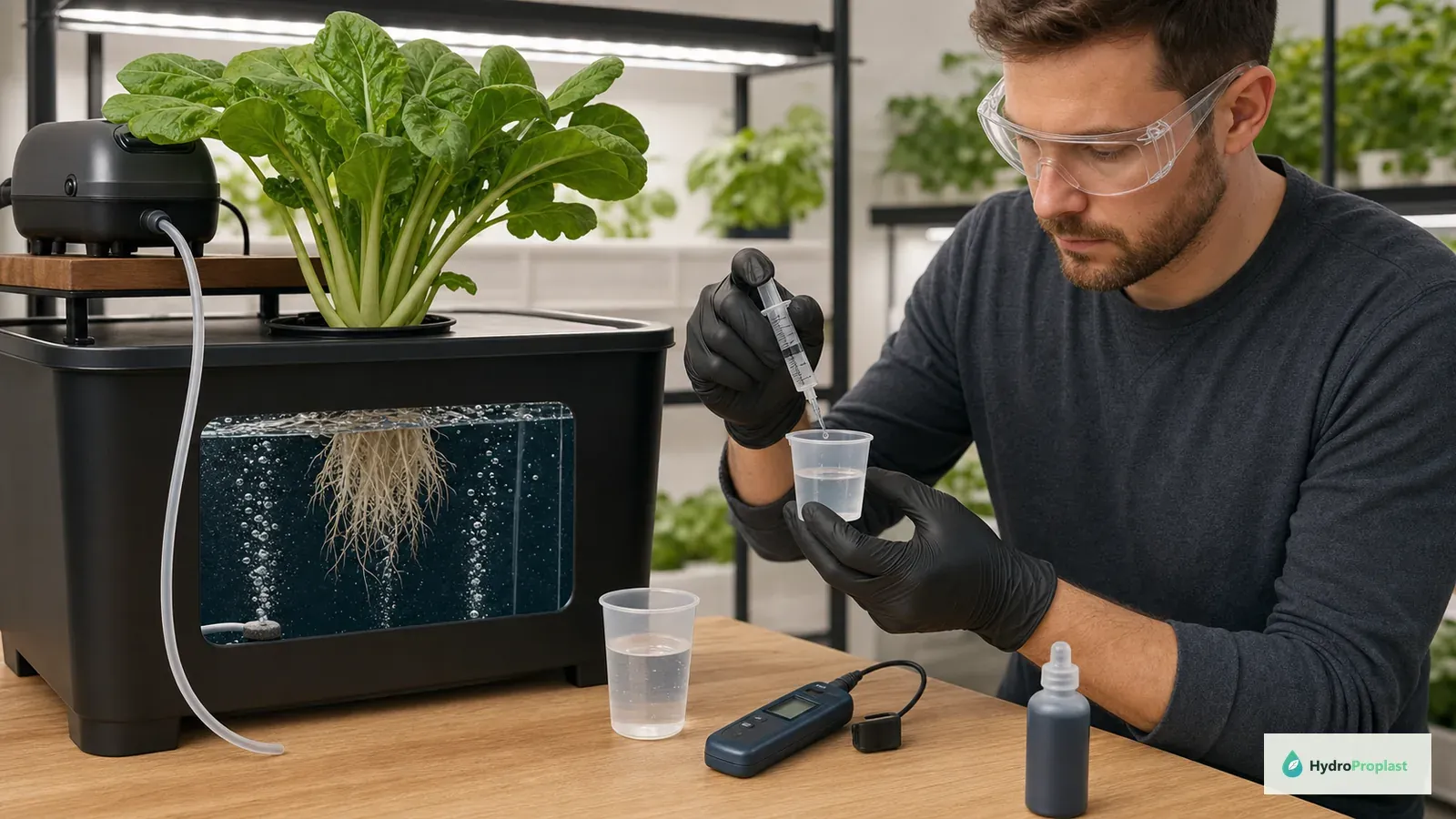
Never mix concentrated pH-up and pH-down together. Never combine either one with nutrient concentrates, and never pour strong concentrate directly onto roots. Follow the product label and safety data, wear the required eye and skin protection, use compatible measuring tools, and store products securely.
Lowering and raising pH
When pH is too high
Use a labeled pH-down product suitable for the crop and system. Different acids add different ions and have different handling risks, so a household recipe is not a reliable substitute for the product label. Add a small dose to circulating solution or to a separate dilution volume as directed, wait for mixing, and retest.
If pH rises again after every correction, investigate alkalinity, new growing media, construction materials, top-up water, and biological activity. Increasing the dose without finding the driver can create large swings and unwanted ion accumulation.
When pH is too low
Use a labeled pH-up product and the same gradual process. Persistent downward drift can reflect nutrient form, root uptake, microbial activity, low alkalinity, or a small unstable reservoir. Adjustment treats the reading; it does not explain the cause.
Avoid bouncing between up and down. If a small reservoir is badly overshot, remaking or diluting the batch may be safer and easier to interpret than repeated opposing additions.
Adapt monitoring to the system
The chemistry is the same, but the best sampling point and the consequences of drift differ by system. Use a well-mixed, representative sample rather than the easiest puddle to reach.
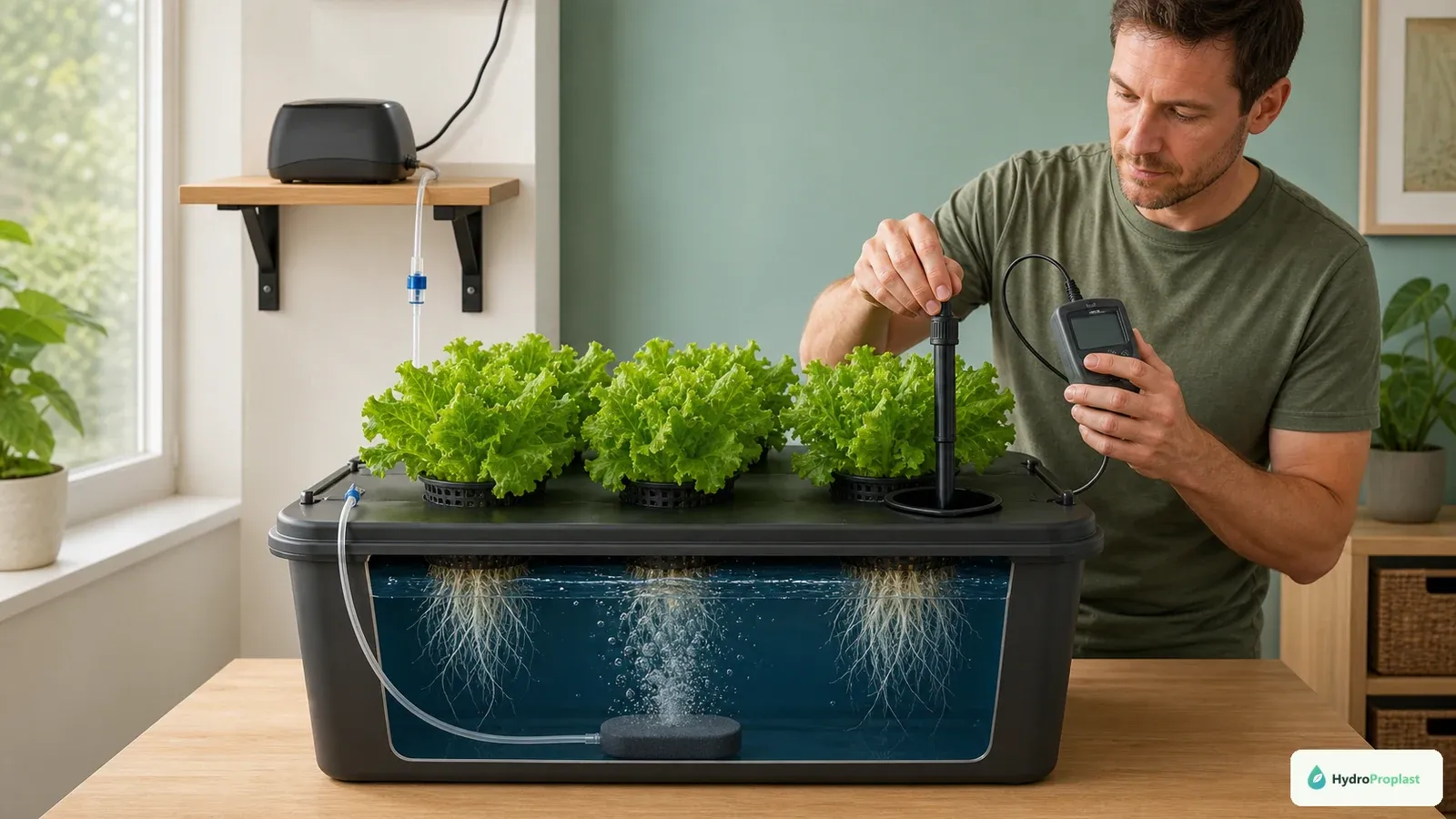
- DWC: sample the mixed reservoir away from a concentrated dosing point and away from bubbles clinging to the probe. Check aeration and water temperature with pH.
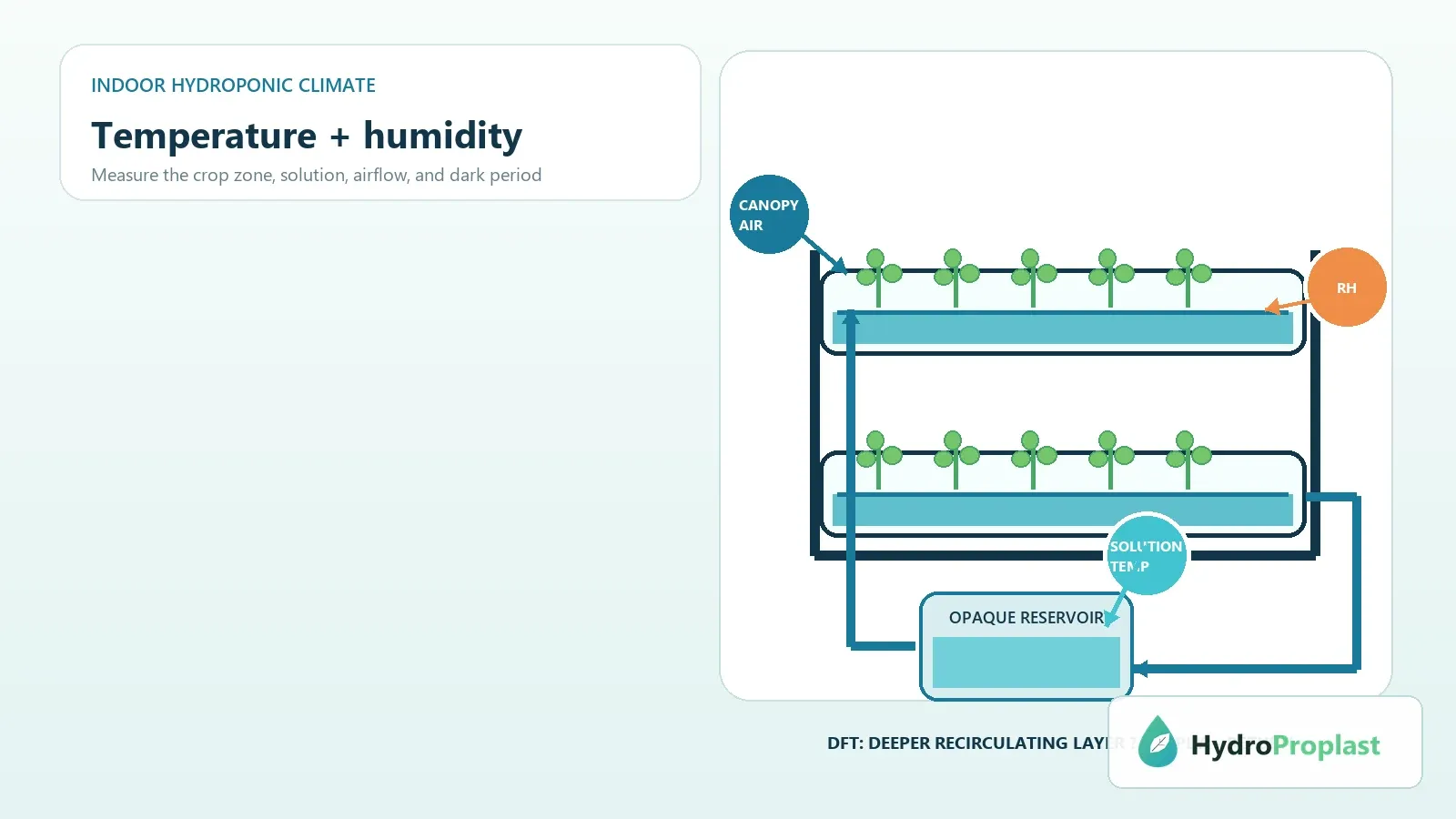
- NFT: compare the covered reservoir with the return flow when diagnosing a problem. A pump or flow failure can stress roots quickly even when reservoir pH is correct.
- Drip: test the reservoir and, when relevant to the medium and irrigation design, inspect runoff separately. Reservoir and root-zone conditions may not match.
- Kratky: avoid contaminating the container or taking excessive sample volume, and preserve the developing air gap rather than topping up blindly.
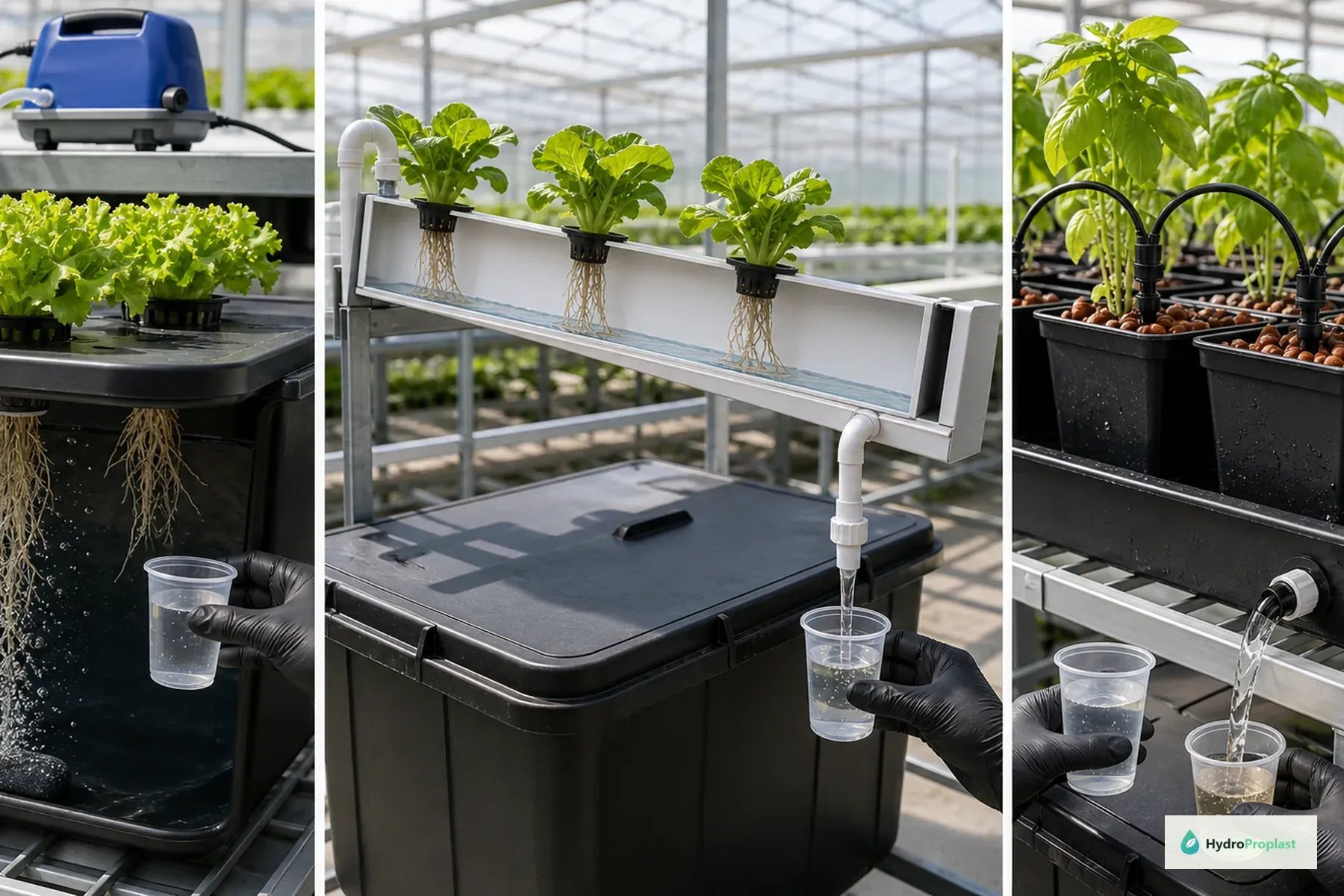
Do not call a system stable from one location alone when plants in different channels or containers behave differently. Uneven flow, blocked emitters, stagnant zones, and media accumulation can create local root-zone conditions that a reservoir sample does not reveal.
How often should you test?
Published guidance varies because systems vary. Oklahoma State recommends daily pH and EC checks, while the University of Minnesota notes that a stable small home system may change slowly. A useful schedule is based on risk rather than habit.
- Check daily while commissioning a new system or learning a new water source.
- Check after mixing, major top-ups, nutrient changes, unusual weather, equipment faults, or visible symptoms.
- Keep closer watch on small reservoirs, rapidly growing crops, high-alkalinity water, and warm conditions.
- Reduce frequency only after a consistent trend is documented; continue routine visual and equipment checks.
Measure at a similar time of day and record the direction and speed of movement. A slow repeatable rise may be manageable. A rapid swing after dosing, a sudden change after a top-up, or disagreement between plant zones deserves investigation.
Read the trend before correcting it
A pH log is more informative than isolated numbers. Record the reading before correction, the dose, the reading after full circulation, and the next-day result. Add EC, water level, temperature, and plant stage. This separates measurement noise from a real drift pattern.
| Observed pattern | Likely checks before another dose |
|---|---|
| pH rises soon after every correction | Source-water alkalinity, top-up water, media, new materials, calibration |
| pH falls steadily | Nutrient form, root activity, biology, low alkalinity, reservoir size |
| pH swings after dosing | Actual water volume, dose size, mixing time, diluted-dose technique |
| Only one plant zone is affected | Flow, blocked emitters, stagnant water, roots, local medium conditions |
| pH looks correct but plants decline | EC, nutrient formula, oxygen, temperature, roots, light, pests |
Symptoms do not diagnose pH by themselves
Unsuitable pH can contribute to interveinal chlorosis, slow growth, distorted new tissue, or several apparent deficiencies at once. The same signs can come from excessive EC, actual nutrient imbalance, warm oxygen-poor water, root disease, poor light, or pests.
Before adding acid, base, or supplements, verify the meter, inspect healthy and affected roots, note whether old or new leaves changed first, and ask what changed recently. If roots or equipment are dirty, follow the between-grow cleaning guide before relying on chemical correction alone.
A practical first-week protocol
- Choose one crop and document its pH and EC range from one reliable reference.
- Record source-water pH and EC before mixing.
- Mix a measured batch of complete nutrient solution in the label’s order.
- Set nutrient strength, then adjust pH near the middle of the crop band.
- Measure at the same time each day for seven days and log water level, temperature, EC, pH, and additions.
- Correct only when the reading leaves the selected band or a verified trend requires action.
- At the end of the week, identify whether pH rises, falls, or stabilizes and change the monitoring schedule accordingly.
For a larger reservoir, first test the product’s effect in a separate measured sample of the same mixed solution. Use that result only to choose a conservative first dose; the full system still needs circulation and retesting. Do not scale a one-liter response blindly when mixing and alkalinity differ.
Common pH-management mistakes
- Adjusting plain source water before nutrients are added.
- Using an estimated reservoir volume instead of the real working volume.
- Treating pH and EC as interchangeable.
- Calibrating with old, contaminated, or returned buffer solution.
- Chasing every 0.1 movement and creating an oscillating reservoir.
- Adding a large dose without allowing circulation and stabilization.
- Using leaf symptoms as proof of pH trouble without checking roots and equipment.
- Ignoring alkalinity when pH repeatedly rebounds.
- Trusting an automatic doser without independent checks, dose limits, and fail-safe design.
Manage the process, not the decimal
Reliable pH management connects a crop-specific band, tested source water, complete nutrient formula, calibrated measurement, representative sampling, safe gradual adjustment, and a useful log. It does not promise that every crop belongs at one number.
Start with one reservoir and learn its direction of drift. When you can mix, measure, and maintain that system with few corrections, you have a sound basis for expanding. A stable acceptable range is a better outcome than a perfect screenshot followed by constant chemical chasing.