A hydroponic light schedule cannot be chosen from hours alone. Plants receive photons at a rate measured as PPFD, and the daily total depends on intensity multiplied by time. A weak lamp run longer may still underlight a crop, while a powerful fixture run too long can waste energy, overheat leaves, and cause stress.
Separate photoperiod from daily light
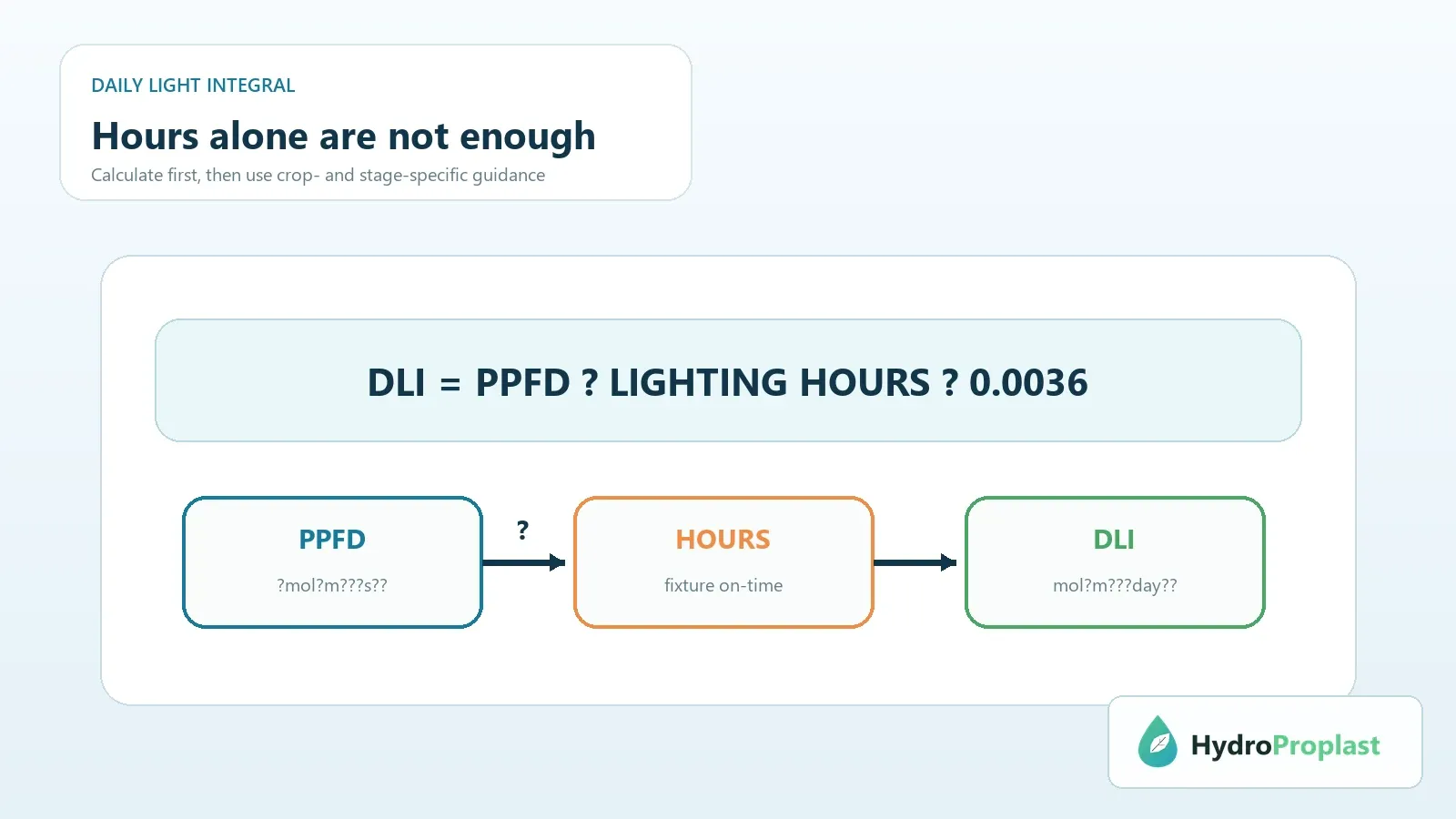
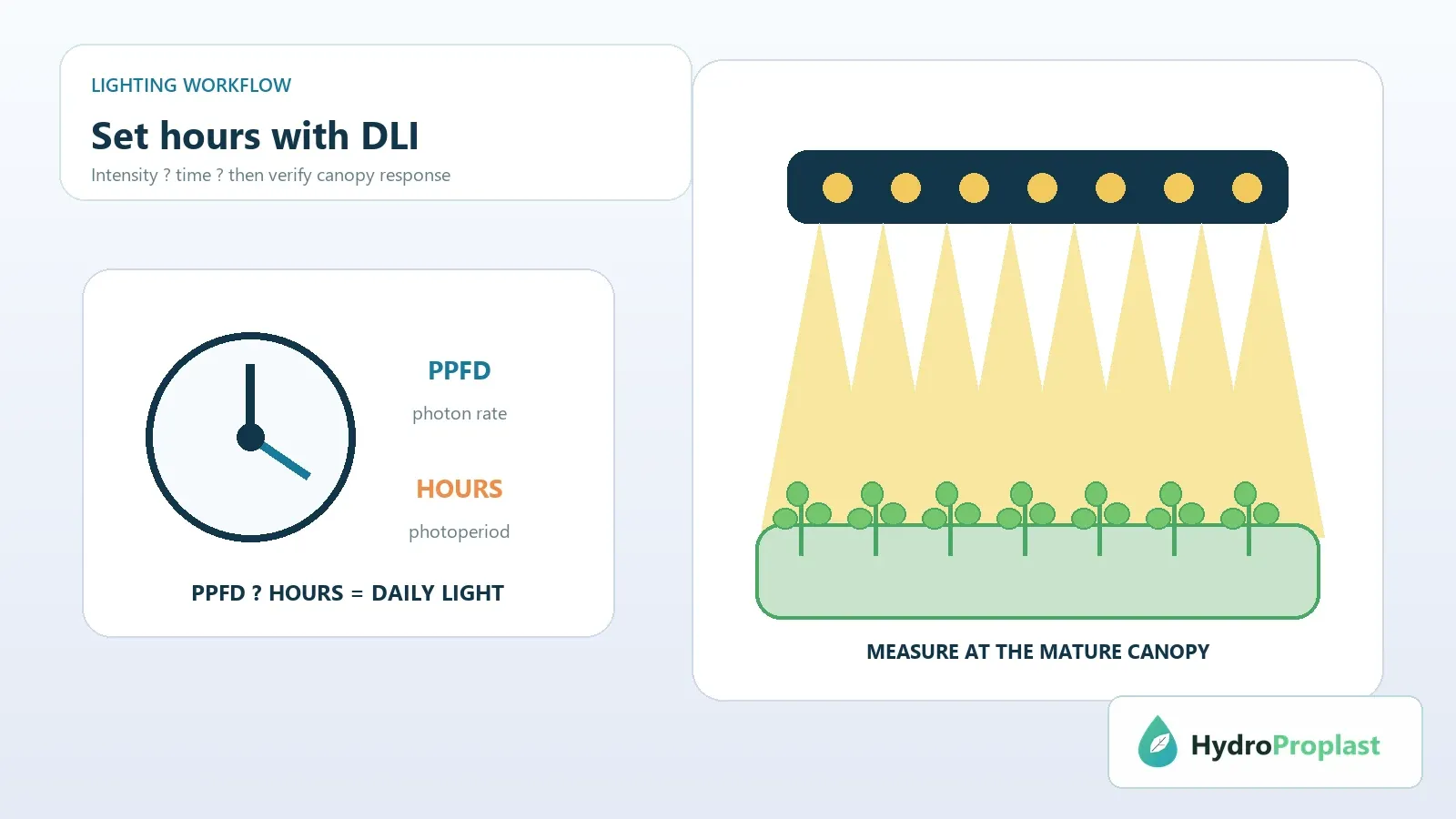
For constant PPFD, DLI equals PPFD multiplied by lighting hours and 0.0036.
Photoperiod is the number of hours the fixture is on. Daily light integral, or DLI, is the total photosynthetically active light delivered during a day. Plants can respond to both the total and the timing.
For constant PPFD, calculate DLI in moles per square meter per day as PPFD multiplied by lighting hours and by 0.0036. This arithmetic does not provide a universal target; obtain crop- and stage-specific guidance.
Measure the mature canopy
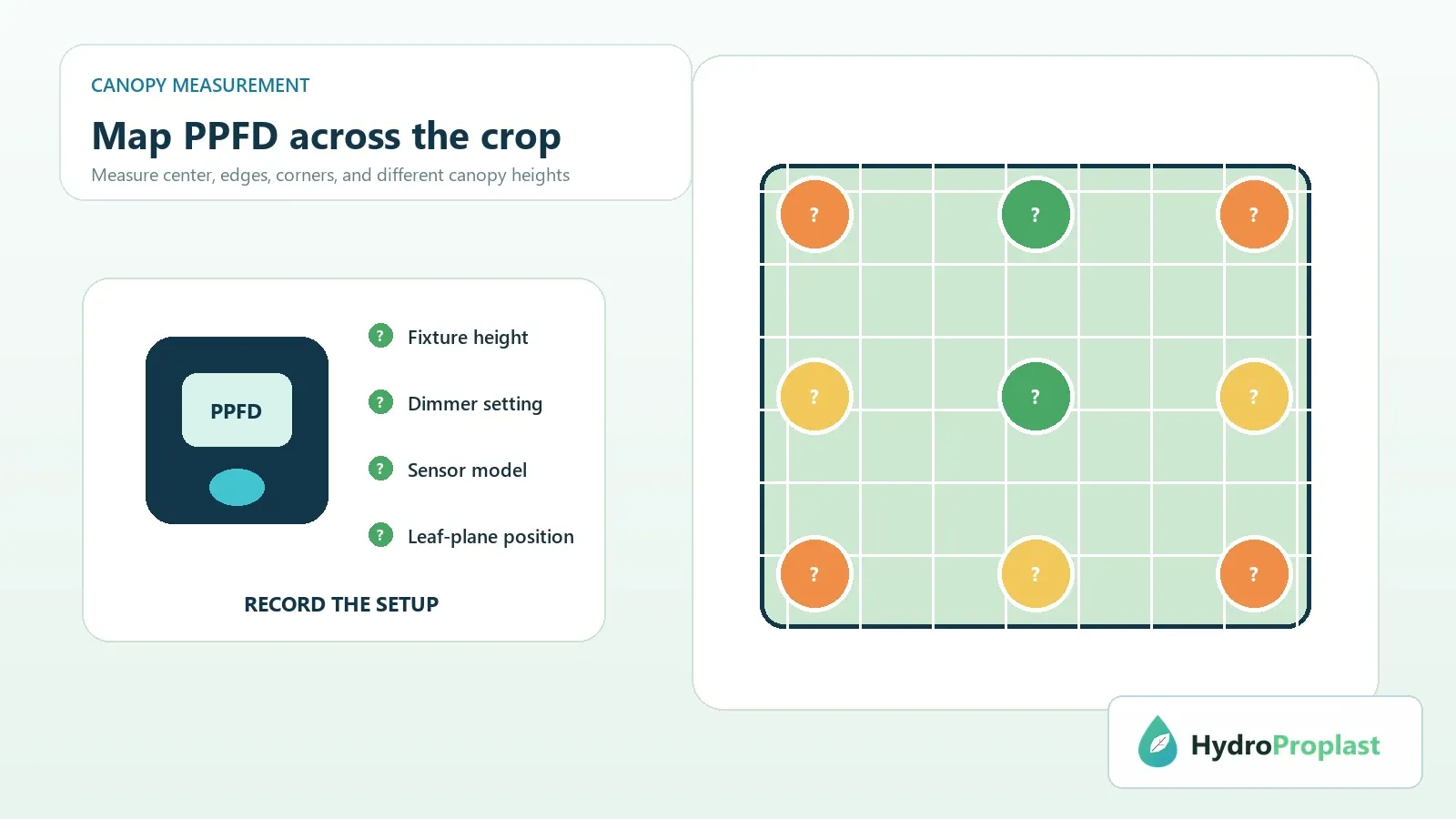
Measure several points across the mature canopy and record the fixture and sensor setup.
Measure PPFD at several points across the area occupied by mature leaves. Include edges, corners, center, and different heights where a crop is trained vertically. A single center reading hides poor uniformity.
Record fixture height, dimmer setting, reflective walls, sensor model, and whether plants were present. The LED selection guide explains coverage maps and efficacy.
Start from crop biology
Leafy greens, herbs, seedlings, and fruiting crops do not share one schedule. Cultivar, stage, temperature, CO2, canopy density, and production goal change useful delivery. Use extension, breeder, or peer-reviewed crop guidance rather than a chart without sources.
University of Minnesota Extension’s indoor lighting guidance explains intensity, duration, and distance.
Schedule germination and emergence
Many seeds do not require light to germinate, while some respond to light; follow packet guidance. Once shoots emerge, provide appropriate illumination promptly. Leaving a covered tray dark after emergence creates long weak stems.
Start tender seedlings at suitable delivery and adjust gradually. Keep fixtures close enough for uniform light only within manufacturer heat and distance guidance.
Prevent leggy seedlings
Long thin stems leaning toward the fixture indicate insufficient or uneven delivery, crowding, or excessive warmth relative to light. Verify the timer and PPFD before strengthening nutrients.
The leggy-seedling guide provides recovery criteria. Existing stretched tissue will not shorten; judge compact new internodes.
Plan leafy-green schedules
Lettuce and many leafy greens can reach useful DLI under moderate PPFD and a practical photoperiod. Extending hours may improve uniform daily delivery when fixture output is limited, but the crop still needs darkness and the room must remain within a suitable temperature range.
Watch compactness, leaf texture, edge plants, and bolting. The lettuce guide connects light with heat and spacing.
Plan herbs by architecture
Basil needs enough delivery to branch compactly; dill can grow tall; thyme remains low beneath other plants. One fixture height may overlight the tallest tips while leaving compact herbs dim.
Group similar canopy heights, prune within crop guidance, or use separate tiers. Do not raise the lamp for one tall plant without measuring the others.
Plan fruiting-crop schedules
Tomatoes, peppers, cucumbers, strawberries, and other fruiting crops generally require a more capable lighting system than leafy crops. Their canopy changes vertically and fruit load raises the value of consistent delivery.
Do not extend hours to compensate indefinitely for inadequate PPFD. Long operation adds energy and heat while lower leaves may remain shaded. Train and space the canopy inside the mapped footprint.
Preserve a dark period
Plants perform important metabolic and signaling processes in darkness. Continuous light can stress many crops, though responses vary. Provide a consistent uninterrupted dark period based on authoritative crop guidance.
Block unintended light from adjacent shelves or room work during the planned night when photoperiod sensitivity matters. Record actual darkness, not only the timer setting.
Use a reliable timer
Choose a timer rated for the fixture load. Verify on and off times by observation, especially after outages, daylight-saving changes, app updates, or power cycling. Stagger high electrical loads only when circuits and crop schedules are designed for it.
Keep plugs, timers, and drivers protected from nutrient splashes and follow electrical codes. A smart plug is not a substitute for correct load rating.
Acclimate plants after transfer
A transplant moved from a propagation shelf to a strong production fixture can bleach or wilt. Begin at lower delivery or greater distance and increase gradually while observing the newest leaves.
Change either intensity or duration deliberately rather than both at once. The response is easier to interpret. Use the established propagation and crop guides until a dedicated transplant page is published.
Recognize insufficient delivery
Clues include elongation, leaning, small pale leaves, slow growth, weak lower canopy, and large spacing between nodes. These overlap with crowding, temperature, roots, and nutrition.
Map symptoms by position. Edge-only stretching suggests uniformity, while whole-canopy decline suggests total delivery or another shared condition.
Recognize excess or heat stress
Bleaching at exposed tops, curling, dry patches, and leaves angled away from the fixture can accompany excessive photon delivery or heat. Measure PPFD, leaf-zone temperature, room temperature, and fixture distance.
A hot nutrient reservoir can create root stress even when leaves look light-damaged. Separate radiant and air heat from root-zone conditions.
Audit energy and climate
Monthly kilowatt-hours equal fixture watts multiplied by daily hours and days, divided by 1,000. Include added cooling or dehumidification. Compare usable canopy delivery per watt, not marketing equivalence.
Changing the schedule shifts room heat and humidity. Running lights at night may help electricity or cooling in some locations, but can raise dark-period conditions elsewhere. Measure before adopting it.
Run a seven-day schedule trial
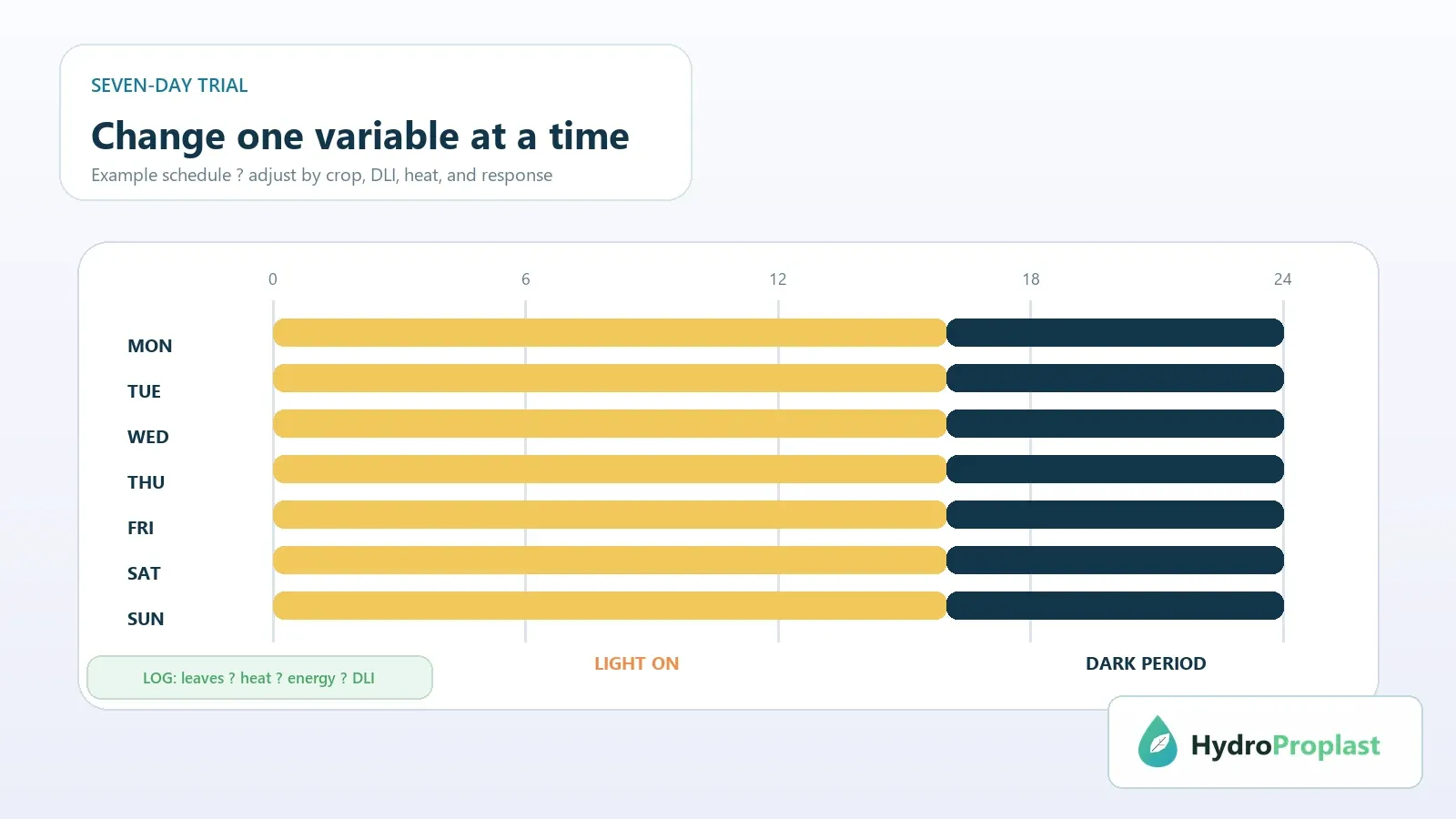
Trial one controlled lighting change for seven days while recording plant, heat, energy and DLI response.
Record PPFD map, fixture height, dimming, on/off times, calculated DLI, maximum leaf-zone temperature, dark-period humidity, and crop response. Photograph the same canopy positions daily.
Change one factor, then repeat. Use new growth, compactness, color, flowering behavior, and energy cost. Do not judge from one old damaged leaf.
Michigan State University’s greenhouse lighting resources provide quantitative lighting context.
The correct schedule is the shortest practical photoperiod that delivers a crop-appropriate measured daily total with acceptable uniformity, darkness, temperature, and energy use. It is verified at the leaves, not assumed from the timer.
A schedule-design worksheet:
Begin with the mature crop footprint, not the empty shelf. Write the crop and cultivar, growth stage, intended harvest, canopy dimensions, and evidence-based DLI range. Measure PPFD on a grid at the planned canopy height. Calculate average, minimum, maximum, and an edge-to-center comparison.
Next select a provisional photoperiod that produces the intended daily total without eliminating darkness. Calculate the PPFD required for that number of hours, then compare it with the measured map and fixture limits. If the center can meet the goal but edges cannot, changing hours will not correct uniformity. Adjust fixture layout, spacing, or reflective boundaries safely.
Example calculations:
At an average 150 µmol/m²/s for 14 hours, DLI is about 7.6 mol/m²/day. At 250 µmol/m²/s for 12 hours, DLI is about 10.8. At 400 µmol/m²/s for 16 hours, DLI is about 23.0. These are arithmetic examples, not recommendations for any crop.
Do not calculate from the fixture’s advertised maximum at an unknown distance. Use measured or credible mapped canopy delivery. If only a lux meter or phone is available, it can help compare relative uniformity under the same fixture, but it does not replace a calibrated quantum sensor for exact PPFD.
Seedling schedule transition:
Record the propagation PPFD and hours before moving trays. Estimate the current DLI, then set the production fixture to a similar or modestly higher delivery for the first stage. Increase in measured steps while watching new leaves. A seedling that wilts immediately may have root or moisture trouble as well as light stress.
Keep tray height uniform. One plug standing above others can receive substantially greater intensity. Rotate trays only under a documented pattern; random rotation hides a poor map and makes plant-position data useless.
Account for photoperiod-sensitive crops
Some plants use day length as a developmental signal in addition to accumulating photons. Flowering behavior can depend on uninterrupted night length, cultivar, and stage. Consult crop-specific authoritative guidance before using night interruption, day extension, or continuous light.
Light leaking from an adjacent tier, hallway, or work lamp can interrupt a planned dark period. Use opaque barriers with safe ventilation, or coordinate shelf schedules. Do not cover fixtures or drivers in a way that traps heat.
Schedule around heat
Log canopy and solution temperatures during the full on period. The warmest moment may occur hours after the lamps start. If heat becomes limiting, reducing intensity, improving HVAC, moving drivers, or shifting operating time may be more effective than merely shortening the day.
When running lights during local nighttime, confirm that noise, condensation, outside-air humidity, and electricity tariffs support the change. The room’s dark period will then occur during daytime, when external heat may still be high.
Separate incompatible canopies
Do not average incompatible crops into one schedule without understanding the compromise. A low leafy crop beneath a tall fruiting plant may receive little usable light even when the room average appears adequate. Separate tiers by crop class or maintain compatible canopy height through planned training and harvest.
Within a shared lettuce or herb shelf, compare center and edge morphology. If only one cultivar stretches, genetics or mature size may contribute; if all edge positions stretch, uniformity is more likely.
Audit fixture maintenance and output decline
Dust, nutrient deposits, yellowed covers, failed diodes, and changed hanging height can reduce delivery. Power off and clean according to manufacturer instructions. Remeasure at the same grid and setting after maintenance.
Keep the initial PPFD map, purchase date, fixture hours, and subsequent audits. A visual impression of brightness cannot confirm output stability. Replace unsafe cords, damaged drivers, or fixtures that fail electrical inspection rather than extending hours to compensate.
Complete the final release checklist
- The schedule is based on a named crop, stage, and source.
- PPFD is measured across the mature canopy.
- DLI calculation and timer settings are documented.
- A consistent dark period is protected.
- Canopy and reservoir heat remain manageable.
- Edge plants receive acceptable delivery.
- Electrical load and mounting are safe.
- The schedule is rechecked after canopy or fixture changes.
A useful light schedule is therefore a measured operating specification. It states where, how strongly, and for how long photons reach the crop, what darkness follows, and how the room responds thermally. Hours are only one line of that specification.
Audit the schedule when the crop changes
A crop-change audit prevents an old schedule from becoming an unsupported default. Before replacing lettuce with basil, or seedlings with fruiting plants, archive the previous map and create a new one at the future canopy height. Recalculate DLI, expected heat load, electrical cost, and required darkness. The same timer setting may be unsuitable even when the fixture remains unchanged.
Version every schedule change
Keep schedule versions with effective dates. Note why each adjustment was made, the measurement supporting it, and the result after at least several days of new growth. If the crop worsens, the previous documented setting provides a safe comparison rather than relying on memory.
Correct an uneven fixture footprint
When a fixture cannot provide both adequate edge delivery and a safe center, reduce the footprint or add correctly spaced equipment instead of extending hours. Conversely, an oversized dimmable fixture can be efficient when operated within a verified map and mounted safely. Purchase power is not the same as delivered light.
Compare lighting with harvest results
At harvest, compare usable yield and quality across canopy positions. Edge losses, uneven maturity, excessive lower-leaf senescence, or fruit set only beneath the center are lighting-design evidence. Combine those observations with measured PPFD rather than changing the nutrient formula.
Release and revalidate the schedule
The schedule is released for routine use only when the timer has been observed, the dark period is protected, the mature canopy map meets the selected crop guidance, thermal peaks are controlled, and energy use is acceptable. Revalidate after changing fixtures, shelf height, reflective materials, plant spacing, or room ventilation.