Size the reservoir for mature demand and safe operation
A hydroponic reservoir should hold enough solution to keep the pump or roots supplied through peak plant demand, slow changes in pH, EC, and temperature, and accept all drain-back without overflowing. There is no universal number of liters per plant because crop size, system type, climate, light, growth stage, and service interval differ.
For beginners, err toward a larger manageable volume rather than the smallest container that fits. More solution generally changes more slowly, giving you time to notice problems. The tradeoffs are weight, cleaning effort, nutrient used during replacement, and the space required for freeboard.
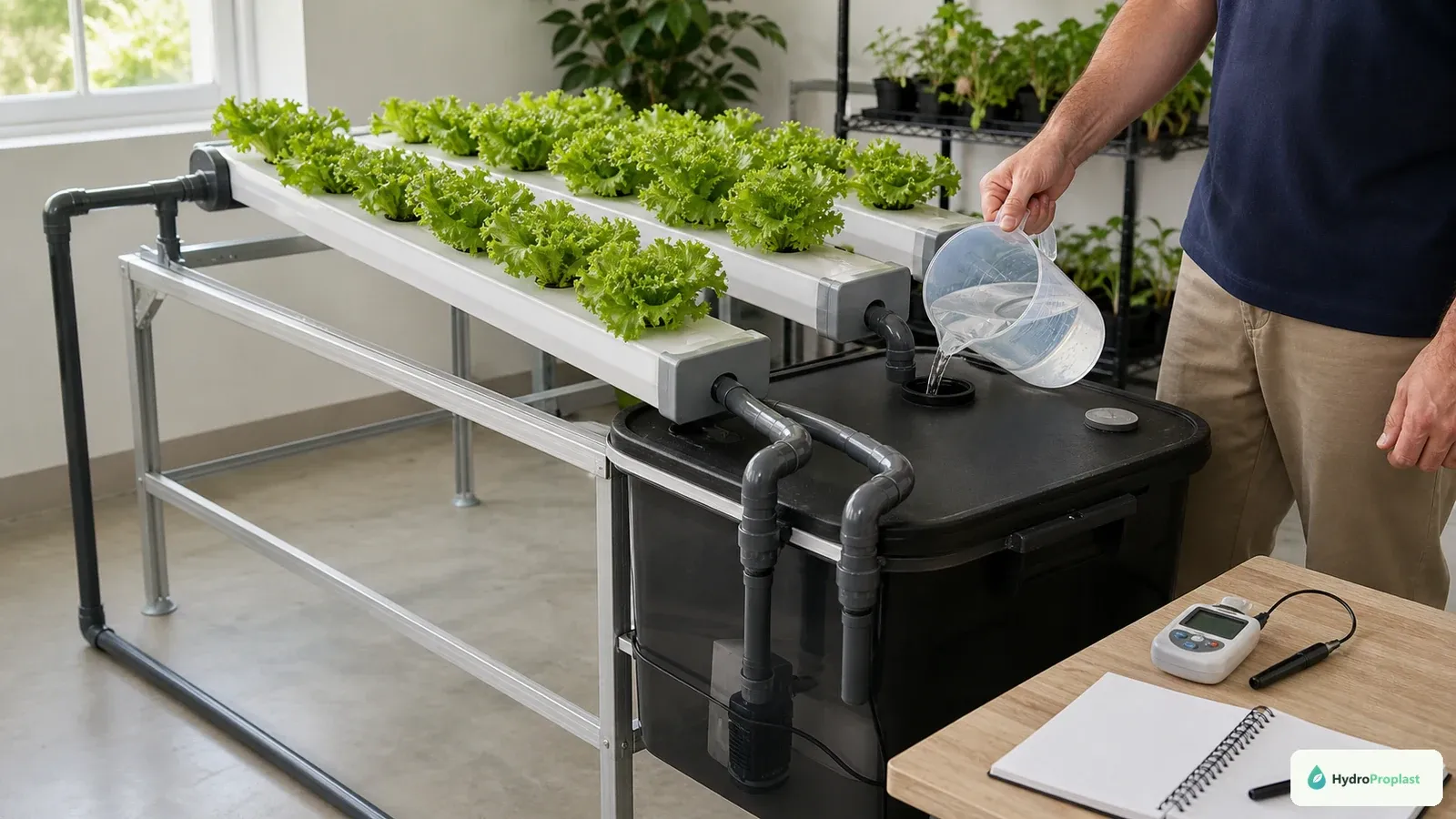
Start with a water budget and hydraulic test instead of an internet ratio. Measure the real working volume after roots, pump, channels, and media displace water. Mark minimum, normal, and shutdown levels on the reservoir.
Separate nominal capacity from working volume
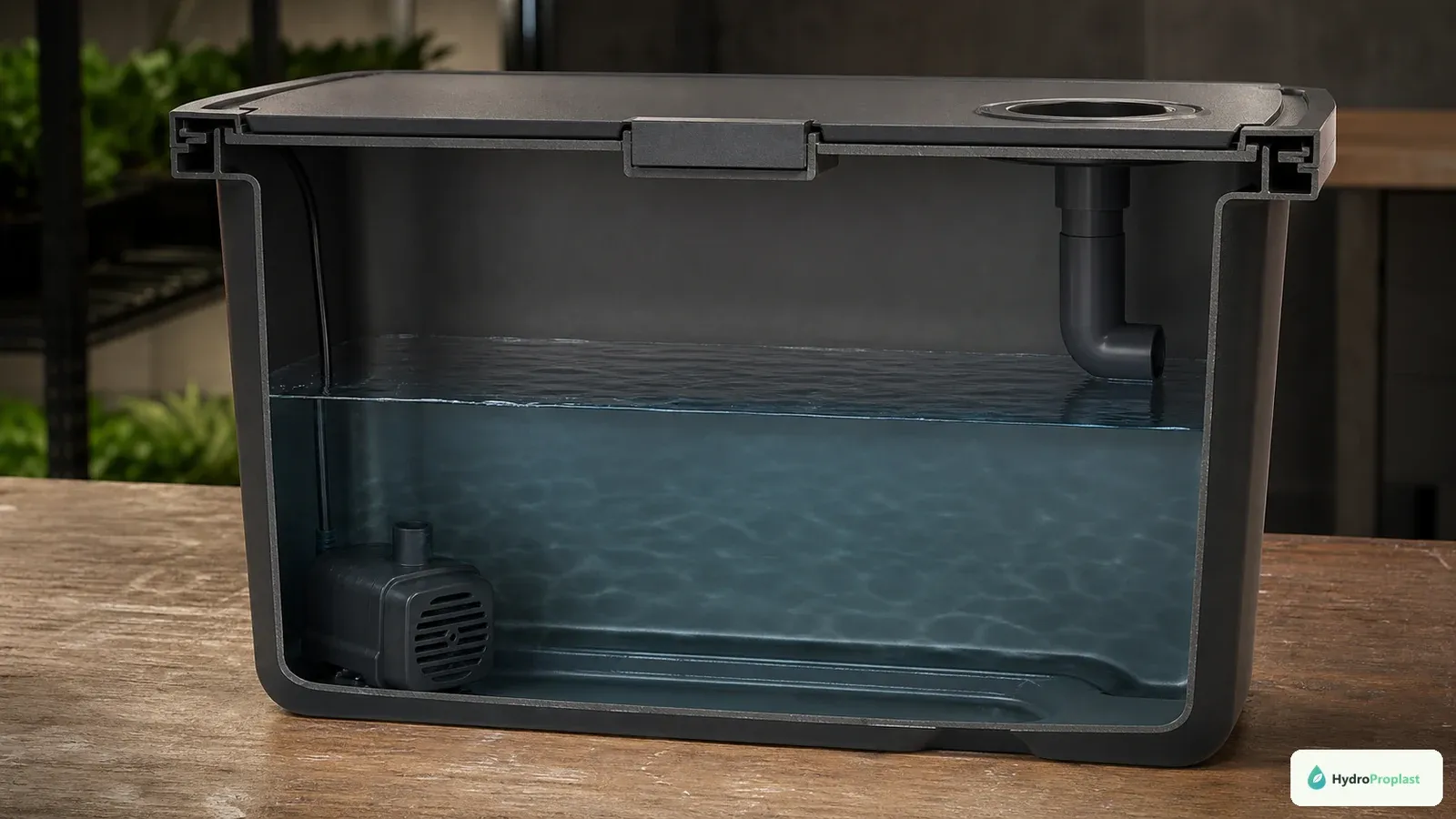
Working volume is less than nominal tank capacity because the system needs headspace and pump operating margin.
A container sold as 20 liters cannot necessarily operate with 20 liters. The lid, pump, roots, return splashing, and safety freeboard reduce usable volume. In recirculating systems, some water resides in channels, trays, tubing, and media while the pump runs.
Working volume is the solution in the complete operating system at the normal level. Shutdown volume is what returns when the pump stops. Minimum operating volume is the lowest level that keeps pump intake submerged or roots supplied safely.
Measure with plain water. Add known quantities, run the system, and mark levels. Stop the pump and confirm the return does not exceed the reservoir’s physical capacity. Never plan to the rim; movement, roots, foam, and uneven floors need margin.
Crop demand is a moving target
Seedlings use little water. A mature basil canopy or fruiting tomato may remove far more, especially under strong light, warm air, low humidity, and airflow. A reservoir sized from week-one consumption can become inadequate near harvest.
Plant count alone is misleading. Four lettuces, four herbs, and four cucumbers have different canopy, duration, and root demands. Repeated harvesting extends a crop and increases the period over which water and nutrient balance change.
Record daily water additions as plants mature. The highest observed demand plus the longest interval between safe inspections informs future sizing. Do not promise unattended days before testing the system under peak conditions.
System type changes the water inventory
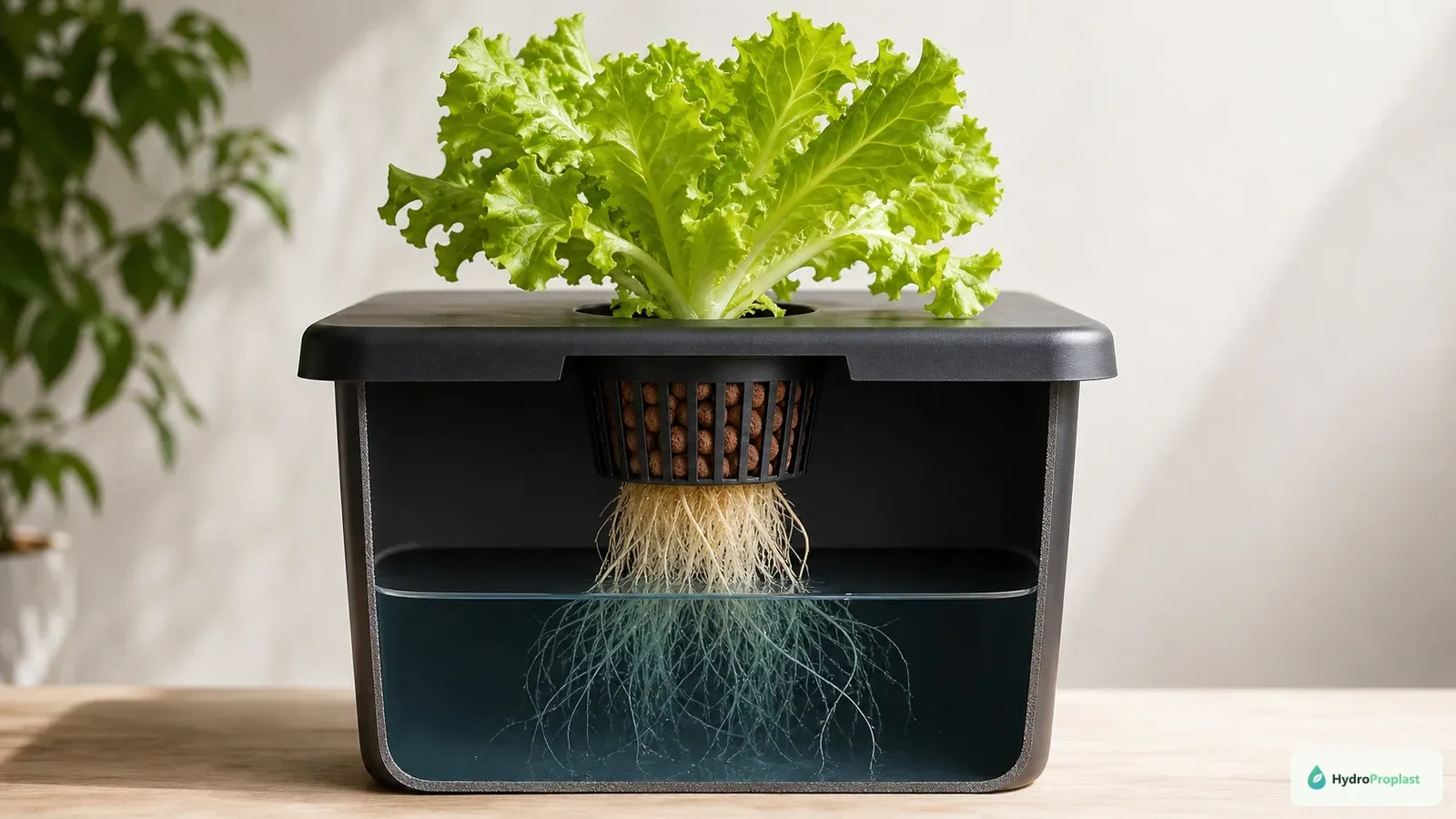
DWC stores most system water around roots. Adequate depth and aeration are central, but a larger volume is heavier and may be difficult to replace. Kratky sizing may aim to carry a short crop while preserving a developing air gap; refilling rules differ from DWC.
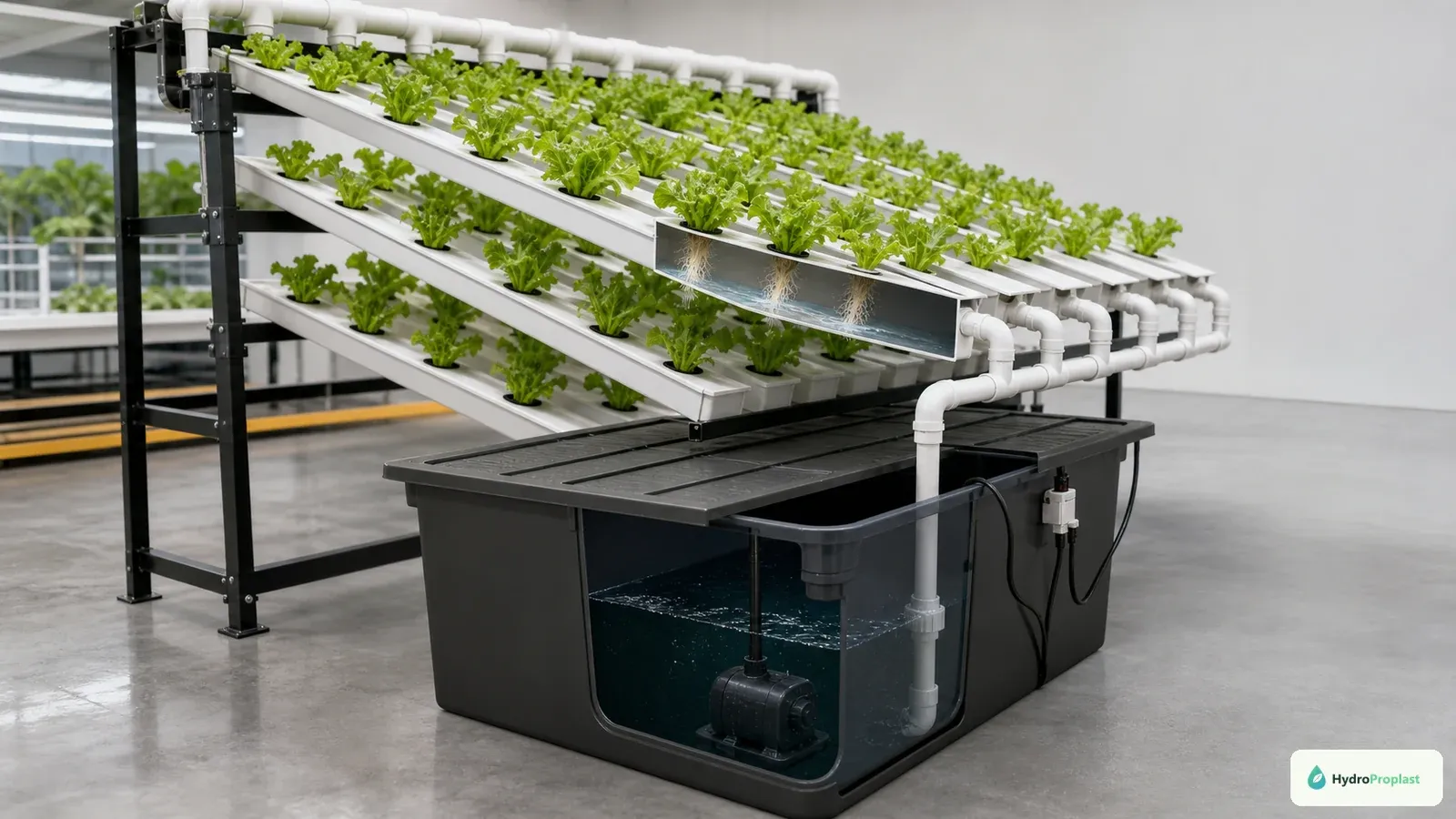
NFT holds relatively little water in channels but depends on reservoir volume and continuous pumping. Ebb and flow transfers a large batch into the tray during each cycle, so the reservoir must keep the pump covered while also accepting full drain-back. Drip systems need capacity for delivery, runoff, and return where recirculated.
The USDA Economic Research Service’s hydroponic system appendix describes these delivery methods. Reservoir sizing follows their hydraulics; “hydroponics” alone does not determine volume.
Stability improves with volume—but only within reason
Adding a small amount of acid, nutrient, top-up water, or plant uptake has a smaller proportional effect in a larger reservoir. Temperature also tends to change more slowly. This buffer can make beginner management easier.
Large volume does not correct the wrong nutrient, diseased roots, poor aeration, or a light leak. It may spread one contamination event to more plants. It also increases filled weight: one liter of water weighs approximately one kilogram before the container and structure are counted.
Choose a volume you can drain, clean, remix accurately, and support safely. A tank so large that solution is never replaced or surfaces cannot be reached is not practical stability.
Calculate pump operating margin
Submersible pumps require a minimum depth and may be damaged by running dry. Place the intake where it remains covered at the lowest operating level, but not where sediment or roots enter easily. Follow manufacturer requirements.
In an active system, run all zones simultaneously at maximum intended flow. Mark the lowest reservoir level reached. Add a margin for daily uptake and evaporation without reducing freeboard for shutdown return.
Pump flow ratings decline with head height and plumbing resistance. Reservoir size does not compensate for an undersized pump. Our air pump versus water pump guide separates oxygenation from liquid movement.
Account for drain-back and displacement
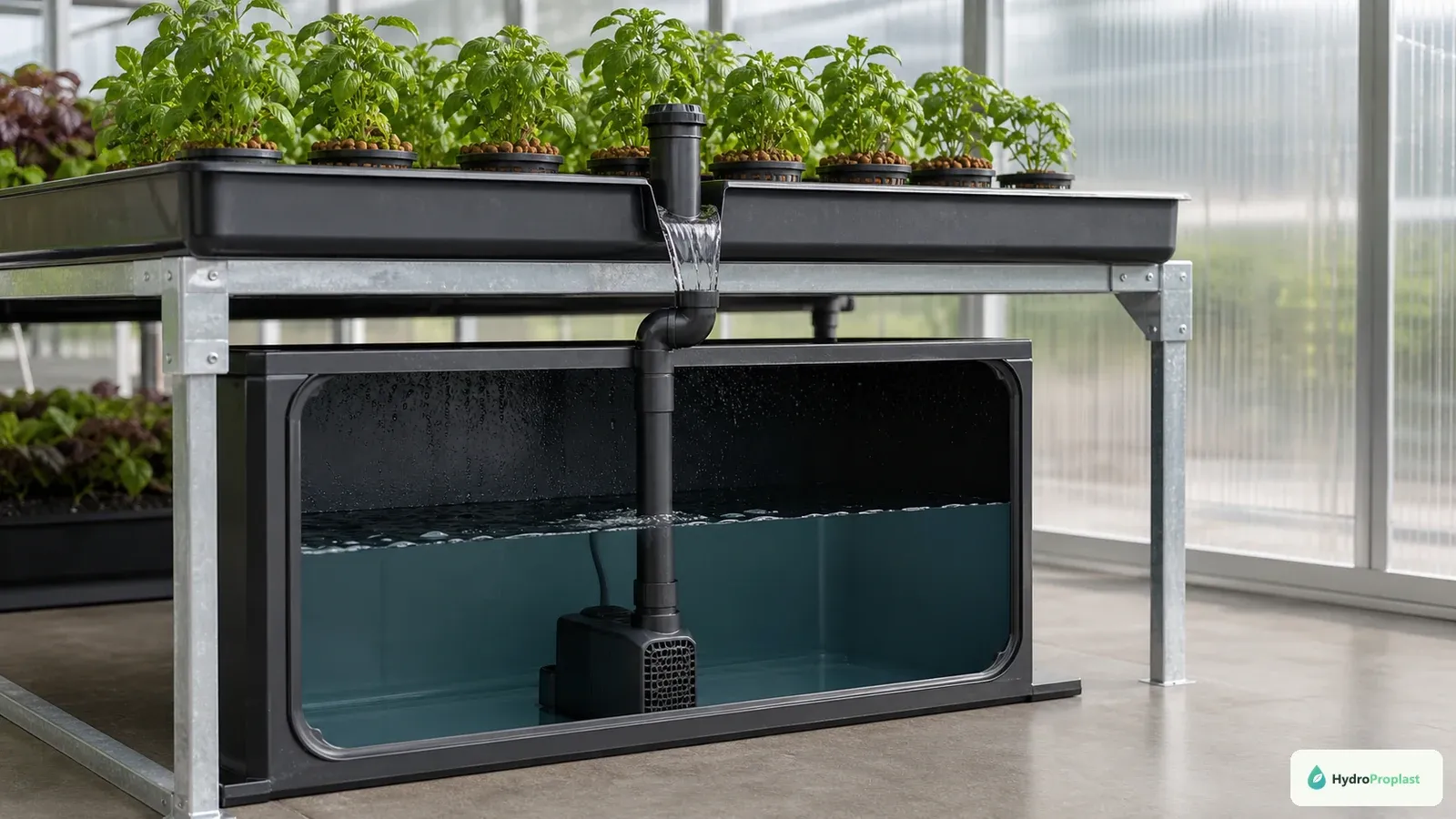
Ebb and Flow reservoirs need enough empty space to receive the tray’s full drain-back volume without overflowing.
When a pump stops, elevated pipes, channels, towers, and trays may empty into the reservoir. Ebb-and-flow media and pots also displace water during flooding. Roots increase displacement during the crop.
Perform a shutdown test at the highest intended operating volume. Watch for siphoning, slow returns, trapped pockets, and overflowing. Repeat after plumbing changes. In a vertical system, a top-line siphon can return more than expected.
Provide an independent overflow path or containment where appropriate. Do not rely only on a timer to prevent a flood. A safe reservoir has both low-level operating margin and high-level drain-back margin.
Shape and access matter as much as liters
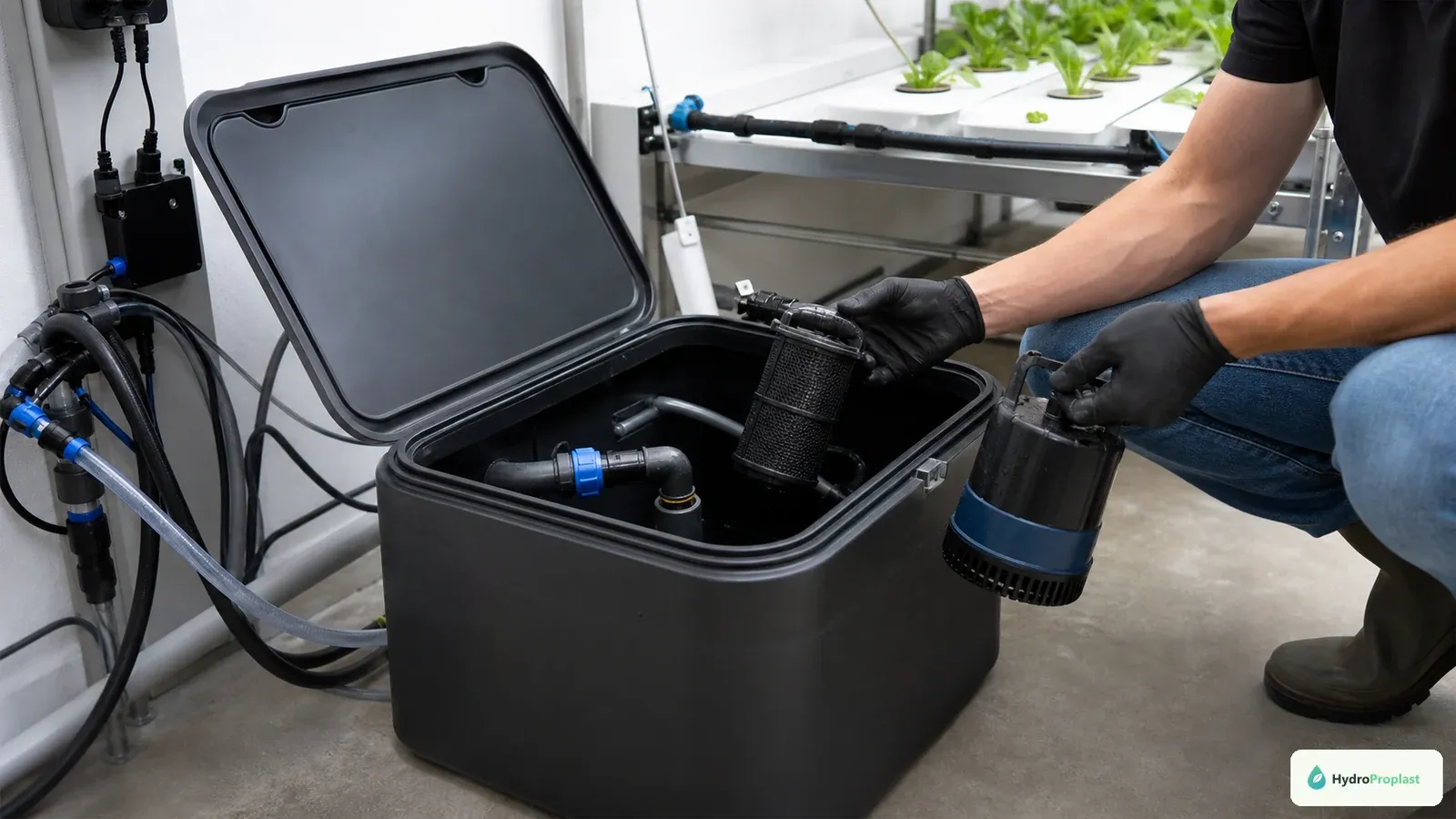
A reservoir that is easy to open, inspect, and clean is more useful than a larger tank with poor access.
A broad shallow tank exchanges heat and light differently from a tall narrow one. A narrow opening may make cleaning impossible. A flexible wall may bow under water load, stressing fittings. Select an opaque, structurally suitable container with a lid and access for pump removal, mixing, sampling, and scrubbing.
The footprint must fit beneath the system without blocking service. Keep the lid strong enough for incidental contact but do not use it as an unverified structural shelf. Place the reservoir on a level surface that supports the full weight.
Avoid containers with unknown chemical history. Block light from level windows and tubing entries to reduce algae.
Indoor temperature and reservoir placement
A larger volume heats and cools more slowly, but location still dominates. Direct sun, hot lights, warm floors, and enclosed cabinets can raise solution temperature. A reservoir placed directly below warm lamps may need more than volume to stay suitable.
Measure temperature through the daily light cycle at the actual location. Insulation can slow change but may also trap heat; active cooling adds cost and complexity. Address room ventilation and heat sources first.
The University of Minnesota Extension emphasizes water quality and environmental management in small systems. Volume is one buffer, not an environmental control system.
A practical sizing worksheet
List crop and mature plant count, system water outside the tank during operation, pump minimum depth, expected peak daily uptake, longest inspection interval, required drain-back capacity, and freeboard. Add them as separate constraints rather than one guessed multiplier.
Select a candidate container, then commission with measured plain water. Mark normal operating level, pump-exposure level, and maximum shutdown level. Run all zones, stop them, and repeat.
During the first crop, record starting volume and every top-up. Note the highest one-day and multi-day demand. If the level approaches minimum before scheduled inspection, increase volume, reduce crop load, or inspect more often.
Examples without false universal ratios:
A single Kratky lettuce may complete in a modest dedicated container under validated conditions, while a long-lived basil needs more reserve. A multi-site DWC tote needs enough depth for roots and aeration plus room for access. An NFT rack may carry little water in channels but needs a reservoir large enough to buffer the entire shared crop.
A fruiting-crop drip system can use substantial water at maturity and must account for media and runoff. An ebb-and-flow tray may demand a large temporary flood volume even when plant uptake is modest.
These examples show why ratios fail. Use published crop and system guidance as a starting point, then verify against the actual environment.
Top-up strategy affects effective capacity
Manual top-ups can extend operation, but they require observation. An automatic float valve holds level but may mask increasing water use and gradually dilute EC if only water is added. It also connects a water supply whose failure can flood the system.
If using automatic top-up, limit the available supply, add overflow containment, and log consumption independently. Verify that source water and nutrient strategy are compatible. A constant level does not mean a constant nutrient balance.
For manual systems, mark top-up increments and record whether water or prepared nutrient solution was used. Pair volume trends with pH and EC.
When the reservoir is too small
Warning signs include frequent low-level alarms, pump exposure, rapid EC and pH swings, repeated emergency top-ups, large temperature changes, and plants competing strongly late in the crop. Roots may occupy service space and make measurements difficult.
Do not solve every symptom by adding concentrate. A small tank can become over-concentrated as water disappears. Confirm level and EC first.
Increasing reservoir size may help, but check whether the structure, pump, drain-back, and cleaning plan can accommodate it. Sometimes fewer plants are the safer correction.
When it is unnecessarily large
An oversized reservoir consumes more nutrient during complete changes, is difficult to lift or drain, and may require stronger circulation for uniform mixing. A small crop may not justify that inventory.
If much of the solution is routinely discarded while readings remain stable, a smaller well-buffered tank or staged mixing may reduce waste. Never reduce below pump, root, temperature, and service margins merely to save nutrient.
Use How Often Should You Change Hydroponic Water? to connect capacity with replacement decisions.
Choose the smallest volume that remains forgiving
The right reservoir is large enough to survive peak demand between inspections, maintain equipment operation, buffer normal additions, and catch drain-back—but small enough to drain, clean, measure, and support safely.
Commission with plain water, document hydraulic levels, and learn from one full crop. That evidence is more reliable than a universal liters-per-plant rule and becomes the basis for expanding without repeating early sizing mistakes.
A final capacity check should include chemistry as well as hydraulics. Mix a normal batch at the marked working level and record how much a small labeled pH-adjustment dose changes the reading. In an undersized reservoir, the same practical measuring increment may cause an unmanageably large jump. The hydroponic pH guide explains why gradual correction and accurate working volume belong together.
Review ergonomics before choosing the container. Can one person open it without disturbing plants, reach every wall with a brush, remove the pump, collect a sample, and drain solution into an appropriate vessel? If not, add a safe drain or choose a different shape rather than assuming a siphon will always work.
Also plan for failure. Limit any automatic top-up supply so a stuck valve cannot release unlimited water. Place the tank where a crack or disconnected return is contained, and consider a floor alarm. A larger reservoir increases buffering but also increases the consequence of a leak.
After harvest, compare actual peak daily uptake, total top-ups, minimum operating margin, and drain-back headroom with the original worksheet. Resize from that evidence before adding plants.
Reserve space for a labeled sample port or clean cup access so routine testing does not require lifting a root-filled lid. Good access reduces contamination and makes consistent pH and EC sampling more likely. If adding that access compromises opacity or structure, choose another container rather than cutting an improvised opening.