The best first system depends on what you can maintain
For most beginners growing lettuce or herbs, a small deep water culture (DWC) system is the best all-round teacher: it has few components, makes the root zone easy to inspect, and introduces aeration, nutrients, pH, and reservoir care without complicated plumbing. If silence and zero pumps matter more than maximum control, use a small opaque Kratky container. If you want a tidy appliance and accept less flexibility, a reputable countertop kit can be easier still.
That is a more honest answer than naming one universal winner. A system that suits six lettuces in a utility room may be wrong for basil on a kitchen counter or tomatoes in a greenhouse. Begin with the crop, light, available space, tolerance for noise, and time you can spend checking the system. Then choose the least complex design that meets those needs.
The USDA Economic Research Service classifies hydroponic methods by irrigation and substrate, including drip, DWC, nutrient film technique, flood and drain, and atomization systems. Those names describe how solution reaches roots; they do not tell you which system fits your home.
Use five questions before comparing equipment
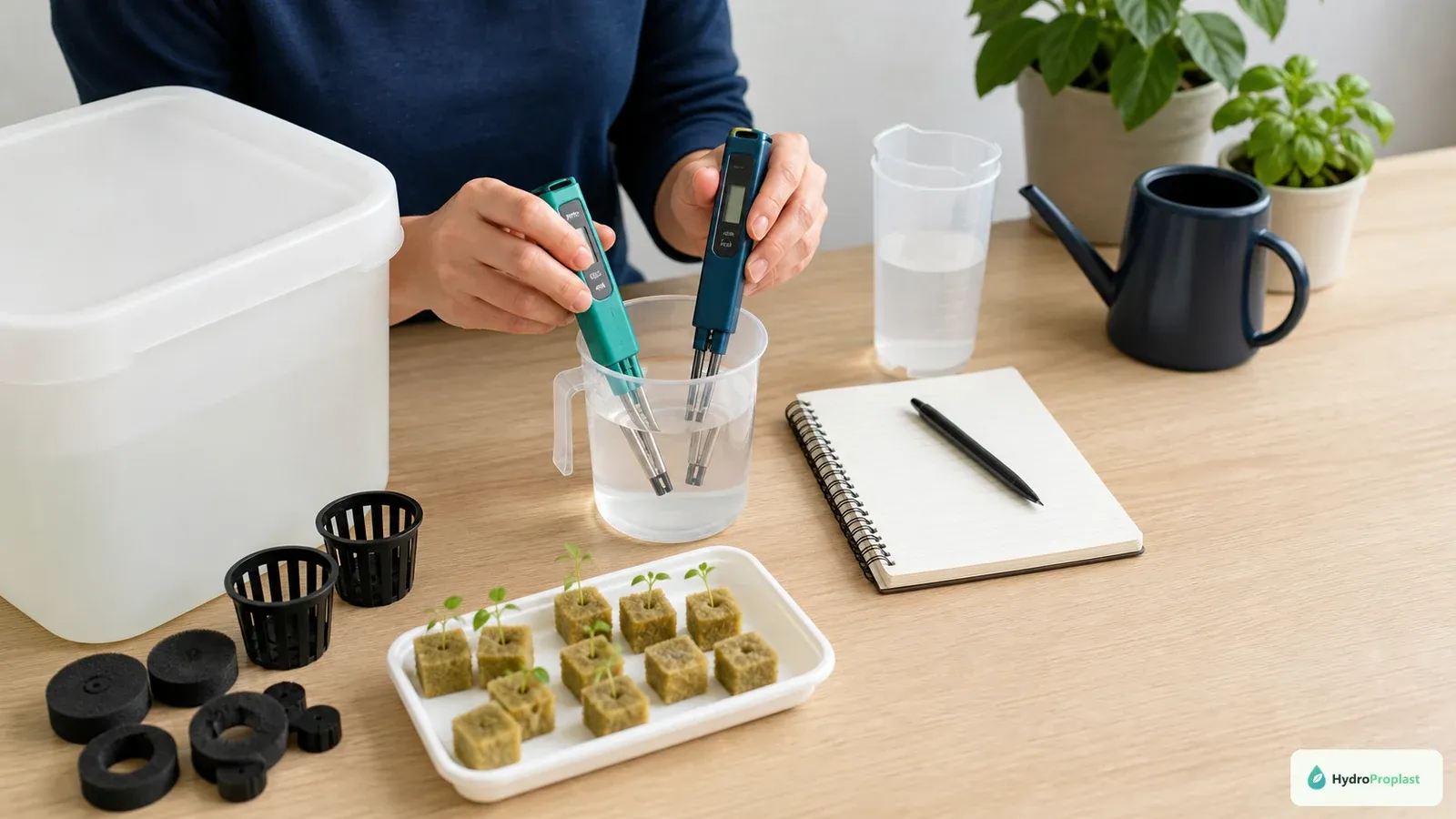
Budget for the complete routine, including water testing, nutrient mixing, seedlings, lighting, cleaning, and safe access to the reservoir.
First, what will you grow? Leaf lettuce, basil, and many compact herbs have modest structural demands and relatively short crop cycles. Tomatoes, cucumbers, peppers, and strawberries need more root volume, light, support, and sustained nutrient management. Do not choose a small countertop garden and then expect it to support an indeterminate tomato simply because the seedling fits.
Second, where will it live? Measure width, depth, and usable height after accounting for the lamp and mature plant. Check access to water, drainage, ventilation, and a safe electrical outlet. A vertical tower may save floor area but still needs clearance, cleaning access, and uniform light from top to bottom.
Third, how long can the system go without inspection? Passive systems avoid pump failures, but small reservoirs can change quickly. Active systems circulate or aerate solution, yet depend on electricity and equipment. If you travel frequently, reservoir capacity and a reliable caretaker matter more than advanced features.
Fourth, what kind of maintenance will you actually perform? Every system needs cleaning and observation. NFT adds channels and flow balancing; drip adds emitters; ebb and flow adds a tray, drain, and timer. Simpler hardware narrows the troubleshooting list.
Fifth, what is the full budget? Include light, nutrients, meters, starter supplies, replacement parts, and spill protection. Our hydroponics startup cost guide shows why the advertised system price is only one line in the budget.
Deep water culture: the strongest general starting point
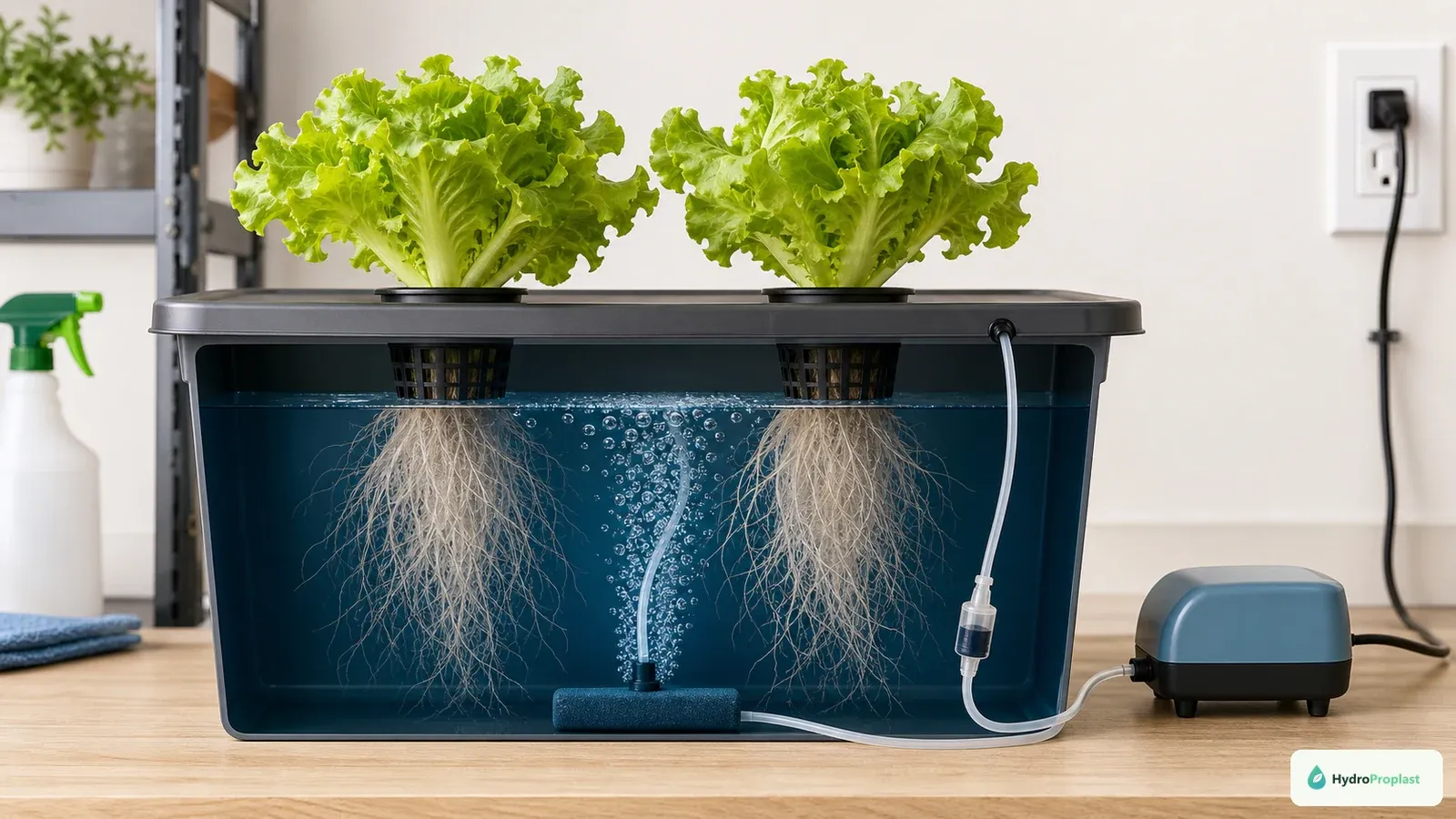
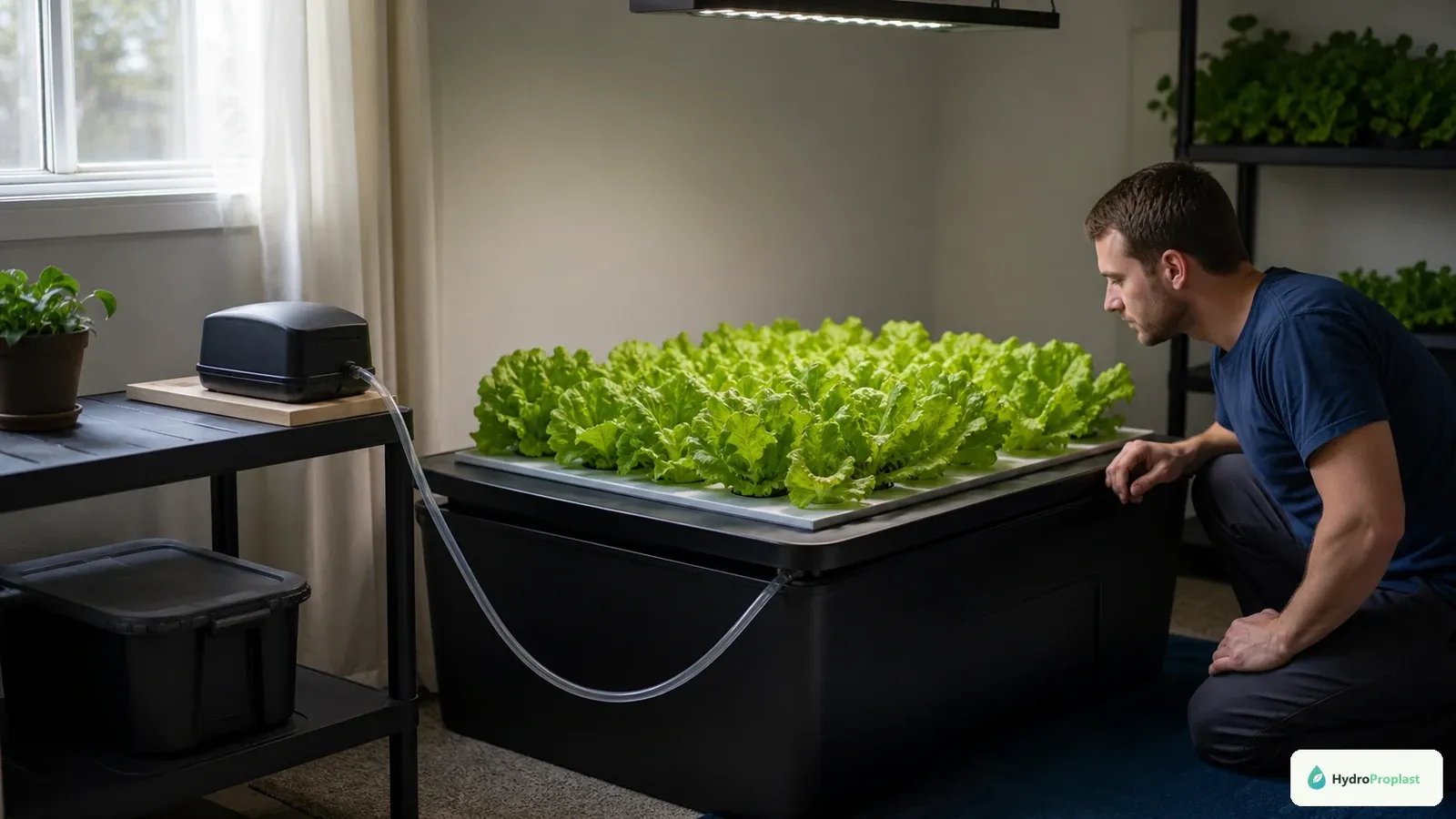
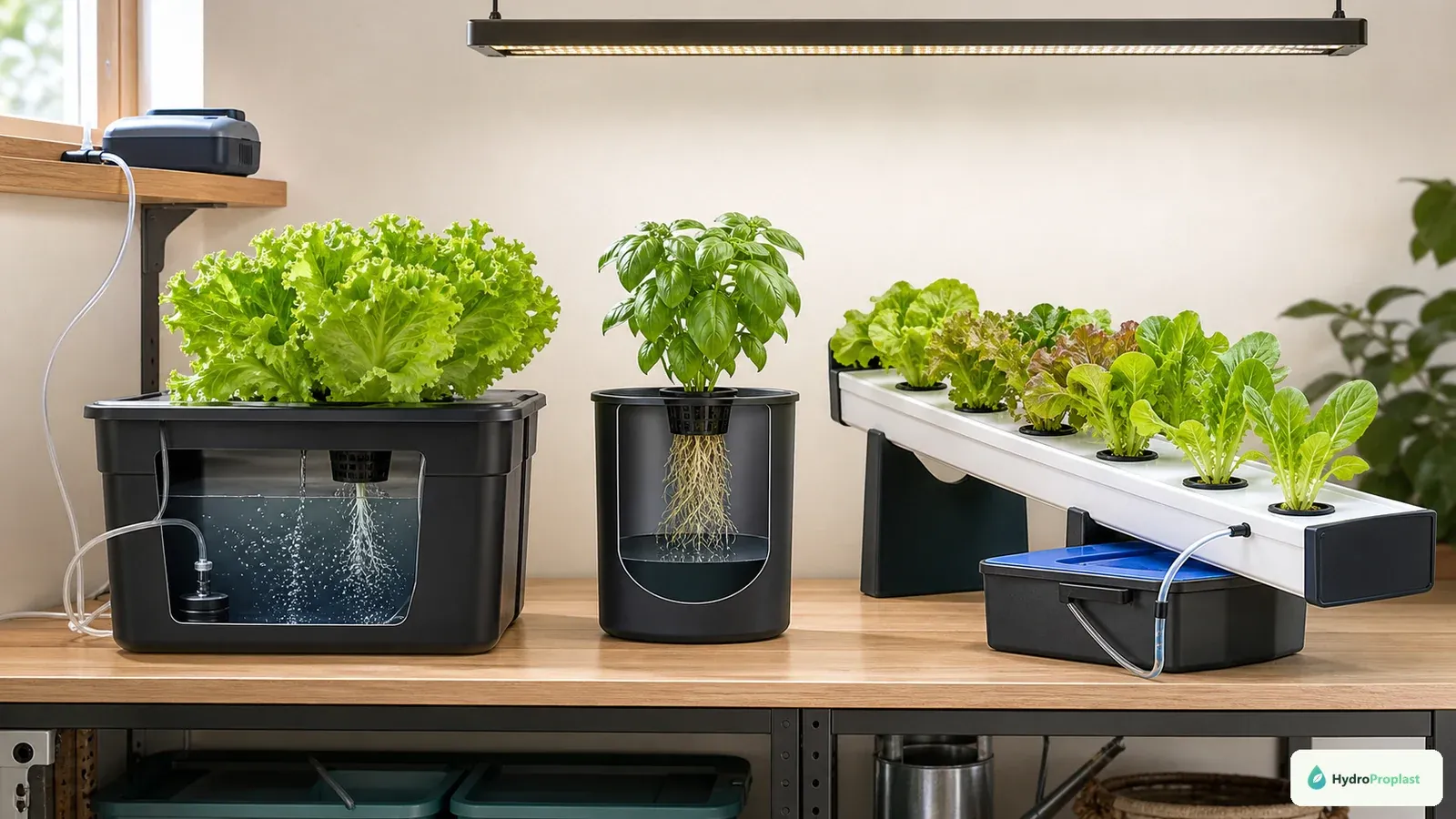
DWC keeps roots in a deep nutrient reservoir while an external air pump supplies an air stone through a protected airline.
In DWC, a plant sits in a lid or raft while roots extend into aerated nutrient solution. An air pump sends bubbles through an air stone, helping maintain movement and root-zone oxygen. The reservoir, plant support, net pot, air pump, airline, check valve, and nutrient are easy to identify and replace.
DWC is especially suitable for a first leafy-green or herb grow. Roots are visible when you lift the lid, so it is easier to connect plant symptoms with water level, color, odor, and temperature. A larger solution volume also tends to change more slowly than a tiny channel or jar, although reservoir size must still match the crop.
Its main tradeoff is dependence on aeration. A failed pump, kinked airline, warm solution, or long power outage can reduce oxygen around submerged roots. Air pumps also make some noise. Keep the pump above the reservoir or use a check valve, leave electrical connections away from splashes, and choose an opaque food-safe container that can be cleaned.
The University of Minnesota Extension’s small-scale hydroponics guide emphasizes that hydroponic plants can still suffer disease and that indoor systems need uniform light at plant level. DWC solves neither issue automatically; it simply gives a beginner a manageable platform for learning them.
Kratky: best when quiet simplicity is the priority
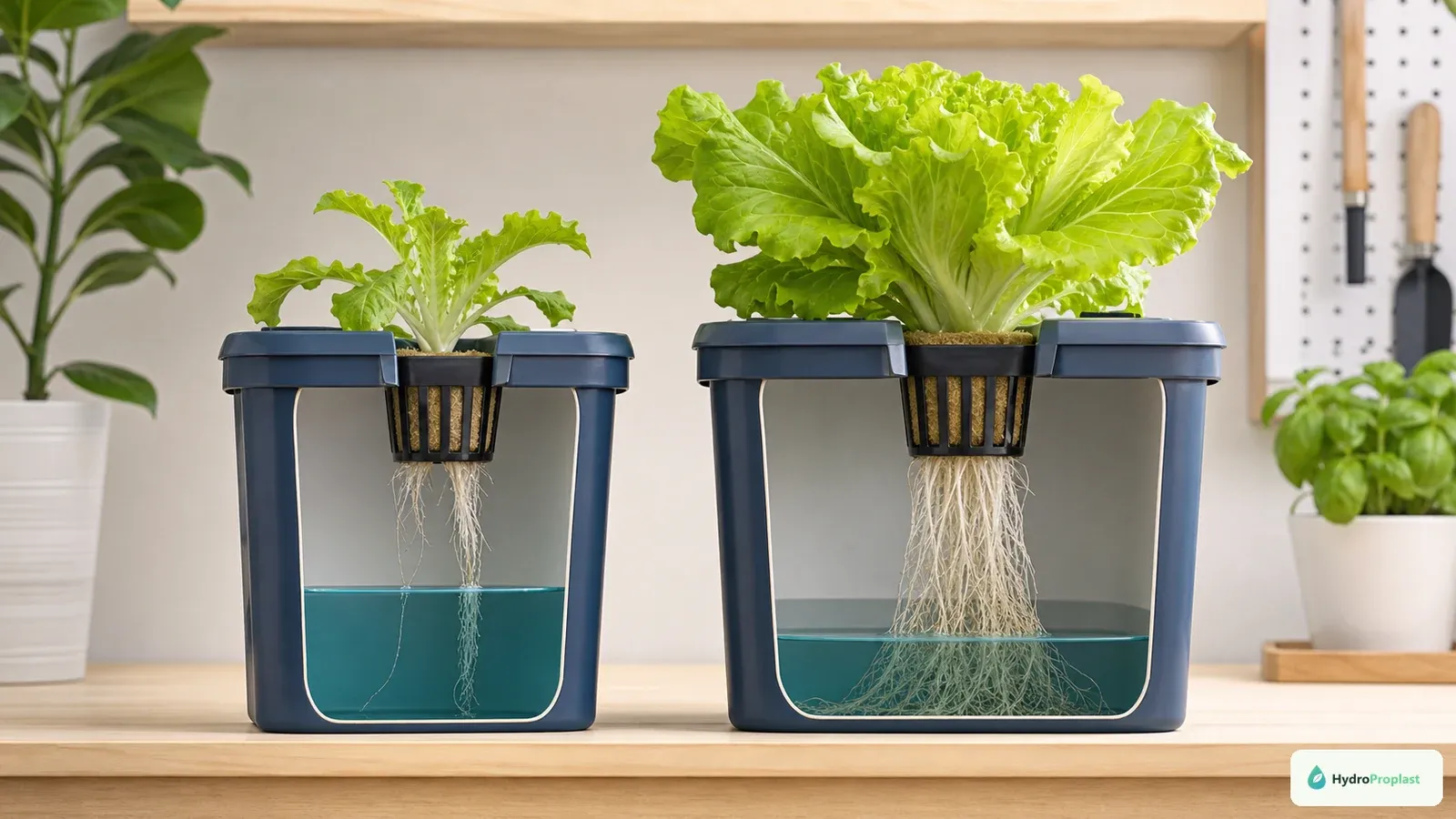
In Kratky growing, solution use creates a humid air gap; lower roots stay in nutrient solution and no circulation or aeration pump is used.
The Kratky method is a non-circulating technique. A seedling begins with its roots near nutrient solution. As the plant uses water, the level drops and exposes part of the root mass to a humid air gap while lower roots continue reaching solution. No air or water pump is required in a correctly sized setup.
Its appeal is obvious: no pump noise, timer, moving water, or electricity for the reservoir. An opaque container, lid, net pot, starter plug, nutrient, and suitable light may be enough for a small leafy crop. It can be an excellent experiment for learning how roots and solution interact.
Kratky is not simply DWC with the air pump removed. The air gap is part of the design and should not be repeatedly filled to the top after air-adapted roots develop. A container that is too small may run out before the crop finishes; an oversized or poorly supported plant may become unstable. Warm conditions and light leaks still create risk. It is less forgiving for thirsty fruiting plants or situations where solution demand is hard to predict.
Choose Kratky for compact, fast crops when quiet operation matters and you can size a separate container for each plant or small group. For a direct comparison of oxygen strategy, refill behavior, and failure modes, see Kratky Method vs Deep Water Culture.
Countertop kits: best for convenience, not necessarily value
A complete countertop kit can remove compatibility decisions. The reservoir, deck, light, pump, baskets, and timer are designed to work together. For a reader who wants herbs near the kitchen and prefers guided controls over selecting components, that convenience is real.
Look beyond the number of planting holes. Compare usable lamp height, reservoir access, replacement basket and plug availability, pump serviceability, cleaning difficulty, operating noise, and whether proprietary consumables are required. Closely spaced holes may support seedlings but crowd mature plants. A fixed short lamp limits crop choice even when marketing photos show fruiting plants.
Kits also concentrate failure into custom parts. If an integrated pump or lamp fails, a generic replacement may not fit. Some models hide roots and tubing, making cleaning harder than a bucket. A kit is therefore best for someone who values a neat footprint and simple setup enough to accept a smaller ecosystem and possible replacement-part constraints.
If you enjoy building, want to expand later, or already own a suitable light, compare those tradeoffs in Hydroponic Kits vs DIY Systems.
Why NFT, ebb and flow, drip, and aeroponics usually come later
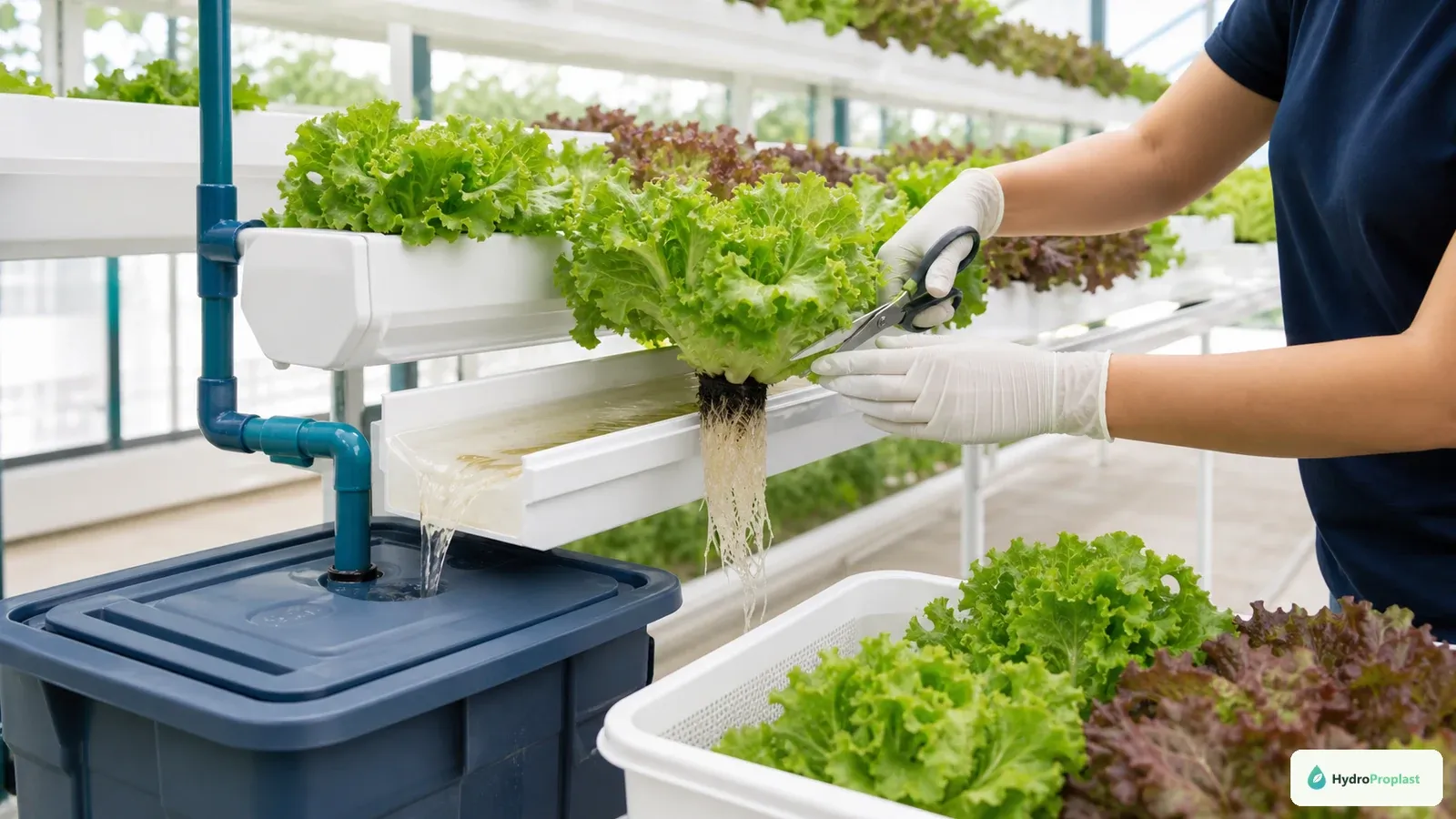
NFT circulates a shallow film of solution through channels. It is space-efficient for many leafy greens and can look wonderfully orderly. But the roots have little water reserve when flow stops, channel slope must be correct, and roots can alter flow as they grow. One pump may support many plants, which also means one failure can affect many plants. Start with NFT when your goal genuinely requires rows of small crops and you are comfortable checking flow distribution.
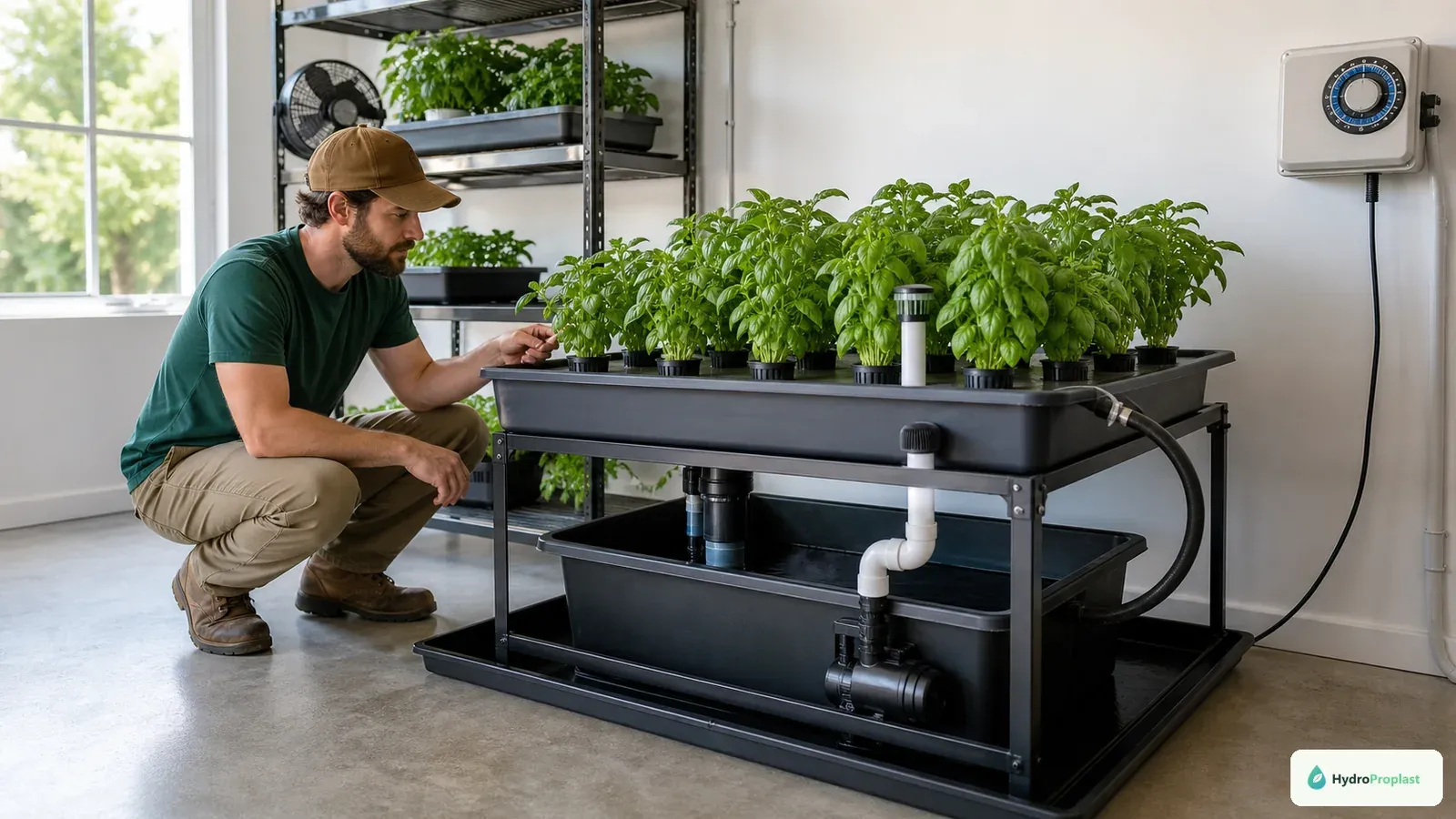
Ebb and flow periodically floods a tray and drains solution back to a reservoir. It accommodates different pots and media and creates alternating wet and airy conditions. The beginner must size the reservoir for the flood volume, set cycles for crop and medium, protect against overflow, and keep drains clear. It is a sensible second system when flexible container placement matters.
Drip irrigation delivers solution to individual plants in media. It scales well and is useful for tomatoes, cucumbers, and peppers, but emitter clogging, runoff, and unequal flow add monitoring. The USDA report notes drip systems are particularly suitable for fruiting crops, which is precisely why many first-time leafy-green growers do not need them.
Aeroponics exposes roots and sprays them at short intervals. High root oxygen is attractive, but pumps, filters, nozzles, pressure, and short-cycle timers create a narrow margin during failure. Oklahoma State University’s hydroponics guide describes aeroponics as the most high-tech of the common home system types. It is a poor default for someone still learning how to mix nutrient solution.
A decision matrix you can use without brand names
Choose DWC if you want the clearest learning system, grow leafy greens or herbs, have room for a moderate reservoir, and can tolerate an air pump.
Choose Kratky if you want silence, minimal hardware, and one short-cycle leafy crop, and you understand that container sizing and the air gap replace active aeration.
Choose a countertop kit if appearance, compactness, and guided setup are more important than component flexibility or lowest long-term cost.
Choose NFT if you want multiple compact leafy plants in channels, have reliable power, and will inspect flow daily.
Choose ebb and flow if you want several media-filled pots or a flood tray and are ready to manage timing, drainage, and displacement volume.
Choose drip if your goal is a larger fruiting crop in substrate and you can check emitters and manage drainage.
Delay aeroponics unless experimentation with pumps, filtration, and spray hardware is itself part of the appeal.
No matrix replaces crop fit. A quiet Kratky lettuce can be easier than DWC, while DWC can be far easier than Kratky for a grower who wants to top up and monitor a shared reservoir. “Best” means fewest important mismatches, not fewest components in the product listing.
Size the first grow for learning, not maximum harvest
A useful first project has one reservoir and two to six leafy plants, or a few herbs with enough spacing to mature. This scale is large enough to reveal differences between plants but small enough to drain, clean, and troubleshoot. Avoid connecting multiple trays, towers, and channels before you know how quickly your local water, room temperature, and crops change the reservoir.
Start seedlings separately and move only healthy plants into the system. Mix a complete hydroponic nutrient according to its directions. Record the date, nutrient amount, pH, water level, and any changes. Watch roots and new growth rather than reacting to old seed leaves. Check pump or air flow every day.
Plan for the crop after harvest. Can the reservoir be carried or drained safely? Can every wet surface be reached with a brush? Are tubing and air stones replaceable? A system that is easy to sanitize between crops is more beginner-friendly than one that looks elegant but cannot be opened.
Features worth paying for—and features to question
Pay for a safe, opaque, adequately sized reservoir; a reliable crop-appropriate light; accessible components; and replaceable pumps or fittings. Stable plant support, straightforward drainage, and clear instructions also reduce mistakes. If water and electricity share a small space, safe cable routing and drip loops are not optional extras.
Question decorative screens that provide no actionable measurement, planting-site counts based on seedlings rather than mature spacing, automatic “plant modes” that cannot be adjusted, and bundles full of consumables without replacement details. Wi-Fi cannot correct poor light distribution or an undersized reservoir.
A pH meter becomes valuable quickly, but the cheapest uncalibrated meter may create more confusion than a quality liquid test kit. EC measurement is helpful for tracking solution concentration, especially in recirculating or larger systems, but it does not identify individual nutrients. Buy instruments you will calibrate and maintain.
Make the choice reversible
The safest purchase is one that teaches reusable skills and does not trap you. Generic net pots, standard airline, replaceable pumps, simple reservoirs, and independent lights can move into another design. A small system can become a seedling station after you upgrade.
Write down your decision in one sentence: “I am growing four lettuces indoors, I can check daily, pump noise is acceptable, and I want to learn reservoir management.” That sentence points to DWC. “I want two herbs beside a bright window with no cable or noise” points toward Kratky, assuming light is sufficient. “I want a clean kitchen appliance and do not want to source parts” points to a kit.
Once the choice is explicit, buy only what supports it. Begin with one crop cycle, document problems, and change one variable at a time. The best beginner system is not the one you will never outgrow; it is the one you can understand well enough to finish, clean, and confidently run again.