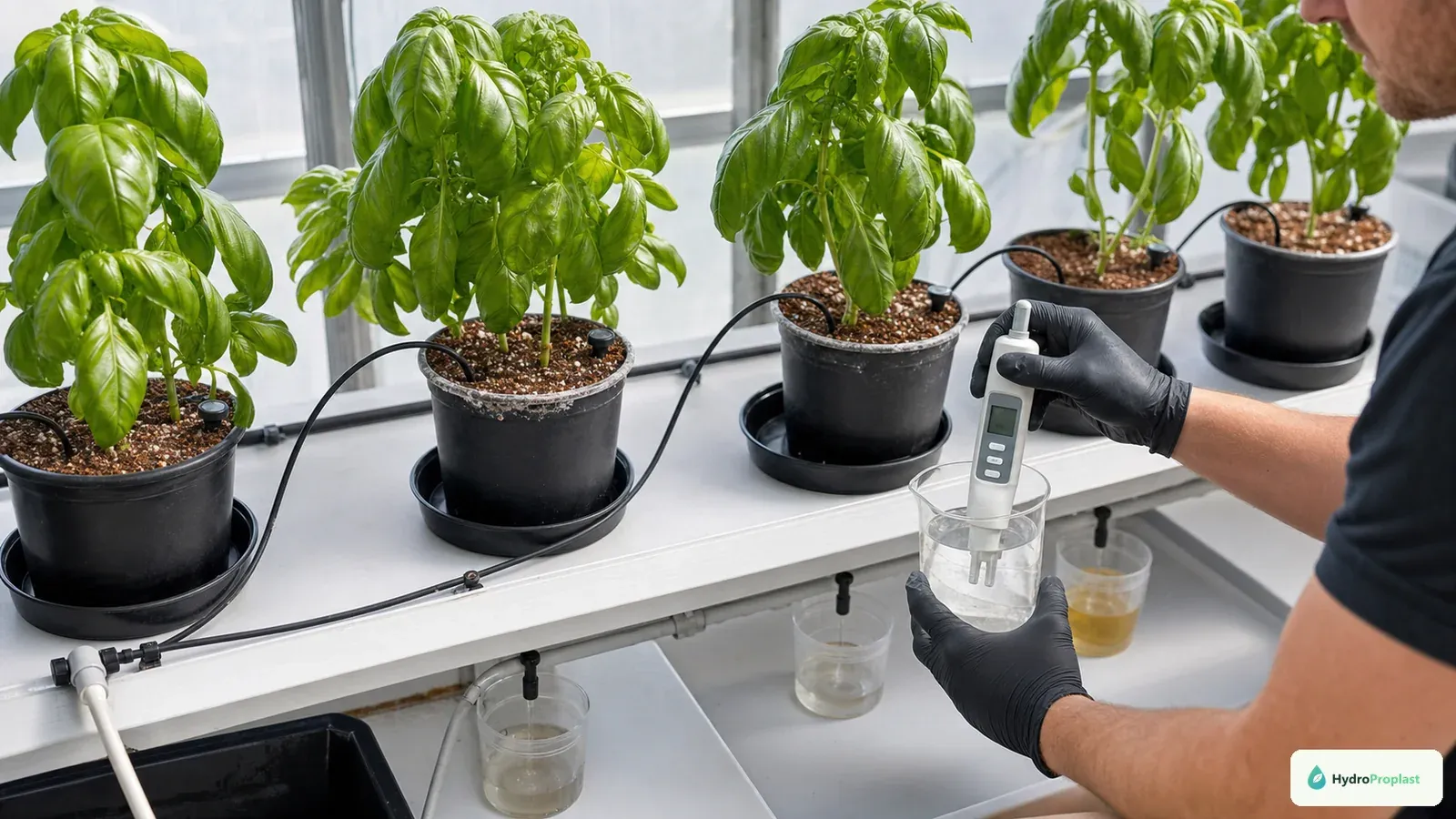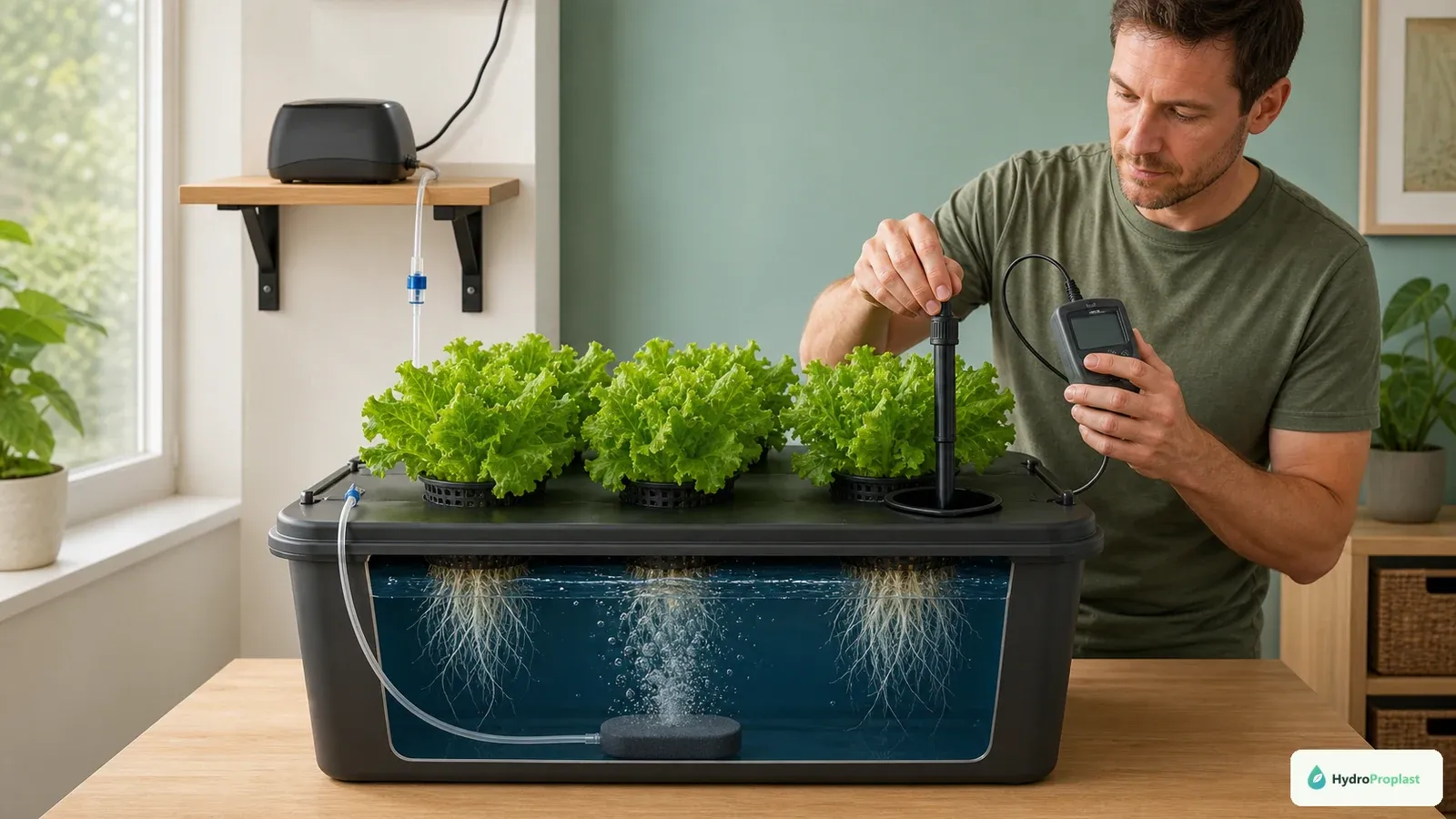
Electrical conductivity, or EC, is a practical indicator of the total dissolved ions in hydroponic water. It helps growers reproduce a nutrient mix and observe how a reservoir changes, but it does not identify individual elements or prove that a plant is well fed. A useful EC program combines a verified meter, a known source-water baseline, crop and product guidance, and trend records.
What EC actually measures
An EC meter applies an electrical signal between electrodes and estimates how readily the solution conducts current. Dissolved charged ions increase conductivity. Fertilizer salts contribute strongly, but source-water minerals, pH adjusters, and other dissolved products also affect the result.
EC is commonly displayed in millisiemens per centimeter. Some meters show microsiemens per centimeter; 1 mS/cm equals 1,000 µS/cm. “PPM” or TDS modes convert conductivity with a manufacturer-selected factor, so two meters can show different ppm values for the same water. Record EC directly when possible.
Why EC cannot diagnose one nutrient
The meter sees combined conductivity, not nitrogen, potassium, calcium, sodium, or chloride separately. A reservoir can have the expected EC but an unsuitable ion balance. It can also have high EC from source-water minerals before fertilizer is added.
Do not add an isolated supplement because a leaf chart names one element. Check roots, pH, mixing records, water analysis, and symptom location. The yellow-leaf diagnostic guide provides a broader process.
Choose and care for an EC meter
Select a meter with a range appropriate to hydroponic solutions, automatic or documented temperature compensation, replaceable or serviceable probes where practical, and calibration standards available for its expected range. Waterproofing, a stable reading, and clear unit display matter more than app features.
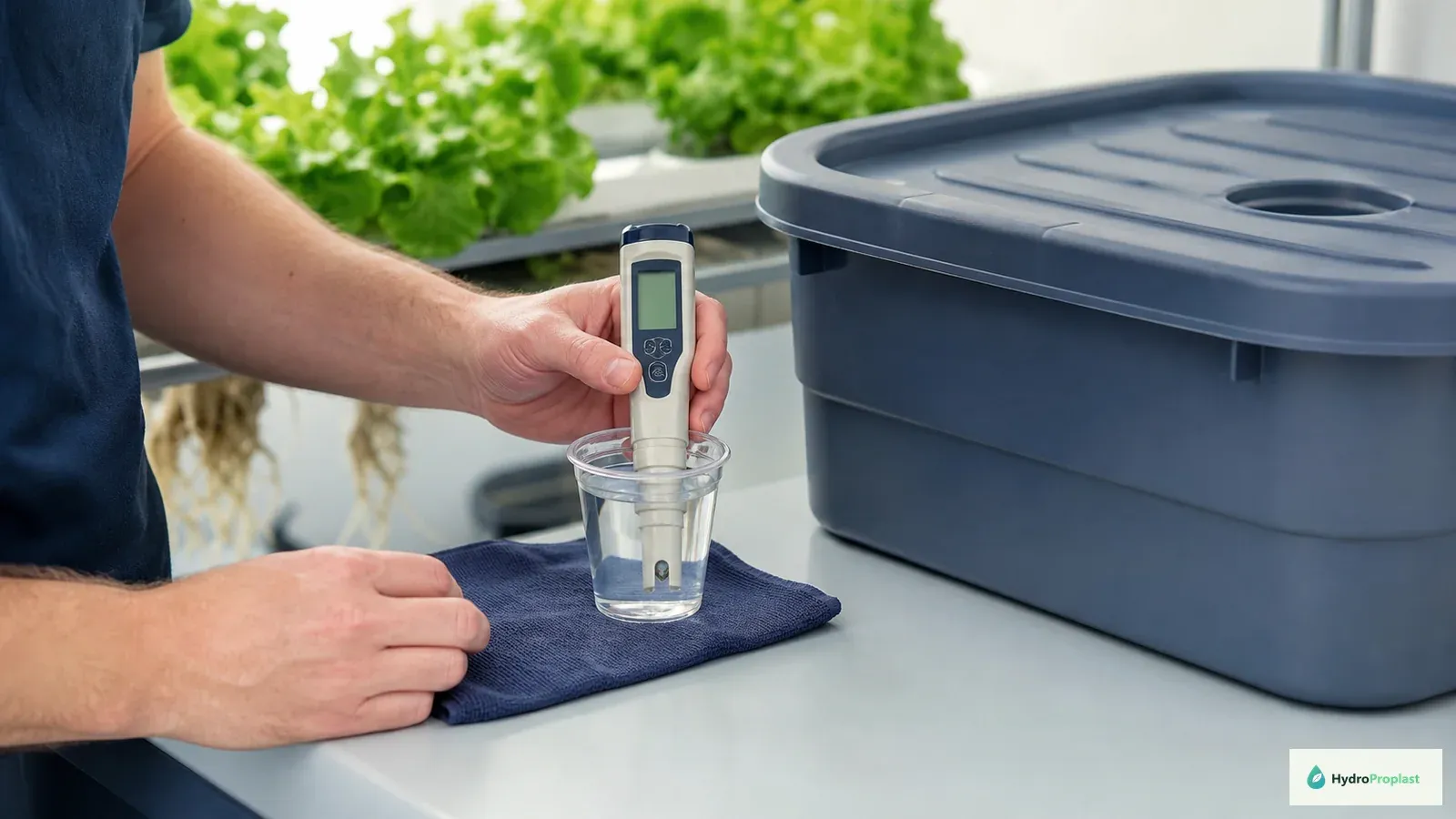
Follow the manual for rinsing, storage, and calibration. EC probes are often stored differently from pH probes. Never assume the two sensors share storage requirements.
The pH and EC meter guide explains instrument roles and limitations.
Calibrate and verify readings
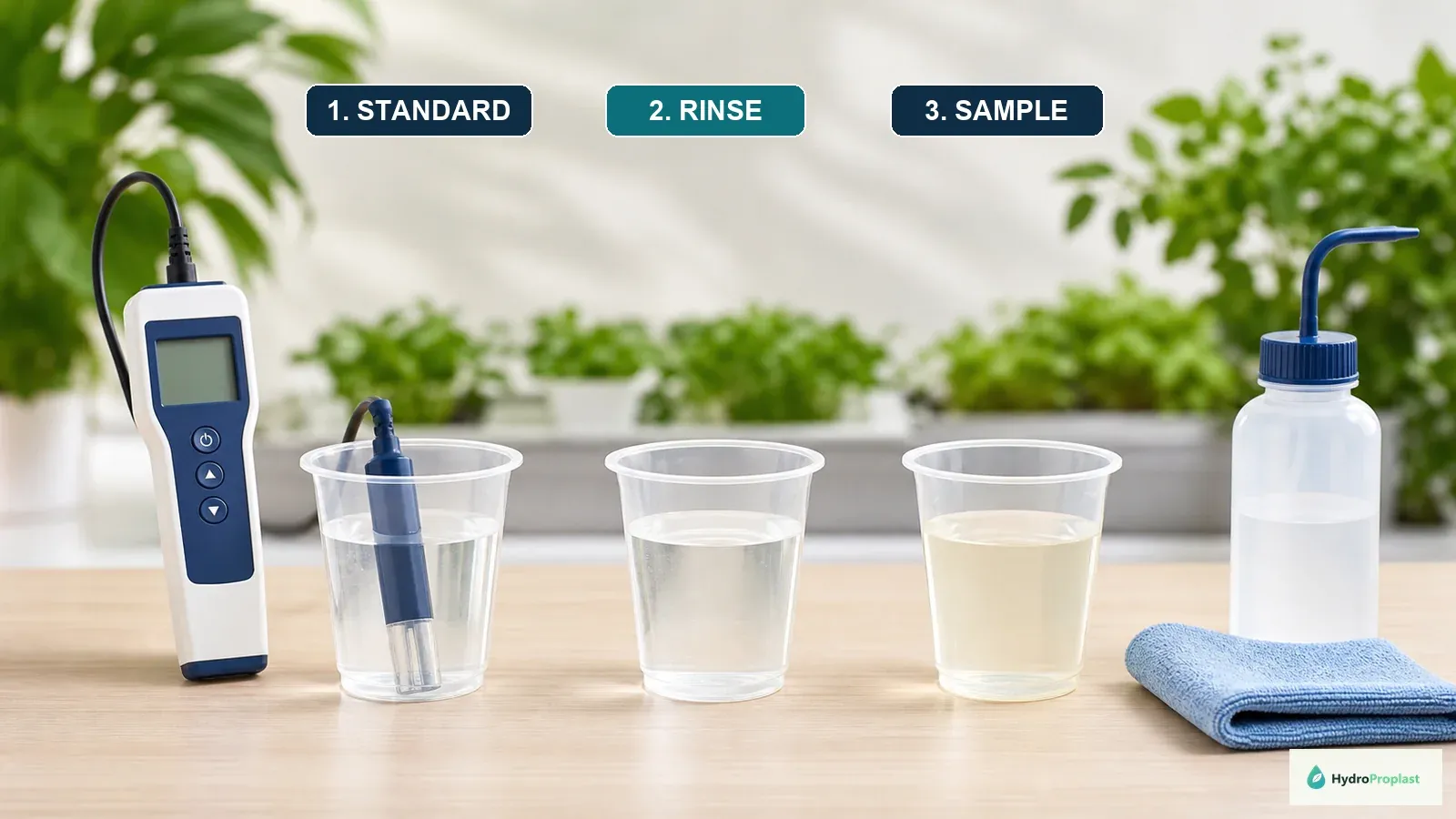
Use fresh, uncontaminated conductivity standard appropriate to the meter. Pour a small amount into a clean vessel rather than inserting a dirty probe into the stock bottle. Allow the probe and solution to reach the required temperature, remove trapped bubbles, and follow the manual.
After calibration, test a second standard or a retained check solution when higher confidence is needed. A reading that drifts, will not stabilize, or fails verification may indicate contamination, damage, low battery, or expired standard.
Oklahoma State University Extension’s EC and pH guide explains measurement and crop management context.
Establish three useful baselines
First measure source water before nutrients. Second measure the newly mixed solution after complete mixing. Third measure the operating reservoir at a consistent point and time. These numbers answer different questions.
Source-water EC reveals the background contribution. Fresh-mix EC confirms repeatable preparation. Reservoir EC shows the combined result of plant uptake, evaporation, top-ups, and additions. Label samples so they are not confused.
Mix a repeatable nutrient batch
Measure the true final water volume. Add separate concentrates to water individually in the order specified by the manufacturer; never mix stock concentrates together. Circulate or stir thoroughly before measuring.
Record product name, lot, dose of each part, source-water EC, final EC, pH, and temperature. If the fresh batch differs from prior batches, recheck volume, units, concentrate strength, water source, and meter calibration before adding corrective products.
Read EC and water level together
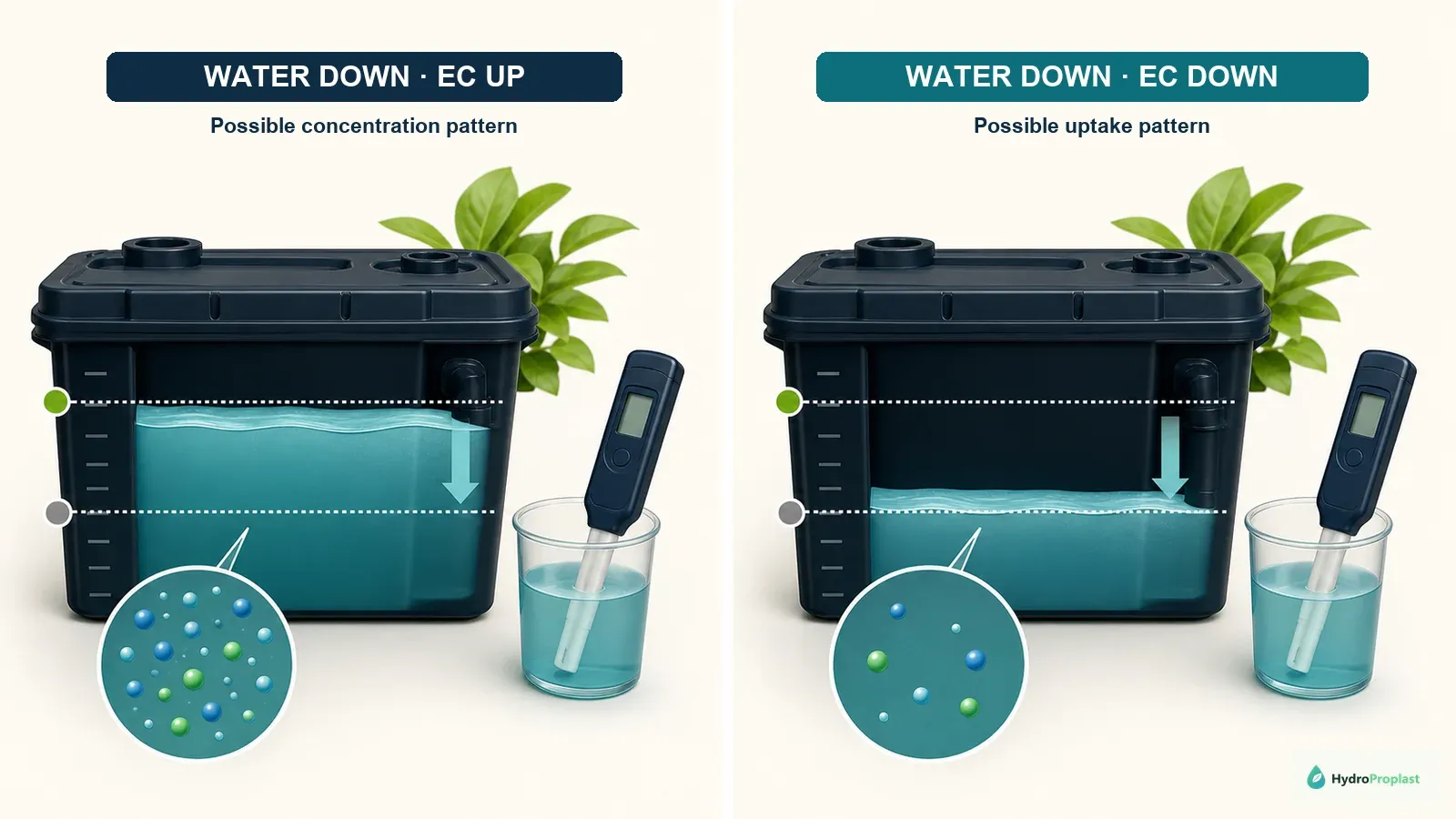
EC without reservoir level is easy to misinterpret. When level falls and EC rises, plants may be taking proportionally more water than ions, or evaporation may be concentrating the solution. When level falls and EC also falls, nutrient uptake may be strong relative to water use. Stable EC with falling level does not prove perfect balance.
Top-ups change the picture. Log plain-water and nutrient additions separately. Mark the reservoir at known volumes so concentration changes can be connected to actual water movement.
Use a trend table
A simple operating table is more useful than a single target:
| Observation | Possible interpretation | Verify before acting |
|---|---|---|
| Water down, EC up | concentration from water use or evaporation | temperature, leaks, top-up history, meter |
| Water down, EC down | ions used faster relative to water | crop stage, fresh-mix baseline, roots |
| Water stable, EC jumps | dosing, contamination, or measurement error | additions, mixing, calibration |
| EC unusually low after top-up | dilution or incorrect batch | volume, source water, dose |
| EC unstable by location | incomplete mixing or flow problem | circulation and sample point |
These are hypotheses, not automatic prescriptions.
Adjust high EC safely
First verify the reading and source-water contribution. Review the nutrient label and crop stage. If the solution is modestly overconcentrated and otherwise known and clean, adding measured suitable water may lower EC. Mix, wait, and remeasure.
Replace the solution when the recipe is unknown, the wrong concentrate was used, contamination is possible, precipitation is visible, or repeated corrections have obscured composition. The water-change guide explains how history affects the decision.
Avoid an abrupt extreme correction that creates a second osmotic, pH, or temperature shock.
Adjust low EC with evidence
Confirm that low EC is not caused by an unexpectedly low source baseline, meter unit error, leak, or recent plain-water top-up. If the verified solution is below the product’s crop-stage guidance, prepare a measured nutrient addition as directed, distribute it into circulating water, then remeasure after complete mixing.
Do not pour concentrate near roots. Do not “dose to a number” when the product recipe, crop, and reservoir volume are unknown.
Separate high EC from nutrient burn
Brown tips and margins can follow high concentration, but also heat, dry airflow, root damage, or irregular water delivery. Diagnose position, timing, roots, temperature, pH, and mixing records.
The nutrient-burn guide provides a controlled response. Existing necrotic tissue will not become healthy; judge recovery by new roots and leaves.
Account for crop stage and environment
Seedlings generally use a milder solution than mature fruiting plants, but exact suitable EC depends on crop, cultivar, product, source water, climate, and production system. Follow authoritative crop and nutrient guidance rather than a universal chart.
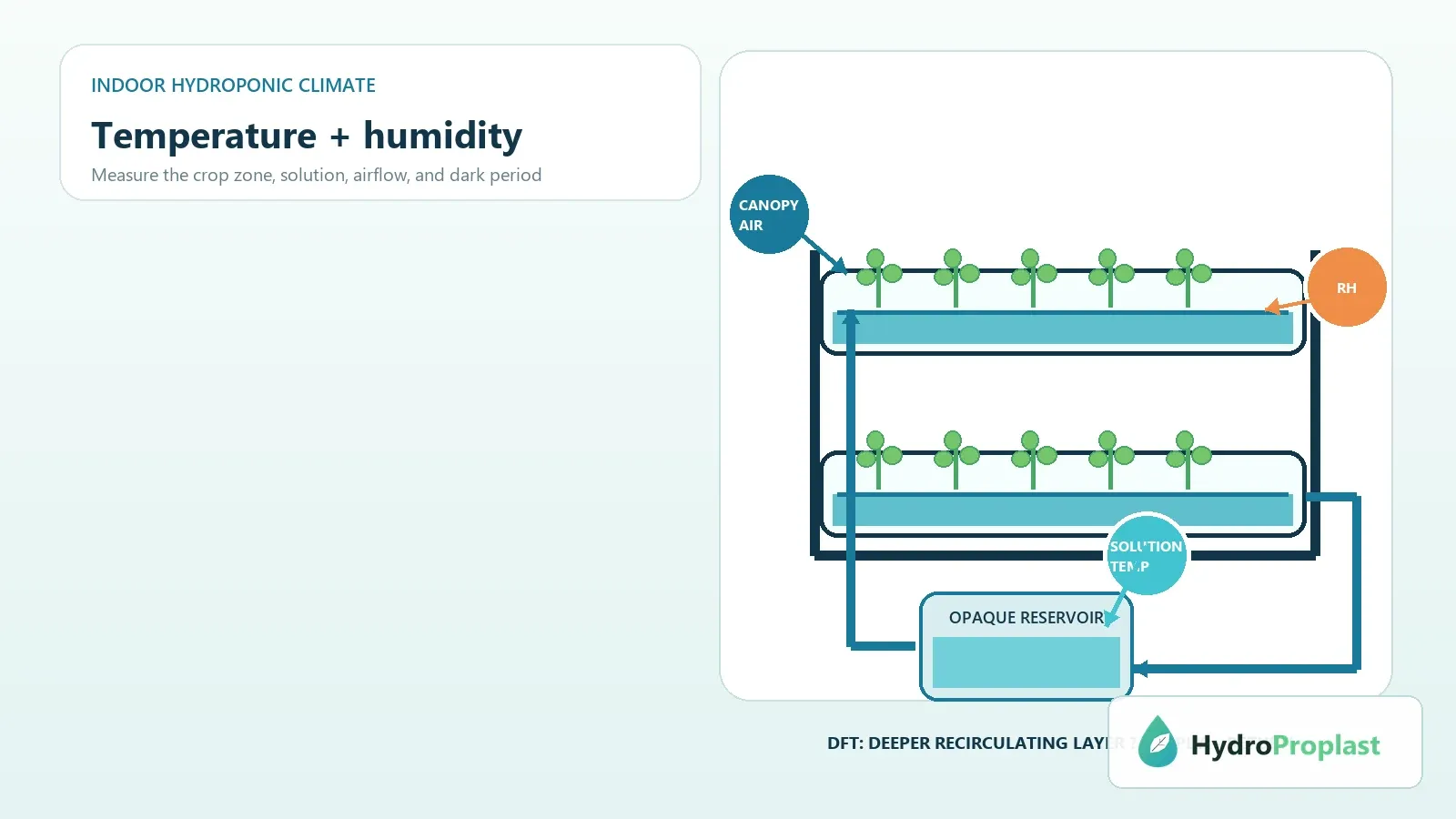
Hot, dry conditions can increase water use and raise reservoir EC. Low light can reduce nutrient demand. Root disease changes uptake. Interpret the meter within the environment.
Sampling technique matters
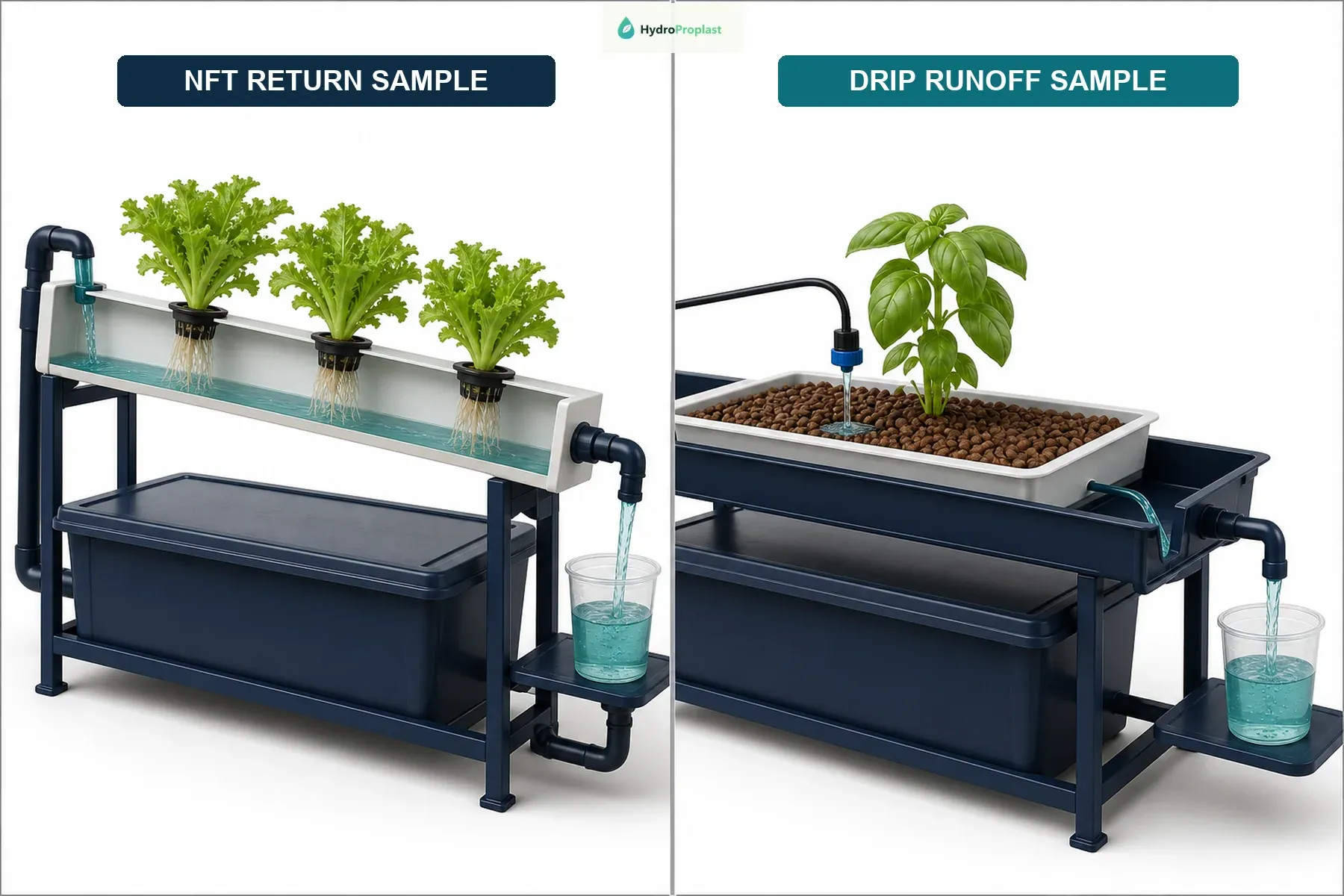
Sample from a well-mixed representative location, not a stagnant corner or immediately beside a dosing point. Use a clean cup, rinse the probe with sample, and avoid returning tested liquid to the reservoir.
Measure at a consistent time relative to top-ups and dosing. For large or uneven systems, compare reservoir, delivery, and return samples to identify mixing or flow differences.
Automatic EC control needs safeguards
A controller can repeat small additions, but a drifting probe, siphoning line, empty stock tank, or wrong volume can create a large error. Calibrate sensors, verify dosing-pump output, set reasonable daily limits, separate injection points, and require adequate mixing delay.
Manually confirm readings after maintenance, power loss, firmware changes, or stock replacement. Automation does not identify individual nutrient imbalance.
Troubleshooting checklist
When EC seems wrong, confirm units, calibration, temperature behavior, probe cleanliness, source water, final volume, product and dose, mixing time, sample location, reservoir level, top-ups, and crop stage. Inspect roots and delivery before assuming uptake.
When the same mismatch returns across batches, obtain a source-water analysis and contact the nutrient manufacturer or local extension service. Keep labels and records available.
A practical logging routine
For a small reservoir, log date and time, level, source or top-up volume, EC, pH, temperature, crop stage, and action. Note the light-cycle position and major weather or room changes. Graphing EC beside water level often reveals patterns that numbers in separate notebooks hide.
The University of Minnesota Extension’s small-scale hydroponics guide provides monitoring context. EC becomes useful when it answers a defined question: Was the batch mixed consistently? Is the reservoir concentrating? Did the correction work? It is a trend instrument, not a complete nutrient diagnosis.
A seven-day interpretation exercise
Begin with a freshly mixed reservoir and a verified meter. Mark the water level and record the source-water and fresh-mix EC. For the next week, measure at the same point and similar time before making routine additions. Record water level, solution temperature, pH, crop condition, and the exact volume of every top-up.
Do not withhold water from plants for the sake of the exercise. When a top-up is required, document the readings immediately before and after complete mixing. The objective is to connect EC direction with water movement, not to force a dramatic trend.
At the end of the week, classify each interval. Did EC rise while water fell? Did both fall? Did a hot day change the slope? Did a nutrient addition produce the calculated response? Investigate inconsistent points for missed additions, sample-location changes, or meter instability.
This small dataset supports a crop-specific operating range more responsibly than copying an isolated number. It also reveals whether the reservoir is too small to remain stable between inspections.
Comparing fresh mix with return water
In recirculating drip or NFT systems, occasional comparison of delivery and return samples can reveal uneven mixing, evaporation, root-zone accumulation, or a blocked branch. Collect samples in clean labeled cups after normal circulation. Measure promptly and avoid cross-contamination.
A difference does not identify its cause. Consider flow rate, media retention, sampling time, temperature, and plant load. Large persistent differences deserve inspection of emitters, drains, and root zones rather than immediate controller adjustment.
Source-water scenarios
Low-EC water leaves more of the measured conductivity attributable to the fertilizer recipe, but it may have limited alkalinity and less pH buffering. Higher-EC tap water may contribute useful calcium or magnesium, or undesirable sodium, chloride, and alkalinity. EC alone cannot tell which.
When source-water EC is substantial or seasonal, obtain a laboratory or utility report. Compare sodium, chloride, alkalinity, hardness, and other relevant constituents with crop and nutrient-provider guidance. Keep internal recommendations connected only to established live pages until any new water-comparison page is published.
Calculation and unit check
If a meter shows 1,500 µS/cm, that is 1.5 mS/cm. A displayed 750 ppm cannot be converted back reliably without knowing whether the instrument uses a 0.5, 0.7, or another factor. Record the configured scale beside ppm values or switch the display to EC.
Temperature compensation helps normalize conductivity to a reference temperature, but it does not correct a dirty probe or an unrepresentative sample. Let the sensor stabilize and follow the specified range.
When to replace the meter
Replace or service an instrument that repeatedly fails calibration, gives unstable readings in a stable standard, has damaged electrodes, or cannot be cleaned according to its manual. Cross-check against another verified meter before discarding it.
Keep calibration date, standard lot and expiry, observed value, and corrective action in the log. A measurement program is trustworthy only when instrument performance is documented alongside plant data.
Final decision rule
Never respond to EC alone. Confirm the meter, read water level and temperature, review additions, inspect roots and delivery, then compare with crop-stage guidance. Make one measured correction and verify its effect. That sequence prevents a useful conductivity reading from becoming an excuse for uncontrolled dosing.
Retain the same sampling vessel, timing, unit, and calibration procedure across each crop cycle so changes remain comparable and auditable.