Hydroponic nutrients are mineral salts dissolved into water. Plants need those ions, but more is not always better. When water evaporates, crops remove ions at unequal rates, source water contributes unwanted minerals, or media is not drained and leached correctly, the root zone can become more concentrated or imbalanced than the reservoir recipe suggests.
Salt buildup is therefore not just a white crust. It is a nutrient-management problem that can reduce water uptake, damage roots, and imitate deficiency. This guide explains where salts accumulate, what EC can reveal, how prevention differs between recirculating and drain-to-waste systems, and when to rinse media or replace solution.
What “salt” means in hydroponics
In this context, salt does not mean only sodium chloride. Fertilizers dissociate into positively and negatively charged ions when dissolved. Those ions include essential nutrients such as potassium, calcium, nitrate, and phosphate, as well as potentially unwanted sodium and chloride from source water.
Electrical conductivity, or EC, estimates the total ionic concentration. Oklahoma State University Extension explains that higher EC generally means a higher total salt concentration. EC cannot identify individual ions or prove that nutrient ratios are correct.
That limitation matters. A reservoir can show a familiar EC while one nutrient has been depleted and another ion has accumulated. Conversely, a high EC may include useful nutrients, unwanted source-water salts, or both.
Why excessive salts injure roots
High dissolved-salt concentration makes it harder for roots to take up water. Plants may wilt even though the root zone looks wet. Excessive nutrients can also cause ion toxicity and imbalance, while damaged roots become less effective at nutrient and water uptake.
Penn State Extension lists over-fertilization, poor water quality, accumulation in aggregate media, and inadequate leaching as causes of soluble-salt damage. Visible symptoms can include wilting, very dark foliage, burnt tips and margins, and root death.
These signs are not exclusive to salt buildup. Heat, low dissolved oxygen, disease, pH problems, strong light, and genuine nutrient shortages can look similar. Treat plant appearance as a reason to measure, not as a diagnosis.
Where salt buildup occurs
In the reservoir
Water leaves through transpiration and evaporation, but dissolved ions do not evaporate with it. Repeated additions of full-strength nutrient solution can therefore push EC upward when plants are using proportionally more water than nutrients.
The opposite can also occur: a crop may remove ions quickly and EC may fall. Stable EC still does not guarantee a balanced solution because plants take up elements at different rates. University of Arkansas research notes that replenishing recirculating reservoirs to a constant EC can still lead to ion accumulation and nutrient imbalance.
In growing media
Drip-fed coir, perlite, rockwool, and other media can accumulate salts where water evaporates or where irrigation fails to move enough solution through the root zone. Pots with uneven emitters, poor drainage, or long dry-back periods are especially vulnerable.
The reservoir EC may look normal while root-zone or runoff EC is high. This is why media-based systems need representative feed and leachate measurements rather than a reservoir reading alone.
On equipment surfaces
White mineral deposits may form around fill lines, emitters, net pots, lids, channel edges, and splash zones. These deposits can indicate evaporation or hard water, but their appearance alone does not reveal what is happening around living roots.
Clean deposits can obstruct emitters and create uneven delivery. Record where they recur; a crust at one dripper can be a plumbing clue, while deposits around every opening may point to source-water minerals or heavy evaporation.
Separate source-water EC from nutrient EC
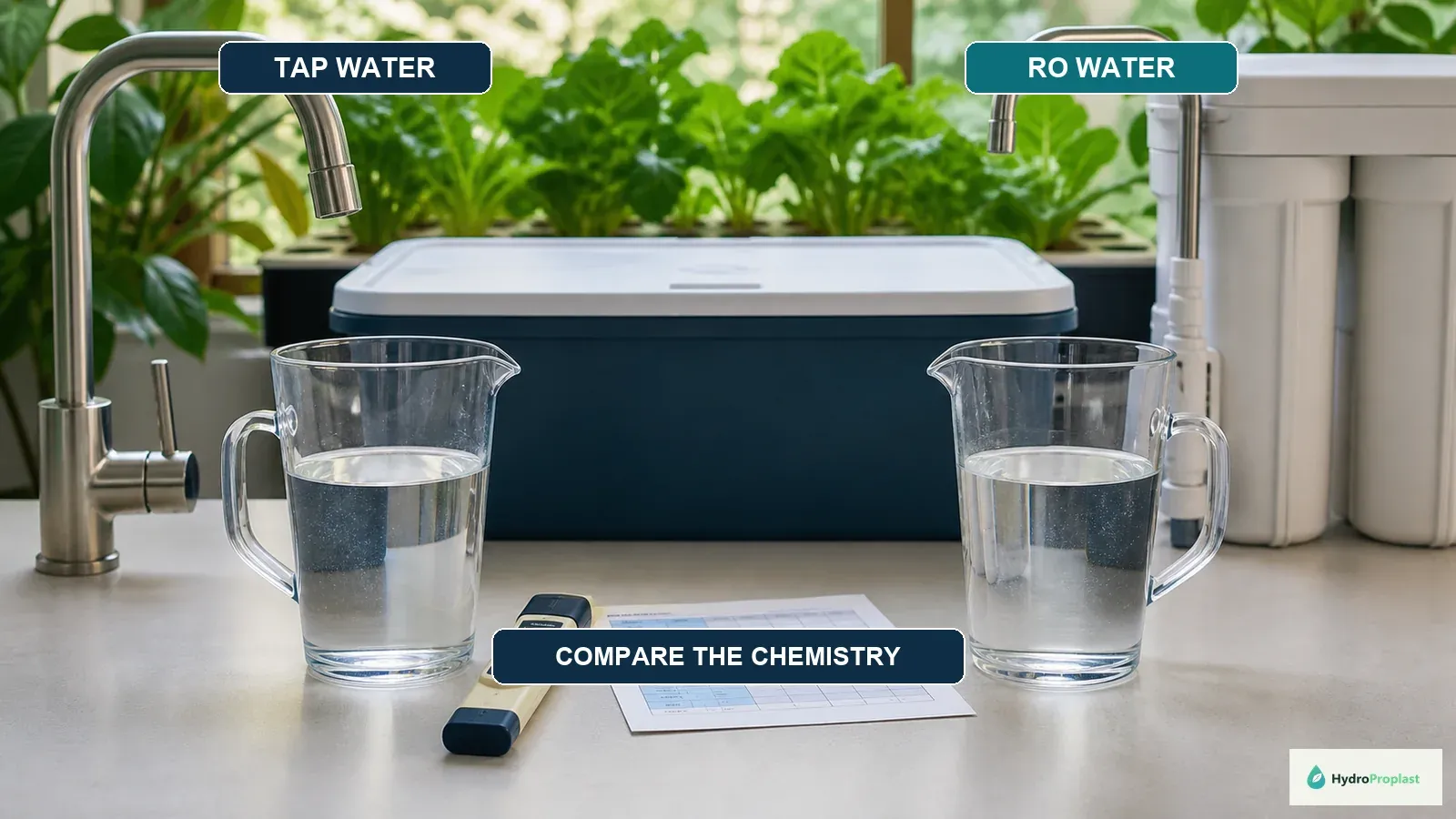
Measure source water before adding fertilizer. Its EC is the starting ionic load, not an amount of plant nutrition. Hardness and alkalinity are also different measurements: EC estimates total conductivity, while alkalinity describes the water’s acid-neutralizing capacity.
Source water may contain calcium and magnesium, but it may also contain sodium, chloride, bicarbonate, or other ions that do not match the crop recipe. Repeated top-ups can concentrate ions the crop absorbs slowly.
If source water quality changes seasonally, after plumbing work, or after installing a filter, retest it. For recurring problems or valuable crops, use a laboratory water analysis rather than trying to infer composition from EC. The tap-water versus RO-water guide explains source-water trade-offs.
Measure a trend, not one isolated number
Use a calibrated EC meter and record readings at a consistent time and sampling point. A useful log includes source-water EC, fresh-solution EC, reservoir EC before top-up, water volume added, EC after mixing, and—where applicable—feed and leachate EC.
Interpret changes with water level:
| Water level and EC trend | One possible interpretation | What to check next |
|---|---|---|
| Water falls, EC rises | More water than ions left the reservoir | Heat, evaporation, crop demand, top-up history |
| Water falls, EC falls | Nutrient uptake may be strong relative to water loss | Crop stage, recipe, leaks, meter accuracy |
| Water falls, EC stable | Water and total ions changed proportionally | Ratios may still be drifting; review solution age |
| EC differs between feed and leachate | The media may be accumulating or releasing salts | Emitter uniformity, irrigation volume, drainage, dry-back |
The hydroponic EC guide provides a fuller framework. Always use crop-, stage-, system-, and climate-appropriate targets rather than a universal EC number.
Compare feed and runoff in drip systems
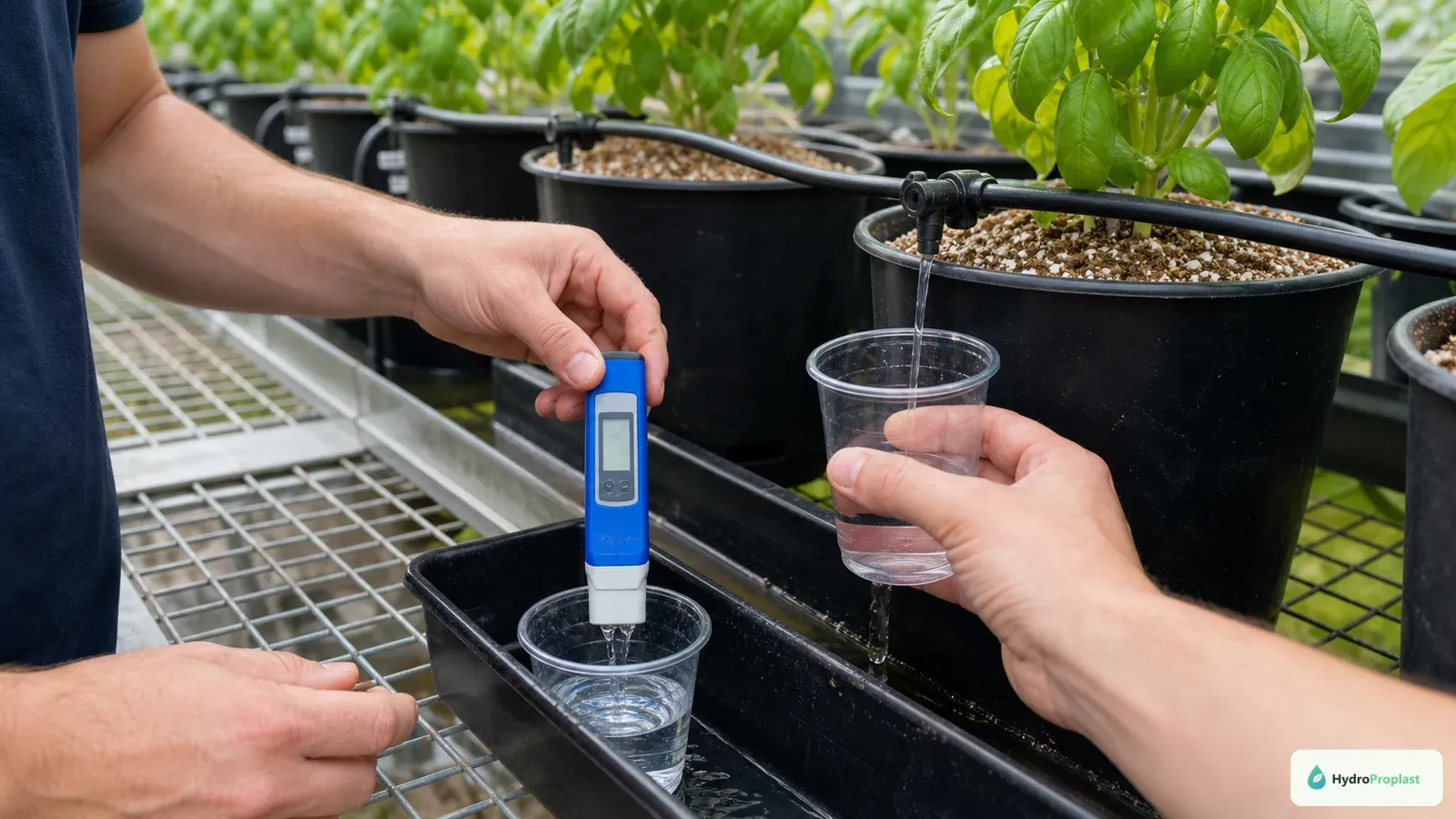
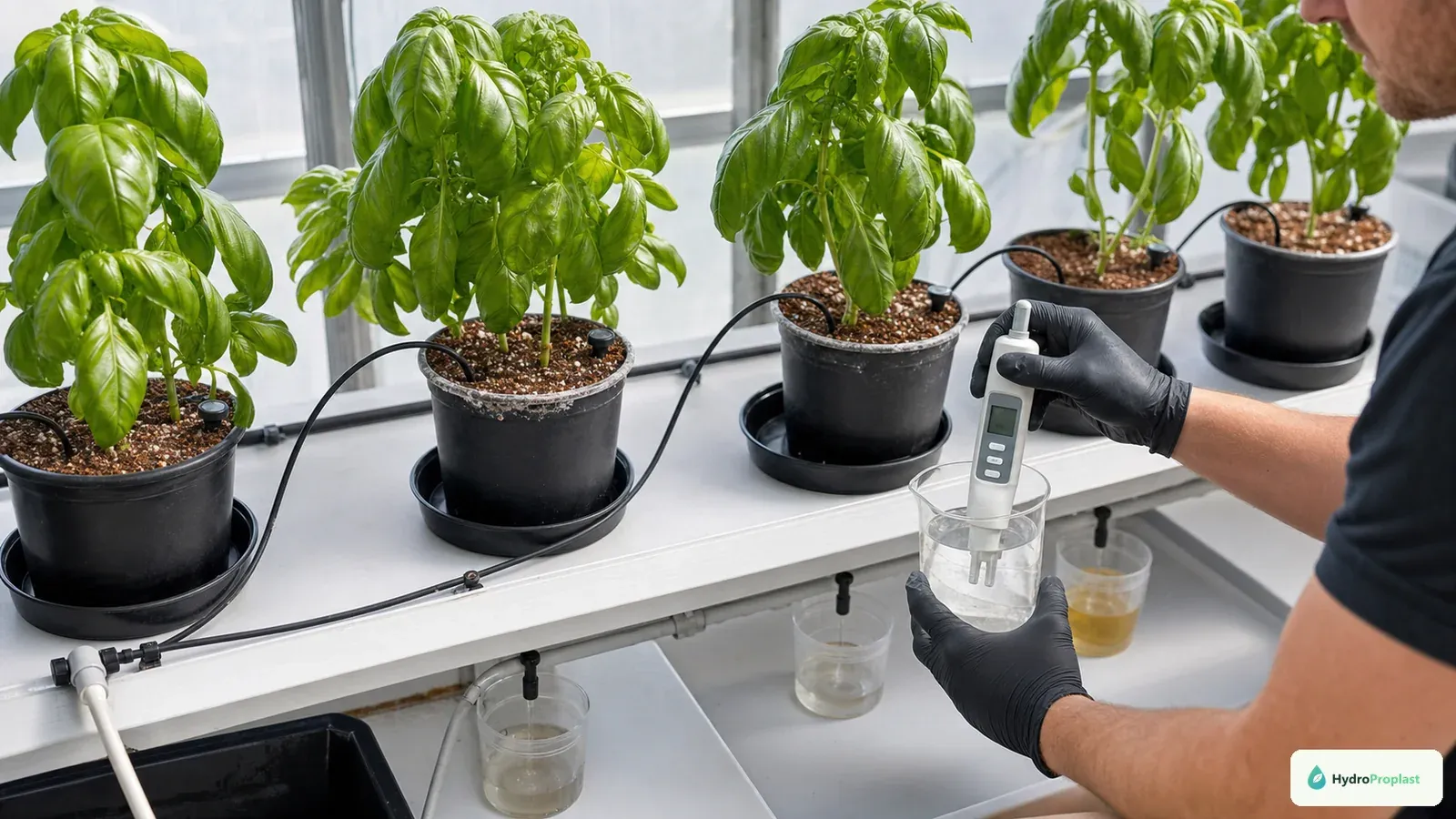
Collect feed and leachate separately from representative pots; a high runoff EC can reveal root-zone concentration that the reservoir reading misses.
For a media-based drip system, collect representative samples from the solution delivered to plants and from the leachate leaving several pots. Use clean containers and the same sampling method each time. Do not rely on the easiest pot alone; include locations at the beginning and end of lines and plants of different sizes.
University of Florida IFAS guidance for greenhouse hydroponic vegetables recommends monitoring both incoming solution and leachate to detect increasing concentrations in media. Its specific ranges and leaching percentages are production- and climate-dependent, so home growers should use them as a management principle rather than a universal recipe.
If runoff EC is consistently much higher than feed EC, first verify the meter, sampling timing, irrigation uniformity, media moisture, and drainage. Correcting one blocked emitter may be more effective than flushing the entire crop.
Prevent buildup in recirculating systems
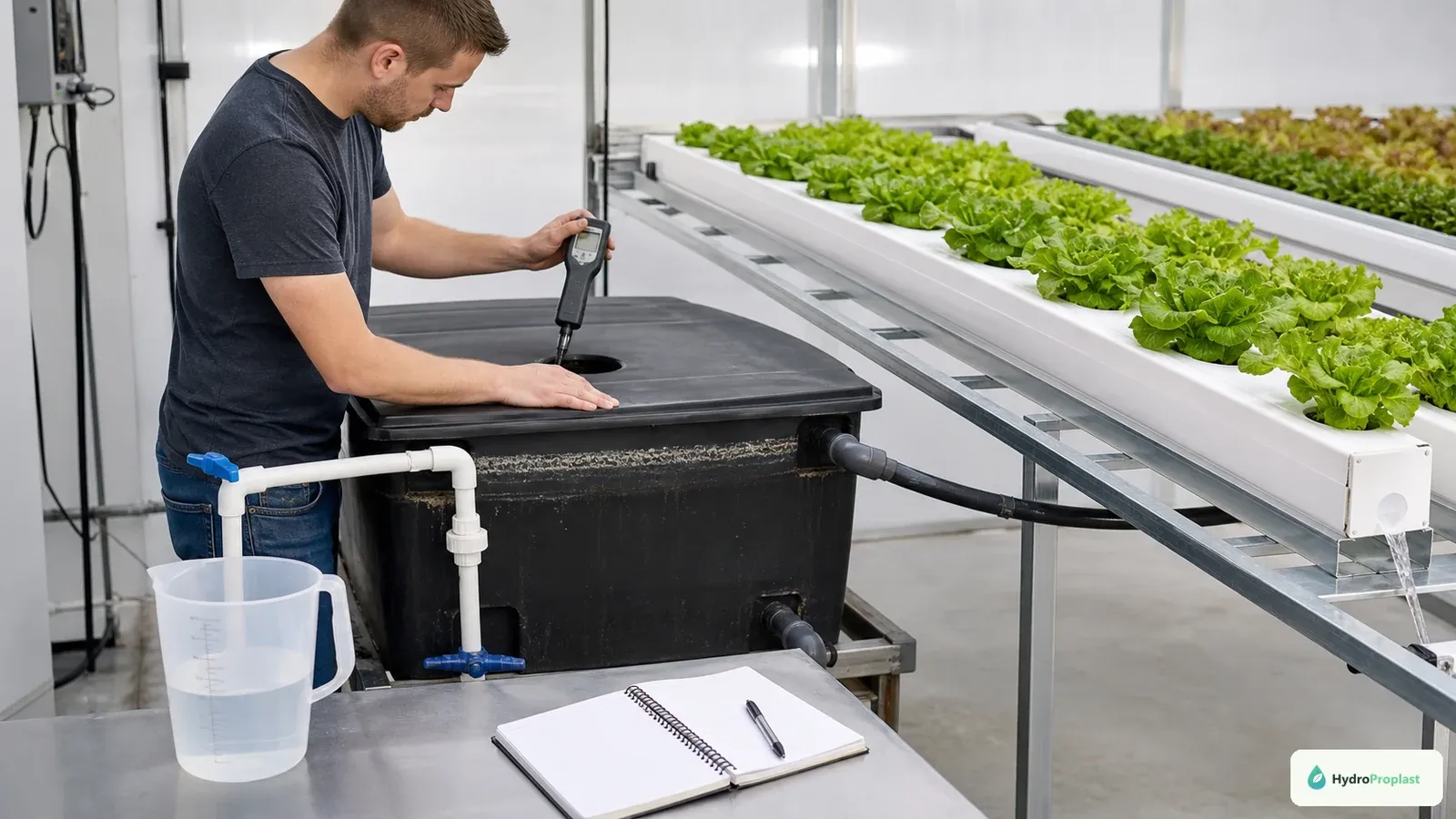
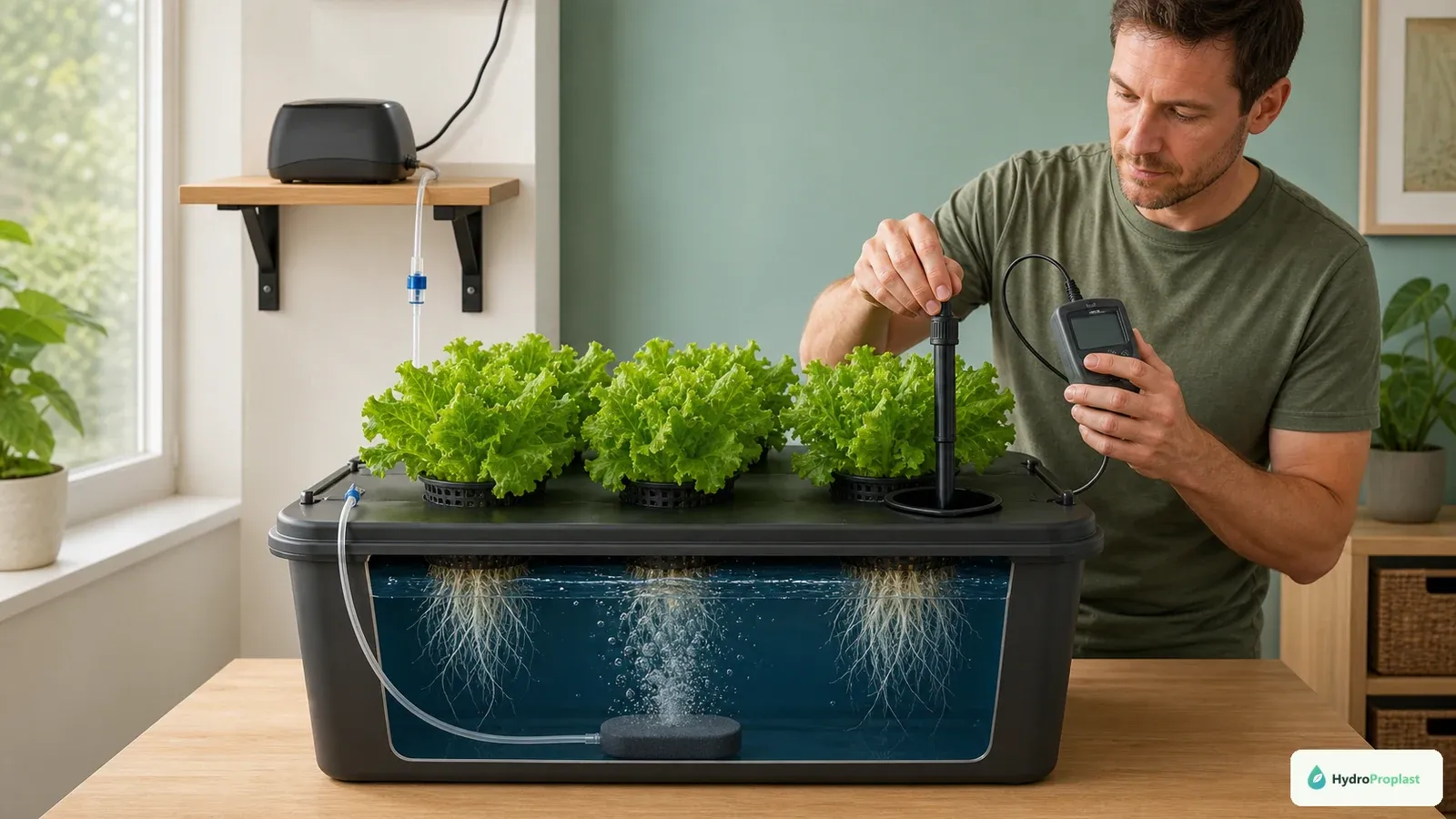
A familiar reservoir EC does not prove that individual nutrient ratios remain balanced after repeated recirculation and top-ups.
NFT, DWC, recirculating drip, and ebb-and-flow systems reuse solution. Because crops do not remove every ion at the same rate, indefinite correction to one EC value can hide changing composition.
Use these controls:
- start with measured source water and a complete crop-appropriate nutrient
- measure actual working reservoir volume rather than nominal container size
- top up according to water level, EC trend, crop stage, and source-water quality
- keep the reservoir covered to reduce evaporation and light
- maintain even circulation, aeration, and return flow
- replace part or all of the solution when history is unclear or repeated corrections no longer behave predictably
- clean deposits and inspect pumps, filters, emitters, and channels between crops
Oklahoma State University Extension advises periodic complete replacement because nutrient ratios can move outside their desired limits over time. The right interval depends on crop, volume, water quality, system losses, and monitoring history; the water-change guide explains how to decide.
Prevent buildup in media-based systems
Drip irrigation must supply enough solution to wet the root zone evenly and provide an appropriate drainage path. If media repeatedly dries hard and receives small concentrated doses, salts can accumulate near roots and at evaporation zones.
Check emitter output with measured catch containers. Replace or clean blocked emitters. Confirm that containers drain freely and are not sitting in stagnant runoff. Adjust irrigation frequency to the crop, container, media water-holding capacity, and environment.
Some production programs intentionally apply a controlled leaching fraction. University of Florida IFAS notes that a small amount of leaching can prevent damaging salt concentration in media, but excessive leachate wastes nutrient solution and can create an environmental disposal problem. Do not copy a percentage without considering crop, climate, media, water quality, and whether runoff is recaptured.
Rinse only when evidence supports it
A corrective rinse can move excess soluble salts out of media, but it also removes nutrients and creates wastewater. It does not repair root disease, a blocked drain, or poor source water.
Before rinsing:
- calibrate the meter and repeat feed/runoff samples
- verify the fertilizer dose and actual water volume
- check every emitter and drain
- inspect roots for disease and oxygen stress
- confirm that runoff can be captured or disposed of responsibly
- choose low-EC water appropriate for the crop and media
Apply water evenly and allow complete drainage. Avoid flooding the crown or leaving roots saturated. After the rinse, restore a correctly mixed crop-appropriate solution instead of guessing with a concentrated supplement. Monitor EC and new growth over the following days.
Replace a concentrated reservoir safely
When reservoir history is unknown, unwanted ions may have accumulated, or EC repeatedly rebounds after top-up, a fresh solution is often easier to interpret than another correction.
Prepare the replacement in a clean container using measured water volume. Add multi-part nutrients separately according to the label and mix thoroughly between components. Match temperature reasonably to the root zone. Verify EC first and pH after the solution is fully mixed.
Do not discharge nutrient solution into storm drains, streams, ponds, or septic systems. Follow local rules. Reuse on suitable soil-grown ornamental plants only when the formulation, crop safety, soil condition, and local guidance make that appropriate.
Clean deposits without contaminating the crop
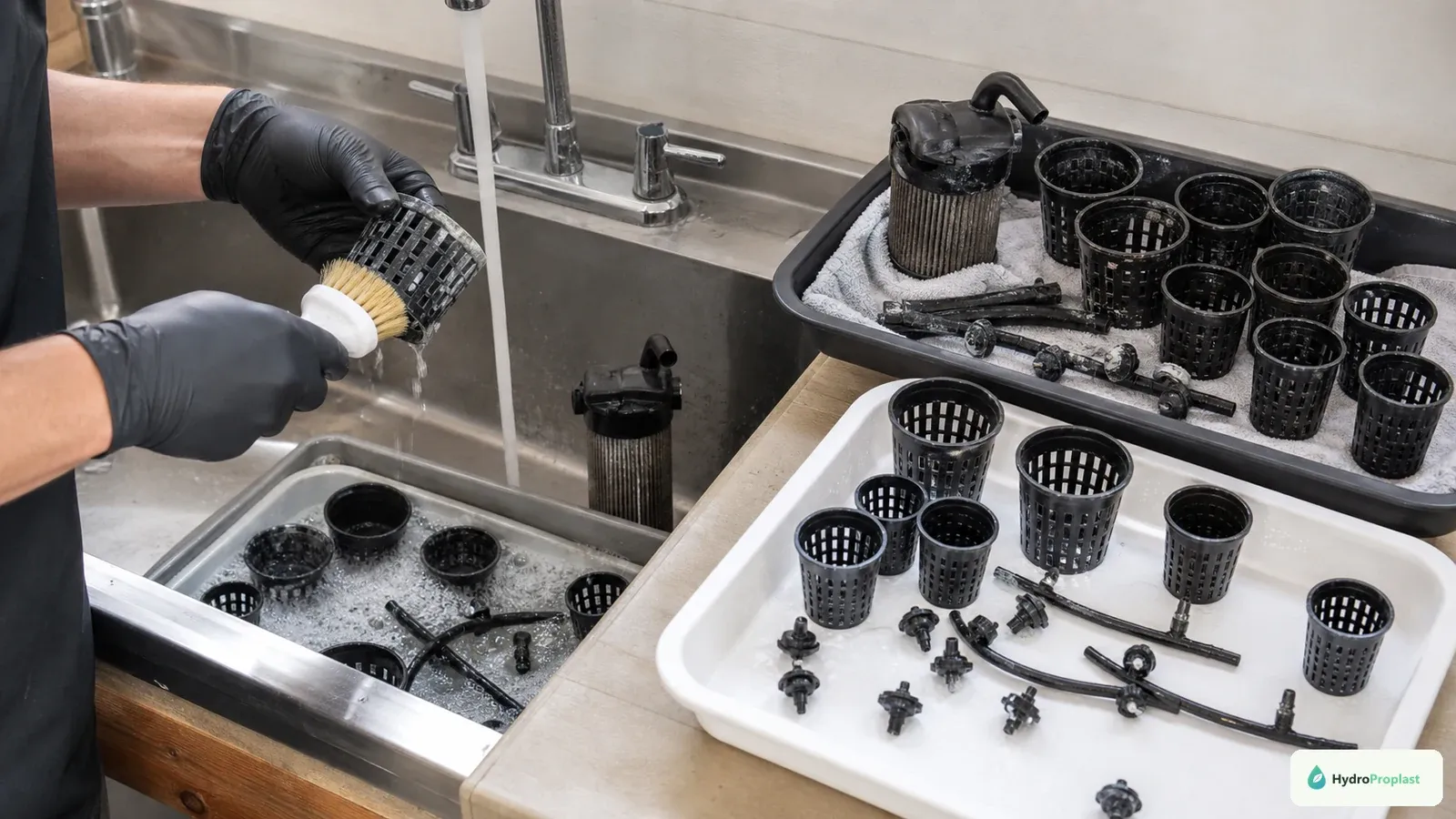
Remove and clean deposits away from living plants and the active reservoir, keeping dirty and rinsed parts separate.
Remove parts from the active system when possible. Brush or rinse mineral deposits away from plants and open reservoirs. Use only cleaning products compatible with the equipment and follow label instructions for concentration, contact time, protective equipment, and rinsing.
Never mix acids with chlorine bleach or other cleaners. Do not scrape deposits into a working reservoir. Replace cracked tubing, damaged seals, and emitters that cannot be restored to uniform output.
After reassembly, run clean water through the plumbing when appropriate, check for leaks, then mix fresh nutrient solution. Keep electrical connections dry throughout the process.
Do not chase symptoms with extra fertilizer
Burnt leaf margins and stalled growth can resemble deficiency. Adding a supplement raises the ionic load and may worsen osmotic stress. Follow the diagnostic sequence in the nutrient-deficiency guide: inspect symptom distribution, roots, delivery, pH, EC, temperature, recipe, and source water before changing nutrient strength.
Judge recovery from new growth. Existing scorched tissue will not become healthy again. Stable EC behavior, firm new roots, normal water uptake, and healthy new leaves are more useful than the color of an already damaged leaf.
Common questions
Is white crust proof of nutrient burn?
No. It shows that minerals have been deposited as water evaporated, but it does not identify their composition or prove the root-zone concentration. Measure source water, feed, reservoir, and leachate as appropriate.
Can I fix high EC by adding water?
Adding appropriate water can reduce total concentration, but it does not restore nutrient ratios or remove unwanted ions. If solution history is unclear or salts have accumulated in media, dilution alone may be incomplete.
Does a normal reservoir EC mean the root zone is safe?
Not always. Media, individual pots, emitters, and channel zones can differ from the reservoir. Compare representative locations and inspect delivery and drainage.
Should I flush on a fixed weekly schedule?
Use crop and system guidance, feed/runoff trends, water quality, and environmental requirements. Unnecessary flushing wastes water and nutrients; waiting for severe injury is also poor management. A documented trigger is better than an arbitrary ritual.
Sources and further reading
- Hydroponics Systems and Principles of Plant Nutrition — Penn State Extension
- Water and Nutrient Management for Greenhouse Hydroponic Vegetables — University of Florida IFAS Extension
- Electrical Conductivity and pH Guide for Hydroponics — Oklahoma State University Extension
- Nutrient Uptake and Management in Recirculating Hydroponics — University of Arkansas
Salt buildup is prevented by keeping a complete record of what enters, what leaves, and what the root zone experiences. Measure source water, EC trends, feed and runoff where relevant, actual reservoir volume, and delivery uniformity. Then rinse, dilute, replace, or repair only when the evidence supports that action.