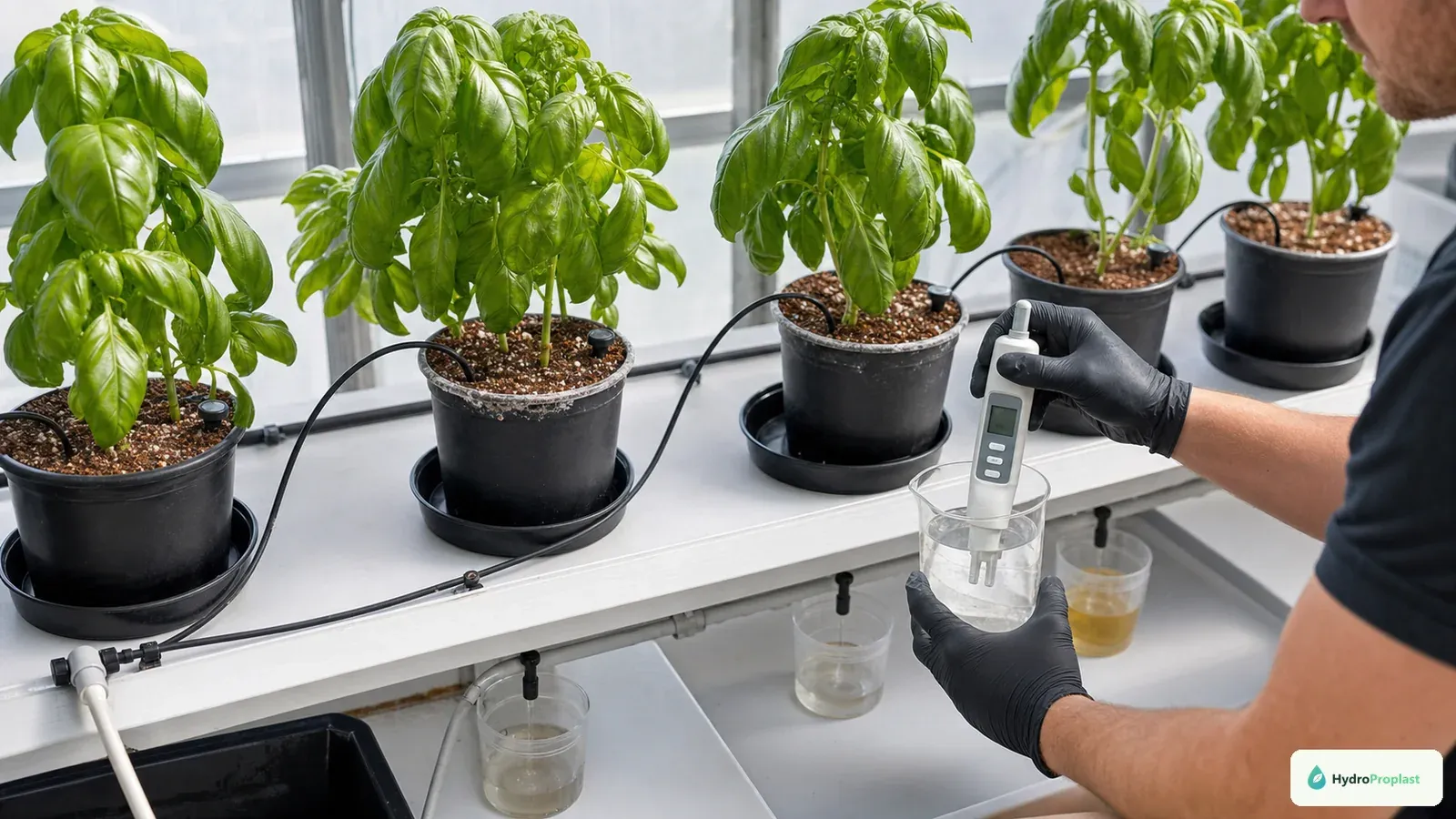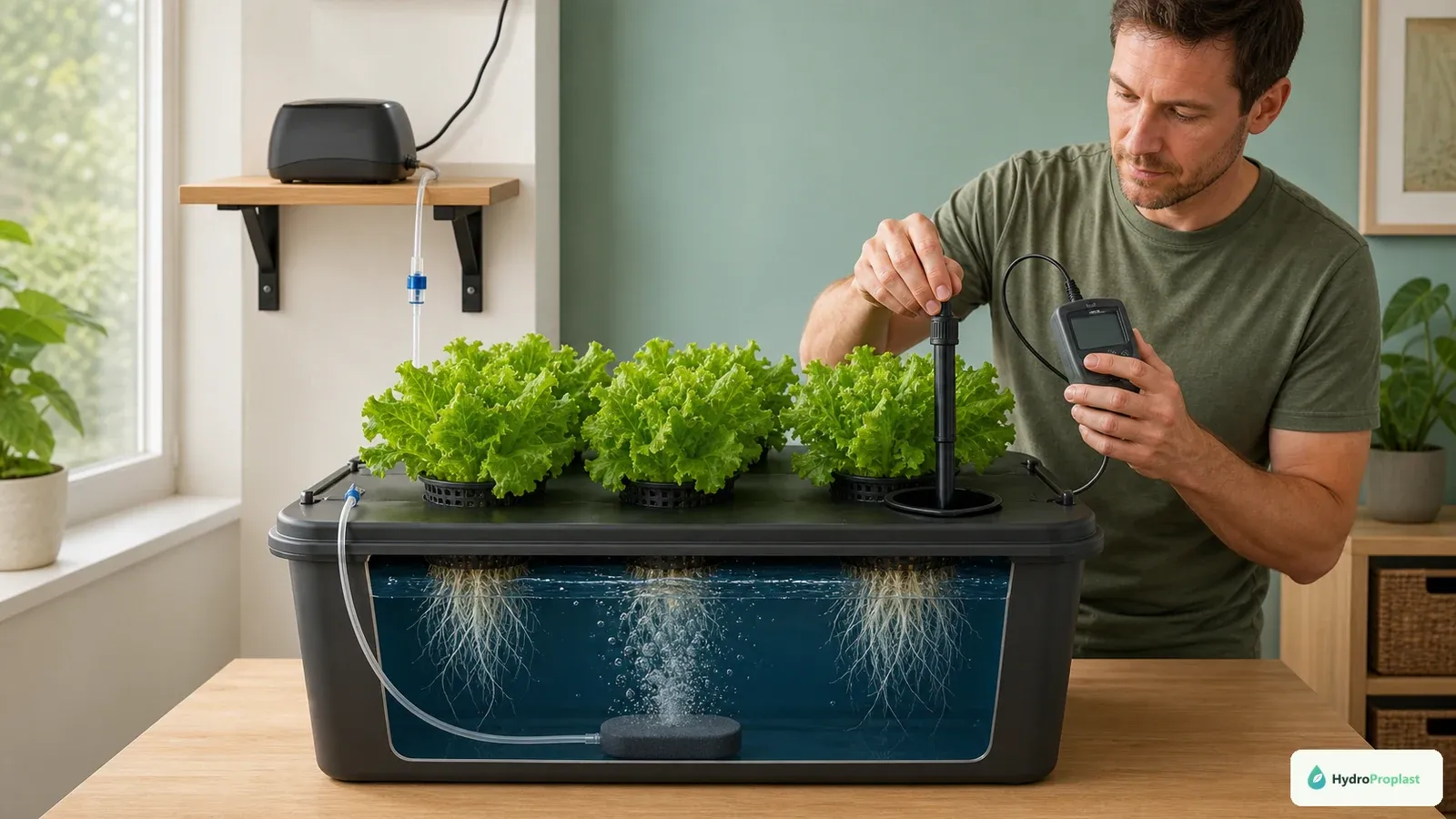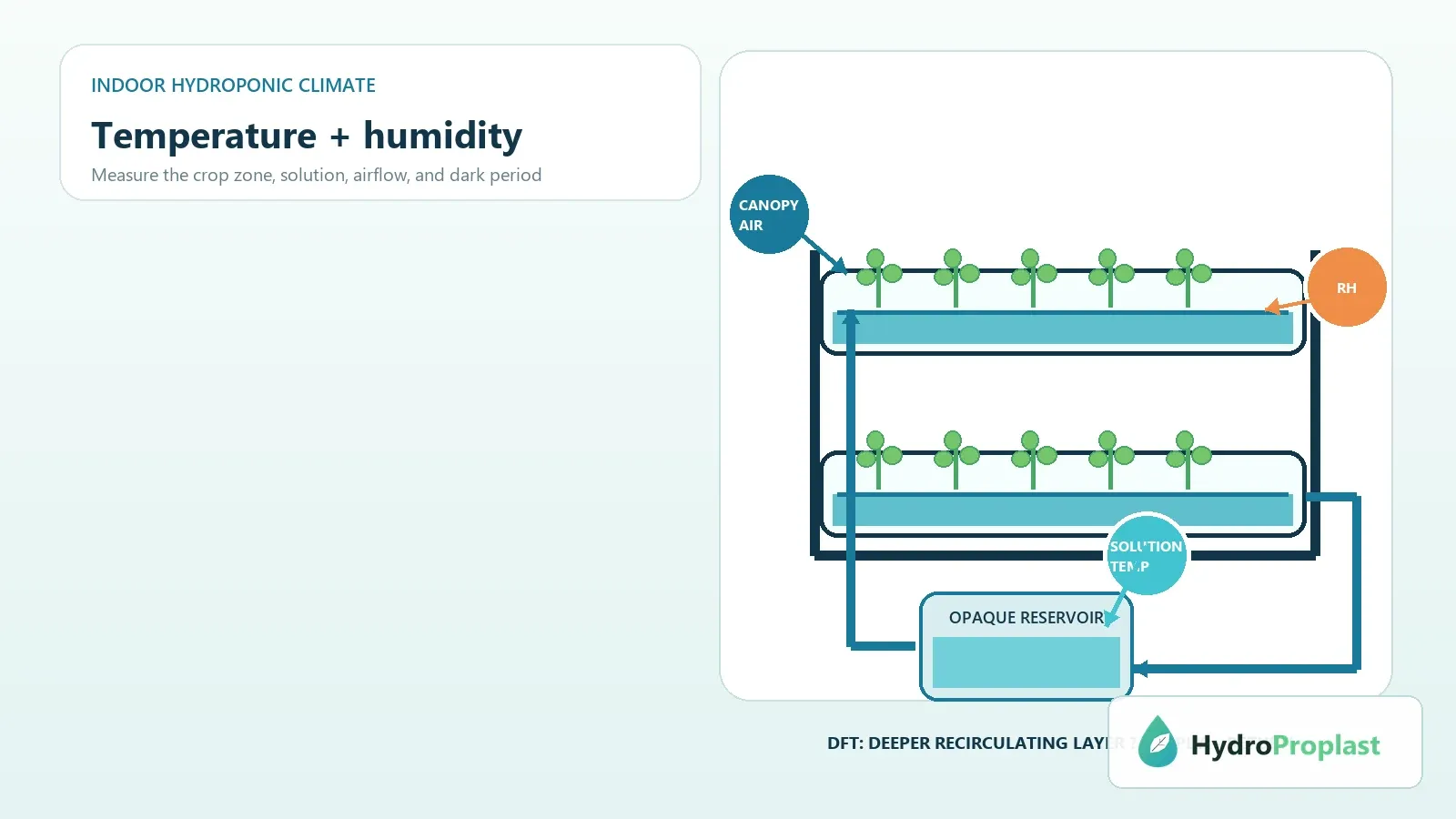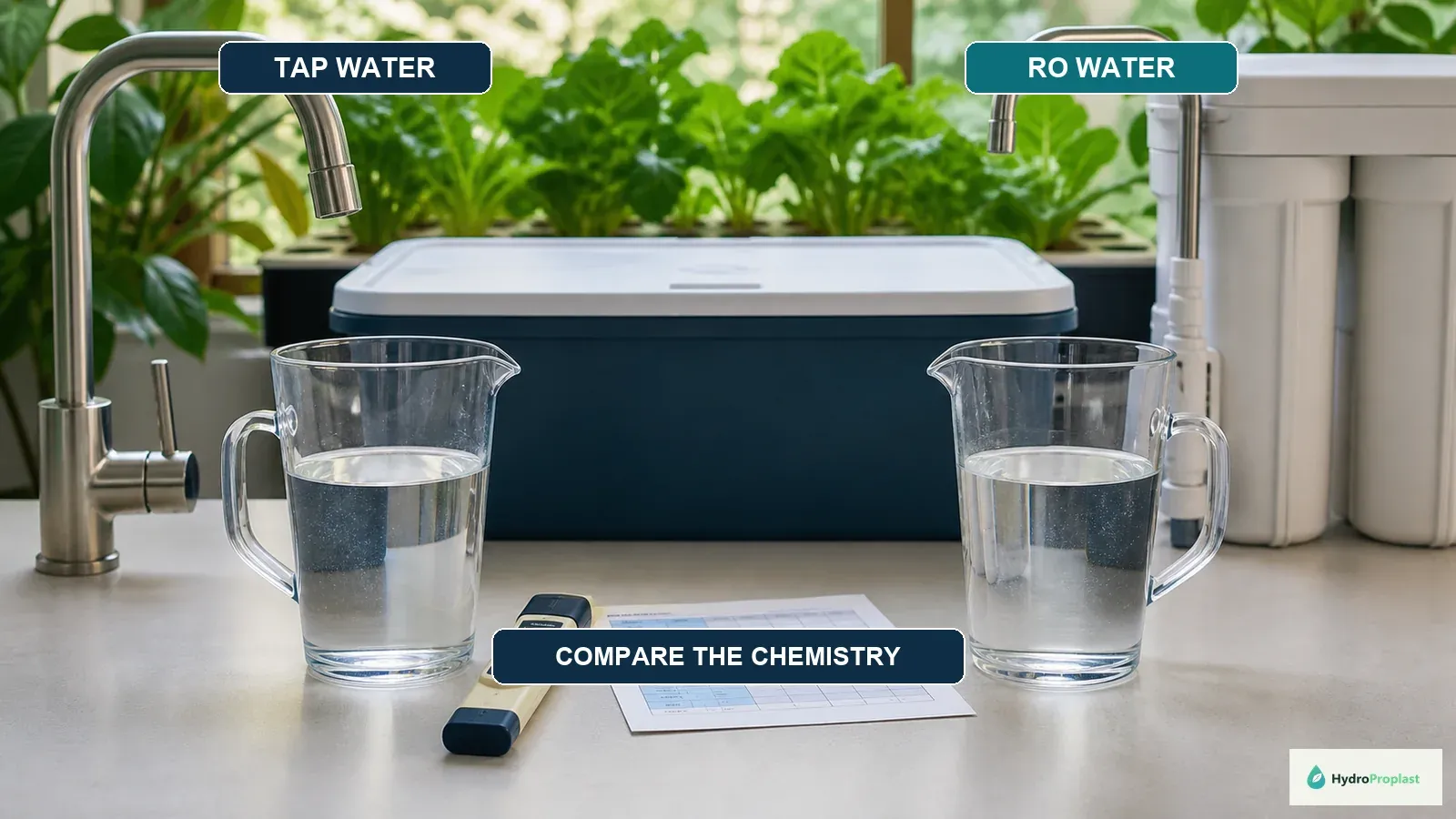
Choosing between tap water and reverse-osmosis water starts with chemistry, not a preference for natural or pure. Tap water can be inexpensive, buffered, and usable. It can also contribute alkalinity, sodium, chloride, or seasonal variation. RO water offers a low-mineral baseline, but the membrane creates reject water, needs maintenance, and removes buffering that can make pH less stable.
Test the water before choosing equipment
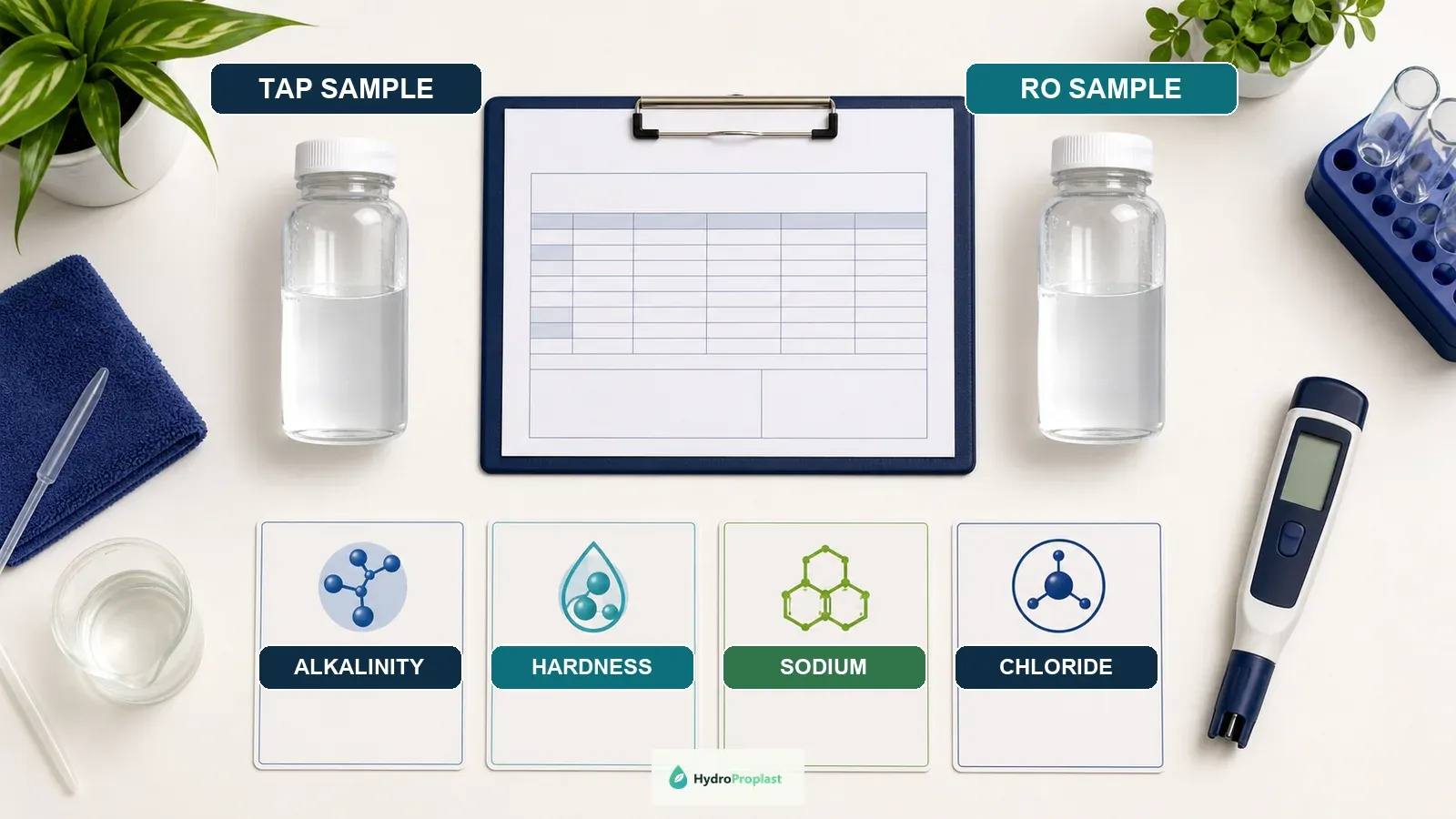
Obtain the utility consumer-confidence report or commission a laboratory analysis of the actual source. A useful report includes alkalinity, hardness, sodium, chloride, sulfate, nitrate, and locally relevant constituents. Well-water chemistry should be tested directly.
Measure source EC and pH on several dates, but do not mistake those readings for a full analysis. EC cannot distinguish helpful calcium from undesirable sodium. pH alone does not reveal how strongly water resists acidification.
The U.S. EPA explains how consumers can obtain drinking-water quality information.
Understand alkalinity separately from pH
Alkalinity describes acid-neutralizing capacity, commonly associated with bicarbonates and carbonates. Water can enter at an acceptable pH yet contain enough alkalinity to push pH upward after nutrients and acid are added.
Low-alkalinity RO water has little buffering, so small additions may move pH more readily. Neither high nor low alkalinity is automatically best; the nutrient formulation must suit the baseline.
Distinguish hardness from alkalinity
Hardness mainly reflects calcium and magnesium, while alkalinity measures buffering. They often occur together but are not interchangeable. Hard water may contribute useful minerals, cause scale, or change how a formula should be dosed.
The USGS overview of water hardness explains its sources. Hydroponic suitability still depends on the individual ion profile.
When tap water is practical
Tap water is practical when its composition is stable, sodium and chloride are not problematic, alkalinity is manageable, and the nutrient manufacturer supports that water type. It avoids membrane cost and reject water.
Run a small crop before scaling. Record source and fresh-mix EC, pH behavior, scale, plant response, and reservoir trends. A successful trial is stronger evidence than a generic claim that all municipal water works.
Problems tap water can introduce
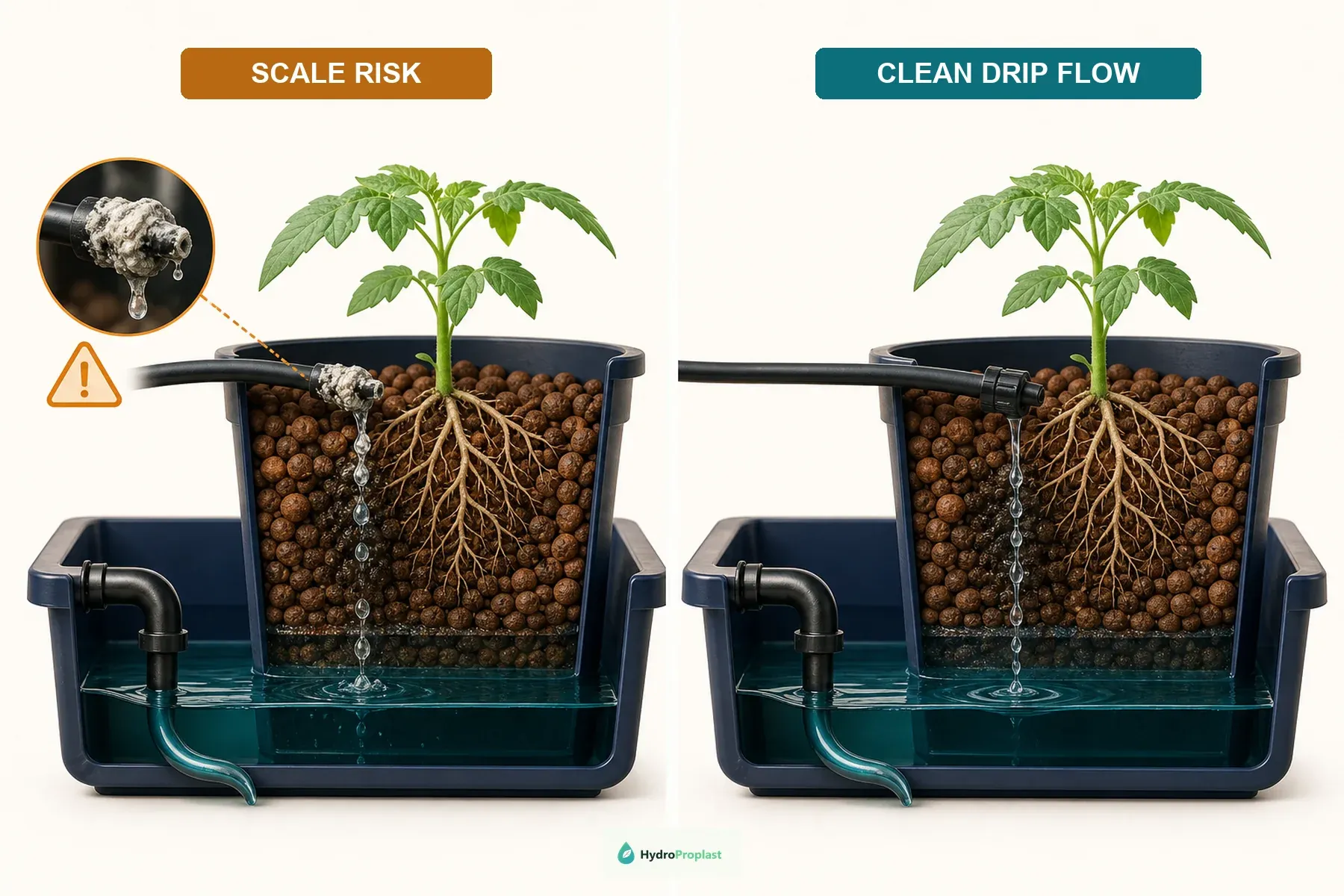
High alkalinity can create upward pH pressure. Excess sodium or chloride can accumulate in recirculating solution. Hardness can contribute scale in emitters, heaters, pumps, and sensors. Municipal treatment and seasonal source changes can alter chemistry.
Do not try to boil away a hydroponic water problem. Boiling consumes energy, can concentrate nonvolatile salts, and does not provide a controlled baseline.
Check household softeners
Ion-exchange softeners commonly replace calcium and magnesium with sodium or potassium. Sodium-softened water may show less scale while becoming less suitable for salt-sensitive crops.
Sample upstream and downstream. A drinking-water tap may bypass the softener while another outlet does not. Confirm plumbing rather than relying on the label tap water.
What RO treatment changes
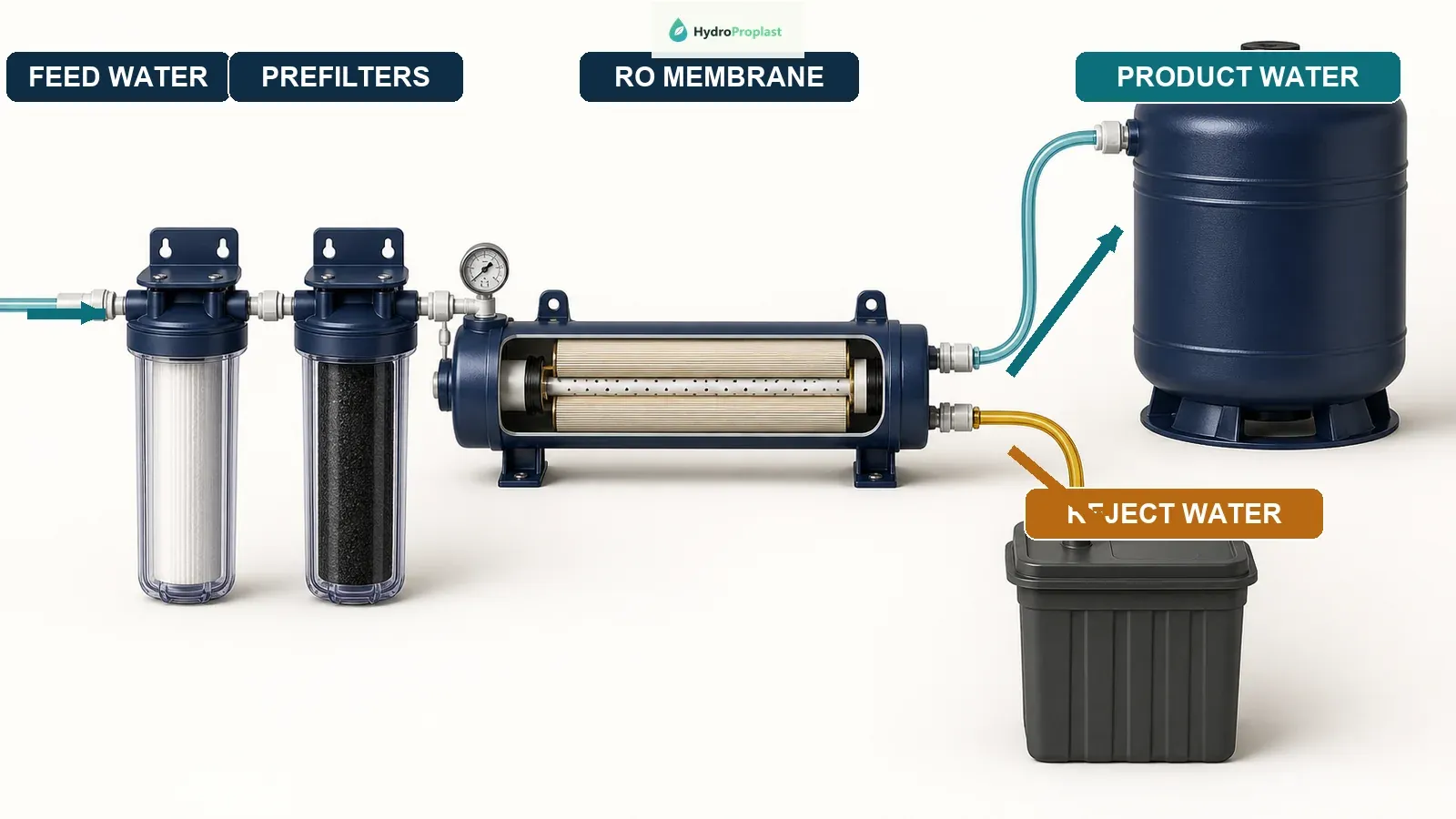
A properly operating RO membrane rejects a large proportion of dissolved ions, creating product water and a concentrated reject stream. Actual rejection depends on membrane condition, feed pressure, temperature, ion type, and design.
RO does not mean sterile. Product tanks, tubing, and filters still require hygienic maintenance. The system does not remove every compound equally, so use certified equipment and suitable prefiltration.
RO costs beyond purchase price
Include prefilters, membrane replacement, pressure requirements, electricity where used, storage, monitoring, and reject-water handling. Calculate the product-to-reject ratio under actual conditions.
A small unit may produce water slowly. Size storage for crop demand without allowing an open vessel to collect dust, light, or biofilm. Use an opaque, clean, covered container.
Verify membrane performance
Measure feed and product EC at similar temperature after the unit stabilizes. Estimate percent rejection as feed EC minus product EC, divided by feed EC, multiplied by 100. This is an operating indicator, not a complete contaminant test.
Trend rejection and production rate. A sudden change can indicate exhausted prefilters, membrane damage, seal bypass, pressure loss, or measurement error. Follow manufacturer service instructions.
Match nutrients to starting water
Some nutrient programs assume calcium, magnesium, or alkalinity in the source. Others are designed for low-mineral water. Use the formula intended for the baseline; do not automatically add a supplement merely because water came from RO.
Mix concentrates separately into measured final volume. Compare source EC with fresh-mix EC. The hydroponic nutrient guide explains complete formulas.
Compare pH management
With alkaline tap water, pH may rise persistently even when the starting number looks normal. With very low-alkalinity RO water, small dosing errors may cause sharp movement. Use a calibrated meter and make diluted incremental corrections.
Never mix acid with chlorine products, alkali, or nutrient concentrates. Follow label protection. The hydroponic pH guide provides a safe sequence.
Decide whether blending helps
A measured blend can reduce RO demand while retaining some alkalinity and minerals. It is useful only when both inputs are characterized and the resulting chemistry fits the nutrient program.
Measure volumes, mix thoroughly, then test EC and pH. Calculate the blend consistently. Retest because tap chemistry and membrane rejection can change. Blending does not selectively remove sodium or chloride; it only dilutes their contribution.
Use a decision matrix
| Situation | Starting option | Verify |
|---|---|---|
| Stable moderate-mineral tap | tap-water trial | alkalinity, sodium, chloride |
| High sodium or chloride | RO or alternate | analysis and membrane rejection |
| High alkalinity | RO or measured blend | buffering and nutrient compatibility |
| Very low-mineral source | low-mineral formula | calcium and magnesium guidance |
| Seasonal changes | active monitoring | updated report and samples |
| Large demand | economic comparison | reject ratio, storage, wastewater rules |
The table narrows a decision; it does not replace crop-specific review.
Monitor over time
Log source EC monthly or when the utility changes supply. Repeat laboratory testing when a well, treatment system, or crop problem changes. For RO, record feed and product EC, production rate, filter service, and membrane age.
Interpret reservoir EC with water level and crop stage. The EC meter guide explains why one value cannot diagnose water quality.
When pH rises rapidly, check alkalinity, dosing, media, and biological activity. When margins burn, verify sodium, chloride, EC, heat, and water uptake. When emitters scale, inspect hardness, precipitation, mixing order, and stagnant zones.
The Oklahoma State University EC and pH guidance supports interpreting water and nutrient measurements together.
Make the final choice from evidence
Use tap water when analysis and trials show its ions and buffering are manageable. Use RO when the source contains constituents that cannot be accommodated reliably, or when a reproducible low-mineral baseline justifies cost and waste. Use a blend when measured chemistry supports a consistent middle ground.
Record the decision, blend ratio, nutrient formula, and monitoring triggers. The best source is not the one with the lowest EC; it is the one that produces a known nutrient solution with acceptable cost, maintenance, and environmental impact.
Run a 30-day source trial
A thirty-day source trial improves confidence. Prepare identical small reservoirs with the candidate water, using the matching nutrient instructions. Keep cultivar, stage, light, volume, and equipment comparable. Record fresh-mix EC and pH, daily drift, correction volume, scale, top-ups, root condition, and new growth. Do not combine the reservoirs or return samples.
At the end, compare stability and workload rather than selecting the greenest single leaf. Include filter use, acid use, reject volume, storage time, and cleaning. A source that requires constant correction may cost more operationally even when the water itself is inexpensive.
For wells, repeat sampling after heavy rain, drought, pump work, or changes in taste, odor, or appearance. For utilities, retain annual reports and notices. For RO, keep membrane and prefilter lot dates. These records reveal whether a crop change actually followed source chemistry.
If analysis identifies a potentially unsafe drinking-water contaminant, hydroponic adjustments are not a substitute for professional water-treatment advice. Follow local health and environmental authorities. Crop production should never be used to dispose of questionable water.
Before scaling, confirm five items: a current analysis, a compatible nutrient formula, a documented pH strategy, an affordable supply and waste plan, and a monitoring schedule. If one is missing, run a smaller trial or obtain specialist guidance first.
Compare total operating cost
A practical cost comparison should use the same finished-water volume. For tap water, include utility price, testing, acid or treatment, scale removal, and any shortened equipment life. For RO, include feed water, reject water, filters, membrane, pressure equipment, electricity, storage, testing, and operator time. Divide total cost by liters of usable product water over the service interval.
Reject water may be suitable for cleaning or landscape use only when its chemistry and local rules permit. It is more concentrated than the feed and should not be sent automatically to salt-sensitive plants or waterways. Design collection so it cannot backflow into product storage.
A water report also helps distinguish operational from crop symptoms. High sodium and chloride may contribute to marginal injury or accumulation, but leaf appearance alone cannot confirm them. High bicarbonate alkalinity may explain persistent correction demand without proving that nutrient strength is wrong. Tissue, solution, or source-water analysis can be more economical than repeated product changes.
Change water sources deliberately
When changing sources, avoid an undocumented mid-reservoir switch. Prepare a fresh known batch, match temperature, follow the nutrient program, and record the transition date. Monitor pH, EC, water uptake, roots, and newest leaves. Existing damage will remain, so assess new tissue and stable operating trends.
Emergency planning differs by source. Tap users should know whether outages or boil-water notices affect production and whether an alternate tested source is available. RO users need enough stored product or a safe backup if a membrane, pump, or prefilter fails. Storage capacity should cover a defined interval without encouraging long stagnant holding.
Keep product and reject tubing clearly labeled. Prevent cross-connections, install backflow protection where required, and follow plumbing codes. Do not route nutrient solution into drinking-water equipment. A certified installer may be appropriate when pressure vessels, permanent plumbing, or large storage tanks are involved.
Questions for the nutrient supplier
- What source-water alkalinity and hardness does the formula assume?
- Does the program include enough calcium and magnesium for low-mineral water?
- Which constituents or EC baseline make an alternate formula preferable?
- How should source-water EC be treated when following the dose chart?
- Is a water analysis required before technical support can interpret a problem?
Questions for an RO supplier
- What rejection and production are specified at the actual feed pressure and temperature?
- Which prefilters are required for disinfectant, sediment, iron, or hardness?
- How is membrane performance verified and how often are filters serviced?
- What is the measured product-to-reject ratio?
- Are wetted materials and storage components appropriate for the intended use?
Write an operating specification
The final operating specification should name the source, sampling point, acceptable analysis range, treatment steps, blend calculation, storage limit, nutrient formula, fresh-mix baseline, and triggers for retesting. This converts a one-time purchase decision into a reproducible water-management procedure.
Choose the simpler adequate source
If both sources perform adequately, choose the simpler lower-impact option. RO is valuable when it solves a demonstrated chemistry problem or provides needed consistency. It is unnecessary complexity when characterized tap water already supports stable nutrition. Conversely, avoiding RO to save water is not sensible if unsuitable source ions repeatedly damage crops and require frequent disposal of failed reservoirs. Compare the whole process.
Review this specification whenever the source, treatment equipment, nutrient product, crop group, or operating season changes materially.