Buy for canopy coverage and crop demand, not “equivalent watts”
Choose an LED grow light by the crop’s light requirement, mature canopy area, mounting distance, distribution map, actual input power, dimming, heat, electrical safety, and manufacturer support. A bright-looking fixture or large advertised watt-equivalent does not prove that edge plants receive useful light.
For seedlings and leafy greens, even coverage and adjustable mounting are usually more valuable than extreme center intensity. Fruiting tomatoes, peppers, cucumbers, and strawberries require a larger lighting and climate commitment. Define crop, plant count, and mature area before comparing products.
University of Minnesota Extension’s indoor lighting guide explains intensity, duration, spectrum, distance, and symptoms of too little or too much light. Use crop-specific research and the fixture’s tested map together.
Understand PPF, PPFD, and daily light
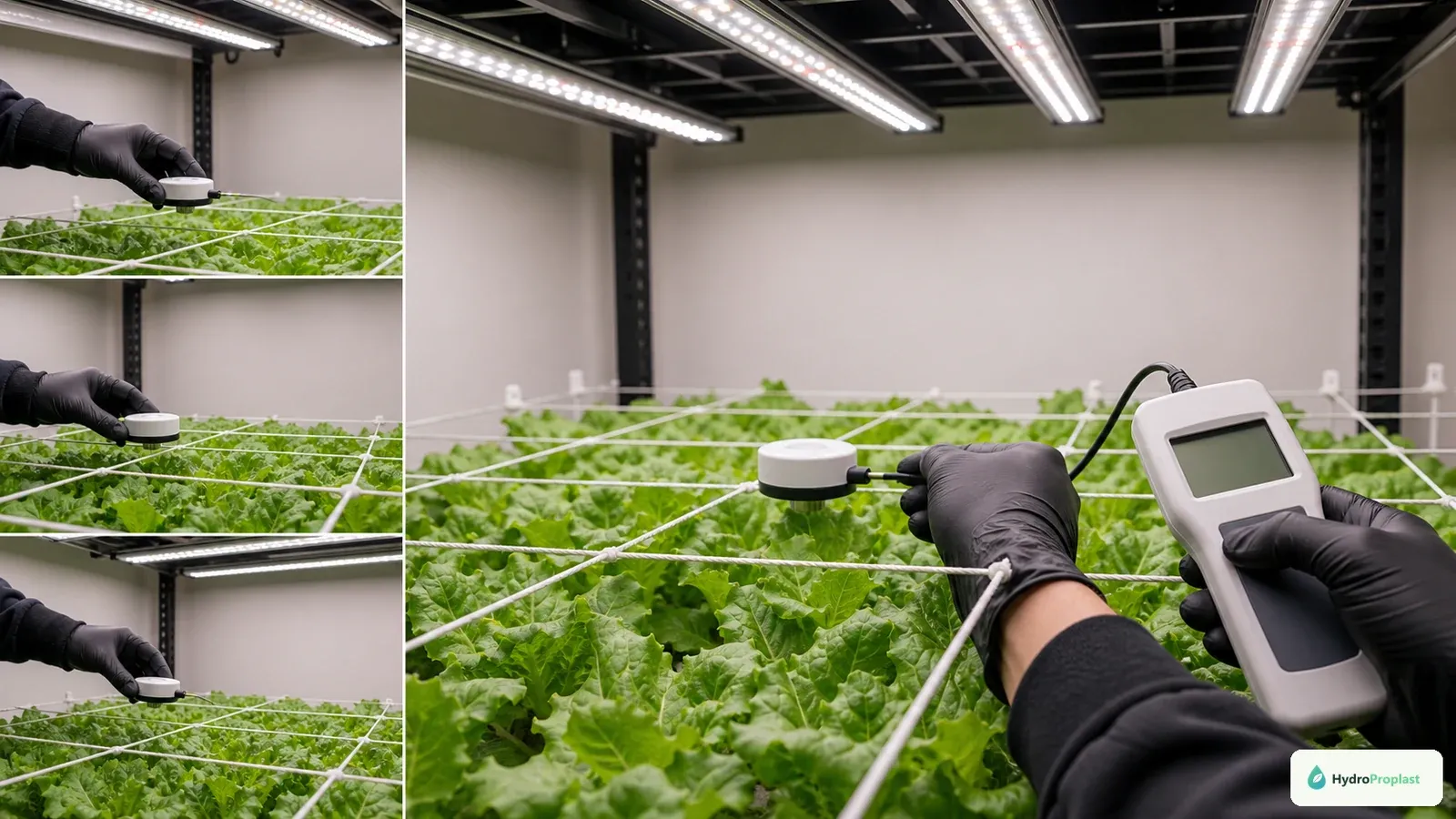
Measure several points at canopy height because a bright center reading can hide weak edges and corners.
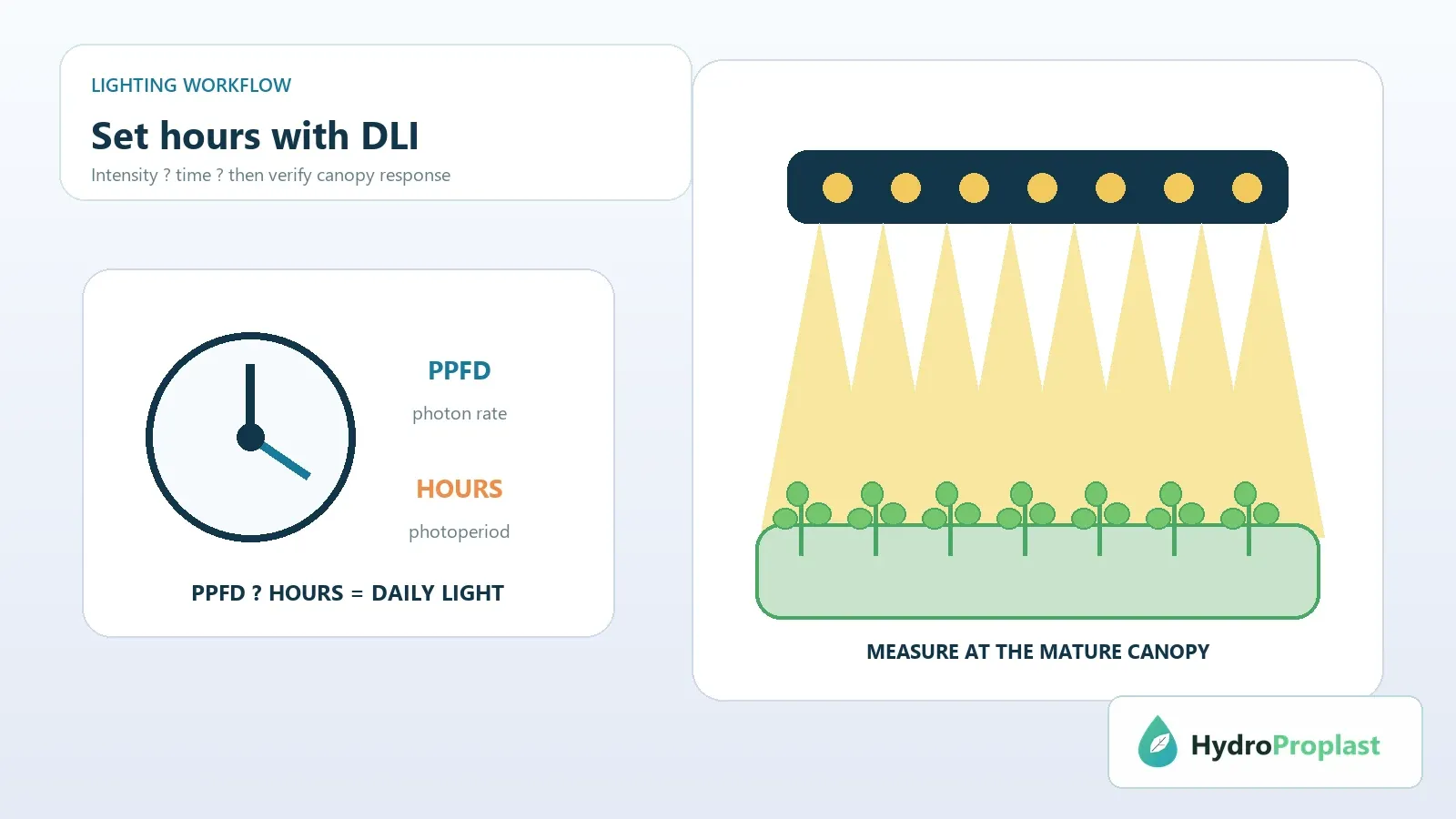
Photosynthetic photon flux (PPF) describes photons emitted by the fixture per second. PPFD describes photon flux reaching a square meter of canopy. Daily light integral (DLI) accumulates that delivery over the light period.
PPF alone does not show distribution. A high-output fixture mounted poorly can create a hot center and dark edges. PPFD at one point is not the canopy average. DLI depends on both intensity and hours, but extending a weak light indefinitely is limited by plant dark-period needs.
Ask for a PPFD map at a stated mounting height and test area. Compare maps made under similar reflective conditions. Marketing maps without distance, area, or measurement method are not decision-grade evidence.
Start with mature canopy dimensions
Measure the area leaves will occupy near harvest, not the seedling tray. Closely spaced holes do not guarantee each mature plant fits. Basil spreads, lettuce heads overlap, and fruiting crops need trellis space.
Divide the canopy into zones and ensure useful light reaches corners. A long shelf may suit two bars better than one square fixture. A vertical tower needs side lighting or rotation strategy, often making total equipment greater than its footprint suggests.
Leave service space and lamp clearance. If the fixture cannot be raised as plants grow, crop choice is constrained.
Spectrum without purple-light mythology
Plants use a broad range of photosynthetically active radiation. Blue, red, and broad white spectra can support growth, but plant shape, flowering response, human visibility, and fixture efficiency differ.
Balanced white or mixed-spectrum light makes pests, nutrient symptoms, and leaf color easier to inspect. A red-heavy fixture is not automatically better for fruiting, and spectrum cannot compensate for inadequate total light or poor temperature.
Prefer published spectral distribution over vague “full spectrum” labels. Avoid medical or yield claims based only on diode color.
Actual power and photon efficiency
Use actual wall input power, not incandescent or HID equivalent wattage. Input power helps estimate electricity and heat; it does not alone measure plant light. Photon efficacy relates useful photon output to electrical power and allows more meaningful comparison when independently tested.
Calculate monthly energy: watts × hours per day × days ÷ 1,000, then multiply by local rate. Include fans and climate equipment. A more efficient fixture can reduce heat load, but all electrical input ultimately affects the room’s energy balance.
Mounting height is a control variable
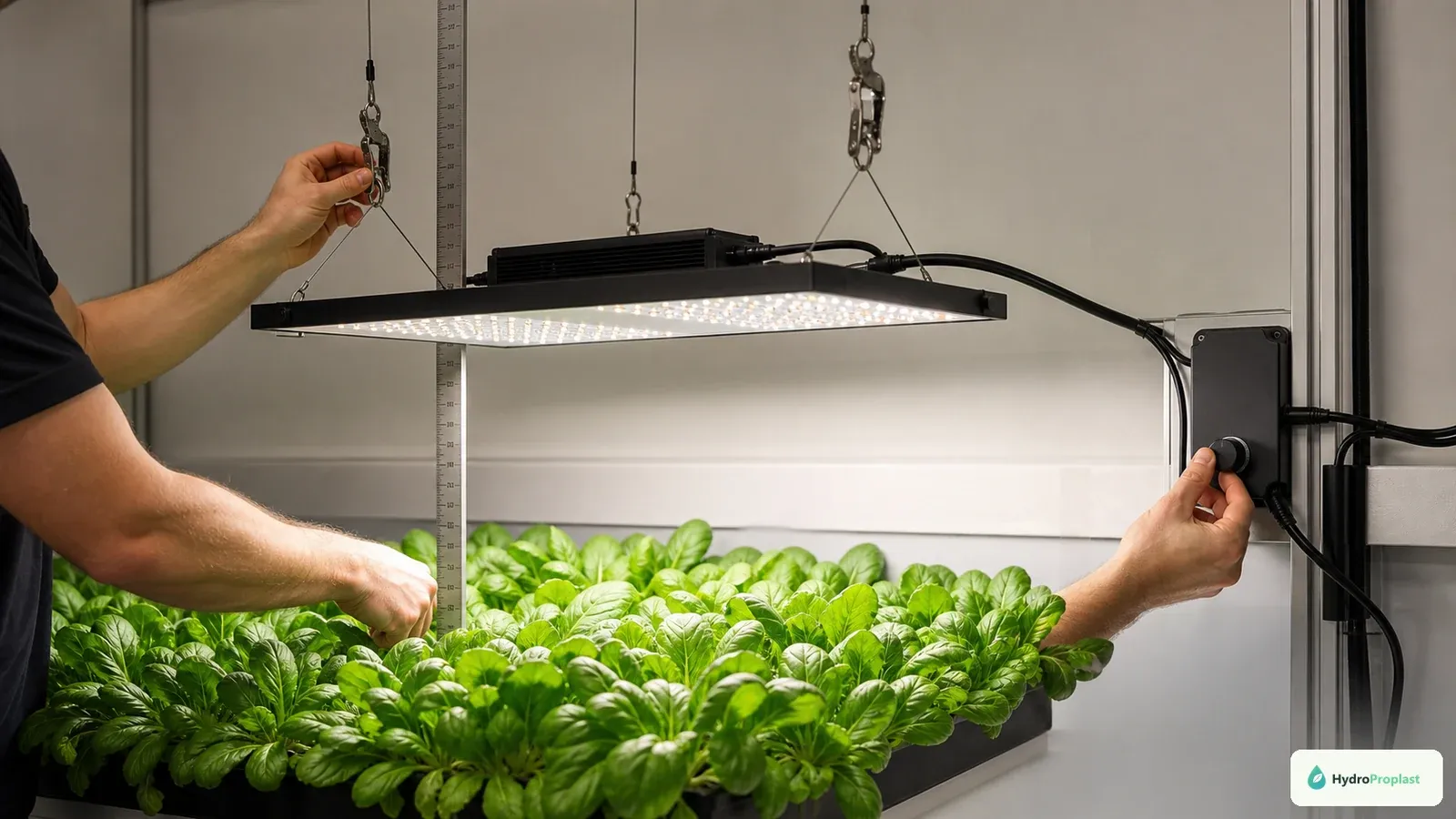
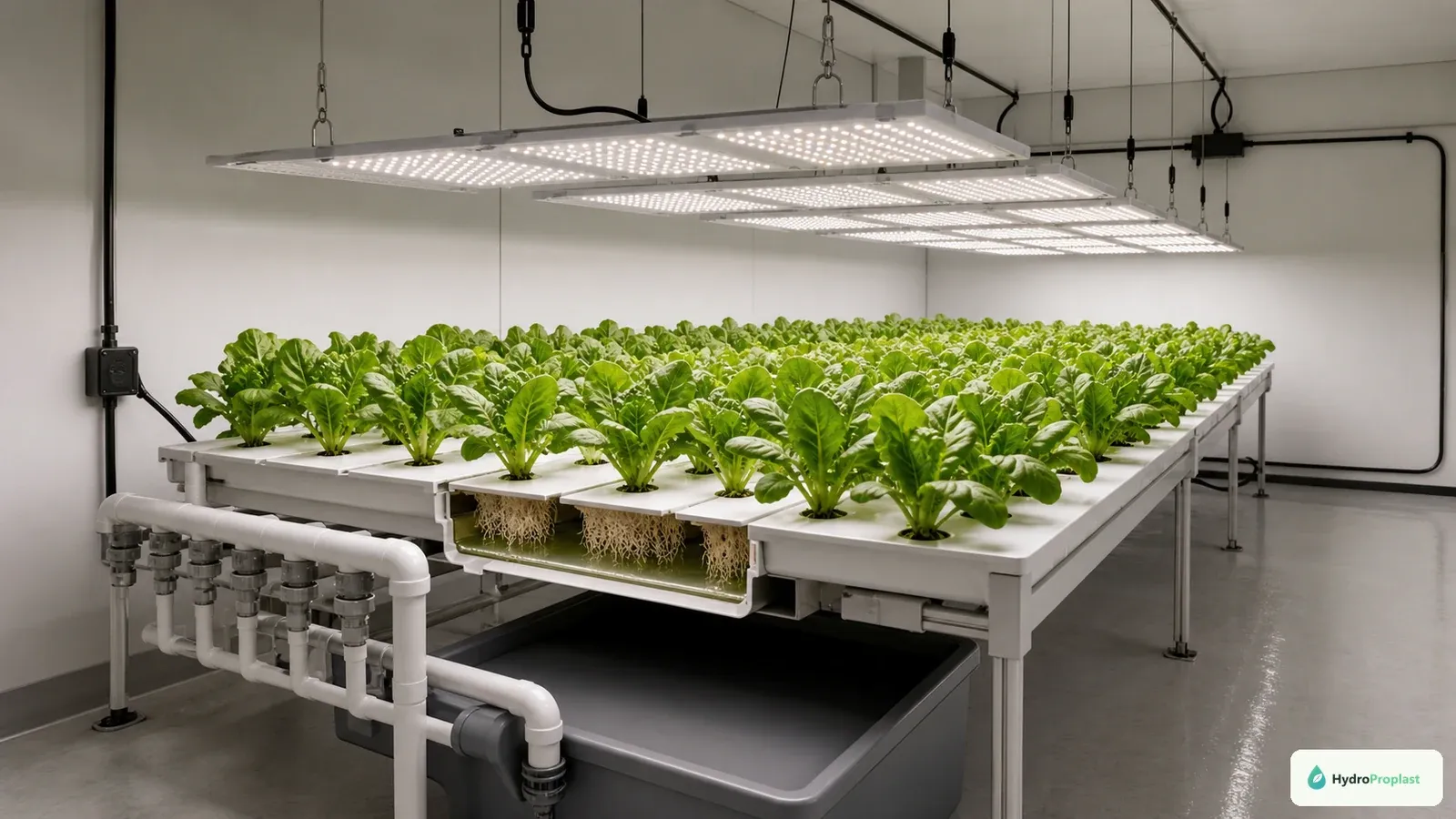
Mounting height changes coverage and intensity; dimming lets one fixture adapt as seedlings grow into a full canopy.
Moving a fixture closer raises intensity and often worsens uniformity; moving it higher spreads light but lowers intensity. Follow manufacturer maps and crop response, then verify the canopy.
Use secure rated hangers and maintain required ventilation clearances. Do not suspend above water with improvised cord or route plugs beneath reservoirs. Raise the lamp before leaves touch it.
For seedlings, close uniform light within fixture guidance helps prevent stretching. Read the leggy-seedling guide before assuming nutrient is the problem.
Dimming improves flexibility
A dimmer lets one fixture serve seedlings and mature plants, manage acclimation, and reduce excess heat. Check whether dimming preserves uniformity and whether the control has repeatable markings.
Do not use dimming to justify an undersized fixture that must run at maximum with poor edge coverage. Conversely, buying extreme output and dimming heavily may waste capital.
Record dimmer position, height, and schedule for each crop stage so successful settings are reproducible.
Heat still matters with LEDs
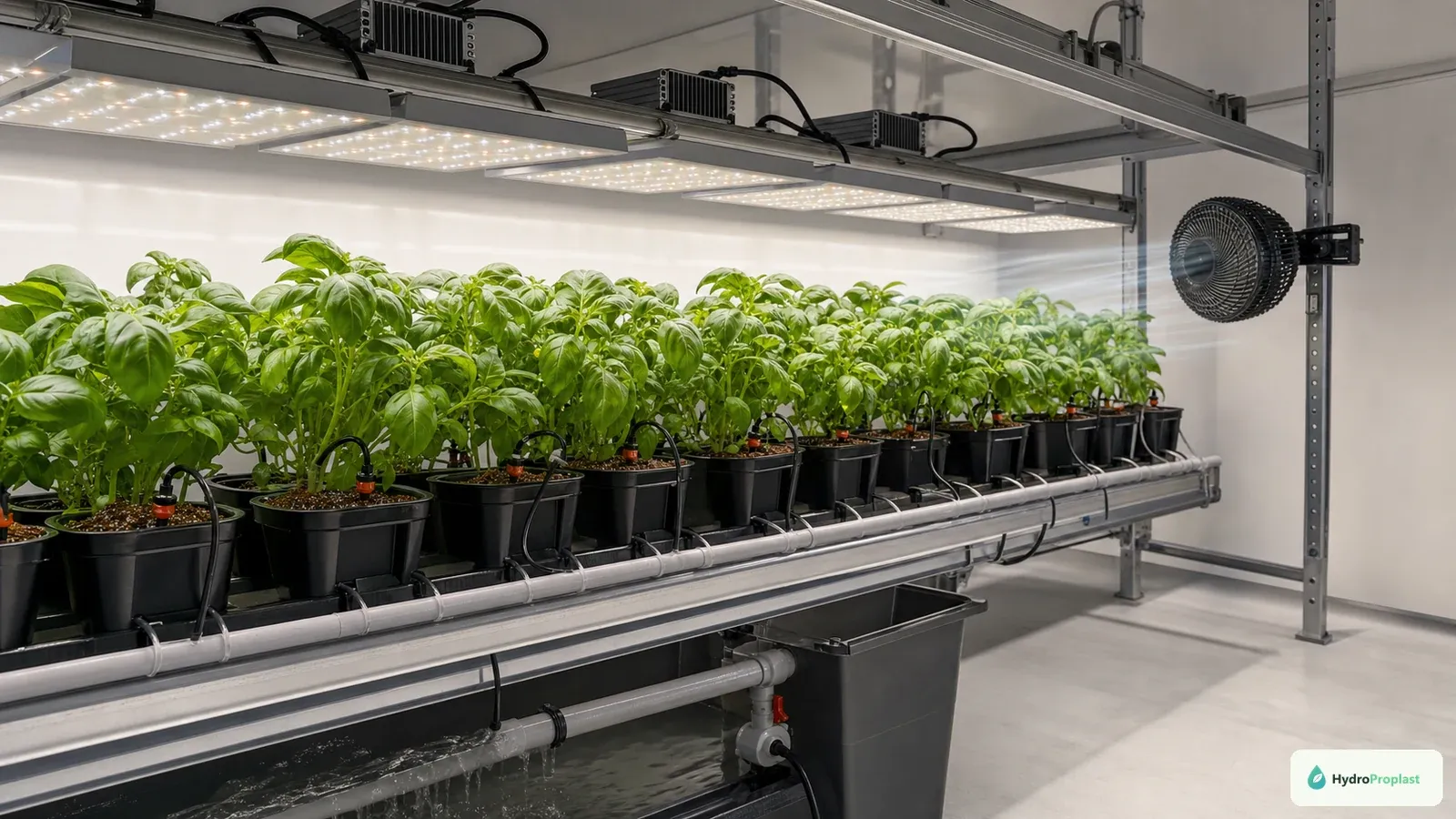
LEDs still release heat, so protect drivers, move air gently, and keep electrical components separated from irrigation water.
LEDs are more efficient than many older sources but are not heat-free. Drivers and heat sinks warm air; radiation warms leaves and reservoirs. An enclosed shelf can accumulate heat.
Measure air, leaf response, and nutrient-solution temperature through the light cycle. Move remote drivers only if manufacturer-approved. Provide ventilation without blowing seedlings dry.
The water-temperature guide explains why lamp heat and root oxygen should be evaluated together.
Duration and dark period
Use a reliable timer and crop-specific photoperiod guidance. Seedlings, leafy greens, and flowering crops have different needs. Many plants require a dark period for normal development.
Do not leave lights on continuously to rescue insufficient output. Longer operation increases electricity and heat and may disrupt crop responses. Measure the delivered intensity first.
Account for sunlight when fixtures supplement a greenhouse or window, but remember that daylight varies with weather and season.
Verify claims and safety
Look for recognized electrical certification applicable to your country, appropriate moisture-location guidance, grounded or double-insulated construction, safe connectors, warranty, and replacement support. Follow local electrical rules around water and use drip loops.
Check whether output data are manufacturer-measured or independently tested, at what distance, and after what operating temperature. Avoid unverified yield guarantees and “replaces 1,000 W” language without actual performance.
Fanless fixtures reduce moving parts but still need unobstructed heat dissipation. Fan-cooled units add noise and dust maintenance.
Measure the installed result
A quantum sensor is the direct tool for PPFD but may be expensive. Borrowing or renting a credible meter can be more useful than buying a questionable sensor. Phone lux apps are not universal plant-light meters; spectrum and device calibration affect them.
Even without a quantum meter, compare growth across the tray, leaf angle, stretch, bleaching, and temperature. Swap plant positions only as a diagnostic, not a permanent compensation for bad coverage.
Photograph the canopy weekly at the same height and exposure. Edge-center divergence reveals distribution problems.
Match light to crop category
Seedlings need uniform light close enough to prevent stretch without scorching tender leaves. Leafy greens favor broad even canopy coverage and predictable scheduling. Herbs vary in mature height and harvest style.
Fruiting crops require adequate intensity over a longer season plus space, pollination, support, and climate management. A countertop lamp that starts a tomato may not finish it.
If crop choice remains open, Best Vegetables to Grow Hydroponically helps avoid buying light for an unsuitable first plant.
A comparison worksheet
For each fixture record canopy area at recommended height, average and minimum map values, actual input watts, efficacy where credibly supplied, spectrum, dimming range, dimensions, driver location, cooling, certification, warranty, and replacement availability.
Calculate fixture count and total power for the complete area. Add hangers, timer, shelf, fan, and possible climate cost. A cheaper light that requires two units may not be cheaper.
Reject products whose claims omit area and distance. Compare systems that serve the same crop and canopy.
Commission before planting every site
Mount securely, run the fixture through the full schedule, and measure air and reservoir temperature. Confirm the timer resumes correctly after power interruption. Check brightness distribution at all plant sites.
Start with fewer plants and observe edge-center growth. Adjust height or dimming one variable at a time. Keep unused hydroponic holes covered.
Avoid overbuying
Do not pay for spectrum channels, app control, sunrise effects, or output beyond the crop unless those features solve a defined need. Reliable dimming, coverage, safety, and efficiency usually matter more.
Buy for the next complete crop, not an imagined room-scale farm. Modular bars can expand later; one oversized fixture may not fit a changed shelf.
The right LED is the smallest safe, supported lighting system that provides verified uniform crop-appropriate delivery across the mature canopy while keeping energy and heat manageable.
A simple lighting audit before purchase:
Draw the mature canopy as a rectangle and record its length and width. List every shelf, plant tier, reflective wall, and obstruction. Decide which crop will occupy each zone at maturity. This prevents buying for the empty seedling tray and discovering that the fixture cannot cover the full leaves later.
Ask the seller for a PPFD map at a stated hanging height and power setting. A useful map shows multiple measurement points across the whole target area, not only the bright center. Confirm whether the test used reflective walls, because a tent can produce different edge readings from an open room. If no credible map is available, treat coverage claims as unverified.
Calculate expected daily light integral from representative PPFD and photoperiod, then validate after installation. DLI in moles per square meter per day is approximately PPFD multiplied by lighting hours multiplied by 0.0036. For example, a measured average of 200 micromoles per square meter per second over 14 hours is about 10.1 moles per square meter per day. This is an arithmetic example, not a universal crop target.
Installation and commissioning:
Mount the fixture to a structure rated for its weight and use a secondary safety restraint where appropriate. Keep drivers, plugs, and connections away from splashes. Arrange cables with drip loops, maintain manufacturer clearances, and do not overload a circuit or power strip. Hydroponic water and mains electricity require conservative installation.
Start dimmed or higher than the final position when moving plants from weak light. Increase delivery gradually while watching new growth, leaf angle, bleaching, curling, and canopy temperature. Measure at multiple points after every major height or dimming change. A phone lux application may show relative uniformity, but it is not a substitute for a calibrated quantum sensor when exact PPFD matters.
Record fixture height, dimmer setting, photoperiod, measured points, room temperature, and crop response. Recheck as plants grow toward the lamp and after shelves or reflective surfaces move. Clean optical surfaces only when powered off and according to manufacturer directions.
A defensible purchase is therefore based on the mature footprint, verified delivery, controllability, electrical safety, and support. Wattage and marketing spectrum names are incomplete proxies. Buy the system you can measure, mount safely, cool, and adjust throughout the crop.
Understanding efficiency and operating cost:
Fixture efficacy describes usable photon output per unit of electrical energy, commonly reported as micromoles per joule. It is more informative than a claim that an LED “replaces” a high-wattage lamp, but only when the output was measured by a credible laboratory. High efficacy does not guarantee good canopy uniformity; optics and fixture shape still determine where those photons land.
Estimate energy before purchase. Multiply actual fixture watts by daily operating hours and days per month, then divide by 1,000 to obtain monthly kilowatt-hours. Multiply by the local electricity rate. Include fans or cooling that the light adds to the room. This comparison can reveal that a slightly more efficient, well-shaped fixture costs less over repeated crops even if its purchase price is higher.
Spectrum and plant appearance:
Broad-spectrum white LEDs are practical for most home hydroponic crops because they support growth and make it easier to inspect leaf color, pests, and nutrient symptoms. Supplemental red, blue, far-red, or ultraviolet channels can influence plant responses, but they add complexity and should be chosen for a defined crop objective.
Do not evaluate a fixture from visual brightness alone. Human eyes are most sensitive to a different range than plant photosynthesis, and two lamps that look equally bright may deliver different photon flux. Likewise, purple light is not automatically more effective simply because its color looks horticultural.
The Oklahoma State University hydroponics overview places artificial lighting within the wider system of crop selection, nutrients, water, and environmental control. Light cannot compensate for a poorly oxygenated root zone or unsuitable temperature.
When comparing final candidates, make a one-page table with tested output, mapped area, efficacy, dimming range, physical dimensions, driver location, warranty, safety certification, and delivered price. Eliminate products that cannot document the first four fundamentals. Then choose based on installation fit and serviceability rather than cosmetic features.
Keep the receipt, manual, serial number, and initial measurement record. If output appears to decline, clean and remeasure at the same positions and settings before concluding that the diodes have failed. Repeatable records turn lighting from guesswork into a controllable crop input.