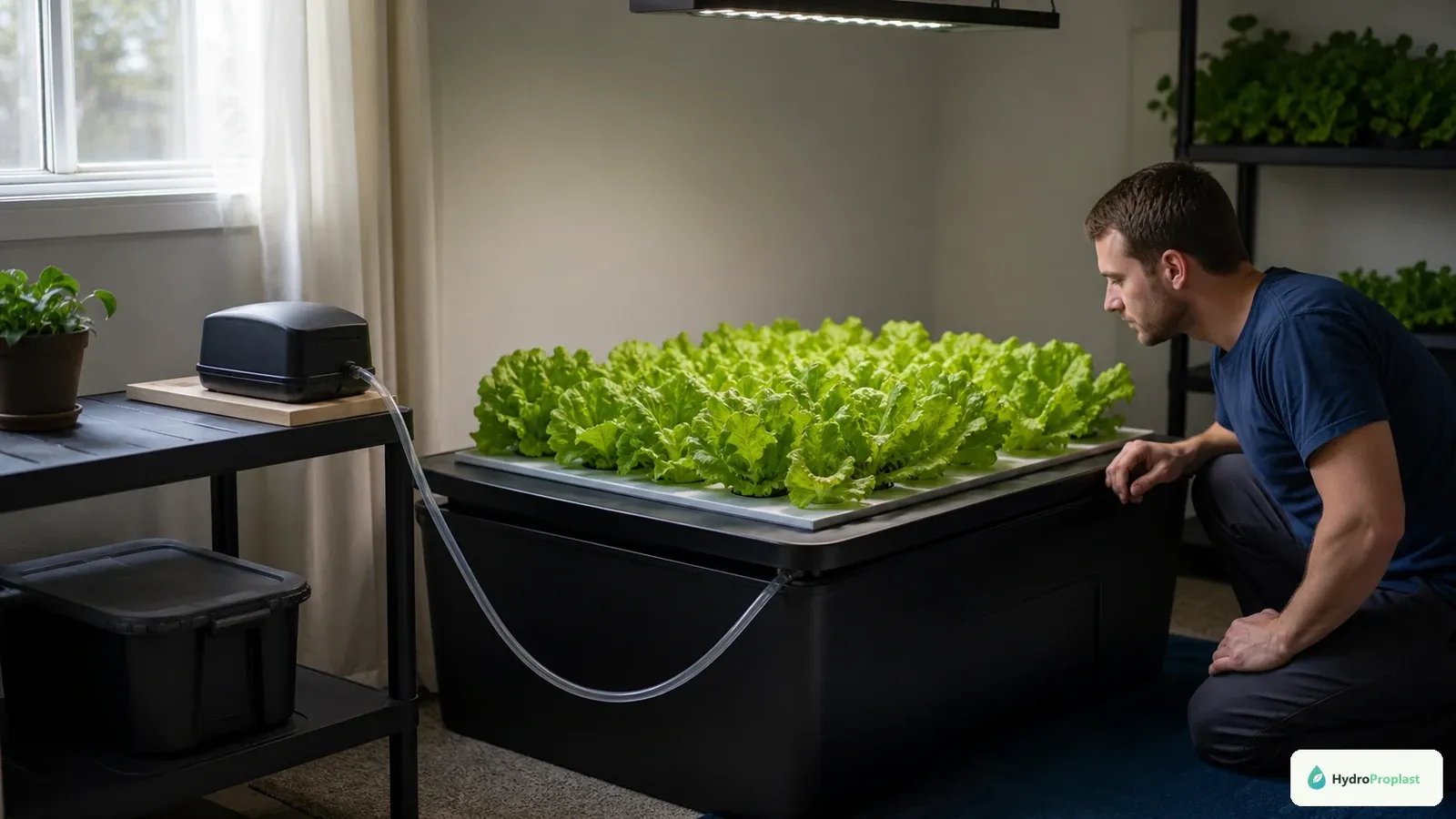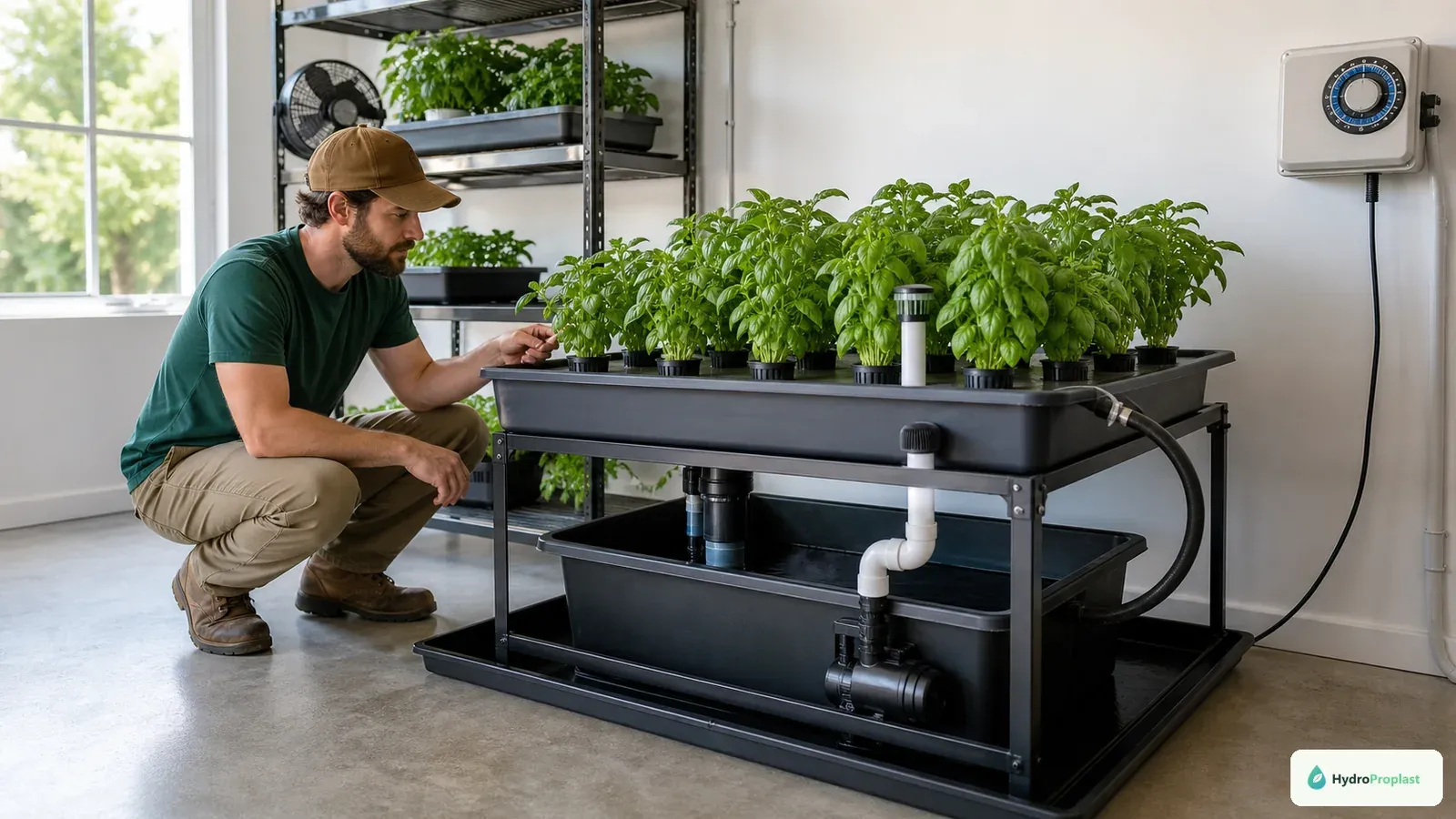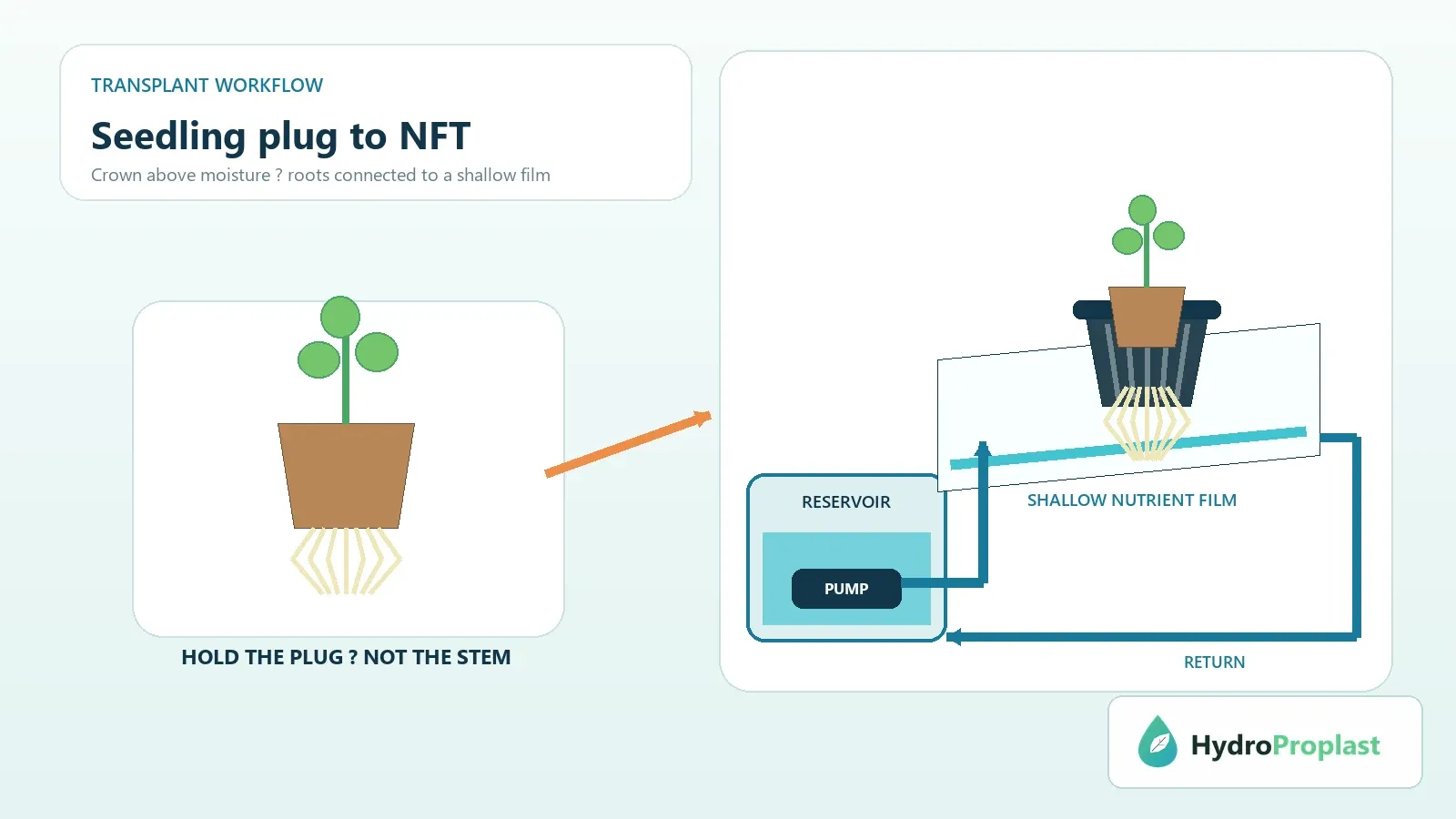
Hydroponic greens and herbs are cleanly grown only when the production and harvest process is hygienic. They can still carry soil-free debris, human pathogens, pests, pesticide residues, and damaged tissue. Quality after harvest depends on crop-specific timing, clean tools, rapid removal of field heat where appropriate, moisture control, and storage suited to the commodity.
Define the harvest product
Decide whether the crop will be a whole lettuce head, outer leaves, baby greens, basil tips, parsley stems, chive leaves, or a final whole-plant cut. The desired product determines maturity, cutting point, handling, and packaging.
Harvesting repeatedly extends the life of roots and crowns, while whole-plant harvest simplifies turnover. Record the method so yield and quality can be compared.
Prepare a hygienic harvest area
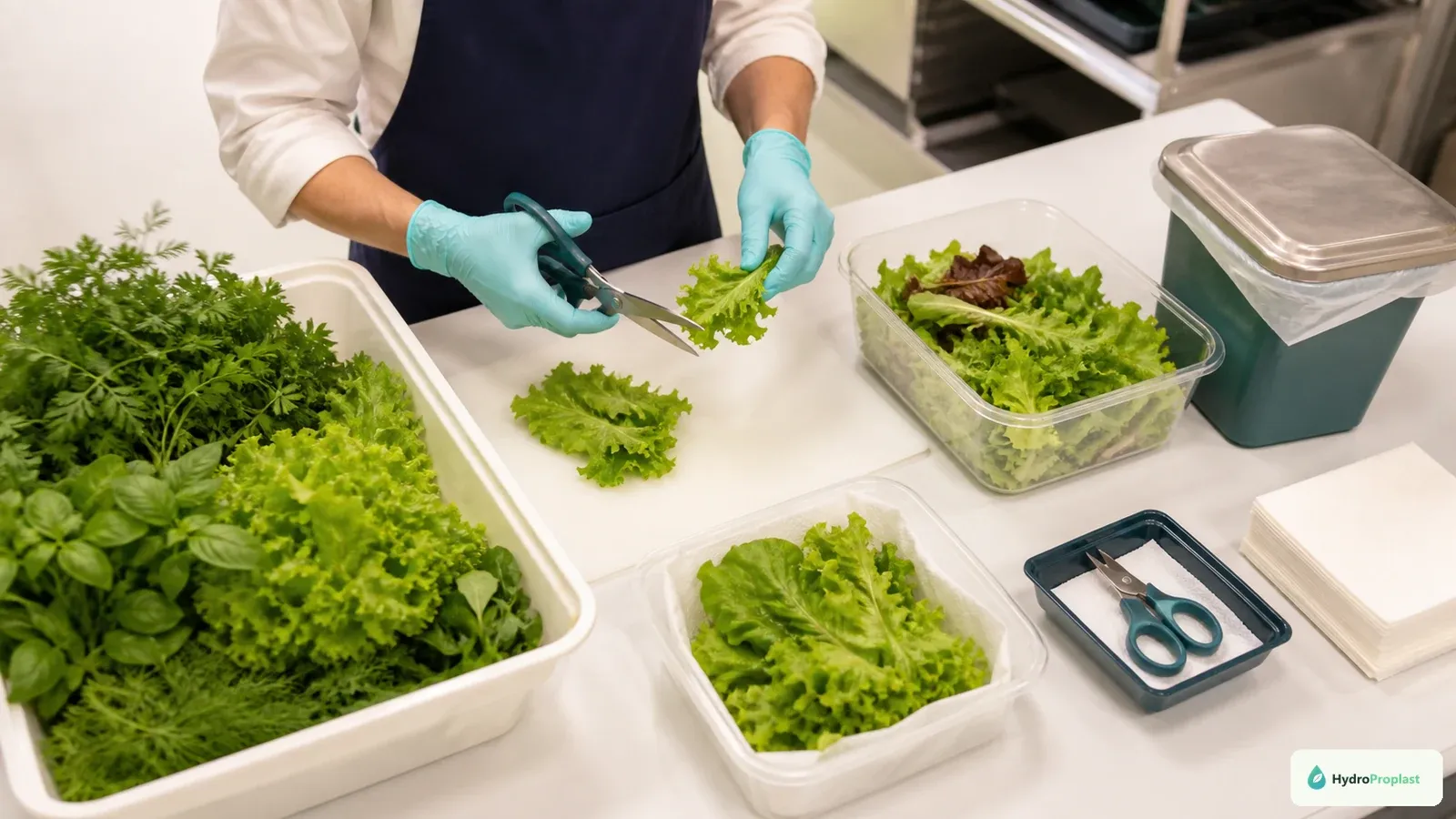
Prepare the harvest area before cutting so clean produce does not touch dirty tools, surfaces, or waste.
Wash hands and follow applicable food-handling requirements. Clean food-contact knives, scissors, bins, scales, and work surfaces before use. Keep harvest tools separate from root, floor, drain, and pesticide equipment.
Use potable water when washing is part of the approved process. Keep pets, soil, chemicals, and crop waste away. Commercial growers need a food-safety plan that meets local rules.
The U.S. FDA provides produce safety resources.
Review treatment and re-entry records
Before harvesting, verify that every pesticide or crop-protection product was labeled for the edible crop and site, and that the preharvest interval has elapsed. Also verify re-entry restrictions for workers.
Do not assume washing removes an unapproved residue. If application records are missing or the interval is uncertain, hold the crop and obtain qualified guidance.
Keep cleaning chemicals, pesticides, and nutrient concentrates away from harvest containers. Never mix chemicals.
Choose the harvest time
Harvest when leaves are fully hydrated but surface-dry, under the coolest practical room conditions. Avoid harvesting immediately after foliar wetting or when leaves are wilted from heat.
The best local time depends on light schedule, irrigation, crop, and workflow. Use measured leaf condition rather than an outdoor farm clock.
Plan enough labor and cold-storage capacity so produce does not sit warm while later rows are cut.
Harvest whole lettuce heads
Inspect the head, lower leaves, crown, and root area. Remove visibly damaged or decaying outer leaves without contacting clean inner leaves with dirty gloves.
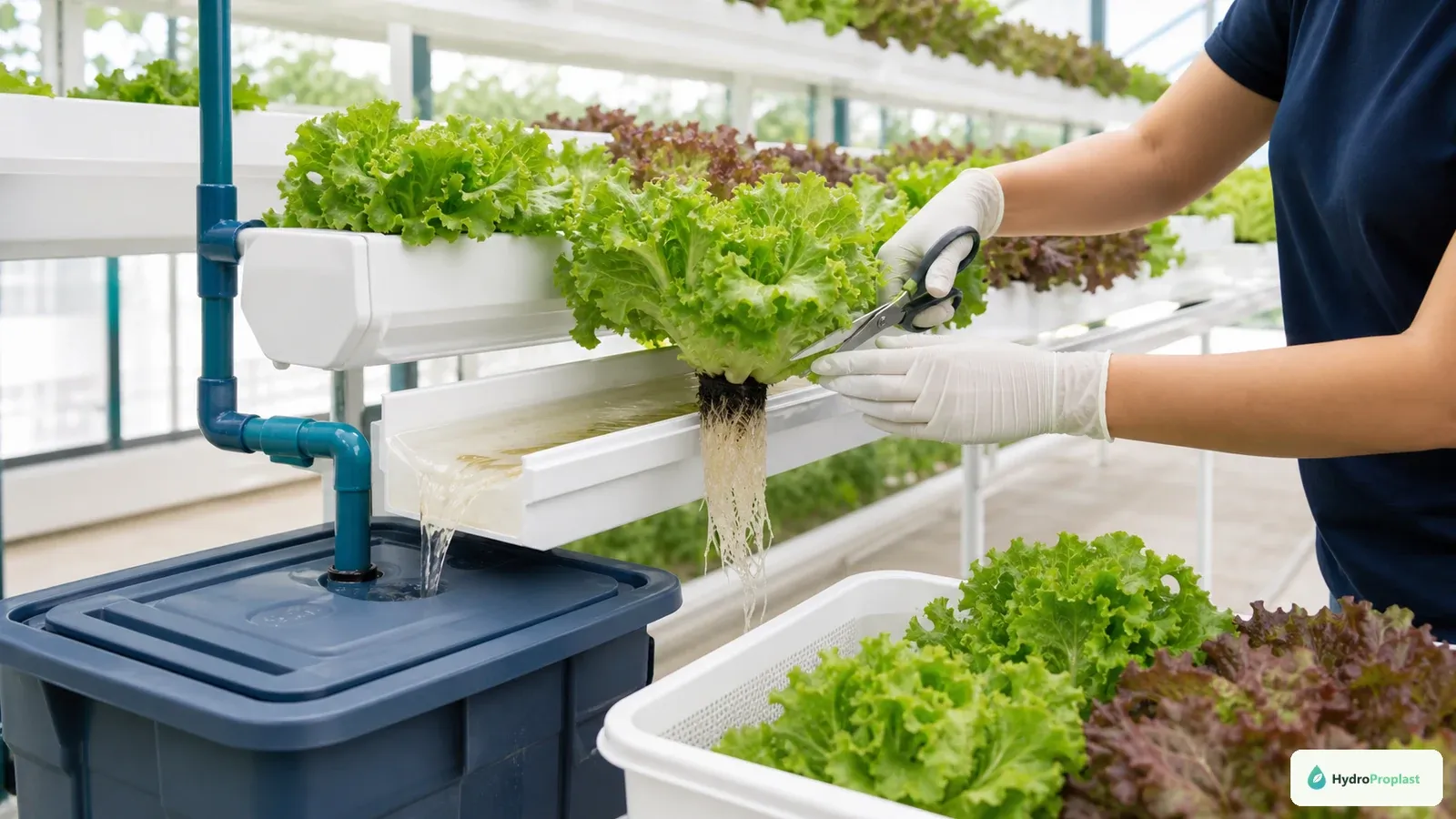
Cut with a sanitized sharp knife above the holder, or lift the plant in a way that keeps roots and nutrient water away from edible leaves. Place heads into clean food-contact containers without compressing them.
For living-root products, food-safety and packaging requirements differ; use an operation-specific plan.
Harvest loose-leaf greens
For cut-and-come-again lettuce, remove mature outer leaves while preserving the central growing point. Keep cuts clean and avoid tearing tissue down into the crown.
Do not remove so much foliage that the plant cannot recover. Harvest frequency depends on cultivar, light, roots, and target leaf size.
Discard leaves with slime, pest contamination, severe disease, or contact with dirty floors. Do not trim around a clearly unsafe decay patch for sale.
Harvest baby greens and microgreens separately
Dense baby-leaf and microgreen crops have different food-safety risks from mature spaced plants. Use a clean blade above the support medium and prevent cut stems from falling onto roots or dirty trays.
Keep harvested product separate from uncut trays and waste. Follow applicable guidance for washing, drying, cooling, and packaging. The FDA’s sprout and seedling guidance concerns related high-risk products; determine which rules apply locally.
When mold, sour odor, slime, or widespread collapse is present, discard the affected crop rather than harvesting around it.
Cut basil for regrowth
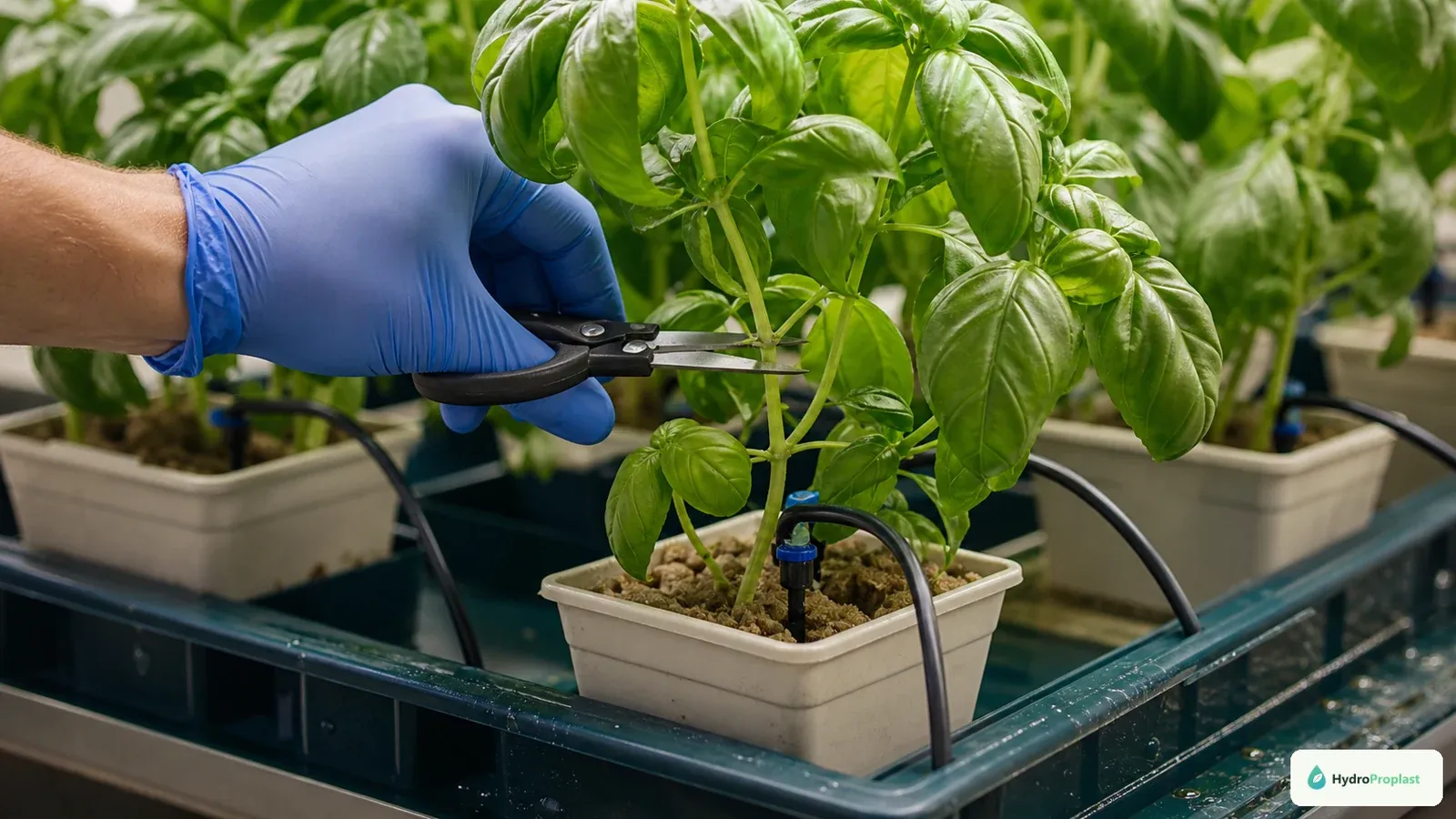
For basil, cut above a node and leave healthy branching tissue when the goal is continued regrowth.
Cut basil tips just above a healthy node, leaving enough leaf area and branching structure for recovery. Use clean sharp scissors and avoid crushing leaves.
Remove flower tips when the production goal and crop plan call for leaf harvest. Do not strip a stressed plant. Keep harvested basil shaded and handle gently; bruising causes darkening and quality loss.
The hydroponic basil guide covers branching and crop age.
Harvest mint, parsley, and chives by architecture
Cut mint stems above nodes and leave a manageable canopy. Harvest parsley from the outer stems while protecting the center. Cut chives above the crown, leaving enough tissue for regrowth.
Different herbs do not share one cutting height. Use crop-specific extension guidance and clean tools between plants, especially when pests or disease are suspected.
Keep aggressive mint roots and old parsley crowns under review; repeated harvest does not make them permanent.
Remove heat promptly
Many leafy greens benefit from rapid cooling after harvest. Move them to suitable refrigeration without delay, using clean containers and allowing cold air circulation.
Do not place large warm loads into a small refrigerator without confirming it can cool them safely. Track product temperature rather than relying only on the thermostat.
Basil and some warm-season herbs can suffer chilling injury at temperatures suitable for lettuce. Store by commodity-specific guidance.
USDA’s FoodKeeper resources provide consumer storage context.
Manage surface moisture
Free water encourages decay and can create condensation inside packages. If washing is used, follow a validated potable-water and sanitation process, then remove excess moisture with clean equipment.
Do not use household bleach or an improvised sanitizer on produce. Commercial wash-water treatment is regulated and requires validated concentration, monitoring, worker protection, and disposal.
Drying must not contaminate leaves with dirty towels, fans, or surfaces.
Select packaging deliberately
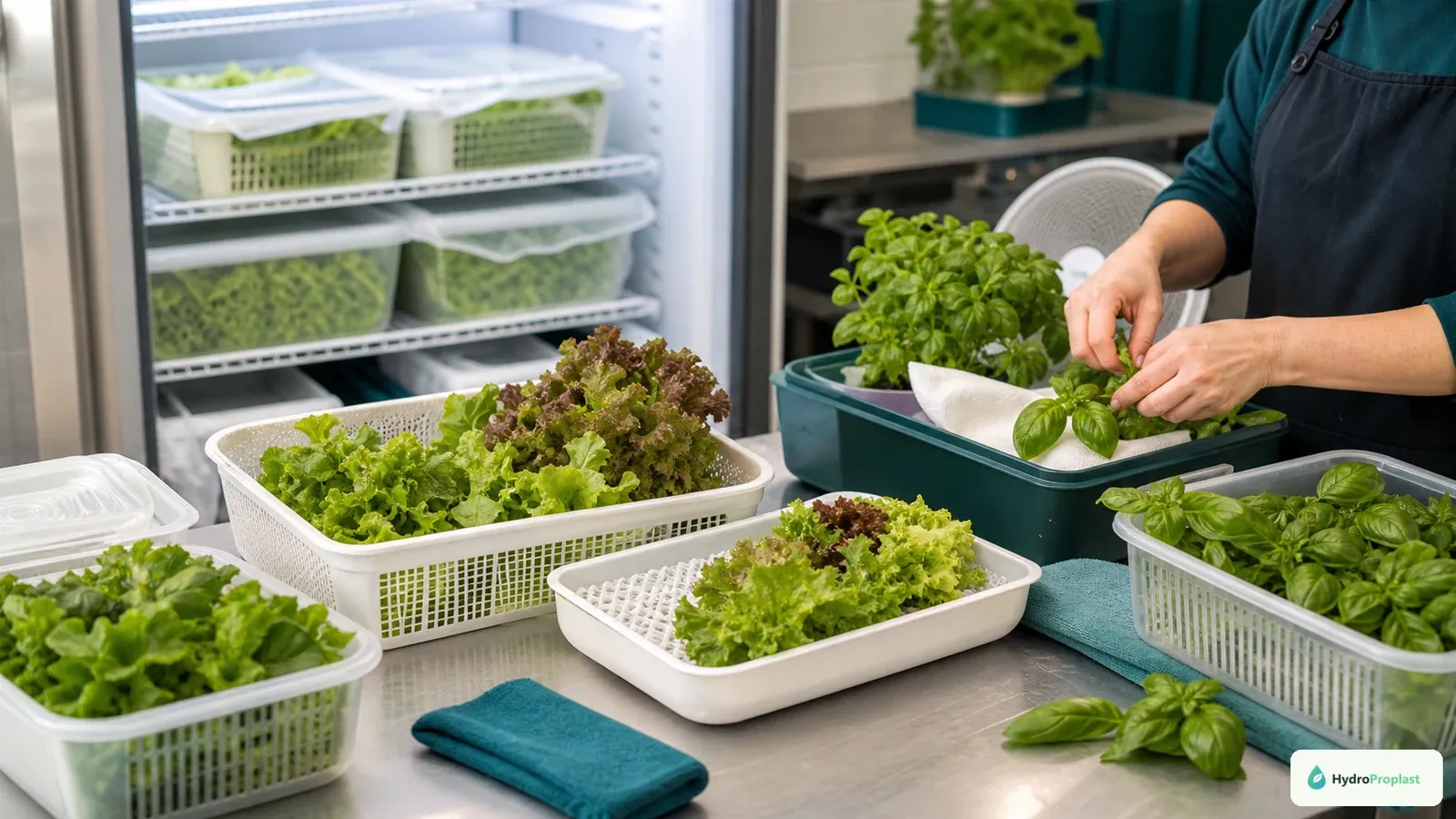
Post-harvest quality depends on cooling where appropriate, surface-moisture control, and packaging suited to each crop.
Packaging should protect leaves without crushing them and manage moisture while meeting food-contact and labeling requirements. Perforation and film properties are commodity-specific.
Pack only product cool enough for the process. Sealing warm wet leaves can create condensation. Avoid overfilled bags that bruise edges and prevent cooling.
Label crop, cultivar or product where relevant, harvest date, lot, and storage instruction for traceability.
Store lettuce and hardy greens
Use clean refrigeration at a temperature appropriate to the commodity and food-safety plan. Protect leaves from freezing, dehydration, ethylene-sensitive interactions, and dirty condensate.
Inspect storage temperature with a verified thermometer. Rotate lots first-in, first-out and remove decaying produce before it spreads moisture and contamination.
Shelf life varies with cultivar, maturity, injury, cooling speed, sanitation, and packaging; do not promise a universal number of days.
Store basil and tender herbs
Basil quality can decline under chilling, while excessive warmth accelerates water loss and decay. Consult crop-specific postharvest guidance for the intended duration and market.
Keep stems and leaves protected from crushing. Do not store wet bunches in a sealed warm package. Evaluate color, aroma, stem condition, and decay each day during a storage trial.
University of Minnesota Extension’s basil guidance provides crop and harvest context.
Create a shelf-life trial
Harvest comparable product from one crop lot. Divide it among intended package and storage conditions while keeping handling documented. Record product temperature, condensation, weight loss, wilting, yellowing, odor, slime, and visible decay.
Do not taste questionable produce. Stop a condition when safety or quality fails. Use the result to set a conservative internal use-by procedure, subject to applicable food-safety rules.
A high harvest weight is not valuable if most product is discarded in storage.
Maintain lot traceability
Assign a lot code linking crop, system, seed or transplant source, harvest date, harvester, treatment records, and storage location. Keep rejected material and reasons.
If a food-safety concern arises, lot records allow affected product to be held or recalled without guessing across every crop.
Commercial distribution requires professional regulatory guidance, labeling, and recall planning.
Clean after harvest
Remove roots, old media, fallen leaves, and crop waste without crossing the clean packing route. Wash harvest tools and containers before label-approved sanitation. Keep waste bins closed and empty them promptly.
For final crop turnover, use the between-crop cleaning guide. Never mix cleaning chemicals, and never use system sanitizer concentrations on food unless the label explicitly covers that use.
Final quality release
Before storage or sale, confirm correct crop and lot, clean appearance, absence of pests and decay, completed harvest interval, suitable product temperature, controlled surface moisture, intact food-contact packaging, and traceability.
Reject produce with unknown chemical exposure, slime, sour odor, widespread disease, dirty-water contact, or broken cold control when safety cannot be established.
A good harvest preserves the quality built in the system. Crop-specific cutting, clean handling, appropriate cooling, moisture control, and traceable storage matter as much as the final days of growth.
Commodity separation plan:
Do not pack lettuce, basil, mint, parsley, chives, and microgreens under one storage assumption. Create a specification for each: harvest stage, acceptable defects, cut location, target product temperature, washing status, packaging, storage condition, and release criteria.
If mixed herb packs are produced, the shortest safe shelf life and most sensitive commodity can limit the whole pack. Validate the combination rather than averaging individual expectations.
Harvest-tool control:
Assign clean tools to the packing area and color-code them away from root and sanitation tools. Inspect blades for rust, cracks, loose fasteners, and trapped plant tissue. Clean before sanitizing because organic debris reduces sanitizer performance.
Any sanitizer must be labeled for the food-contact surface and used at its directed concentration, contact time, temperature, PPE, ventilation, and rinse requirement. Never mix chlorine products with acids, ammonia, peroxide, vinegar, or other cleaners.
Washing decision:
Washing can remove visible debris but also spreads contamination through shared water when poorly controlled. Home users should follow public-health advice. Commercial operations need validated water quality, sanitizer management where applicable, temperature control, monitoring, and corrective actions.
Do not wash produce in the hydroponic reservoir or return wash water to it. Do not rely on washing to make decayed, pest-contaminated, or illegally treated produce safe.
Cooling verification:
Measure product temperature within representative packages, not only refrigerator air. Record harvest time, entry into cooling, and time to the operation’s target. Avoid stacking containers so tightly that cold air cannot move.
Warm product can create condensation inside closed packaging. Pre-cooling and packaging order should be validated for the commodity and facility.
Utah State University Extension provides postharvest information resources that can support commodity-specific research, while local extension services can help interpret practical handling.
Basil quality trial:
Harvest comparable tips from the same crop and divide them among candidate storage methods recommended by authoritative guidance. Evaluate color, aroma, turgor, stem darkening, condensation, and decay at fixed intervals.
Do not infer safety from appearance or aroma alone. The trial establishes quality limits under a documented process; it does not replace food-safety controls.
Lettuce quality trial:
Use heads or leaves of comparable maturity. Record fresh mass, cooling rate, packaging, temperature, condensation, edge browning, wilting, and decay. Handle controls with the same clean procedure.
If one package stays crisp but traps water, quality and microbial risk must both be evaluated. Select the process that maintains clean dry-enough leaves and stable refrigeration.
Cold-chain interruption:
Define the maximum permitted excursion through a qualified food-safety plan. Use time-temperature records for commercial product. If the limit is exceeded or records are missing, hold the lot and obtain qualified disposition guidance.
Do not simply re-cool a questionable lot and reset its shelf-life clock. Traceability must preserve the excursion.
Consumer handling:
Provide storage and washing instructions appropriate to the product and local rules. Keep labels accurate; hydroponic, pesticide-free, organic, washed, and ready-to-eat are distinct claims with regulatory implications.
Do not claim pesticide-free if any crop-protection product was used or records are incomplete. Do not claim sterile or pathogen-free.
The lettuce growing guide provides crop-stage context before harvest.
Final batch record:
Record system, crop, cultivar, seed lot, harvest date and time, workers, treatment clearance, tool sanitation, wash status, cooling times, storage location, package type, yield, rejects, and release decision. Link complaints or spoilage observations back to the lot.
A defensible shelf-life statement comes from repeated lots under controlled handling, not one successful bag. Review the specification when cultivar, season, packaging, refrigerator, washing process, or distribution time changes.