Start with a range you can calculate, not a universal price
The cost to start hydroponics at home can be modest for one passive container or substantial for a lit indoor system, but a single dollar figure would be misleading. Region, crop, existing equipment, electricity price, climate, and desired plant count change the answer. A useful budget has three layers: equipment needed once, supplies replaced each crop, and ongoing energy and water costs.
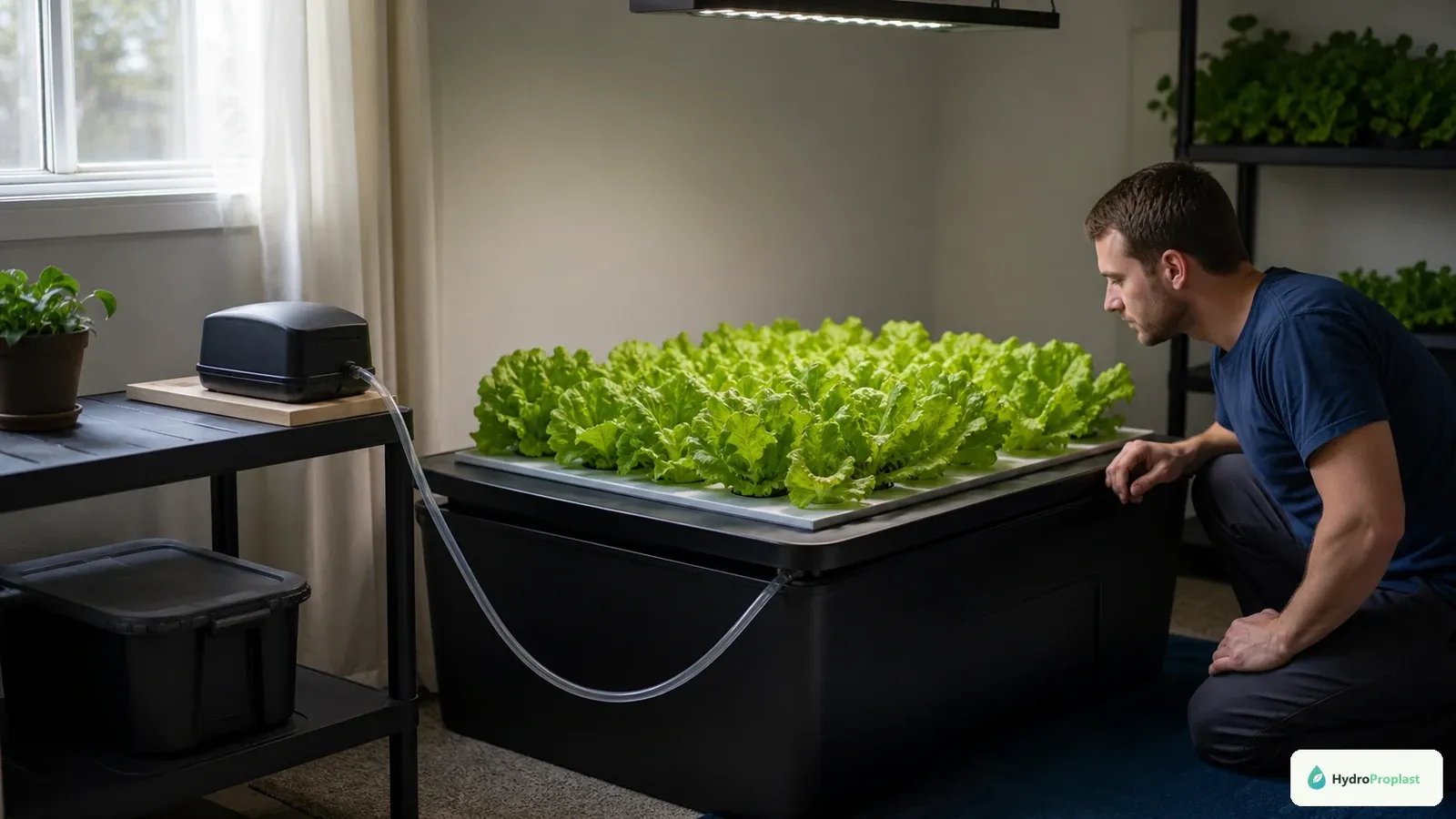
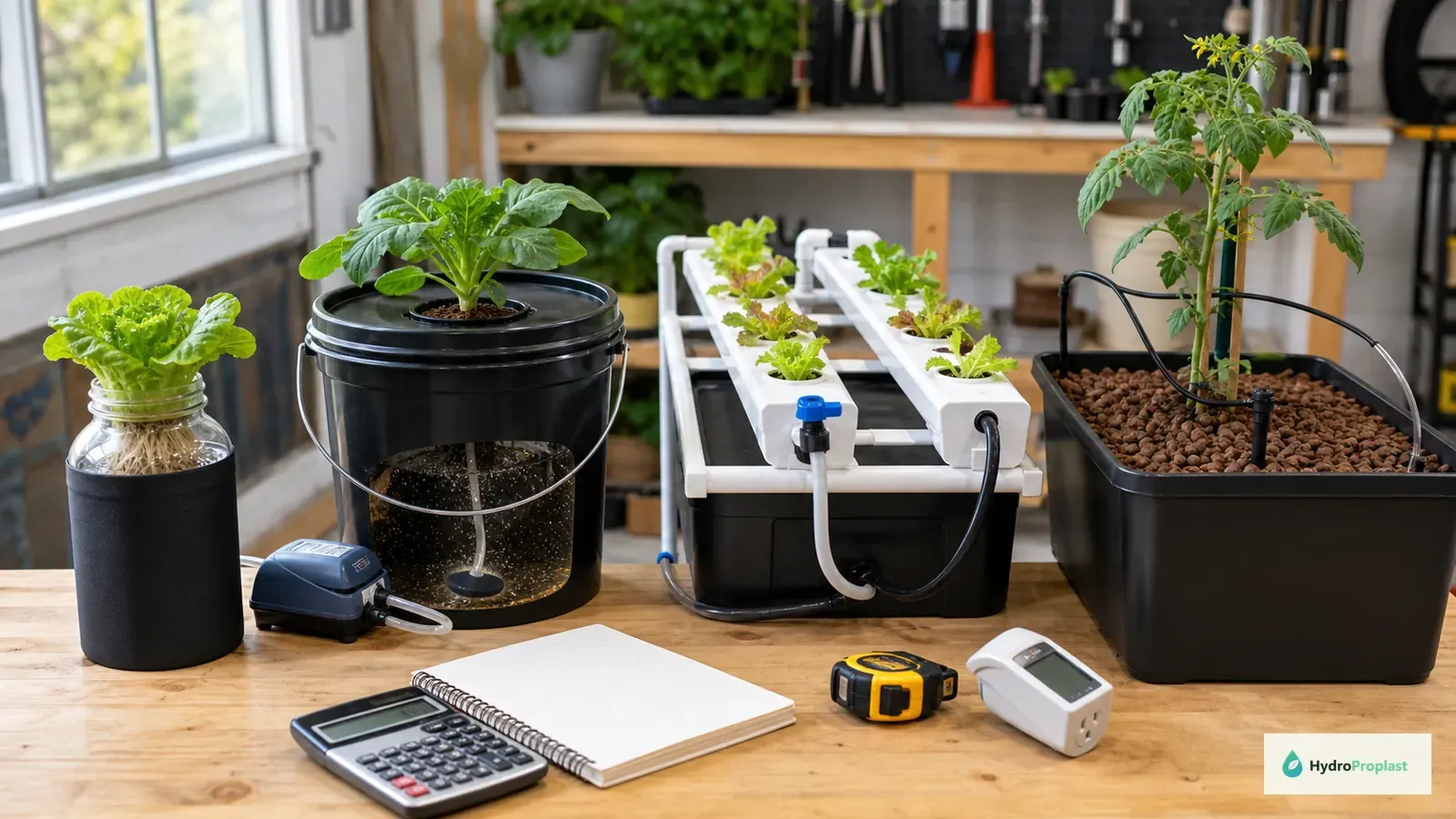
For a first experiment, the lowest-cost credible route is usually an opaque Kratky container for one or two leafy plants using suitable natural light. A small DWC build adds an air pump and related parts but teaches more active reservoir management. A countertop kit bundles the main hardware at a higher convenience price. An indoor DIY rack or fruiting-crop system adds serious lighting, support, ventilation, and often climate costs.
Do not set the budget from the reservoir or kit price alone. A system without adequate light, complete nutrient, safe electrical placement, and a way to check the root environment is unfinished. This guide gives a worksheet so you can insert local prices without relying on temporary product listings.
If the roles of the reservoir, nutrient solution, root oxygen, and growing medium are not yet clear, begin with What Is Hydroponics and How Does It Work? before turning the component list into a shopping list.
Budget in three layers
- Startup equipment: reservoir and structure, aeration or irrigation, lighting when required, meters, tools, and electrical or spill protection.
- Per-crop supplies: seeds, starter media, complete nutrient, pH products, and cleaning consumables.
- Monthly operating cost: electricity, water, climate control, and a replacement reserve.
Define the crop and location before opening a store page
The crop determines much of the budget. Lettuce, basil, and compact herbs can finish in relatively small systems and need no fruit support. Tomatoes, peppers, cucumbers, and strawberries remain in the system longer, use more water and root space, need stronger light, and may require trellising or pollination help indoors.
Location determines whether sunlight or electric lighting carries the crop. A bright window may still provide uneven or insufficient light, especially through winter or for fruiting plants. Outdoor sun can remove the lamp expense but introduces weather, pests, heat, and algae risk. A greenhouse uses sunlight but can require ventilation, cooling, heating, and shading.
Write a one-line project brief: crop, number of mature plants, location, available light, and intended harvest period. “Four lettuces indoors on a shelf” is a budgetable project. “Grow vegetables hydroponically” is not.
The University of Minnesota Extension advises sizing small hydroponic production for the indoor space and crop, and notes that uniform light at plant level is required. That makes measuring the growing area an economic step, not just a layout detail.
One-time system costs
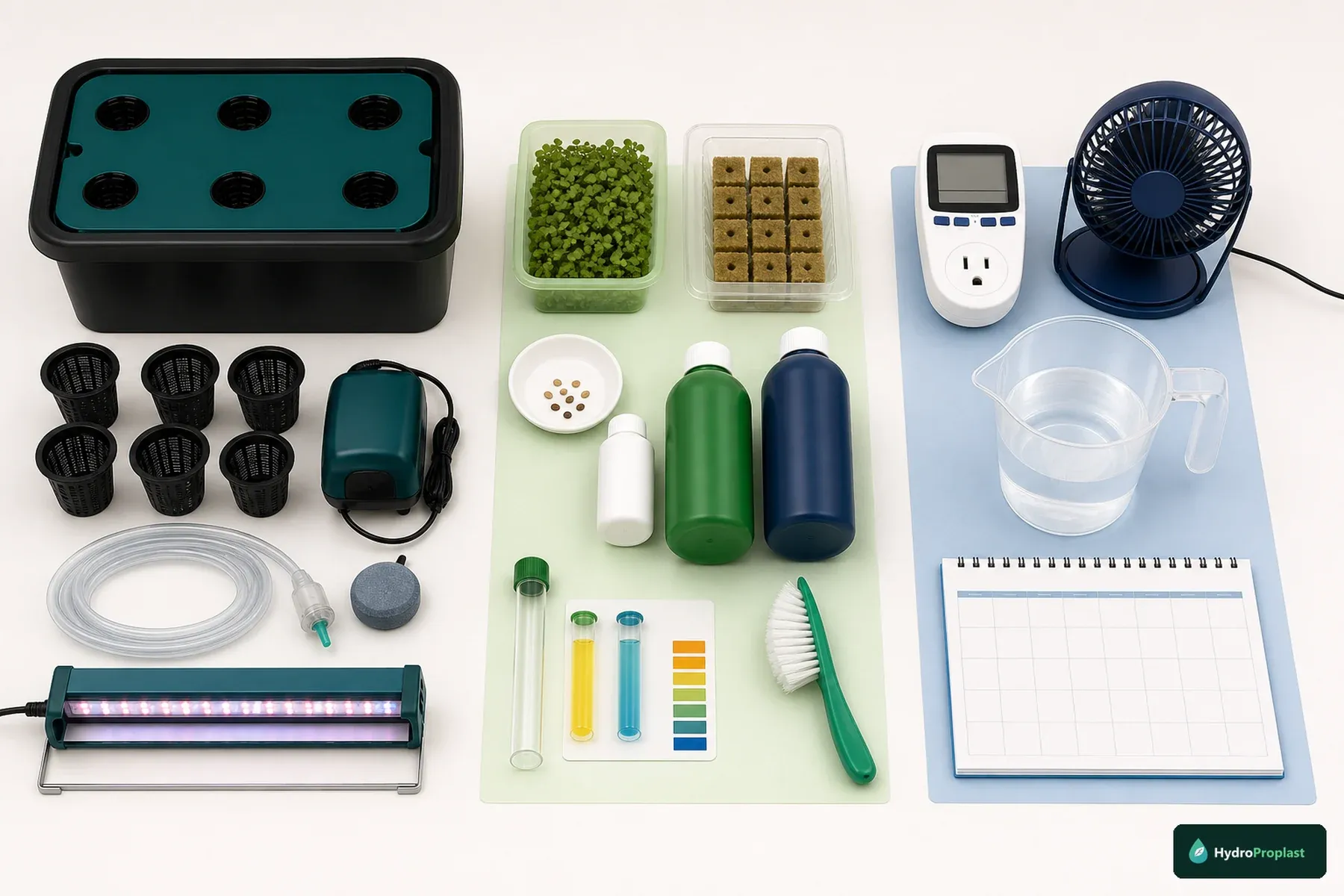
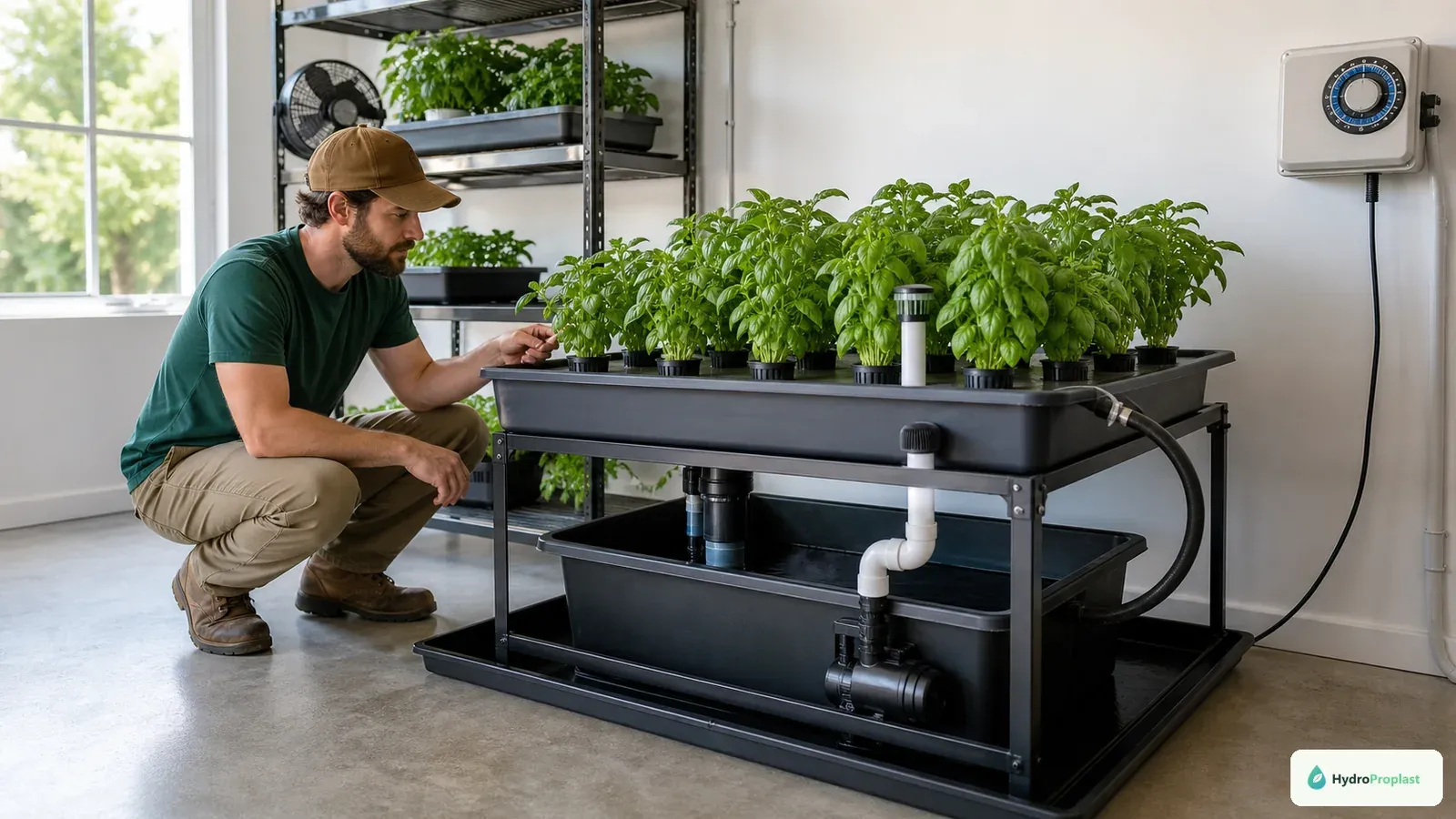
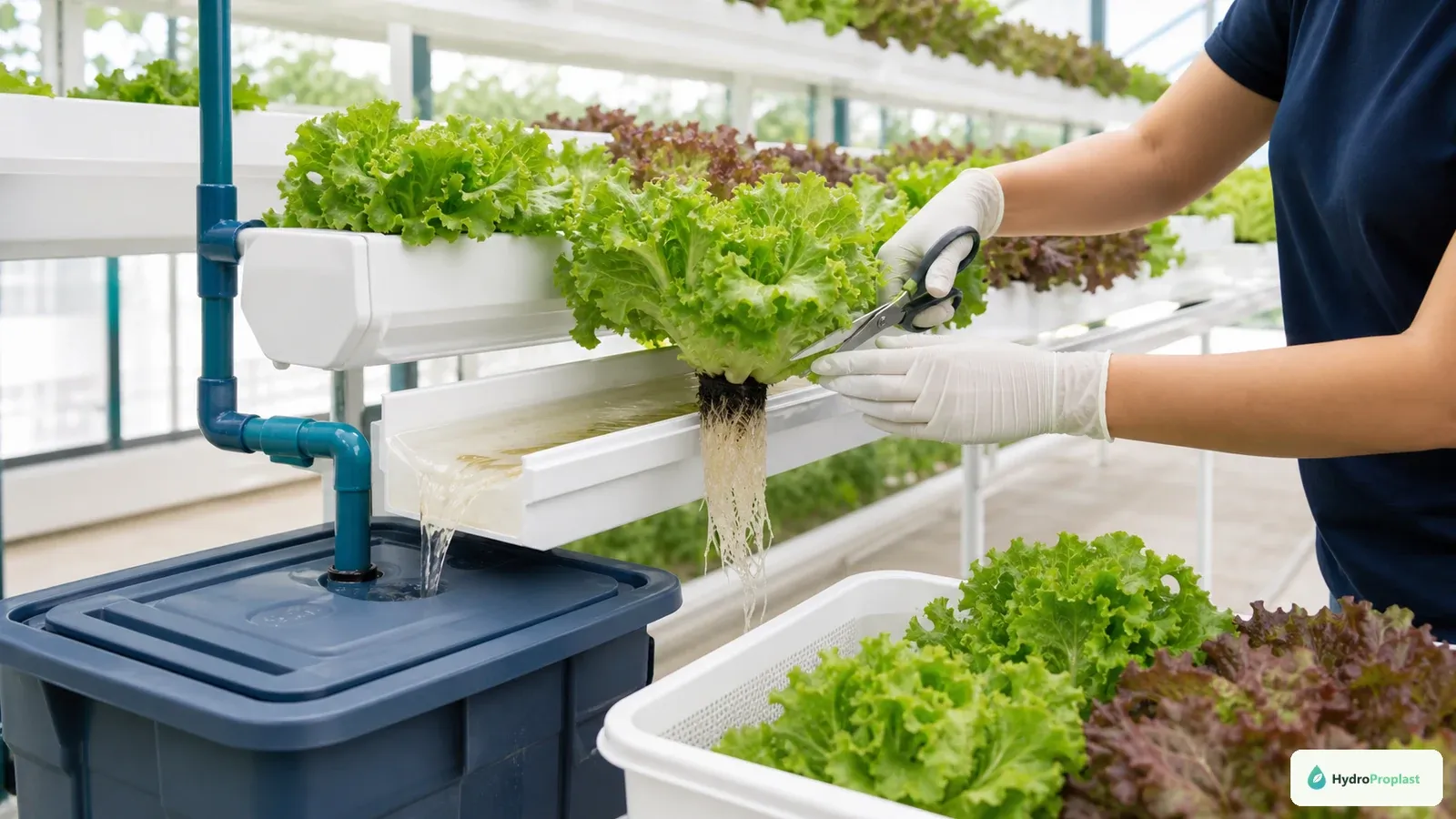
Begin with the wet hardware. Depending on the method, this can include an opaque reservoir, lid or raft, net pots, tubing, fittings, plant supports, and a tray to contain spills. DWC needs an air pump, airline, check valve, and air stone. NFT needs channels, supports, a submersible pump, return plumbing, and adequate reserve volume. Ebb and flow needs a flood tray, drain fittings, pump, timer, and reservoir sized for water displacement. Drip needs a pump, manifold, tubing, emitters, substrate containers, and drainage handling.
Then add the growing environment. An indoor lamp should be selected for crop type and actual canopy area, not only advertised wattage. You may need a timer, adjustable hangers, reflective or washable surrounding surfaces, fan, shelf, trellis, or tent. Heating, cooling, humidification, or dehumidification can exceed the system cost in a difficult room.
Add measurement and safety. A pH test kit or meter is a basic planning item. An EC meter is helpful for tracking dissolved salts, particularly in recirculating systems or higher-value crops. Include calibration and storage solutions when the meter requires them. Use safe outlet placement, drip loops, suitable extension hardware, and spill containment; do not treat these as optional upgrades.
Finally add tools. Measuring cylinders or syringes, a scale if the nutrient requires it, a bucket, cleaning brush, scissors, and possibly drill bits or a hole saw belong in the startup column. Separate reusable tools from components so a second build is not charged twice.
Recurring crop costs
Seeds are usually a small line, but germination supplies repeat. Starter plugs, cubes, or loose medium may be single-use or reusable depending on material and plant health. Start extra seeds to allow for poor germination without filling the budget with unnecessary varieties.
Hydroponic nutrient is a recurring essential. Compare cost per volume of working solution at the recommended concentration, not bottle size alone. Multi-part concentrates may be economical but must be measured and mixed correctly. Do not combine concentrates directly, and do not assume a general soil fertilizer is complete or suitable for recirculating hydroponics.
pH adjustment and meter consumables repeat more slowly. Include calibration buffers, electrode storage solution, replacement probes where applicable, and pH up or down products. Source-water quality can create additional expense for filtration or blending, but test before buying treatment equipment.
Pumps, air stones, tubing, seals, and lamps have finite lives. Their replacement interval varies with quality, duty cycle, water conditions, heat, and maintenance, so avoid invented annual figures. Instead, record purchase dates and keep a small repair reserve. A spare pump can be justified when one device supports many plants or when replacements are difficult to obtain.
Cleaning supplies also belong here. Use materials appropriate for the system and follow product safety directions. Never mix cleaning chemicals. The cheapest system becomes expensive if inaccessible surfaces encourage repeated crop loss.
Electricity: calculate from watts and hours
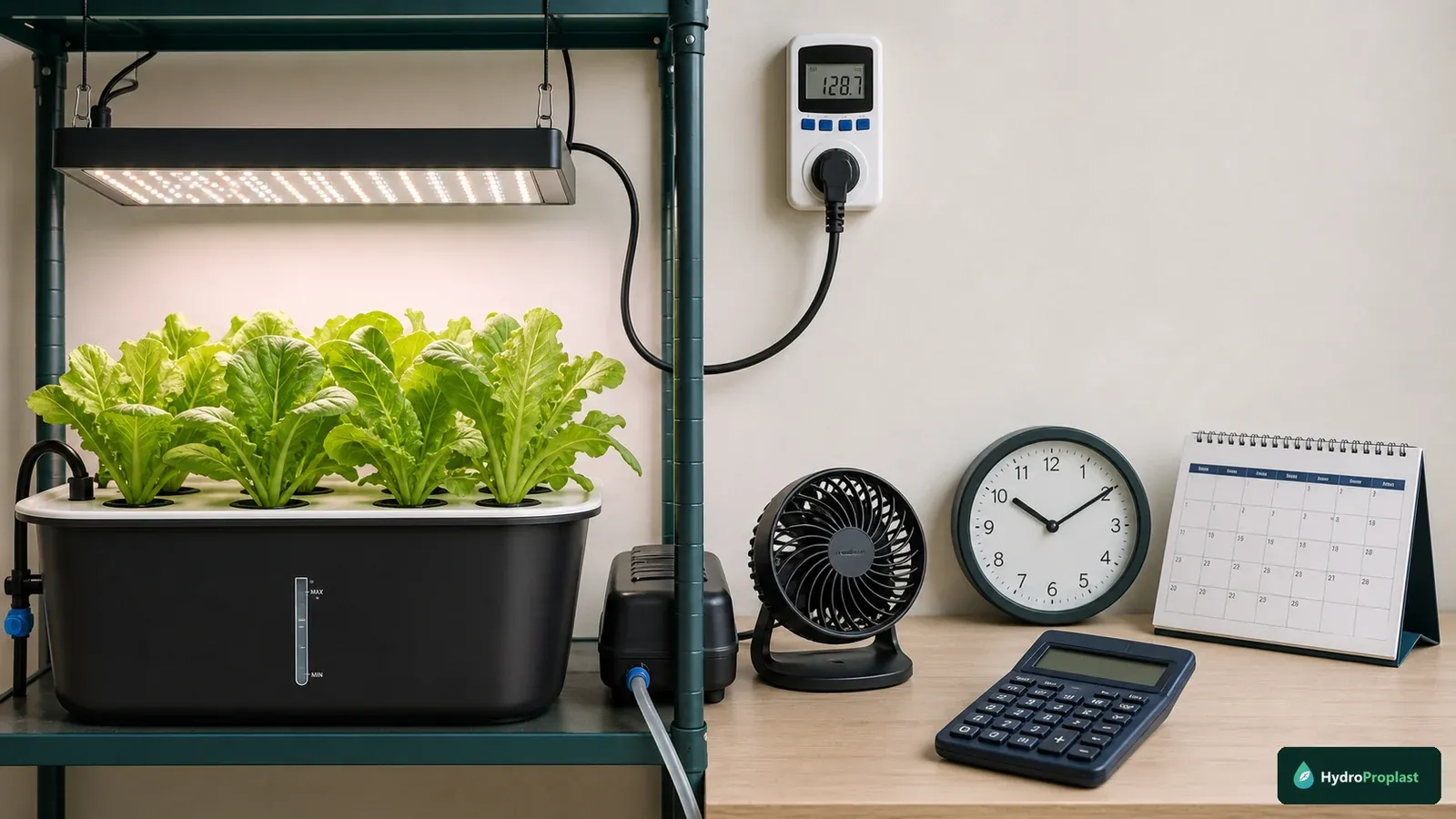
Electricity is the ongoing cost most likely to be underestimated indoors. Calculate each device separately:
monthly kilowatt-hours = watts × hours per day × days ÷ 1,000
Multiply the result by your local electricity rate. Use measured power if you have a reliable plug-in meter; otherwise use the manufacturer’s actual input-power specification rather than a marketing equivalent. A 100-watt lamp operating 14 hours per day for 30 days uses 42 kilowatt-hours. This example is arithmetic, not a recommended lamp size or photoperiod.
Air pumps may run continuously. Water pumps may run continuously or on a timer. Fans, heaters, chillers, and dehumidifiers can cycle unpredictably, so a plug-in energy meter gives a better estimate after operation begins. Climate equipment may dominate the bill in hot, cold, or humid spaces.
The USDA Economic Research Service’s controlled-environment agriculture report notes that controlled systems can reduce some resource use while likely requiring greater energy use. Do not justify indoor hydroponics with water savings while ignoring the lamp and climate load.
Water and nutrient-solution economics
Water cost itself may be small in many households, but source quality and disposal can matter. Measure reservoir volume, top-ups, and full solution changes rather than relying on a generic “uses 90 percent less” claim. Closed recirculating systems recover solution; open drip systems may produce runoff. Leaks and excessive flushing erase theoretical savings.
The system should allow accurate volume measurement. Nutrient labels usually specify a dose per liter or gallon, so an uncertain container volume creates both cost and plant-health errors. Mark working levels after accounting for roots and equipment displacement.
When solution is replaced, follow local guidance for disposal and avoid releasing concentrated nutrient into storm drains or natural waterways. Suitable diluted solution may sometimes be used on compatible ornamental or soil-grown plants, but salinity, crop safety, and local rules matter. The purpose of budgeting is not to stretch solution beyond safe management simply to reduce cost.
The USDA National Agricultural Library’s hydroponics collection links university resources on closed and open systems. Whether water and nutrient are recovered is a design choice; the word hydroponic alone does not guarantee efficiency.
Four starter scenarios
Passive leafy-green trial
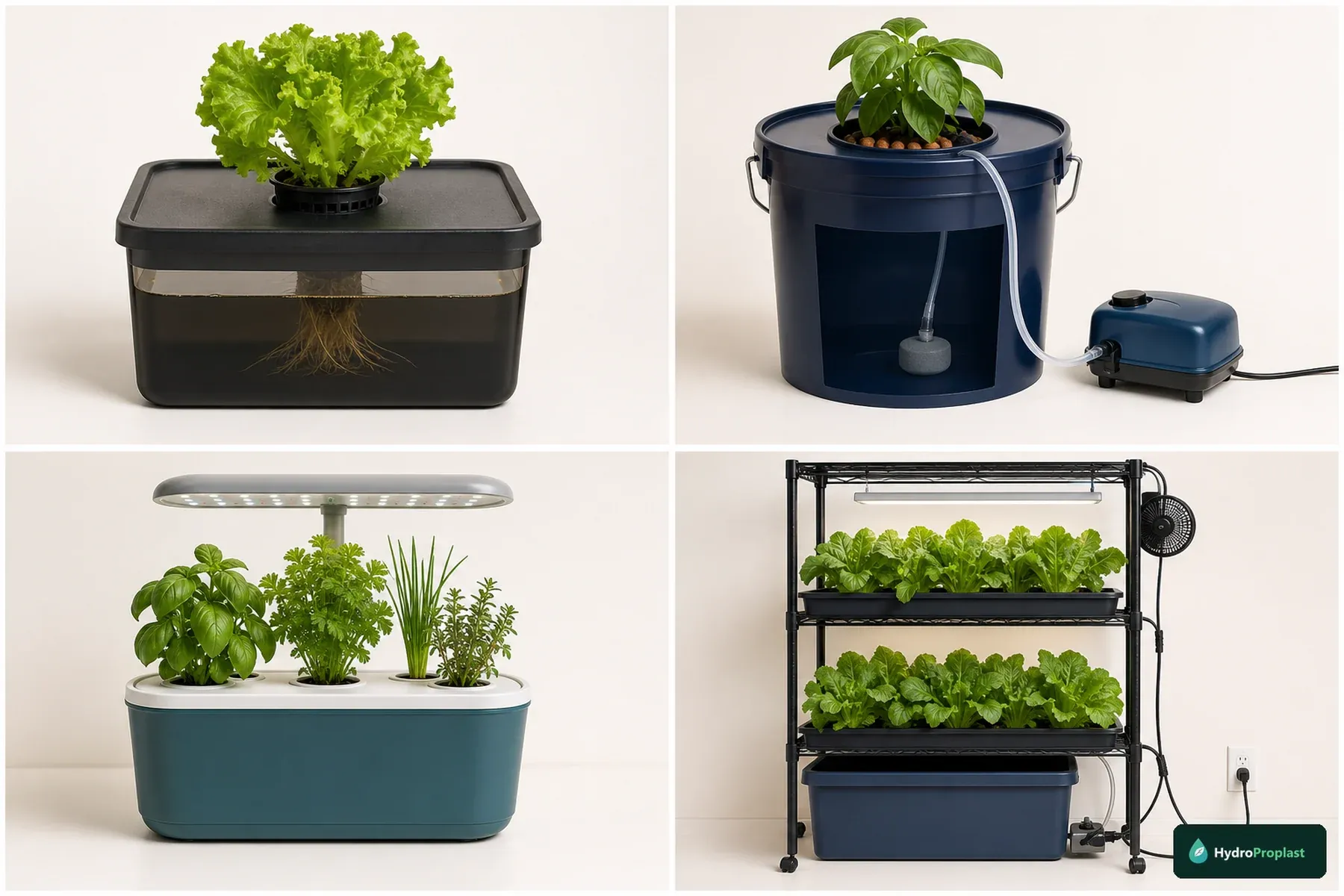
Budget for one or more opaque containers, lids, net pots, starter plugs, seed, complete nutrient, and pH testing. Add a lamp only if the site lacks adequate crop-appropriate light. This is the fewest-component route, but reservoir capacity must match the crop and the Kratky air gap must be managed correctly.
Small DWC project
Add an air pump, airline, check valve, and air stones to the passive list. A larger opaque reservoir can support several lettuces or herbs, but consider whether roots tangle and whether the lid remains removable. The pump’s power use is usually straightforward to calculate, and standard parts can keep replacement costs predictable.
Countertop kit
The purchase price may include reservoir, deck, pump, timer, baskets, and light. Add replacement plugs, seeds, nutrient after the sample runs out, pH testing, cleaning supplies, and any proprietary replacement parts. Evaluate mature plant capacity rather than the advertised number of holes. Our kits versus DIY comparison helps assign a value to convenience and repairability.
Indoor rack or fruiting-crop build
Budget for stronger and broader light coverage, structural shelving, fans, a larger reservoir, pumps, substrate or channels, drainage, trellis support, measurement tools, and possibly climate control. Fruiting crops make this a long operating commitment. Calculate energy and consumables for the whole planned crop period, not one month.
These scenarios should not be converted into fixed price bands without local research. Use them as shopping-list boundaries and obtain current prices from vendors available in your region.
Kit, DIY, used equipment, or repurposed materials
A kit trades component selection for integration. It can be economical when you value time, presentation, and a small footprint. Check lamp height, pump and plug availability, cleaning access, and whether generic consumables fit. A cheap kit that cannot finish the crop is not inexpensive.
DIY can reduce long-term replacement cost through standard parts, especially if you already own suitable tools and lighting. It can also create expensive mistakes: a cracked reservoir, mismatched fittings, undersized pump, or unsafe stand. Leak-test with plain water and include the cost of failed prototypes honestly.
Used equipment deserves careful inspection. Lights and pumps may have unknown operating hours; reservoirs may contain residues; porous media and inaccessible tubing may carry roots or biofilm. Compare the cost of sanitizing and replacing consumables with buying clean components.
Repurposing does not mean any container is suitable. Avoid containers with unknown chemical history. Confirm structural strength when filled—water is heavy—and protect the solution from light. Never cut or modify electrical equipment to make it fit.
Costs that should stop a bad plan early
If adequate lighting and climate control exceed the budget, change the crop, location, or season rather than buying the rest of the system. Seedlings can survive under poor light while producing a disappointing crop; this delays recognition of the problem.
If you cannot access affordable complete nutrients or pH testing, pause. Plain water and a decorative planter are not a sustainable hydroponic setup. If replacement pumps or proprietary parts are unavailable locally, choose standard components.
If spill containment, safe electrical routing, and sufficient structural support do not fit the space, the project is not ready. A filled reservoir should not sit where a leak damages a floor or reaches an outlet. A rack must support the total water, plants, lights, and hardware with margin.
If the only way the budget works is a guaranteed yield or exaggerated grocery saving, reject that forecast. Crop failures, learning time, electricity, and unused harvest all affect payback. Home hydroponics can provide freshness, interest, access, and control without being the cheapest source of produce.
Build a total-cost worksheet
Create rows for reservoir and structure; irrigation or aeration; light and hangers; timer and fan; meters and calibration; seed-starting materials; nutrient and adjustment products; seeds; cleaning; tools; spill and electrical safety; crop supports; and replacement reserve. Add quantity, local unit price, expected reuse, and whether the item is essential before planting.
Below that, calculate monthly energy for every powered device and estimate crop-cycle consumables from label doses and actual reservoir volume. Keep water treatment as zero until testing shows it is needed. Add a contingency for small missing fittings or replacements rather than pretending the list is exact.
Then compare the total with a simpler alternative. Could a beginner DWC or Kratky system meet the same learning goal? Could fewer mature plants fit better under one lamp? Could you grow in sunlight during a suitable season?
Spend in an order that protects the crop
Fund the limiting resources first: adequate light, a sound root-zone system, complete nutrient, measurement, and safety. Decorative enclosures, app controls, extra planting holes, and advanced automation come later. Buy equipment for the first defined crop rather than an imagined future farm.
Keep the initial system reversible. Independent lights, standard pumps, net pots, and simple opaque reservoirs can be reused if you change methods. Record purchase price, power, and replacement specifications so the second crop has a real cost history.
The best startup budget is not the smallest total. It is the smallest complete system that you can operate safely, clean thoroughly, and run for an entire crop. Once you have one cycle of water, energy, nutrient, and replacement records, your own data becomes more valuable than any generic price estimate.