The best hydroponic grow medium is not a universal product. It is the material that gives roots enough air, holds an appropriate amount of moisture, stays stable in the chosen system, and fits the grower’s irrigation routine. A medium that performs beautifully under frequent drip pulses can stay dangerously wet in a passive container. A loose material that works in a deep net pot may fall straight through a small cup.
This guide compares common media by function rather than popularity. It will help home growers choose a practical option for seedlings, net pots, drip systems, ebb-and-flow beds, and indoor vegetables.
What a hydroponic medium actually does
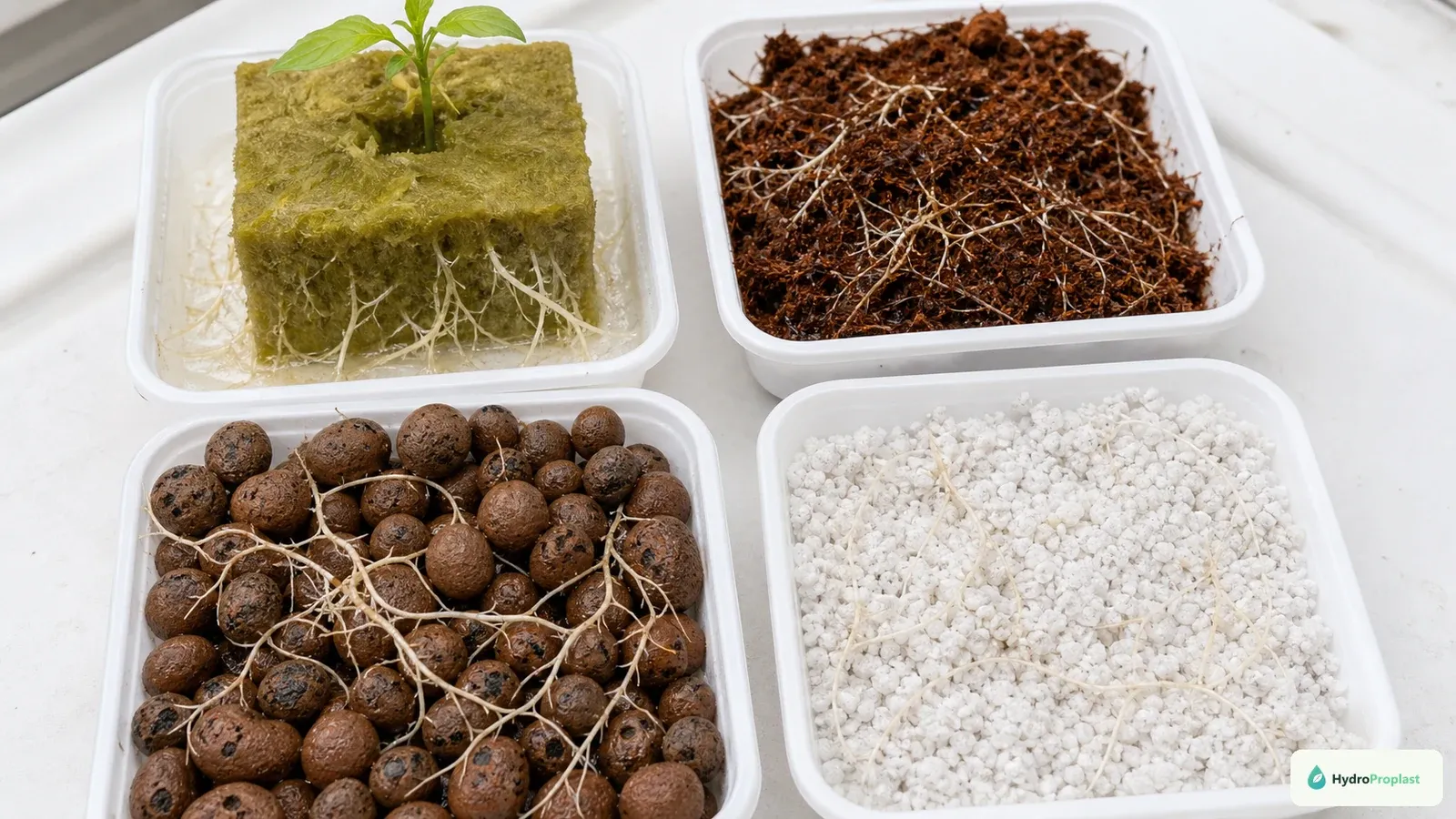
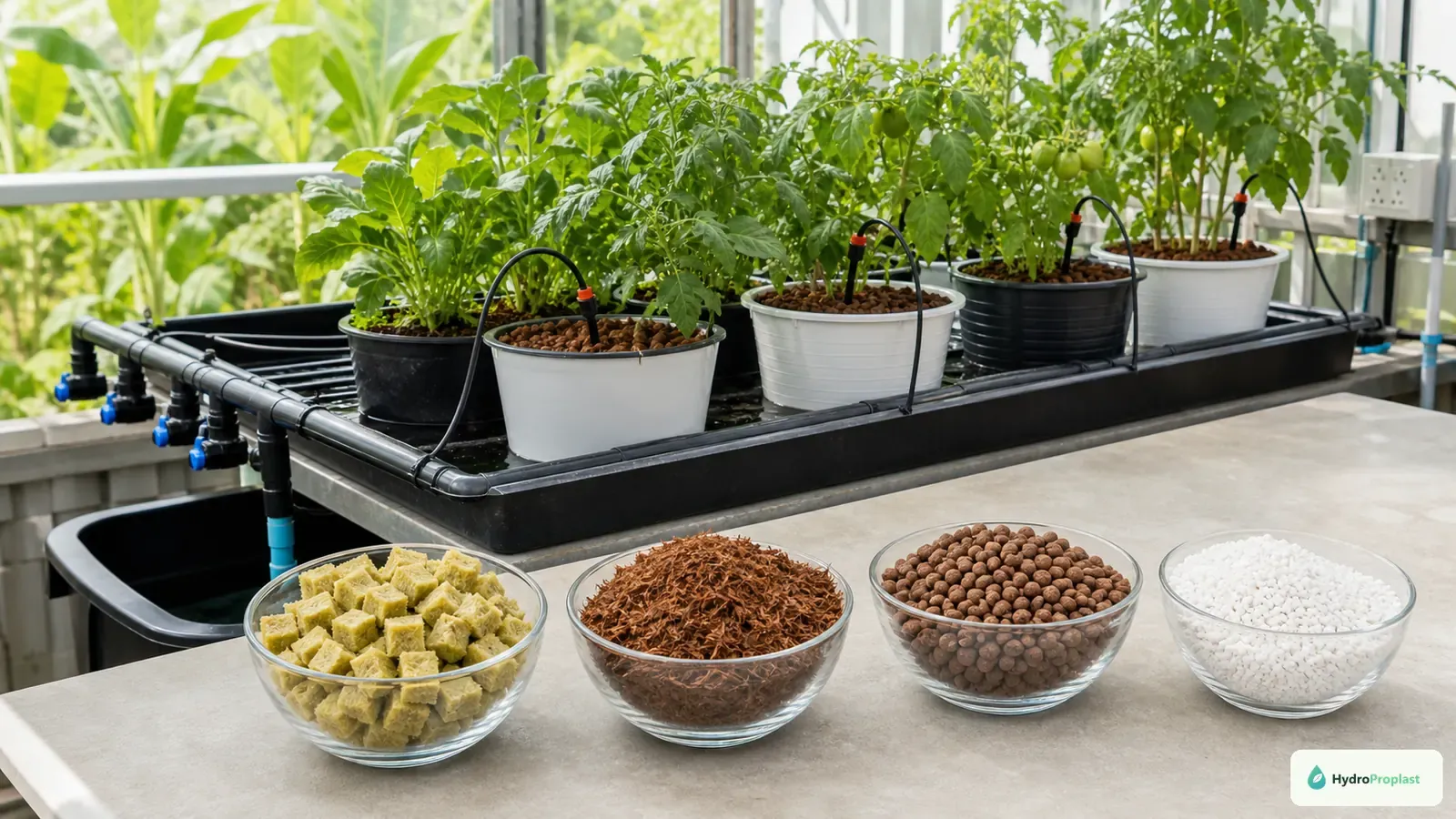
Compare water retention, air space, structural support, and root contact before choosing a medium.
Hydroponic media do not feed plants in the way fertile soil does. Nutrients arrive in the solution. The medium mainly supports the plant and manages the balance between water and oxygen around its roots.
A useful medium creates pores of different sizes. Larger pores drain and refill with air. Smaller pores retain moisture between irrigations. Particle shape, compression, container depth, root density, and irrigation frequency all change that balance. Product names alone therefore cannot predict performance.
A good choice should also be reasonably clean, chemically stable, easy to handle, and compatible with the pump and plumbing. The Oklahoma State University overview of soilless growing media explains how physical properties such as porosity, water retention, and bulk density affect root-zone performance.
Start with the hydroponic system
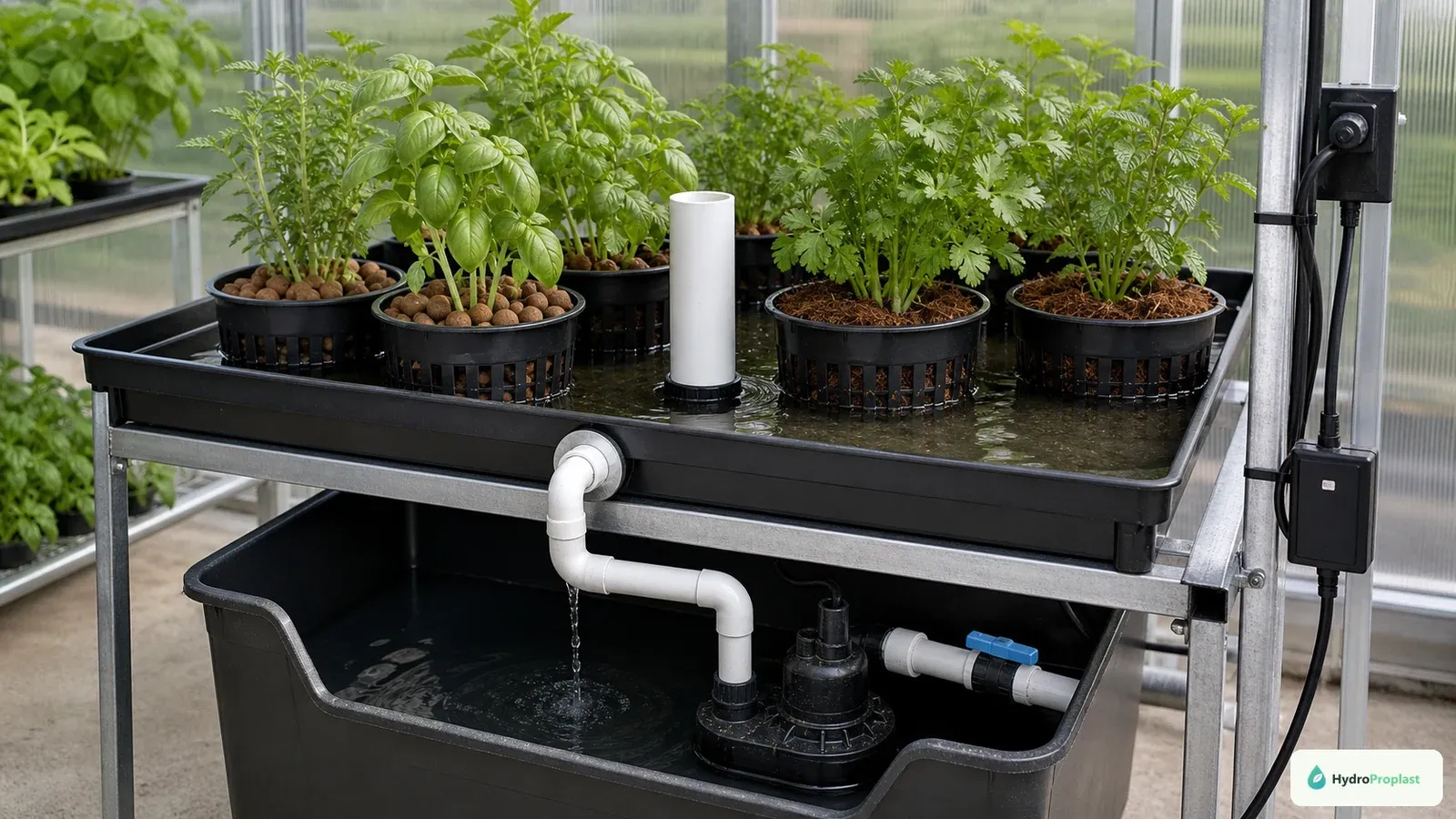
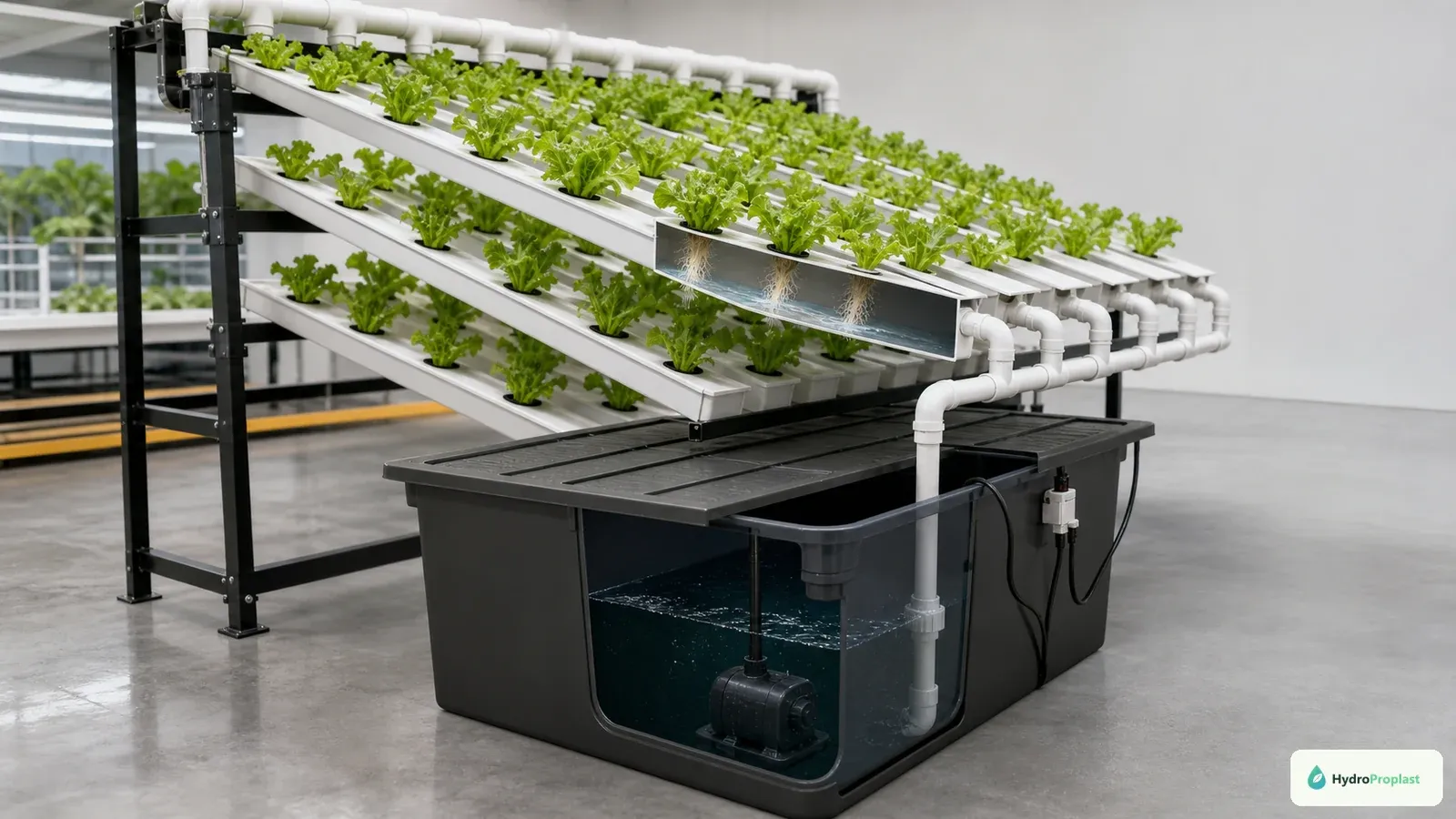
Ebb and Flow media must hold roots securely while accepting a temporary flood and draining freely afterward.
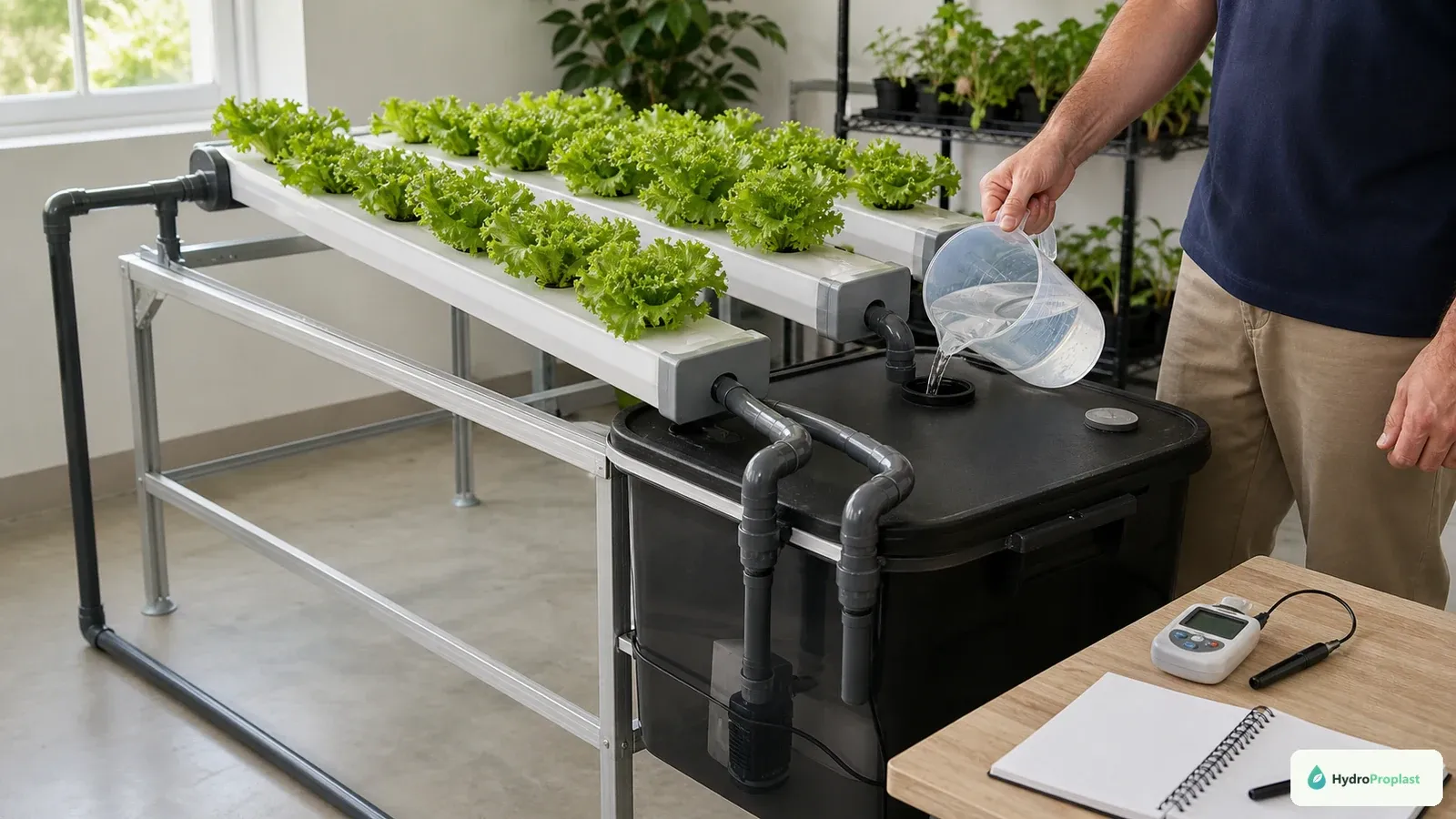
In deep water culture, roots eventually hang in aerated solution. The medium only needs to anchor the crown in a net pot, so a small quantity of coarse, stable material is usually enough. In drip irrigation, the medium is the working root zone and must distribute repeated doses without remaining saturated. Ebb-and-flow containers need media that wet evenly during flooding yet drain promptly afterward.
NFT channels often use little or no loose medium after establishment. The seedling plug supports the plant while roots enter the nutrient film. Passive systems such as Kratky need a stable crown position and a deliberate air gap; the medium must not wick excessive water into the stem.
If the system is still undecided, compare the best hydroponic systems for beginners before purchasing a large bag of material.
Rockwool and mineral-wool cubes
Rockwool cubes are uniform, lightweight, and convenient for germination and transplanting. Their shape fits many propagation trays and net pots, and roots can grow through the fibers easily. They are especially useful when seedlings must move from a tray into NFT, DWC, or drip equipment with minimal root disturbance.
The main risk is water management. A cube can look dry on top while remaining saturated in its lower half. Leaving cubes in standing water reduces oxygen and encourages weak roots. Pre-moisten them evenly, allow drainage, and irrigate according to cube weight rather than a rigid clock.
Mineral wool is not biodegradable and its dry fibers can irritate skin and lungs. Handle dry products gently and follow the manufacturer’s safety directions. Some products may require initial pH conditioning; use the current product instructions rather than relying on a universal soaking recipe.
Coco coir
Coco coir retains substantial moisture while preserving useful air space when its structure is good. It is popular for drip-irrigated peppers, tomatoes, cucumbers, and herbs. It can be used alone in suitable containers or blended with perlite to increase drainage and reduce compaction.
Quality varies. Poorly processed coir may contain excess salts, fine dust, or inconsistent particle sizes. Choose a horticultural product that has been washed and buffered, and check runoff EC before planting when quality is uncertain. Coir can also interact with calcium and magnesium, so nutrient programs designed for inert media may need adjustment.
Because coir stays moist, new growers commonly irrigate too often. Let crop size, container volume, drainage, and measured root-zone conditions guide the schedule. Do not let runoff sit around the container base.
Expanded clay pebbles
Expanded clay pebbles are coarse, reusable, and highly aerated. They are well suited to net pots, DWC lids, flood-and-drain buckets, and recirculating systems where rapid drainage matters. Their weight supports larger plants better than a tiny foam collar, while their large particles are less likely than fine media to clog plumbing.
Clay pebbles hold less readily available water than coir or fine vermiculite. Young transplants may therefore need careful top watering until roots reach the irrigated zone. Rinse new pebbles thoroughly to remove dust. Between crops, remove roots, clean, and sanitize according to a safe system-cleaning process; visibly degraded or impossible-to-clean material should be replaced.
They are reusable, but reuse is not automatically sustainable if cleaning consumes excessive water or spreads disease. Keep batches associated with healthy crops separate from suspect material.
Perlite and vermiculite
Perlite is very light and creates drainage and aeration. It is commonly blended with coir rather than used loose in exposed recirculating systems. Dry perlite dust is irritating, and floating particles can escape pots or enter reservoirs. Moisten it before handling and contain it in an appropriate pot or fabric liner.
Vermiculite holds more water and has greater nutrient-holding capacity. It can help a blend retain moisture, but too much may keep the root zone wet and compress over time. Perlite and vermiculite are not interchangeable: one generally opens the mix, while the other generally increases retention.
A simple coir-perlite blend is often forgiving in drain-to-waste drip containers, but there is no magic ratio for every crop and climate. Begin with the medium manufacturer’s crop guidance, observe drainage, and change only one variable at a time.
Seed-starting plugs
Compressed peat, coir, foam, and bonded-fiber plugs make transplanting tidy. The important traits are consistent moisture, enough air, structural integrity, and a size that fits the final holder. A plug should stay together during transfer without strangling emerging roots.
Do not bury a wet plug deeply inside another water-retentive medium. Keep the plant crown above persistent moisture and make sure the plug can drain. For a complete propagation routine, see how to germinate seeds for hydroponics.
Product chemistry matters at this stage because seedlings have little buffering capacity. Use clean water and a mild, crop-appropriate nutrient program only after emergence and early establishment. The Oklahoma State University hydroponics guide provides useful background on system and nutrient management.
Matching media to common crops
Leaf lettuce and basil in NFT usually need only a propagation plug. In DWC, the plug may be surrounded by clay pebbles for stability. Fruiting crops in drip containers need a larger root volume; coir or an engineered coir-perlite blend is often easier to irrigate evenly than a pot filled only with coarse pebbles.
Microgreens are different because the crop is harvested young. Mats, shallow soilless media, or purpose-made pads may be appropriate depending on the method. Review the hydroponic microgreens setup guide rather than applying mature-plant rules to a short-cycle tray.
Large cucumbers and tomatoes also require physical support independent of the root medium. A grow bag cannot replace trellising, clips, or a stable frame.
How container geometry changes performance
A tall narrow container and a shallow tray filled with the same material will not hold identical air-water profiles. Water tends to remain in a saturated layer near the bottom after drainage. In a shallow container, that layer occupies a larger fraction of the root zone.
This is why copying an irrigation schedule from another grower often fails. Pot height, total volume, emitter output, room temperature, airflow, plant size, and drainage path all matter. Test the assembled container before planting: wet it evenly, allow it to drain, and inspect whether water pools at the bottom.
Cleanliness, reuse, and disposal
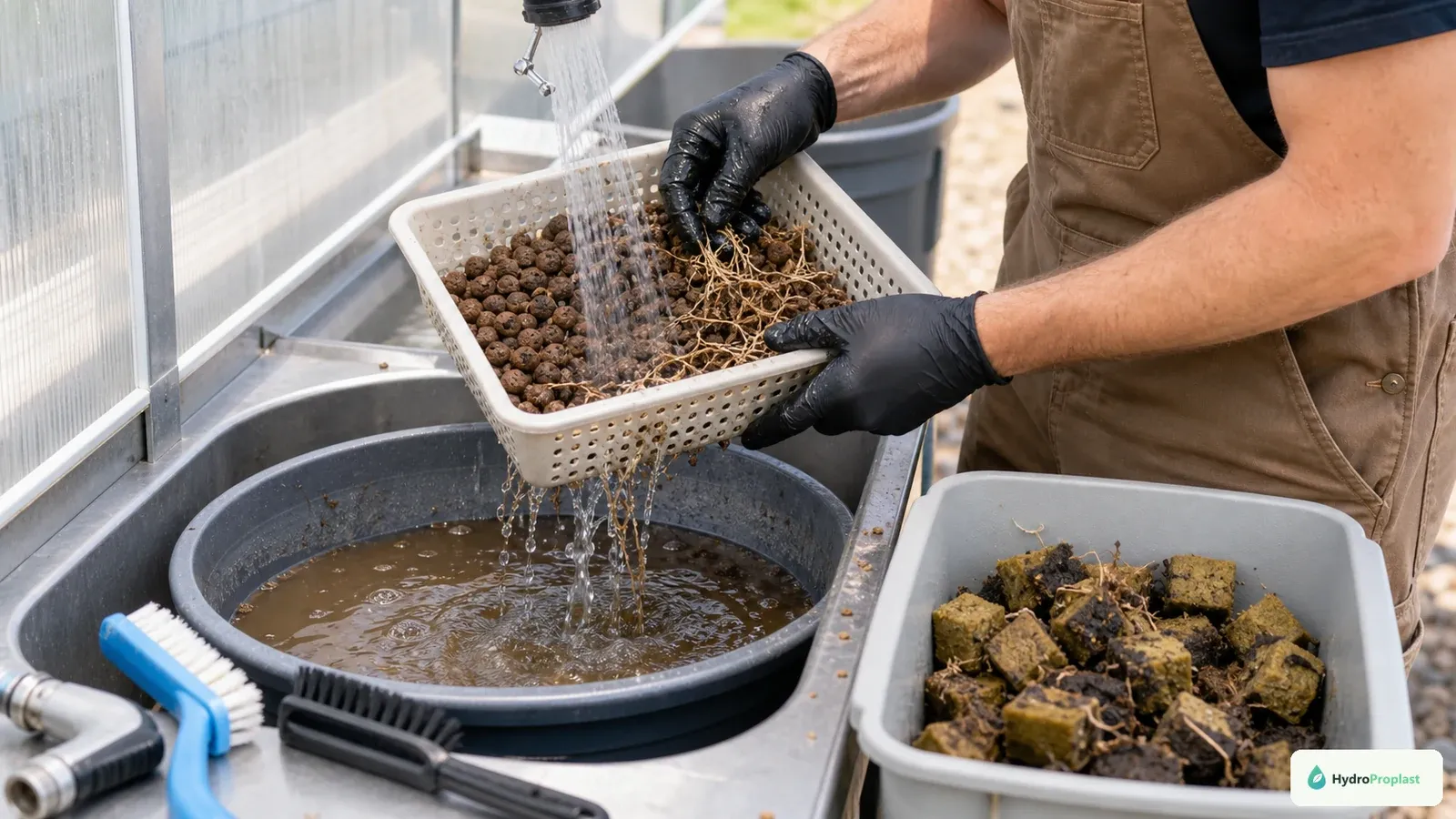
Clean reusable media thoroughly and keep disposable starter materials separate to avoid carrying roots and pathogens forward.
Rinse dusty inert media before they enter a system, but do not assume rinsing sterilizes them. At crop change, remove roots and organic debris first. Cleaning makes sanitizing more effective. Never mix household chemicals casually, and follow label concentrations and contact times.
Porous organic materials are difficult to restore after root disease. Reusing them can carry pathogens into the next crop. Coarse clay may be reusable when roots can be removed and the material can be cleaned thoroughly. Single-use plugs are normally discarded.
For a full turnover sequence, use the guide to cleaning a hydroponic system between grows.
Cost should be measured per successful crop
A cheap medium is expensive if it causes lost seedlings, clogged pumps, or constant hand watering. Include shipping weight, storage, preparation, replacement frequency, and disposal. Locally available, consistent material often beats an exotic option that cannot be replaced during the season.
Small trials are valuable. Run two identical containers with different blends while keeping cultivar, light, nutrient solution, and irrigation as similar as possible. Record container weight after irrigation, time to drain, runoff EC and pH, root appearance, and plant growth.
Common selection mistakes
Choosing by water retention alone is the biggest error. Roots need oxygen as well as moisture. Other mistakes include packing a medium too tightly, allowing fine particles into pumps, placing stems below a permanently wet surface, and changing both the medium and nutrient formula at the same time.
Do not diagnose every leaf symptom as a medium problem. Check root-zone temperature, oxygen, pH, EC, light, and pests. The Oklahoma State EC and pH guide explains why solution measurements need to be interpreted together.
A practical selection checklist
Before buying, answer these questions:
- Will roots sit in solution, receive intermittent floods, or depend on drip irrigation?
- How often can the system be inspected?
- Does the crop need a small plug or a large supported root volume?
- Can particles escape into pumps and tubing?
- Does the product have consistent horticultural quality?
- Can it be rinsed, stored, cleaned, reused, or disposed of safely?
- Does its moisture behavior match the room’s heat and airflow?
For many beginner systems, the simplest answer is a propagation plug plus rinsed clay pebbles in a net pot. For larger drip-grown crops, quality coir or a coir-perlite blend is often practical. The best medium is the one whose moisture and aeration behavior you can observe and manage consistently—not the one with the longest list of claimed benefits.
A home comparison test:
Fill two identical containers to the same depth, one with each candidate medium. Add equal volumes of water slowly, allow complete drainage, and weigh or measure what remains. Repeat after the media have been wetted and dried several times. This does not replace laboratory porosity testing, but it reveals obvious differences in retention, drainage speed, settling, and handling.
Then run a small crop trial with matching plants. Use the same nutrient batch, light zone, container geometry, and irrigation hardware. Observe how quickly the upper and lower zones dry, whether emitters distribute water evenly, and whether roots remain white or naturally nutrient-stained without odor or slime. Record runoff volume and trends rather than reacting to one reading.
Media can also alter system maintenance. Fine particles may collect in filters and pump housings. Organic fragments can support biofilm. Very light particles can float during flooding and shift the plant. A useful trial therefore includes inspection of plumbing and reservoir cleanliness, not only leaf growth.
When changing media mid-season:
Do not strip a healthy established root ball merely to adopt a fashionable substrate. Root damage and altered irrigation can outweigh any theoretical benefit. Change at propagation or between crop cycles when possible. If an emergency transplant is necessary, preserve healthy roots, provide temporary support, and monitor the plant more closely until new roots colonize the material.
Store unused media dry, covered, and away from pests and chemical contamination. Label opened batches so an unexpected salt or pH issue can be traced. Keep product specifications and lot information when consistency matters across successive plantings.
A robust medium-management plan includes a defined irrigation trigger, a drainage path, a way to inspect roots, and a crop-change procedure. Once those pieces are clear, product selection becomes simpler: choose the least complicated material that reliably provides the needed air, moisture, and support in the actual container.