Vertical hydroponics can turn limited floor space into useful growing area, but only when every tier receives enough light, water, drainage, airflow, and access. A short, serviceable rack is often more productive than the tallest tower that fits under the ceiling.
Vertical growing saves floor area, not complexity
Vertical hydroponics stacks or tiers plant sites so more canopy occupies a small footprint. It can be useful in apartments, balconies, indoor rooms, and greenhouses where horizontal space is scarce. It does not create light, headroom, water pressure, structural strength, or maintenance access; those constraints often become harder when plants are stacked.
Choose a vertical design for compact leafy greens, herbs, or strawberries when you can light every tier, catch every drain, support the full wet weight, and reach the top and bottom safely. Avoid it when one pump would lift beyond its capability, a leak could damage living space, or mature plants would shade one another.
The best small-space system is often a short two- or three-tier rack rather than the tallest tower available. Density should be measured in healthy mature canopies, not empty planting holes.
Three layouts sold under one name
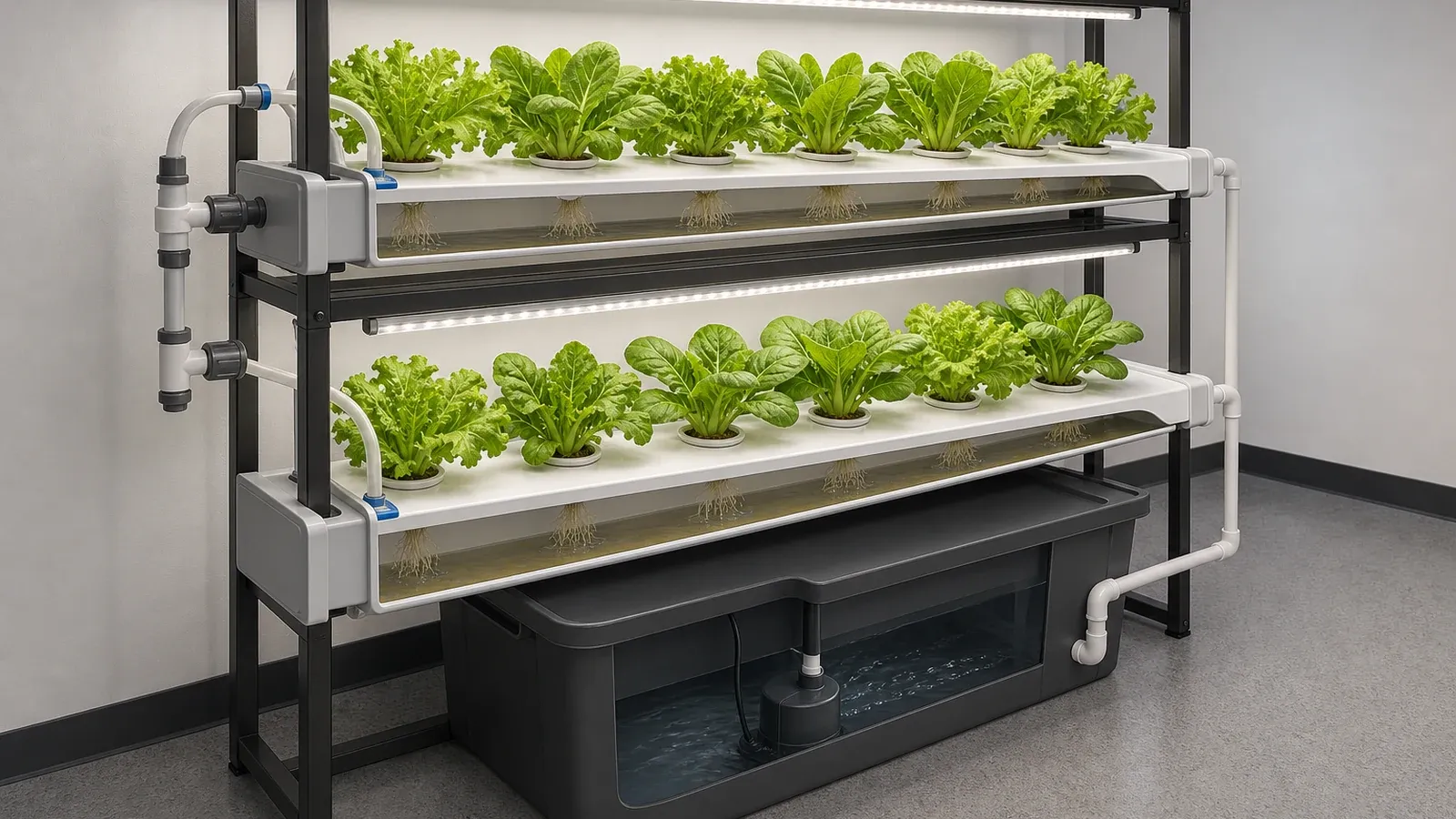
A short NFT rack gives every tier its own light and keeps the sloped supply and return channels accessible for inspection.
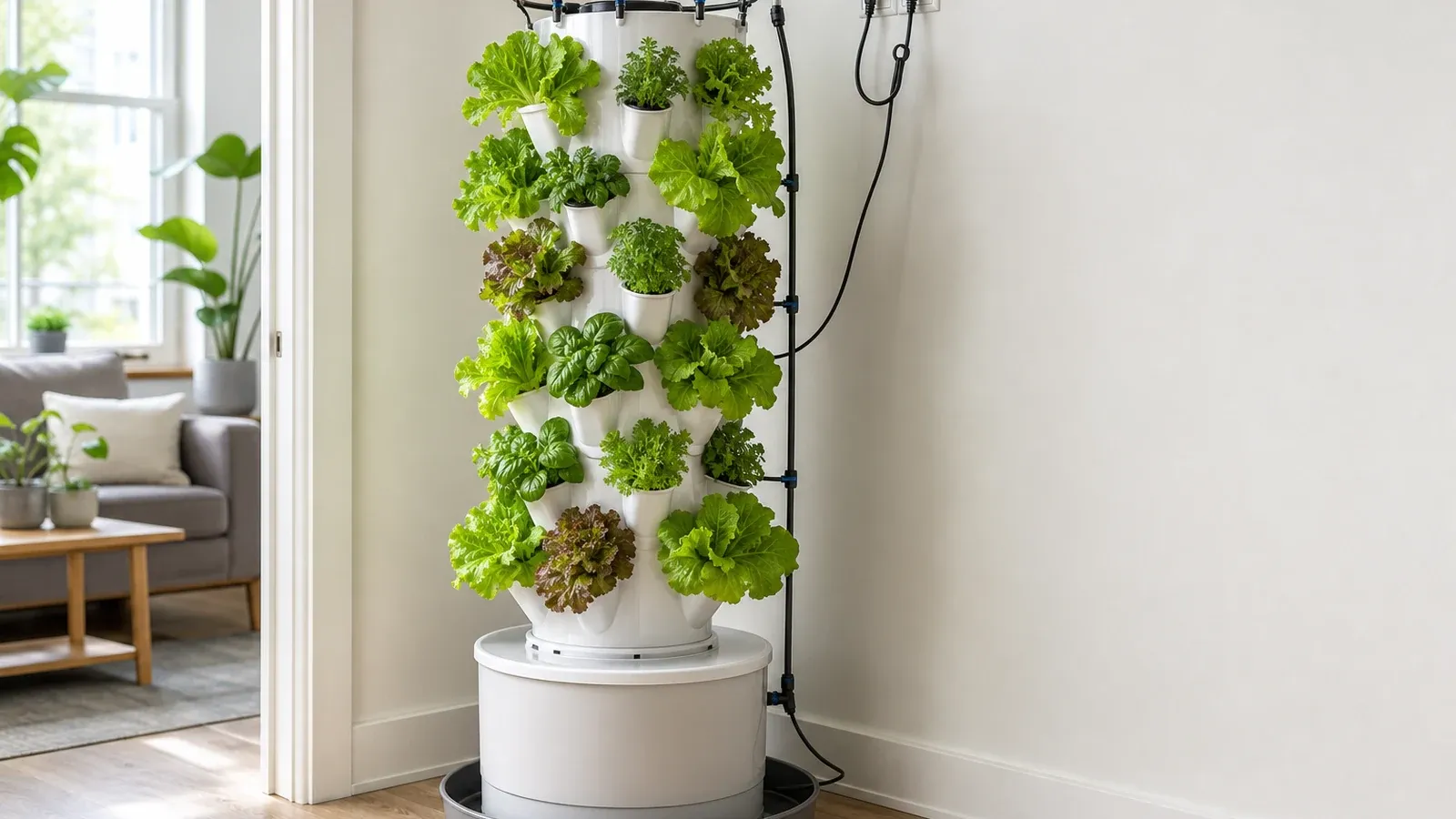
A vertical tower places sites around an upright column. Solution may be pumped to the top and distributed downward over roots or media. Towers minimize footprint but can be difficult to light evenly from one direction and may hide internal roots and drains.
A tiered rack arranges channels, trays, or pots on shelves. Each level can use NFT, drip, DWC, or ebb-and-flow principles. Racks take more floor width than a tower but are easier to inspect, light with bars, and isolate by level.
A wall or A-frame angles channels or containers toward available light. It can improve access and exposure, but it needs a stable frame and safe return path. Never rely on a decorative wall fixing without calculating filled weight.
Select the hydraulic method first, then the orientation. A vertical object is not a complete hydroponic system.
Light becomes the first limiting resource
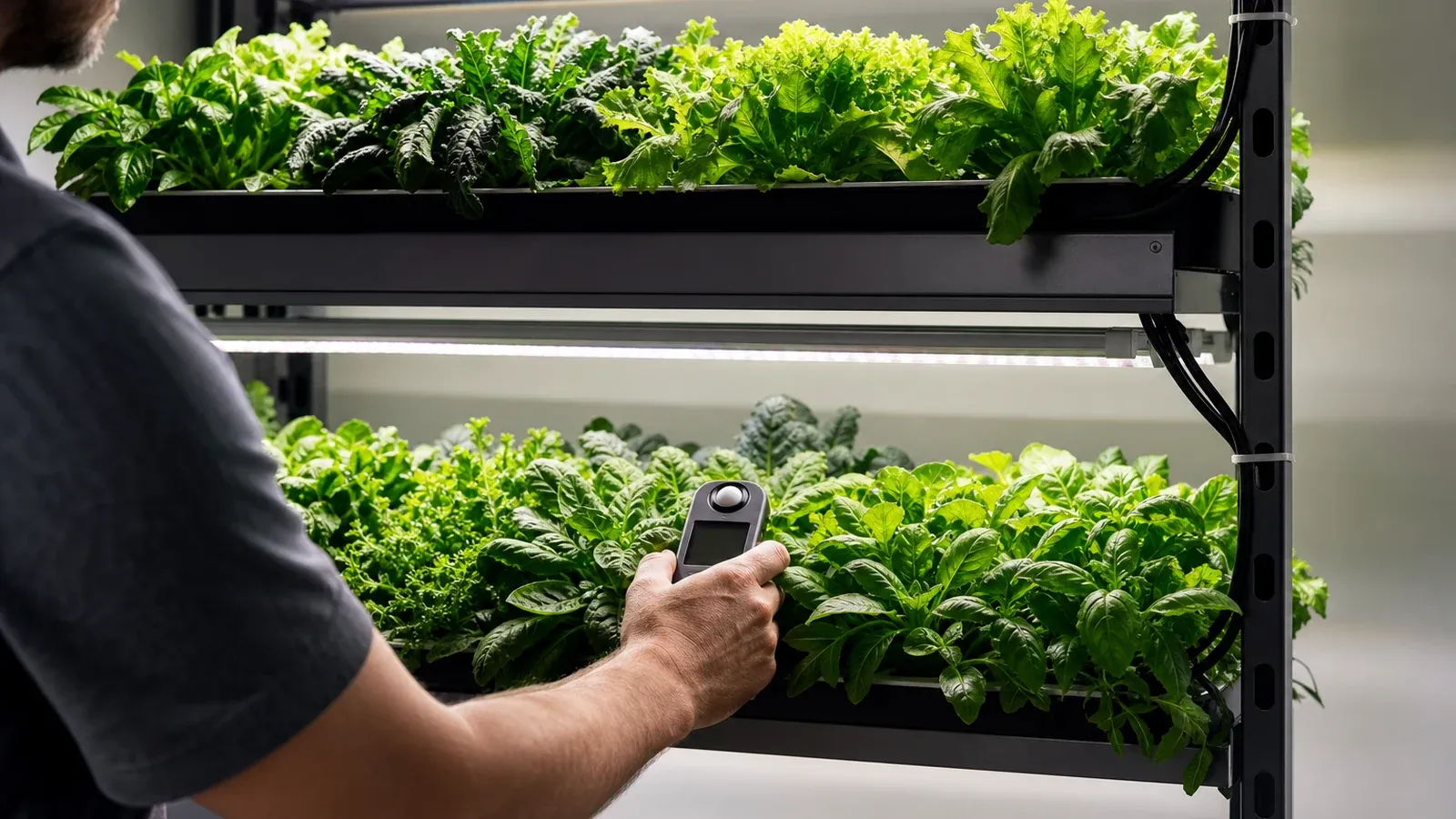
Measure light at mature leaf height on every tier; brightness at eye level does not reveal shading inside the canopy.
Plants on top can shade lower tiers, and a lamp above the structure favors the upper canopy. Side lighting can improve distribution but increases fixtures, cables, heat, and energy. A window may illuminate one side while the other stretches.
Our guide to choosing LED grow lights for hydroponics explains why coverage should be checked at plant level. Evaluate each mature canopy position, not brightness at eye level. Rotate only if the structure and crop tolerate it; rotation is not a substitute for sufficient daily light.
Keep tall crops off lower tiers where they collide with shelves. Provide adjustable lamp height and space for airflow. Reflective surroundings may redistribute some light but cannot replace appropriate fixture output and coverage.
Start with fewer sites than the frame holds. Observe leaf overlap and stretch before planting every opening.
Pump head and distribution determine whether every tier drinks
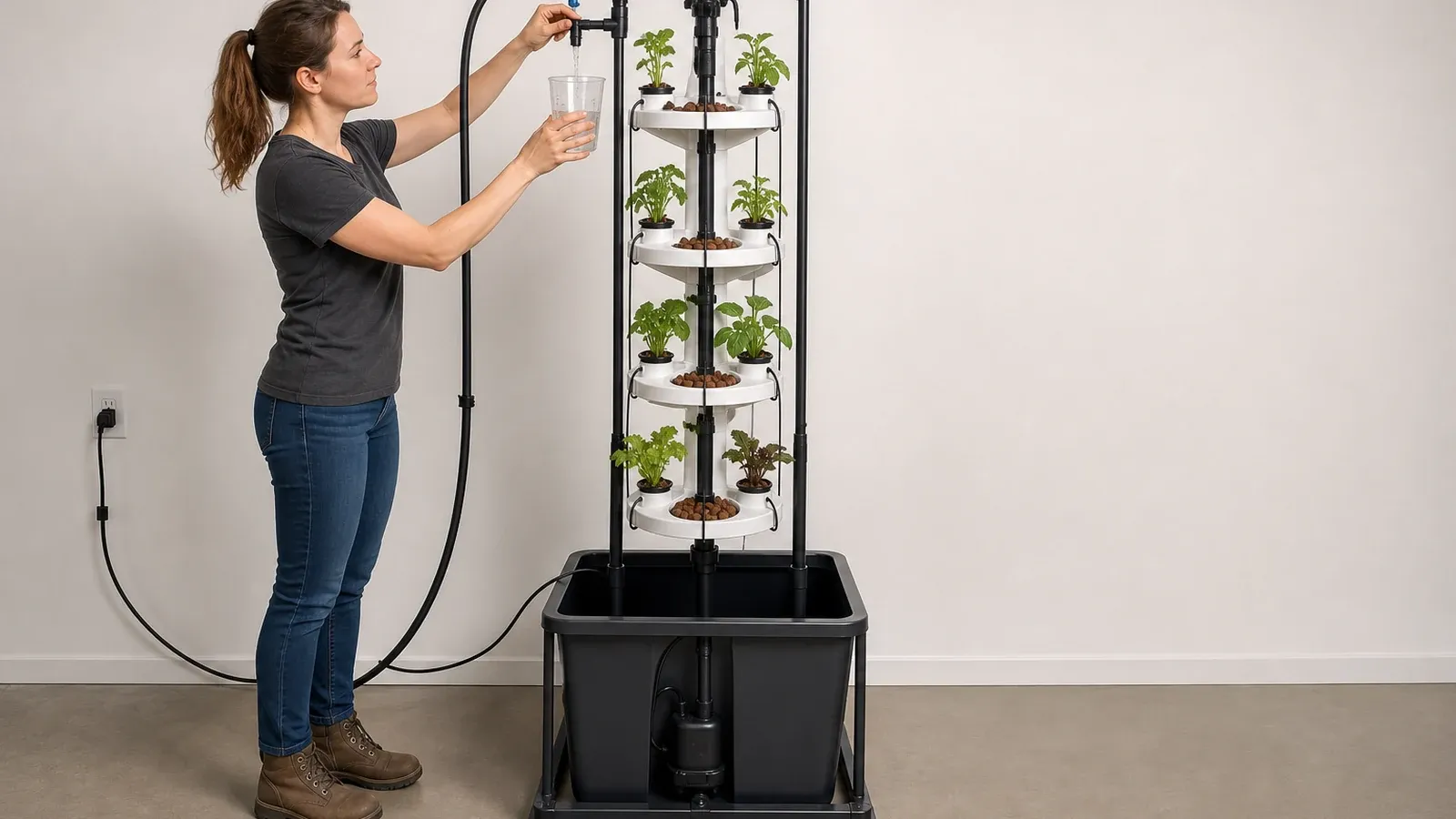
Check actual flow at the highest outlet because pump delivery falls as lift, tubing, fittings, and manifolds add resistance.
A pump must lift solution from the reservoir to the highest outlet. Manufacturer flow ratings usually decrease as vertical head increases. Tubing length, fittings, filters, and manifolds reduce delivery further. Select from the pump’s flow curve at actual lift rather than its zero-head headline.
At the top, distribution must divide solution evenly. A tower with one heavy stream and several dry sectors is not functioning. On a rack, valves can balance tiers, but a nearly closed valve may clog or drift. Measure return flow from each zone over the same interval.
The USDA Economic Research Service’s hydroponic system appendix distinguishes delivery methods such as drip, NFT, DWC, and flood-and-drain. Their failure modes remain when stacked: NFT needs continuous even flow, drip emitters can clog, and flood trays need sufficient drainage.
Keep the pump accessible and provide a low-level mark. One hidden pump should not support more plants than you can protect during failure.
Drainage is a gravity system with consequences
Every liter pumped upward must return safely. Drain paths need capacity beyond normal flow, protection from roots, and enough slope to avoid stagnant pockets. A disconnected top line can release the reservoir onto the floor quickly.
Water-test with the structure in its final position. Run at maximum intended flow, partially restrict a return, stop the pump, and observe drain-back. The reservoir must hold all returning water without overflowing. Trays must catch leaks from joints and plant sites, not only the reservoir.
Keep electrical connections above possible spray, use drip loops, and avoid routing cables beneath joints. A floor water alarm is inexpensive compared with damage in an apartment.
Do not place a tower where servicing the back requires tipping a filled structure. Access is part of containment.
Structural load and stability
Water, wet media, plants, channels, lights, and trellises create a substantial load. Tall narrow towers also create leverage when bumped. Anchor only to appropriate structures and follow hardware load guidance; do not assume a bookshelf or balcony rail is suitable.
Put the heaviest reservoir low to improve stability. Level the base so flow and weight distribute as intended. Wheels must be rated for the total load and locked during operation; moving a full system can strain fittings.
Outdoor vertical units face wind. Mature foliage behaves like a sail, and trellised crops increase leverage. Secure the system and consider the consequences of a blocked drain during rain.
Children and pets add pull and collision risks. Guard tubing, nutrient containers, and electrical parts while preserving ventilation and access.
Crop selection by mature shape
Lettuce, pak choi, compact herbs, and some strawberries suit closely managed vertical sites. Even these need spacing for airflow and harvest access. Basil can become broad; mint can overtake neighbors; strawberries produce runners.
Tomatoes, cucumbers, and peppers demand root volume, strong light, support, and space for a long canopy. A vertical label does not make them compact. If grown, use larger containers and independent trellising rather than crowded tower pockets.
Place similar crops and ages in a shared nutrient loop. Mixed plants may have incompatible pH, EC, temperature, and harvest timing. A fast lettuce root can also obstruct flow before a slower neighbor finishes.
Our best vegetables for hydroponic beginners helps select crops by difficulty rather than marketing photographs.
Reservoir changes faster under dense canopy
More plants in a footprint can remove water rapidly. A small reservoir may swing in level, concentration, pH, and temperature. Size it for mature demand, pump operating depth, and drain-back volume—not only to fit beneath the tower.
Use a complete hydroponic nutrient, measure working volume, and track pH and EC trends. EC reflects total dissolved ions but not the amount of each nutrient. Top-ups and replacement should respond to crop and water conditions, not a universal calendar.
Block light from reservoir, tubing, channels, and unused sites. Vertical openings can admit light from many angles. Algae and roots can turn narrow internal passages into maintenance problems.
If one reservoir serves many plants, a mixing or correction error affects them all. Make small adjustments, circulate, and retest.
Airflow, humidity, and heat between tiers
Dense leaves trap humidity and reduce air movement. Lower tiers may remain damp while top plants experience warmer, drier air. This can change water use and disease pressure even when all roots share one reservoir.
Provide gentle airflow through each canopy without blasting seedlings or evaporating media excessively. Leave room to inspect leaf undersides and remove dead tissue. Do not use plant density to hide bare structure; crowding increases shading and makes pests harder to detect.
Lamps between shelves add heat near leaves and reservoirs. Measure air and solution temperatures at different levels. Address room ventilation and fixture distance rather than attempting to correct heat only with reservoir additions.
Maintenance access sets the practical height
You should be able to inspect every inlet, root zone, drain, leaf surface, and fitting without unsafe climbing. The top must be reachable for cleaning while the bottom reservoir remains accessible for measurement and pump removal.
Roots inside towers can form mats that are difficult to extract. Removable panels or channel lids reduce crop-turnover time. A one-piece decorative tower may look tidy until old roots block the central return.
Between crops, remove all roots, disassemble serviceable parts, clean wet surfaces, flush lines, and inspect seals. Follow cleaning-product labels and never mix chemicals. If complete sanitation requires special tools or dismantling a room, the structure is too complex for its location.
Compare vertical systems with a simple shelf
A short rack of independent DWC containers uses more shelf depth but isolates failures and makes roots visible. A vertical recirculating tower uses one reservoir and less floor area but connects risks. A rack of NFT channels offers orderly leafy-green rows but depends on continuous flow.
Compare with NFT pros and cons before choosing stacked channels. If media pots fit the crop, ebb and flow can irrigate a tier but requires careful flood volume and drainage.
Sometimes the simplest solution is two sequential shelves, each with its own shallow system and lamp. It may occupy slightly more footprint while offering better light and service access.
Commission one level at a time
Assemble and water-test the lowest-risk zone first. Measure pump flow at operating head, check distribution, stop and restart power, verify drain-back, and simulate a partly blocked return. Photograph normal flow and mark reservoir levels.
Add one tier and repeat. Do not plant the whole structure before confirming hydraulics at final height. Start with evenly developed seedlings of one crop and leave unused sites covered.
Record water additions, pH, EC, temperatures at different tiers, pump behavior, and plant growth. If upper and lower plants diverge, compare light, airflow, and delivery before changing nutrient for the whole reservoir.
Decide whether vertical is genuinely space-efficient
Measure total usable volume, including lamp clearance, service aisle, reservoir access, and mature leaves. A tower that blocks a doorway or needs to be moved for every check is not saving functional space.
Choose vertical hydroponics when a compact crop, uniform lighting plan, reliable pump, stable structure, safe drainage, and full maintenance access fit together. Choose a conventional layout using the beginner system comparison when stacking adds more failure points than productive canopy.
Begin shorter than your maximum ceiling height. A vertical system earns expansion only after one crop can be harvested, drained, and cleaned without leaks, dry sites, dangerous reaching, or permanently shaded plants.
Calculate productive space instead of planting-site density
Measure the mature canopy area that receives usable light, not the base footprint alone. Add the service aisle, lamp distance, reservoir access, and clearance needed to remove roots or channels. Divide expected mature plants by that functional area. This comparison may show that a short rack produces more accessible canopy than a narrow tall tower with shaded pockets.
Map each site by tier and compass direction. During a trial crop, record leaf temperature or visible stress, growth, and harvest from each position. Consistent weak growth on one side points toward light, airflow, or distribution rather than a whole-reservoir nutrient problem.
Also calculate the cost and power of every lamp, fan, and pump needed to make the stacked arrangement work. A system that saves floor area but requires multiple side lights may still be appropriate in an apartment, but the tradeoff should be explicit.
Leave capacity unused in the first crop. Covered empty sites make flow and cleaning easier to observe. Fill them only after the structure proves that the lowest, highest, front, and rear positions can support comparable healthy plants without unsafe reaching or chronic shading.