Drip hydroponics gives each plant its own measured supply of nutrient solution, making it a practical choice for tomatoes, peppers, cucumbers, strawberries, and other crops grown in substrate-filled pots. Its success depends less on adding more tubing than on even emitter output, suitable growing medium, reliable drainage, and a maintenance routine that catches restrictions early.
Drip hydroponics is targeted irrigation in a growing medium
A hydroponic drip system sends nutrient solution through tubing to an emitter near each plant. The solution wets a substrate such as coir, perlite, mineral wool, or expanded clay, and the medium balances water with root-zone air. Excess may drain away in an open system or return to a reservoir in a recirculating system.
Drip makes the most sense for tomatoes, peppers, cucumbers, strawberries, and other crops that benefit from individual containers, physical support, and controlled irrigation. It can also grow herbs and greens, but those crops often fit simpler DWC, Kratky, or NFT systems.
Its advantage is flexibility: each plant receives solution at its own container. Its recurring problem is distribution: small emitters and lines can clog, drift in output, or detach. A drip system is beginner-friendly only when flow is visible, drainage is planned, and every emitter can be inspected.
Follow the solution from reservoir to drain
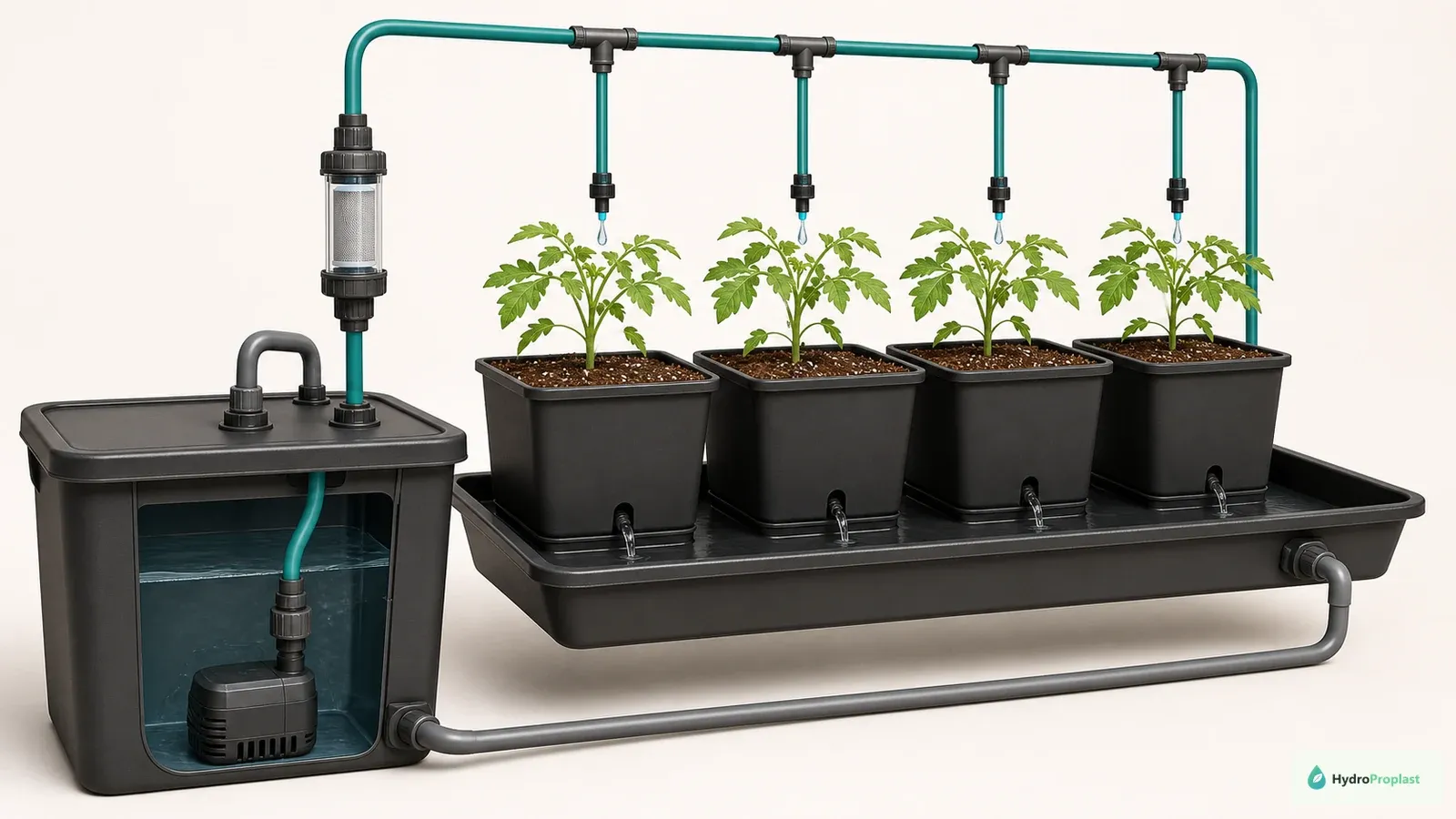
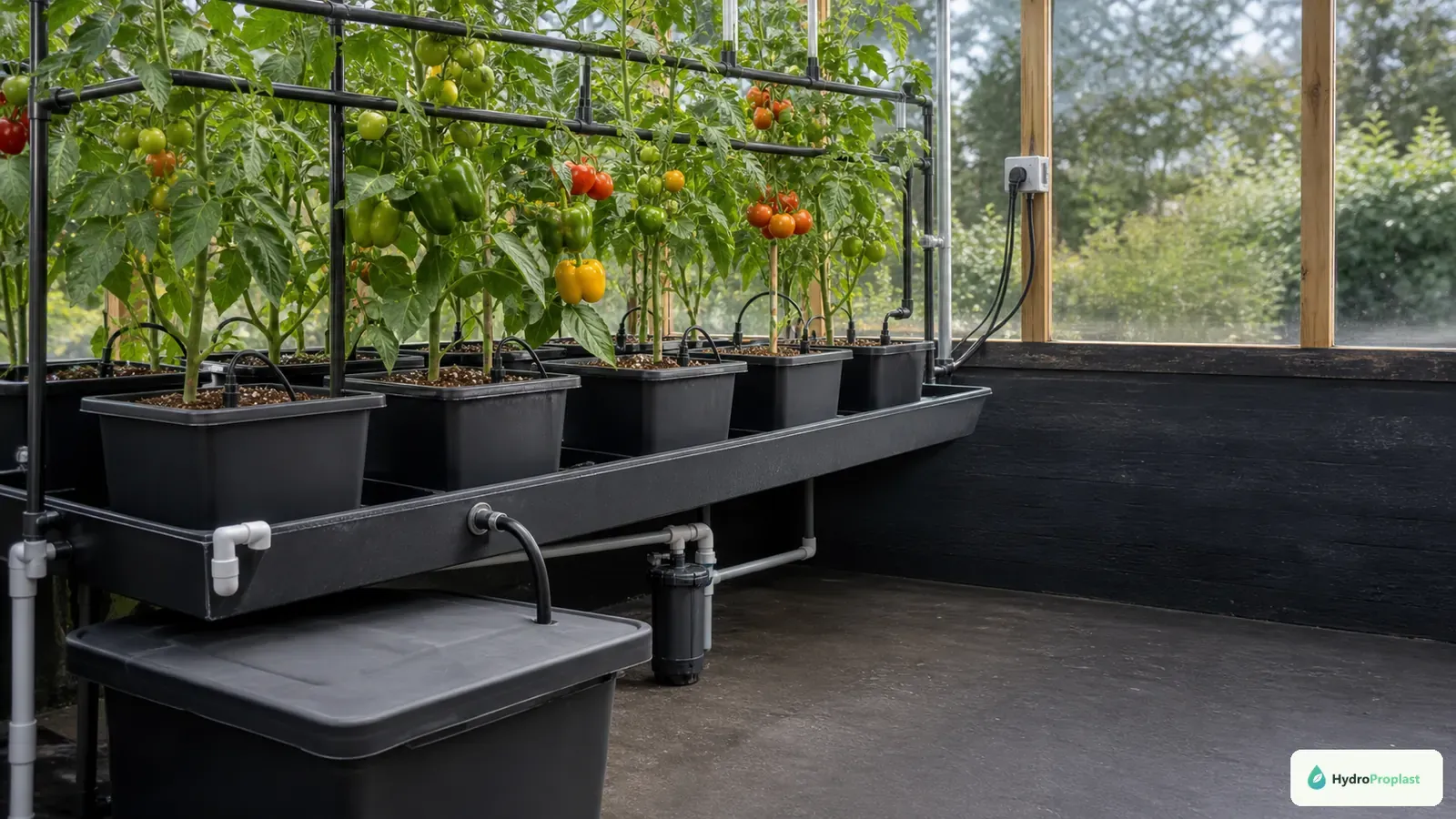
Follow the complete circuit: pump and filter, main supply line, individual emitters, growing medium, drainage tray, and sealed return to the reservoir.
A pump draws mixed nutrient solution from the reservoir and pushes it into a main line. A manifold or branch fittings divide the flow into small tubes. Emitters release solution at the base of each plant. The medium absorbs and distributes moisture; gravity moves excess toward a drain.
The USDA Economic Research Service’s hydroponic systems appendix describes drip as applying solution periodically around individual root zones and identifies it as particularly suitable for fruiting crops. Oklahoma State University’s hydroponics overview likewise describes a timer controlling a submerged pump that supplies small drip lines.
The pump rating at zero lift is not the delivered flow. Vertical height, tubing length, fittings, filters, and pressure requirements reduce performance. Design from the emitter backward and test every outlet with the system in its final position.
Recirculating or drain-to-waste
In a recirculating design, runoff drains back to the reservoir. This recovers water and nutrients and centralizes measurement. It also carries root-zone debris, altered solution, and possible pathogens back to every connected plant. Return plumbing adds leak and blockage points.
In drain-to-waste, each irrigation is mixed and applied without reuse. Nutrient composition at delivery is more predictable, but runoff must be minimized, collected, and disposed of responsibly. “Waste” does not mean it should flow to a storm drain or natural waterway.
The right choice depends on water availability, local disposal rules, crop value, disease strategy, and willingness to monitor a recirculating reservoir. A home beginner should not select an open system simply to avoid measuring runoff. Collect and compare input and drainage so timing and volume can be corrected.
Choose medium before choosing a timer
Coir retains more water than coarse expanded clay. Perlite improves air space but can move or escape through drains. Mineral wool has distinct wetting and handling characteristics. Blends behave differently from their ingredients alone.
Oklahoma State University’s soilless growing media guide explains that medium choice depends on crop, irrigation-water pH, cost, longevity, and system. It must remain moist long enough for uptake while preserving air.
A schedule suitable for clay pebbles may keep coir excessively wet. Pot size, root mass, temperature, humidity, light, and crop stage also matter. Begin from reliable crop-and-medium guidance, then assess container weight, drainage, roots, and plant response.
Components worth sizing carefully
Use an opaque reservoir with adequate operating volume and freeboard. Choose a pump for required flow at actual head and for compatibility with the emitter system. Some emitters need pressure that a small fountain pump cannot provide evenly.
Install filtration appropriate to the smallest passage, but make the filter easy to inspect. A filter that is never cleaned becomes the system-wide restriction. Use valves or a manifold to balance zones, and secure lines so movement does not redirect water away from the medium.
Every pot needs drainage capacity greater than maximum delivery. Put containers on a stable, waterproof support and provide a collection tray or return gutter. Trellises for fruiting crops should transfer load to a frame, not thin irrigation tubing or pot rims.
Keep water and electricity separated, use drip loops, and test with plain water before plants are present.
Emitters: precision with a maintenance cost
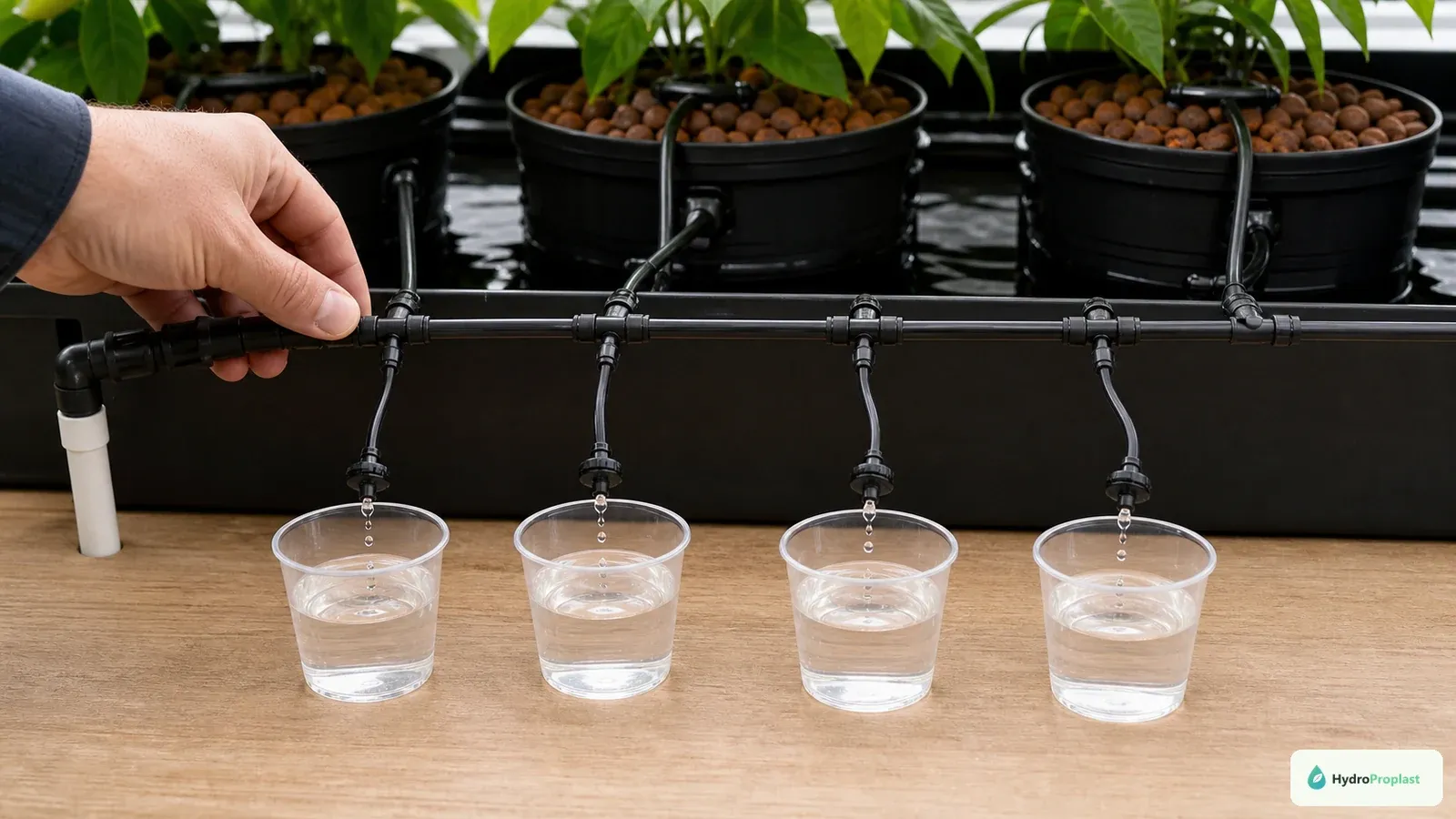
Collect every emitter for the same timed interval; comparing the volumes exposes partial blockages and pressure imbalance before plants diverge.
Pressure-compensating emitters can improve uniformity within their specified operating range. Simple open-ended lines are easier to flush but may vary with height and distance. Drip stakes place water near the plant but can become dislodged or hidden by foliage.
Do not judge the system from the first visible drip. Measure output from several emitters over the same time using separate containers. Compare the beginning and end of each line. Repeat after roots and nutrient deposits have had time to affect the system.
Keep spare emitters and connectors. Flush line ends where the design allows. Use only cleaning methods compatible with the crop, nutrient, tubing, and manufacturer guidance. Never force an unknown chemical through planted root zones.
Irrigation timing is a plant-and-medium decision
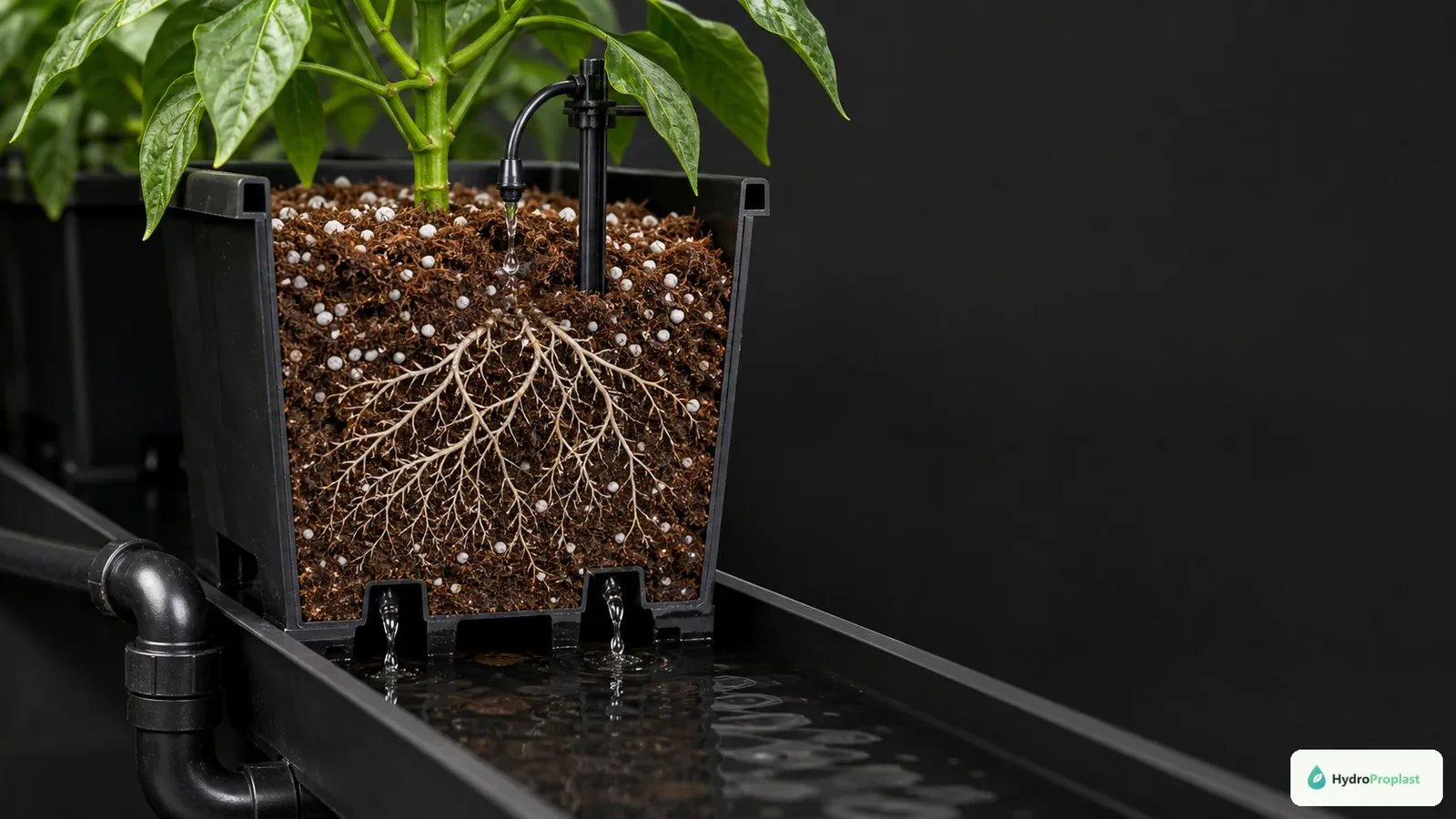
The emitter should wet the root medium rather than the leaves, while every pot drains into containment with enough capacity for the maximum delivery rate.
The goal is to replenish water and nutrients while allowing adequate root oxygen. Short, frequent events may suit a fast-draining medium and mature crop; a retentive medium may need fewer events. Indoor night irrigation may be reduced, but no universal schedule covers every climate and crop.
Underwatering appears as light pots, dry zones, wilting, concentrated salts, and uneven growth. Overwatering appears as persistently saturated medium, poor root condition, algae, and reduced oxygen. Both can lead to leaf symptoms that resemble nutrient problems.
Check where moisture spreads. One emitter may create a wet column while the rest of a large container remains dry. Two emitters or a different delivery pattern may be needed as roots expand. Do not merely extend runtime if that produces excessive runoff beneath one spot.
Nutrient, pH, EC, and runoff
Mix a complete hydroponic nutrient for measured water volume. Check source water and follow crop-stage directions rather than assuming fruiting plants always need stronger solution. pH influences nutrient availability; EC provides a broad view of dissolved-ion concentration.
In recirculating systems, monitor reservoir trends and replace solution when imbalance or management requires it. In drain-to-waste systems, periodically compare input with collected runoff. A large EC difference or extreme runoff fraction can signal that irrigation volume, frequency, or concentration needs review, but crop- and medium-specific interpretation matters.
Avoid reacting to one reading. Verify meter calibration, sampling method, water level, and plant symptoms. See Do You Need a pH and EC Meter? for the role and limits of both instruments.
Why fruiting crops often fit drip
Tomatoes, peppers, cucumbers, and strawberries need longer production periods than a lettuce crop. Individual substrate containers provide root volume and can be spaced beneath strong light. Trellising can be designed around each plant, and irrigation can be divided into zones.
Drip also makes it possible to remove one pot without exposing an entire NFT root mat. Different emitter counts can serve different container sizes, although combining crops with incompatible nutrient and climate needs in one reservoir remains problematic.
These benefits do not make small countertop drip systems suitable for every fruiting plant. Mature canopy size, light, pollination, temperature, and support may become the limiting factors. Select the crop before the kit.
Diagnose uneven growth systematically
If one plant lags, collect and compare emitter output. Inspect for a kink, clogged filter, blocked emitter, empty line, displaced stake, or drainage problem. Then compare light, plant age, root health, pests, and medium moisture.
If downstream plants lag consistently, the manifold or pump may not maintain adequate distribution. If every plant wilts at the same time, check reservoir level, pump, timer, power, and main filter before adjusting nutrient.
If media remains wet, verify drain openings and irrigation frequency. If salts appear on the surface, check concentration, evaporation, and leaching strategy rather than scraping away only the visible symptom.
Record changes and alter one variable at a time. A simultaneous new timer schedule, nutrient strength, and emitter type makes the result impossible to interpret.
Prevent and recover from failures
Use a reservoir low-level mark so the pump never runs dry. Know whether the timer resumes correctly after an outage. Keep a spare pump when one device supports long-duration crops. Position lines so a detached tube drains into containment rather than onto the floor.
Alarms for water on the floor or low reservoir level can reduce damage, but they do not replace inspection. A recirculating return needs capacity for maximum drainage and protection from roots. An open system needs a collection plan sized beyond normal runoff.
Compared with NFT, media provides a moisture buffer during a short interruption. Compared with DWC, the plant is not sitting in a large water reserve. Recovery time depends on crop, medium, container size, temperature, and root condition; avoid fixed survival promises.
Cleaning and crop turnover
Between crops, remove roots and spent medium, clean pots and reservoir, flush or replace small tubing, open the pump, clean filters, and test every emitter. Porous media should be reused only when its properties and previous plant health make reuse sensible.
During production, remove debris, inspect drain paths, and keep algae from exposed wet surfaces by blocking light. Do not allow roots to grow into a shared return unnoticed.
A simple manifold with labeled, replaceable lines is easier to maintain than hidden tubing woven through a decorative structure. Build for disassembly.
Decide whether drip is your best next system
Choose drip when you are growing fruiting crops or larger plants in individual media containers, need flexible spacing, can manage emitters and drainage, and will measure distribution. Start with a few identical pots on one accessible line.
Choose ebb and flow when several pots can share a flood tray and uniform periodic irrigation. Choose NFT for rows of compact leafy crops with continuous flow. Use the beginner system comparison if simplicity is more important than crop-scale flexibility.
Water-test, measure each outlet, confirm drainage, and run the timer through a power interruption before transplanting. A dependable drip system is not defined by how many tubes it has, but by whether each root zone receives a known amount and every excess drop has a safe destination.
Perform a distribution audit as plants mature
At commissioning, collect output from every emitter for the same measured interval and calculate how far each differs from the group average. Repeat the audit after transplanting, after roots fill the pots, and whenever one plant diverges. The goal is not laboratory precision; it is finding an emitter that silently delivers much less or more than its neighbors.
Also measure drainage from representative containers. No drainage can indicate insufficient irrigation or simply a still-small root system in retentive medium; excessive drainage can indicate too much runtime, channeling, or a poorly matched pot. Interpret the number with moisture distribution and plant condition.
Label lines and pots so records remain useful. If an emitter changes, swap it with a known good unit and see whether the problem follows the hardware. This simple test separates irrigation faults from light, pest, or plant-specific problems and prevents a whole-system nutrient adjustment based on one blocked outlet.