Air pumps move gas; water pumps move nutrient solution
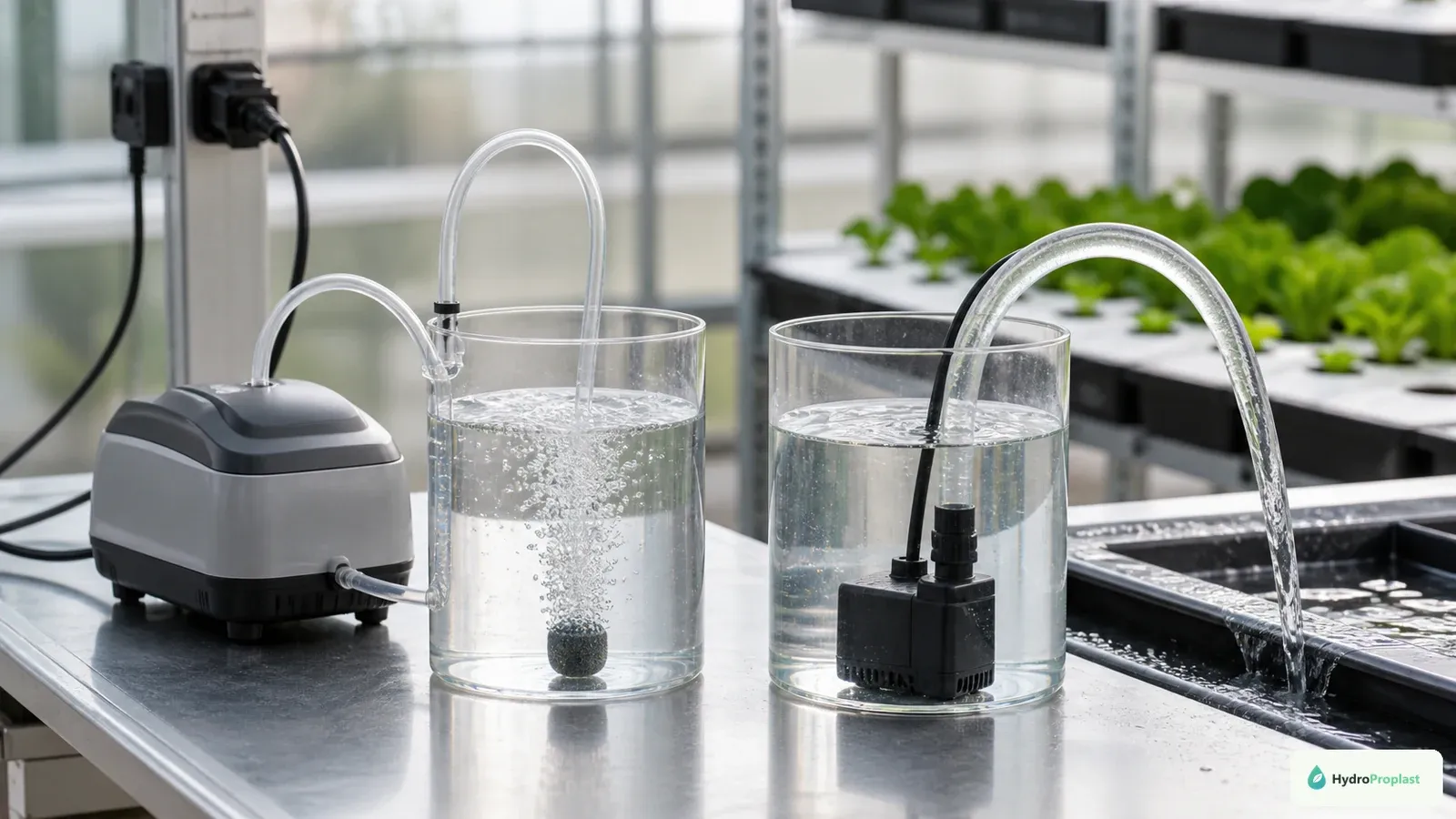
An air pump pushes air through airline to an air stone or diffuser, helping gas exchange in a reservoir. A water pump moves liquid through tubing, channels, drip lines, towers, or flood trays. They solve different problems and are not generally interchangeable.
DWC usually needs an air pump because roots remain submerged in solution. NFT, drip, ebb and flow, and vertical recirculating systems need a water pump to deliver solution. Some systems benefit from both: a water pump handles irrigation while an air pump aerates the shared reservoir.
Kratky is designed to use neither for the root reservoir when correctly sized and operated; its falling water level creates an air gap. A wick system also moves solution passively. Choose equipment from the root-delivery method, not a generic “hydroponic pump” label.
What an air pump actually does
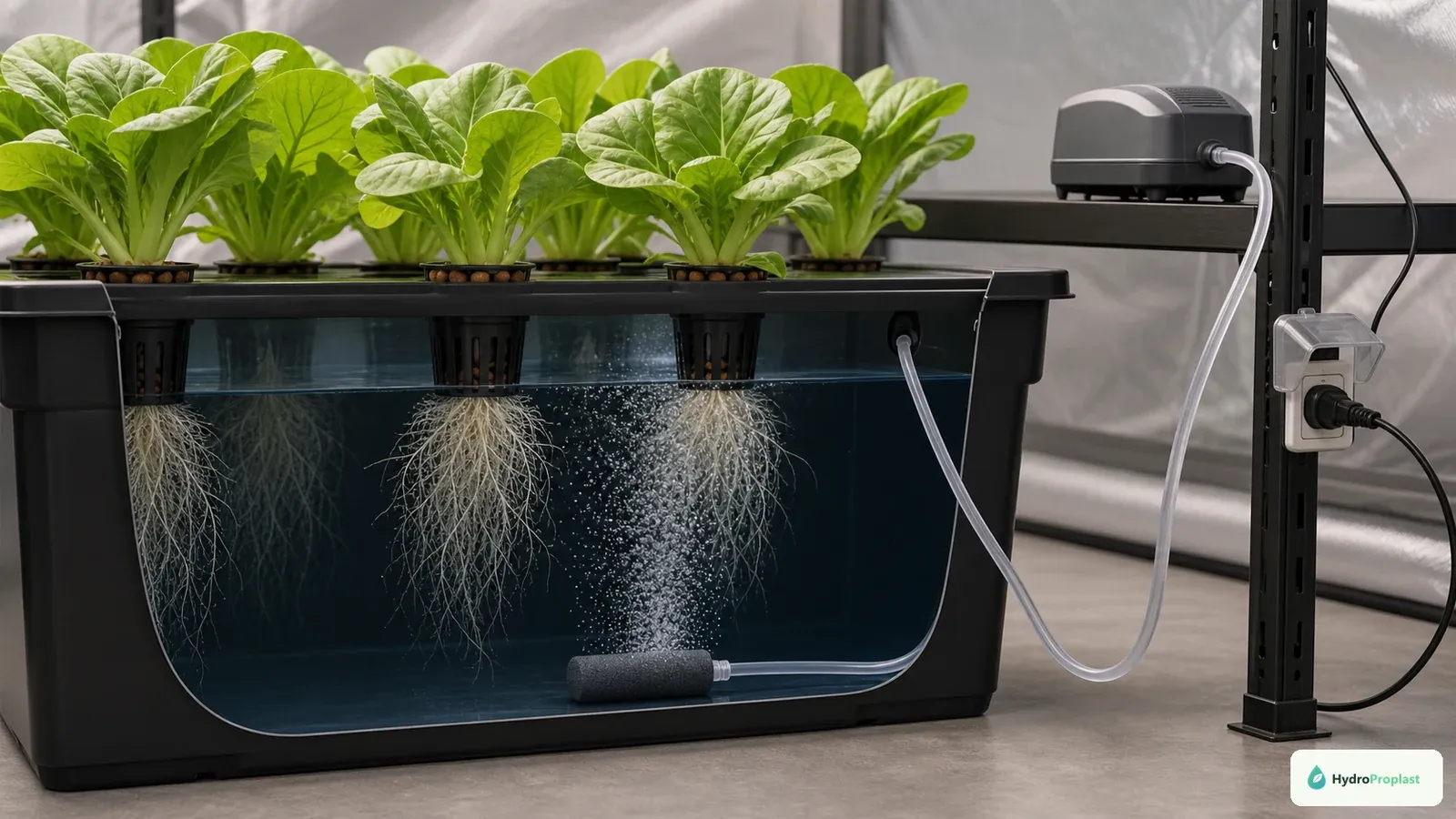
DWC roots depend on dependable aeration because a large part of the root mass remains submerged.
The pump draws room air and sends it down tubing. An air stone divides flow into bubbles, increasing gas-water interface and creating movement. Oxygen enters solution through gas exchange, while circulation helps distribute it.
Tiny bubbles are not automatically proof of high dissolved oxygen. Pump output, water depth, diffuser condition, temperature, root demand, and reservoir shape matter. A clogged stone can make the pump sound normal while delivery falls.
Keep the pump in clean, cool air and above the reservoir waterline, or use a suitable check valve to reduce back-siphon risk. Follow its ventilation and duty-cycle requirements; do not enclose it to silence noise if that causes overheating.
What a water pump does
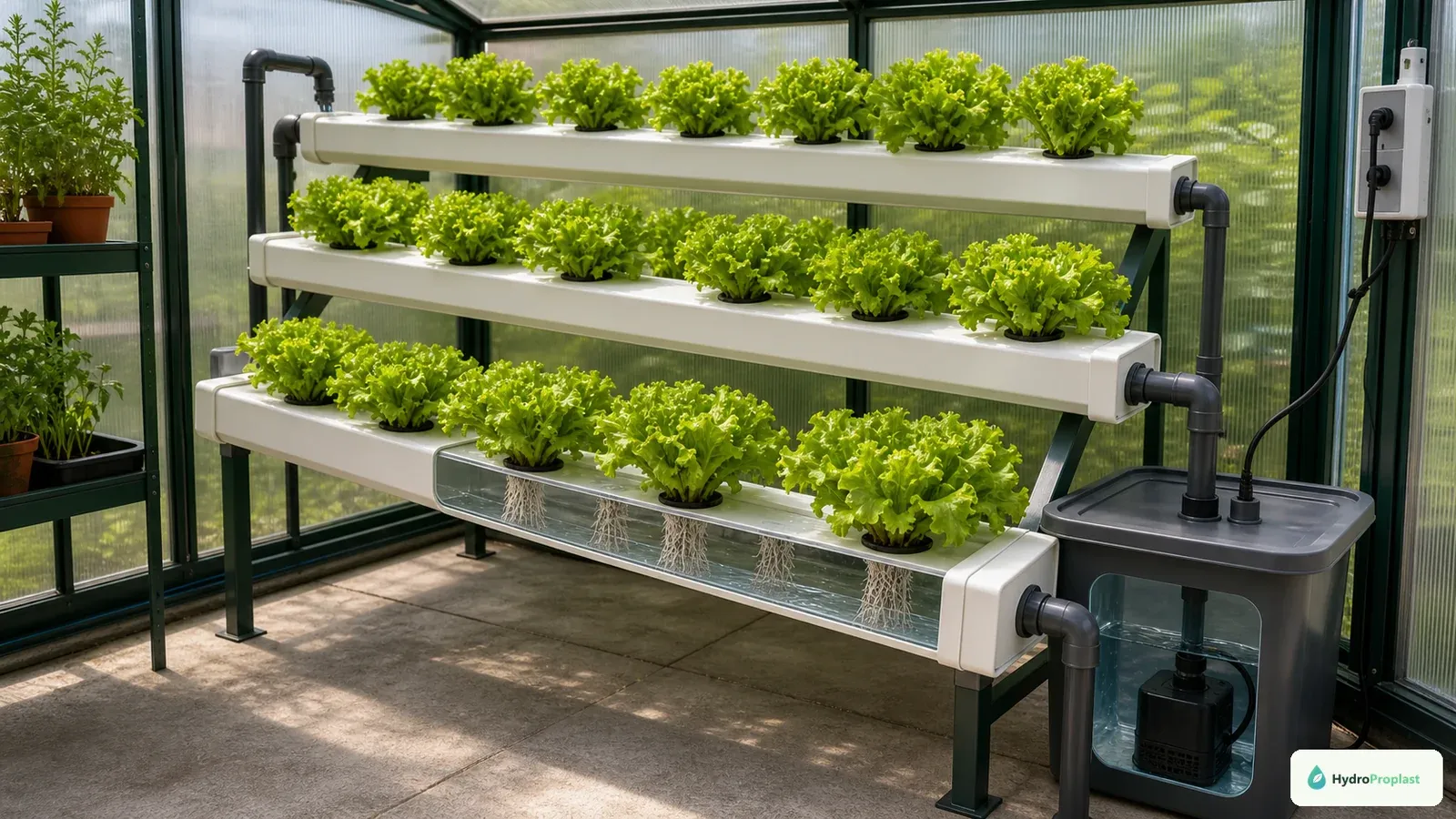
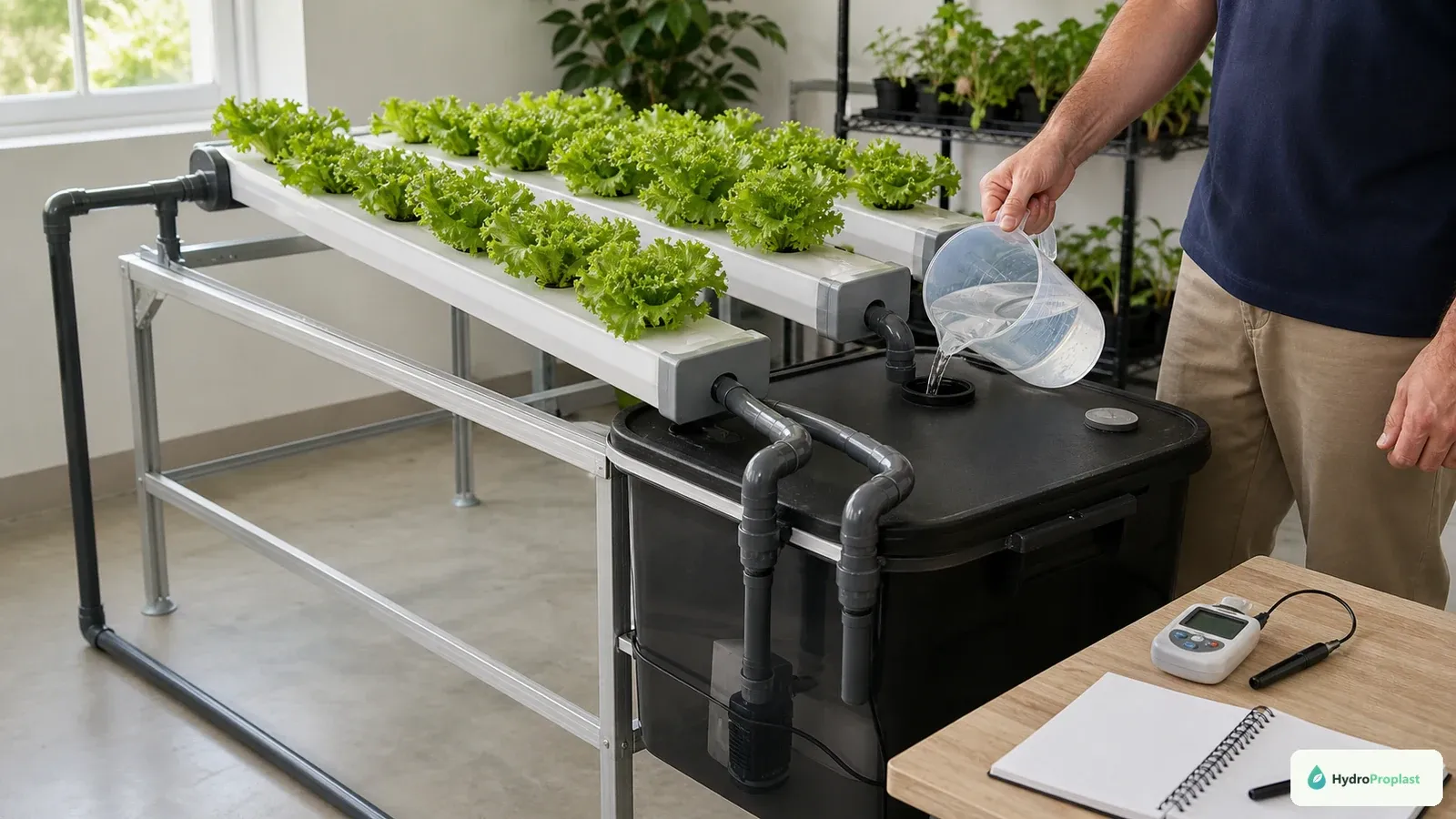
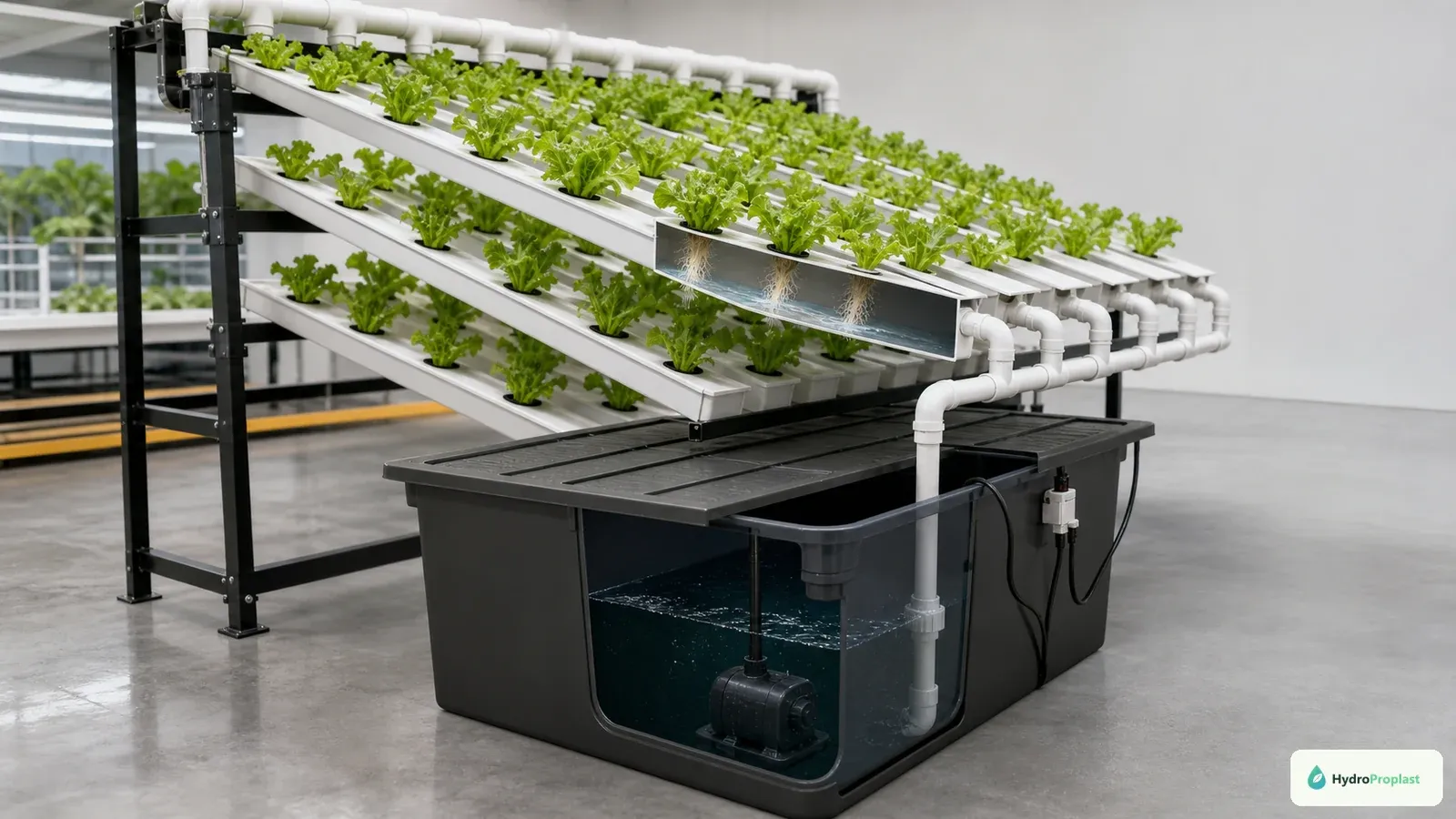
An NFT water pump must deliver enough flow at the installed lift height, then gravity carries the thin film back to the reservoir.
A submersible or external pump lifts and circulates nutrient solution. In NFT it supplies continuous channel flow. In drip it feeds manifolds and emitters. In ebb and flow it fills a tray on a schedule. In a tower it must overcome vertical head to reach the top.
The USDA Economic Research Service’s hydroponic systems appendix describes these delivery methods and DWC’s oxygenated solution. The plumbing task determines pump selection.
Water movement can agitate the surface and contribute to gas exchange, but a circulation pump hidden below the surface is not automatically sufficient DWC aeration. Verify root-zone oxygen strategy rather than assuming moving water equals oxygenated water.
Which systems need which pump
DWC: air pump as the standard active requirement; a water pump may circulate a linked system but does not replace validated aeration.
NFT: water pump for constant flow; reservoir aeration may add resilience depending on design and temperature.
Drip: water pump selected for emitter flow and pressure; air pump optional depending on reservoir conditions.
Ebb and flow: water pump selected for flood volume and head; timer and drainage are critical.
Aeroponics: water pump or pressure pump matched to spray system, filtration, and nozzles; air pump is not the delivery mechanism.
Kratky and wick: normally neither, because passive oxygen and moisture strategies are part of the design.
Reading air-pump specifications
Look for airflow at the intended depth or backpressure, number of outlets, continuous-duty guidance, power, noise, and replaceable diaphragm availability. Marketing based only on aquarium size does not describe a dense hydroponic root mass.
Deeper water creates more pressure for the pump to overcome. Splitting one outlet among many stones reduces flow per branch. Unequal tubing lengths and restrictions can make distribution uneven.
Use a manifold with valves when appropriate, but do not restrict the pump outside manufacturer guidance. Check each stone visually and by feel of airflow before connecting to the crop. Keep a spare pump for a high-value shared reservoir.
Reading water-pump specifications
The headline flow rate is commonly measured at little or no vertical lift. Actual flow decreases with head height and plumbing resistance. Use the pump curve at the system’s vertical rise, then account for tubing length, fittings, filters, and manifolds.
NFT needs stable flow across channels; drip emitters may require a pressure range; ebb and flow needs enough flow to reach flood level within the intended time. A tower needs both lift and safe return capacity.
Confirm whether the pump is submersible, external, continuous-duty, or intermittent. Check minimum water level, solids handling, tubing size, and compatibility with nutrient solution. Oversizing can create overflow, noise, heat, and difficult valve restriction.
Air stones, diffusers, and maintenance
Fine-pore stones produce many small bubbles but may require more pressure and clog sooner. Larger-pore diffusers may be easier to maintain. Material, reservoir depth, nutrient deposits, and biofilm affect performance.
Position diffusers to move water through the root zone without tangling roots around tubing. Secure them so buoyancy or vibration does not move coverage. Avoid placing a stone directly where bubbles keep a pH probe unstable.
Clean or replace diffusers according to safe manufacturer guidance. Do not wait for bubbles to disappear. Record normal appearance and pump sound after installation so changes are noticeable.
Filters, intakes, and roots
Water-pump intakes need protection from roots and debris without a screen so fine that it silently starves the pump. A serviceable prefilter can protect drip emitters and aeroponic nozzles, but it must be inspected.
Keep roots away from impellers and return openings. A mature system behaves differently from an empty test. Provide access to remove the pump without tearing the entire crop.
Never let a submersible pump run dry unless specifically designed for it. Mark the minimum reservoir level and account for water held in channels during operation.
Pump heat and water temperature
Both pumps use electricity and release heat. A submersible water pump transfers much of its heat into solution. An air pump can send warmer room air and heat itself if poorly ventilated. The effect depends on power, volume, room, and duty cycle.
Monitor temperature before and after changing equipment. A stronger pump is not free cooling or free oxygen. In a small reservoir, even modest heat can contribute to daily swing.
Use the water-temperature guide to connect heat, dissolved oxygen, and root health.
Noise and vibration
Air pumps can hum through shelves and lids. Place them on a stable vibration-damping surface that does not block ventilation. Avoid hanging by airline or wrapping in insulation.
Water pumps can transmit vibration through rigid tubing and stands. Flexible sections and secure mounting may help within manufacturer guidance. Cavitation, rattling, or changing sound can indicate low water, intake blockage, trapped air, or wear.
Choose for the room. A quiet bedroom system may favor Kratky over DWC; a greenhouse may make pump noise irrelevant. Do not trade away safety or cooling solely for silence.
Power failure and backup priorities
Identify what roots lose when each pump stops. DWC loses active aeration. NFT loses continuous water delivery. Drip and aeroponics lose scheduled irrigation. Ebb-and-flow media retains some moisture but misses cycles.
Failure tolerance depends on temperature, crop, root mass, media, and residual water; avoid universal survival times. Test alarms and controller restart behavior. Keep compatible spare pumps and labeled tubing.
Backup power must support the actual starting and running load and be used safely. Sometimes powering a small air pump is easier than the full lighting system, but an NFT crop still needs water movement. Prioritize the life-support function for the specific method.
Electrical and siphon safety
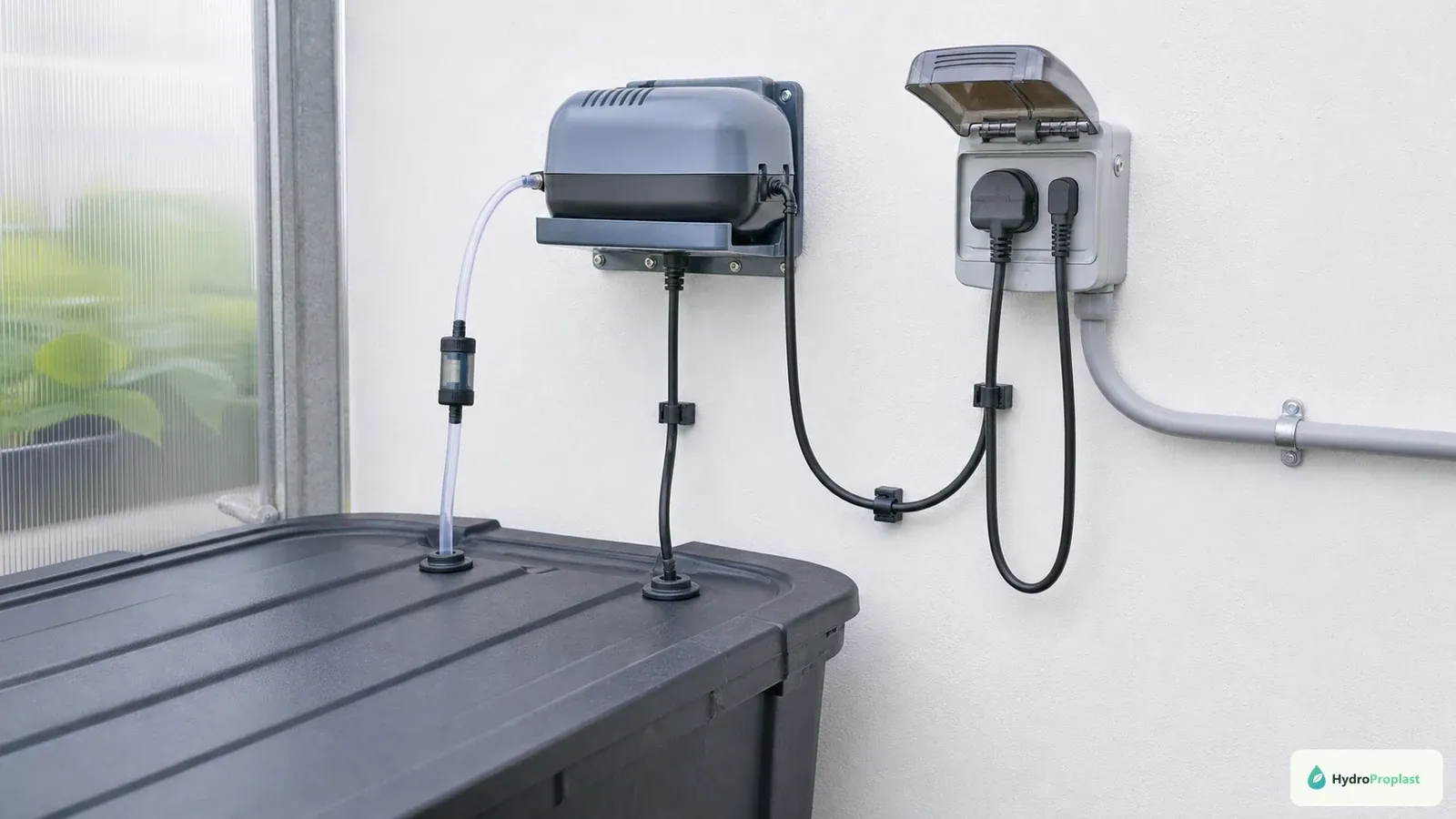
Keep outlets elevated and covered, use drip loops, and prevent back-siphoning through air lines.
Use equipment approved for the location, ground-fault protection where required, drip loops, dry connections, and cables routed away from spill paths. Do not handle plugs with wet hands.
An air pump below water level can siphon water backward when off; elevation or a correctly oriented check valve reduces risk. Water-pump plumbing can also siphon elevated lines into the reservoir or onto the floor. Test shutdown behavior.
Never lift a pump by its power cord. Isolate power before opening an impeller or moving wet components. Follow all manufacturer instructions and local electrical requirements.
Test delivered performance
For an air pump, connect final tubing and stones at operating depth. Check every outlet, observe water movement, and measure dissolved oxygen if the crop risk justifies an appropriate meter. Repeat as roots mature.
For a water pump, collect return flow over a measured time from each zone. Test at minimum reservoir level and maximum head. Stop and restart power, watch drain-back, and simulate a partly restricted filter.
Document valve positions, working level, pump model, and normal flow. A specification sheet starts the design; commissioning proves delivery.
Common pump-selection mistakes:
Buying by reservoir liters alone ignores head, root demand, plumbing, and system type.
Using one tiny air pump with many split outlets produces bubbles everywhere but inadequate flow per stone.
Choosing a water pump by zero-head rating underdelivers at the top of a tower.
Oversizing and choking flow can add heat and stress fittings.
Assuming circulation equals aeration leaves DWC roots vulnerable.
Ignoring minimum water level exposes a submersible pump.
Hiding pumps inside inaccessible structures prevents maintenance.
Decide by function, then add resilience
Choose an air pump when roots need deliberate reservoir aeration, especially in DWC. Choose a water pump when nutrient solution must travel to channels, emitters, trays, or elevated sites. Use both when irrigation and reservoir oxygen are separate requirements.
If you are choosing a first method, compare Best Hydroponic System for Beginners. If DWC and passive operation are the main options, read Kratky Method vs Deep Water Culture.
Select from delivered performance, install safely, keep parts serviceable, and test failure recovery before roots depend on the system. The right pump is not the largest one; it is the one that reliably performs the required life-support function at the actual operating conditions.
Oklahoma State University’s hydroponics guide illustrates the functional distinction: water culture uses an air pump and air stone, while ebb and flow, drip, NFT, and aeroponics use nutrient pumps in different operating patterns. Use those functions as the equipment checklist.
Calculate redundancy by consequence. One multi-outlet air pump is neat, but its failure affects every DWC bucket. Two smaller pumps on separate circuits may isolate risk, while individual check valves and clearly labeled lines make faults easier to locate. Redundancy adds heat, power, and maintenance, so it should match crop value and replacement time.
For water systems, consider zoning. One pump feeding several NFT channels may be reasonable if a spare can be installed quickly. A tall tower and a low drip bench may need different pressure and should not be forced onto one poorly balanced manifold.
Keep a commissioning record with delivered airflow or visual baseline, measured liquid return per minute, head height, valve positions, working water level, and power-restart behavior. Repeat after cleaning and near mature root mass.
Finally, stock the failure parts that are actually specific: diaphragm kit or air pump, correct water pump, tubing, check valves, fuse or controller where user-serviceable, and fittings. A spare that does not match lift, pressure, voltage, or connection size is only shelf clutter.
Review energy use over the full crop. Multiply actual input watts by operating hours, and include backup or redundant units. Intermittent water pumping may use fewer hours than continuous aeration, but starting loads, controller behavior, and crop risk still matter. Choose efficiency only among pumps that deliver the required function.
At crop turnover, inspect diaphragms, impellers, shafts, cords, tubing, and check valves for wear. Compare current delivered flow with the commissioning record. Preventive replacement based on manufacturer guidance is easier than identifying a weak pump after roots begin to decline.