Slow hydroponic growth is a comparison, not a diagnosis. A seedling may be slow because the cultivar normally develops gradually, while a mature plant may stall after roots overheat, light weakens, or solution management changes. Diagnose against the correct crop, stage, and previous growth rate before adding nutrients.
Define what slow means
Record sowing, emergence, transplant, and observation dates. Compare plants of the same cultivar and stage under similar conditions. Measure new leaves, internode length, canopy width, root growth, water use, and harvest progress.
A plant that is compact but steadily producing leaves is different from one that has stopped making new tissue. Advertised days to harvest are estimates shaped by environment and harvest definition.
Map the pattern
If every plant slows together, investigate shared light, temperature, solution, pump operation, and source water. One slow site suggests a blocked emitter, weak light edge, damaged plug, or local root problem.
If one cultivar lags while others thrive, confirm its normal habit and environmental preference. If only new transplants stall, review propagation and handoff conditions.
Photograph fixed positions weekly. Spatial and time patterns narrow the cause before any treatment.
Check the root zone first
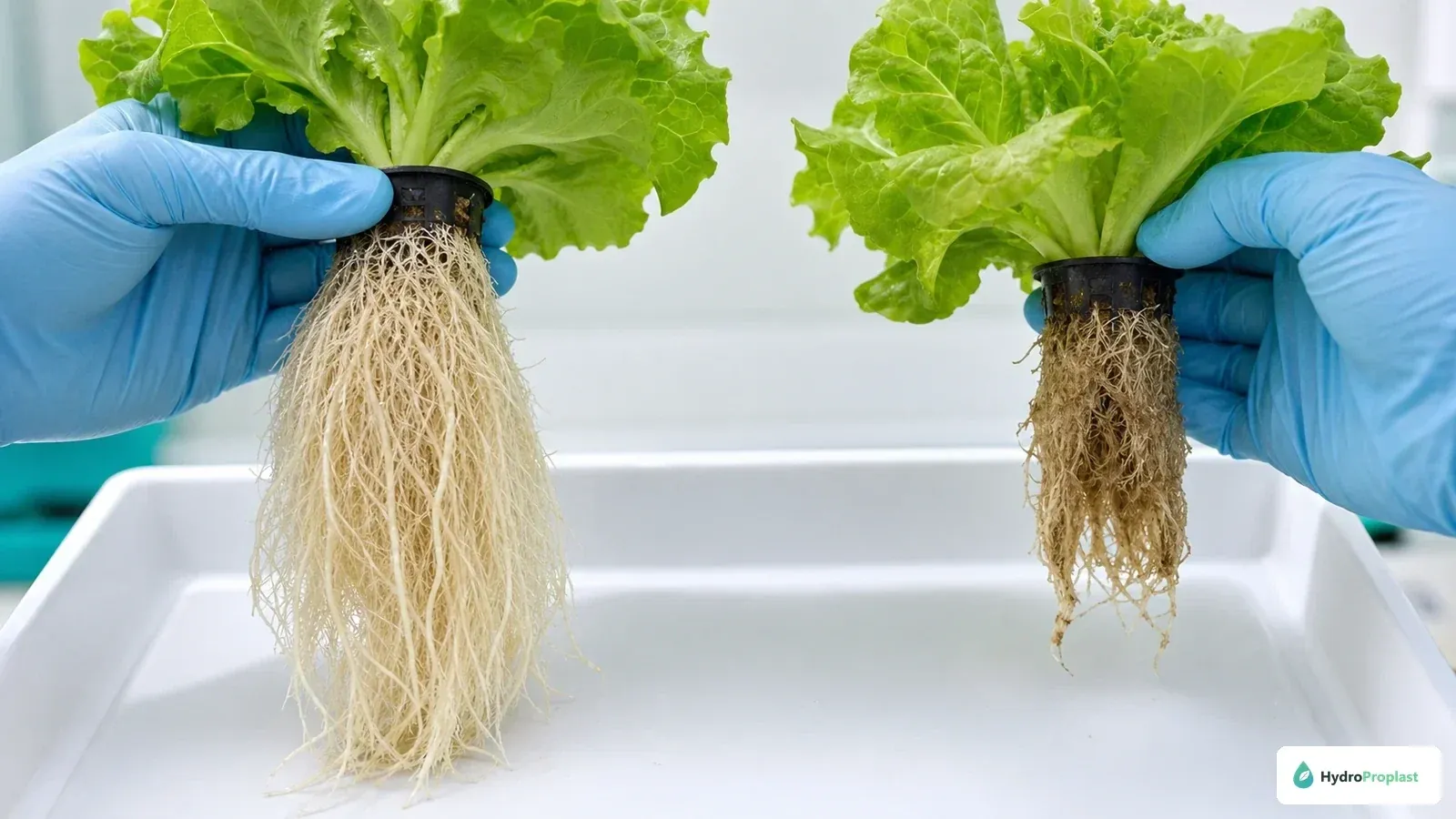
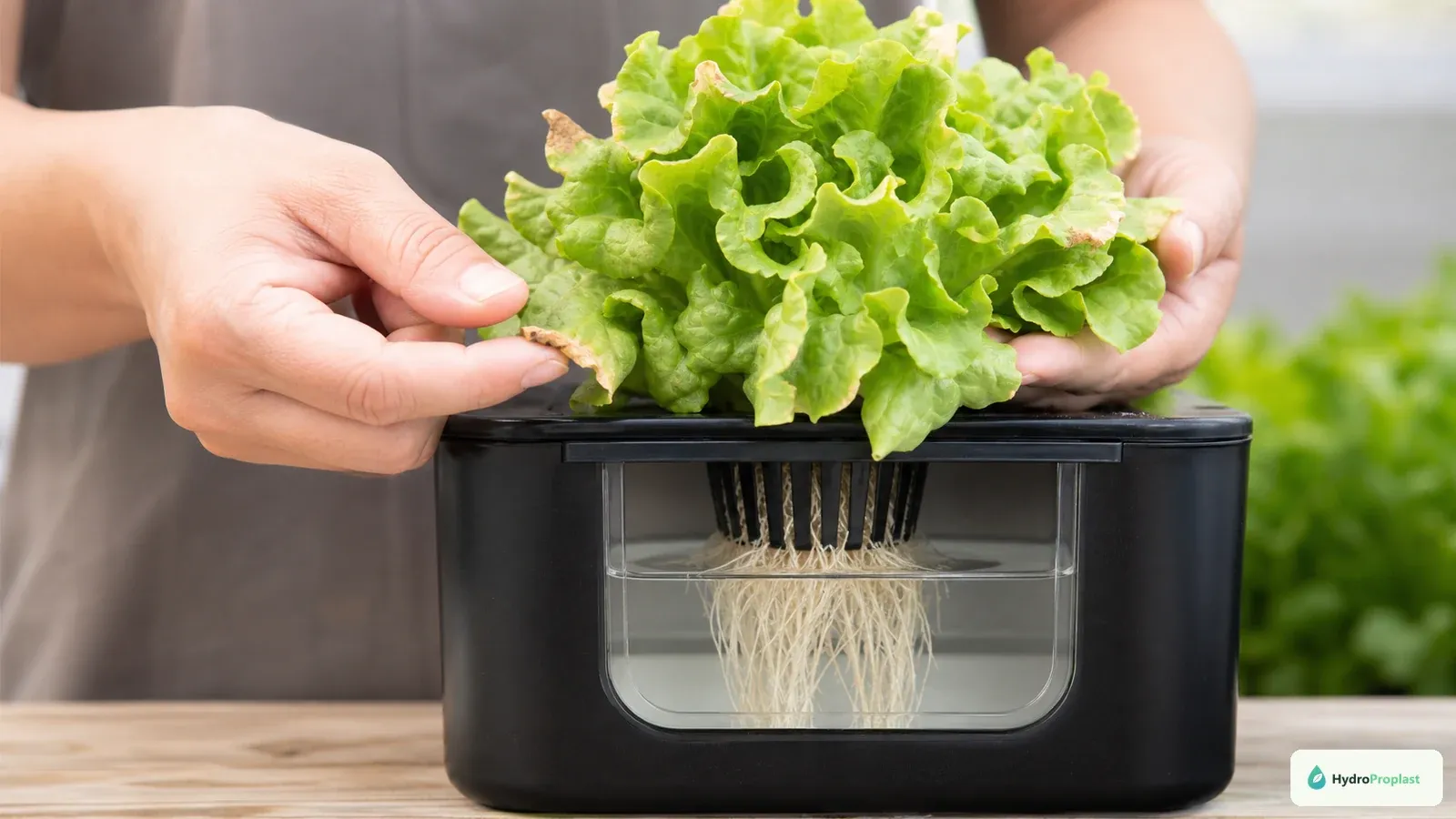
Healthy new root tips and firm tissue are more useful clues than root color alone.
Lift representative plants carefully. Healthy roots are firm with active tips; nutrient staining can be harmless. Slime, odor, tissue breakdown, or no new tips indicates root stress.
Verify solution temperature, oxygen support, pump or air delivery, water level, and debris. The root-rot guide explains diagnosis beyond root color.
A damaged root system cannot use light or nutrients normally. Correct root-zone function before increasing fertilizer.
Verify actual light delivery
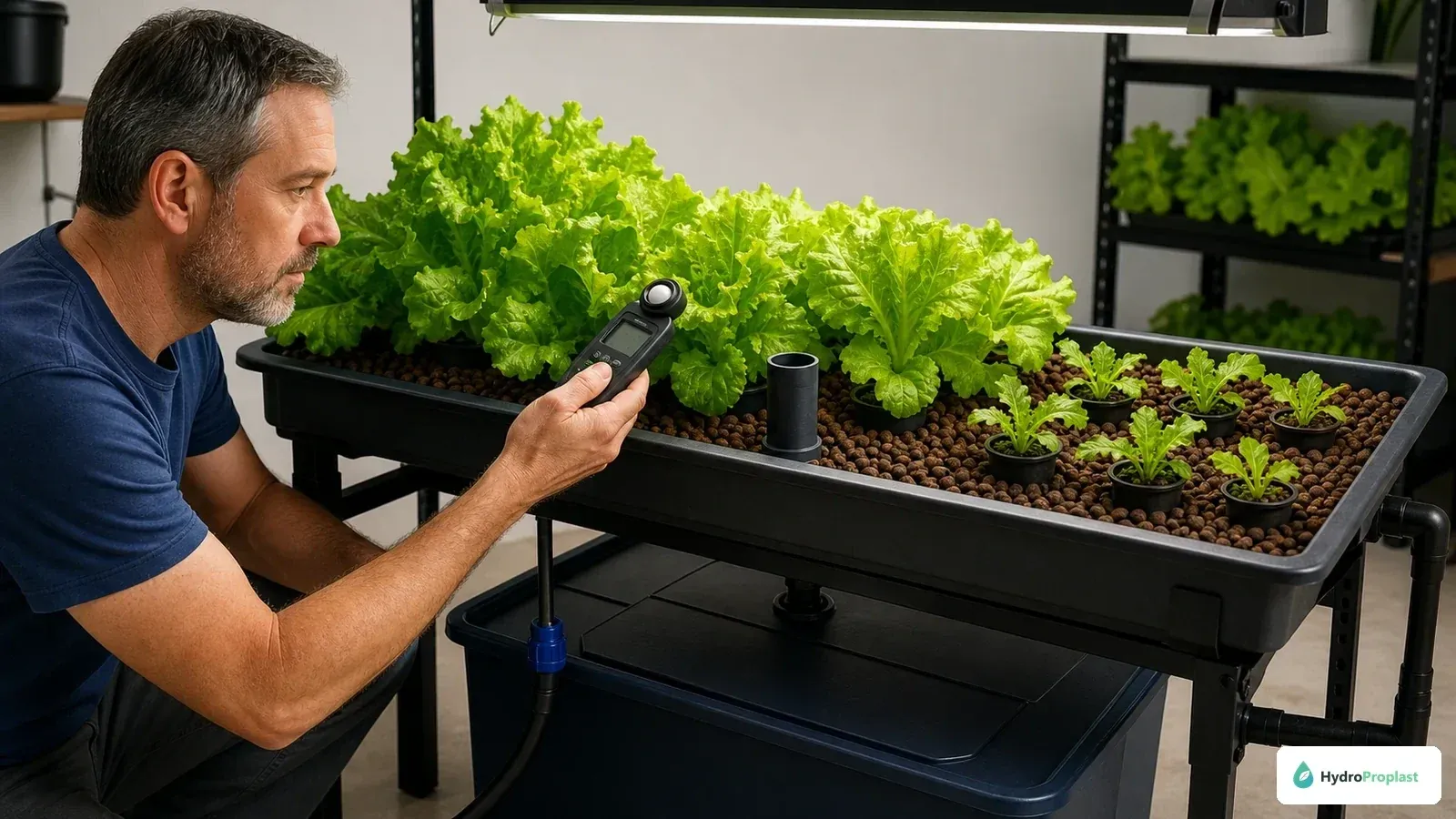
Measure PPFD at canopy center and edges, and confirm timer operation. Fixtures may be too high, dimmed, dirty, partially failed, or blocked by taller plants. Human visual brightness is unreliable.
Weak light often produces slow biomass, pale leaves, long internodes, or leaning. Excessive light or heat can also stall growth and damage upper leaves.
Use the LED grow-light guide to audit coverage and fixture settings.
Compare daily light with crop needs
Photoperiod and intensity work together. Calculate DLI from measured PPFD and hours, then compare with authoritative crop and stage guidance. Do not extend hours indefinitely to compensate for a weak map.
Preserve a dark period. Mixed canopies may require separate shelves because fruiting crops, herbs, and seedlings do not share one useful schedule.
Record any light change and assess new growth after several days.
Measure air and solution temperature
Cool-season crops may slow in heat, bolt, or lose quality; warm-season crops may slow when air and roots are too cool. Hot nutrient solution holds less oxygen and can intensify root stress.
Log the full lights-on and dark cycle. A single midday room reading can miss a cold night or hot upper shelf. Compare canopy air with solution temperature.
Do not correct heat by adding nutrients or correct cold with an unregulated heater.
Inspect water delivery
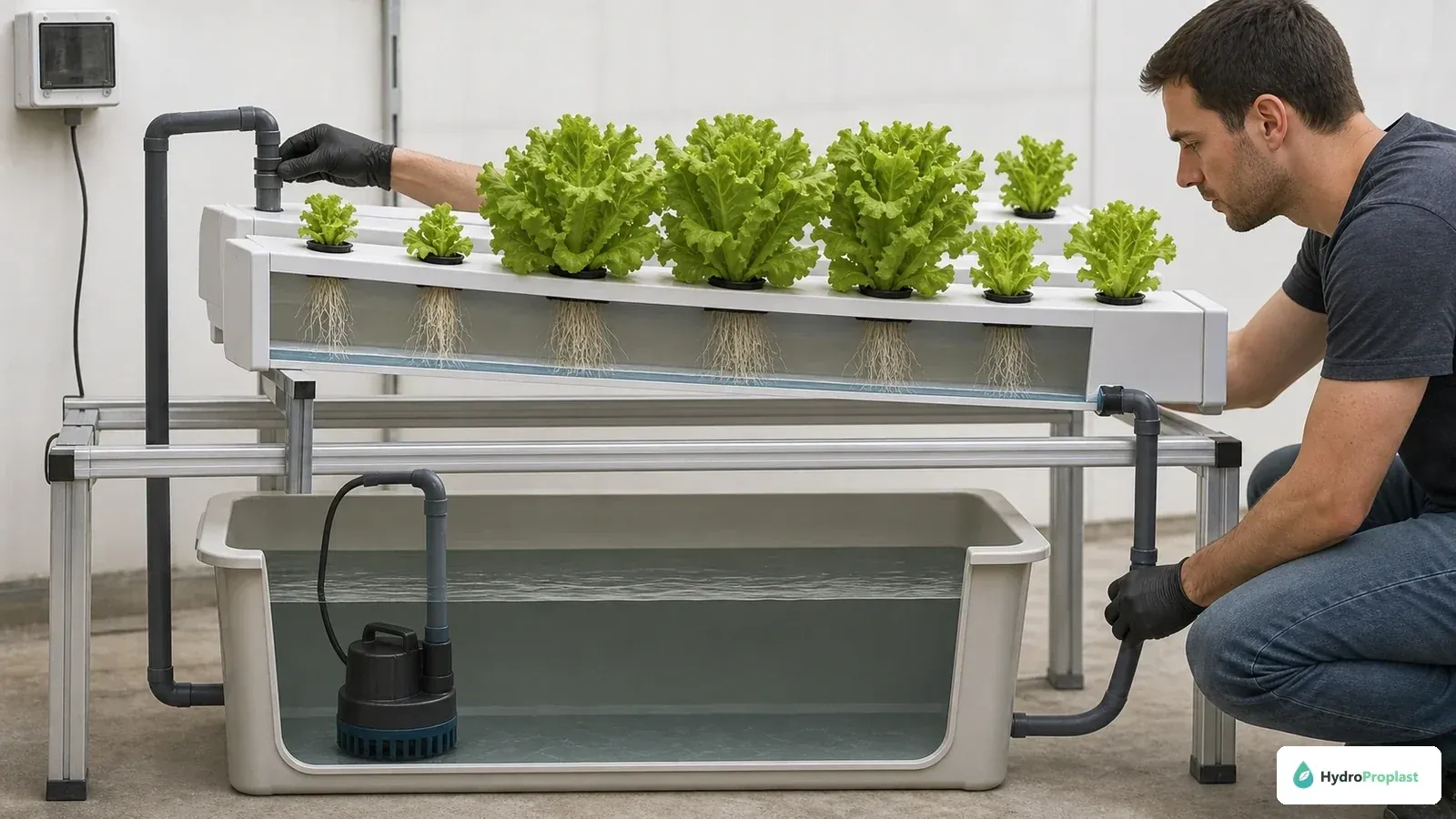
In NFT, compare inlet flow, the shallow nutrient film, channel slope, roots, and return flow.
In drip systems, collect representative emitter output for a fixed interval. In NFT, inspect inlet, film, roots, slope, and return. In DWC, compare bubble distribution and water height. In passive systems, preserve the intended air gap.
A plant may receive enough water to avoid wilting but not enough consistent delivery for active growth. Another may sit saturated and oxygen-limited.
Repair the local delivery fault before changing the shared reservoir.
Verify pH measurement
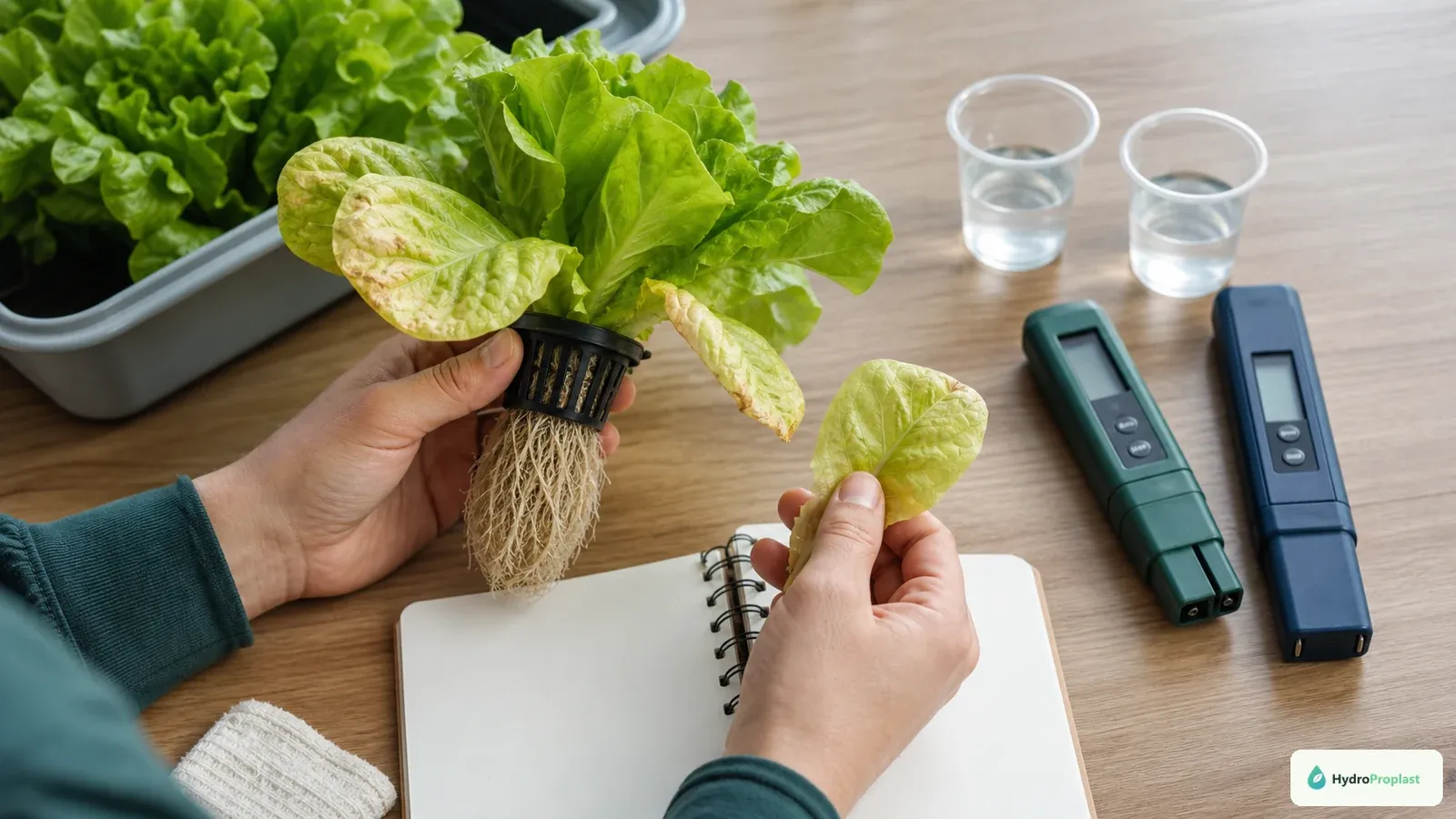
Calibrate the pH meter with fresh standards and test a well-mixed sample. An unsuitable pH can reduce nutrient availability even when EC looks normal.
Use small diluted adjustments according to product directions. Never add acid and alkali together or pour concentrate beside roots. The hydroponic pH guide provides a safe sequence.
Repeatedly feeding a pH-limited crop can create excessive EC.
Interpret EC with water level
EC represents total dissolved ions, not individual nutrients. Record source water, fresh-mix baseline, reservoir level, top-ups, and crop stage.
Rising EC while water falls can indicate concentration; falling EC can accompany uptake or dilution. Stable EC does not prove balanced nutrition. Verify the meter and mixing record.
Do not dose to a generic internet number. Follow the nutrient manufacturer and crop evidence.
Audit nutrient mixing
Confirm final reservoir volume, product, dose, units, and order of addition. Add separate concentrates individually to water. Check whether an automatic doser ran incorrectly or a stock tank was empty.
Review source-water EC, alkalinity, sodium, and chloride when problems recur. A formula designed for low-mineral water may behave differently with hard or softened water.
The hydroponic nutrient guide explains complete formulations.
Check spacing and canopy competition
Crowded plants shade lower leaves, restrict airflow, hide pests, and compete below the lid. A small seedling hole pattern may be unsuitable for the mature crop.
Compare edge, center, tall, and short plants. Thin or harvest according to crop guidance. Do not remove healthy leaves indiscriminately; restore useful spacing and light distribution.
Inspect roots for channel dams and intertwined masses before they stop flow.
Inspect pests and disease
Use magnification on leaf undersides, tips, crowns, and stems. Aphids, mites, thrips, whiteflies, fungus gnats, and disease can slow growth before dramatic symptoms appear.
Quarantine suspect plants and identify the cause. Use only pest controls labeled for the edible crop and indoor setting, following PPE, re-entry, and harvest intervals.
Do not spray a pale plant simply because no nutrient explanation is obvious.
Consider transplant shock and seed quality
Recently moved seedlings may pause while roots establish. Check whether the plug reaches moisture, the crown remains aerated, and light increased gradually.
Poor seed vigor, old seed, uneven germination temperature, or early stretching can create weak transplants that never match healthy controls. A reserve seedling may be more efficient than prolonged recovery.
Record seed lot and propagation conditions so repeated slow starts can be separated from production problems.
Change one supported factor
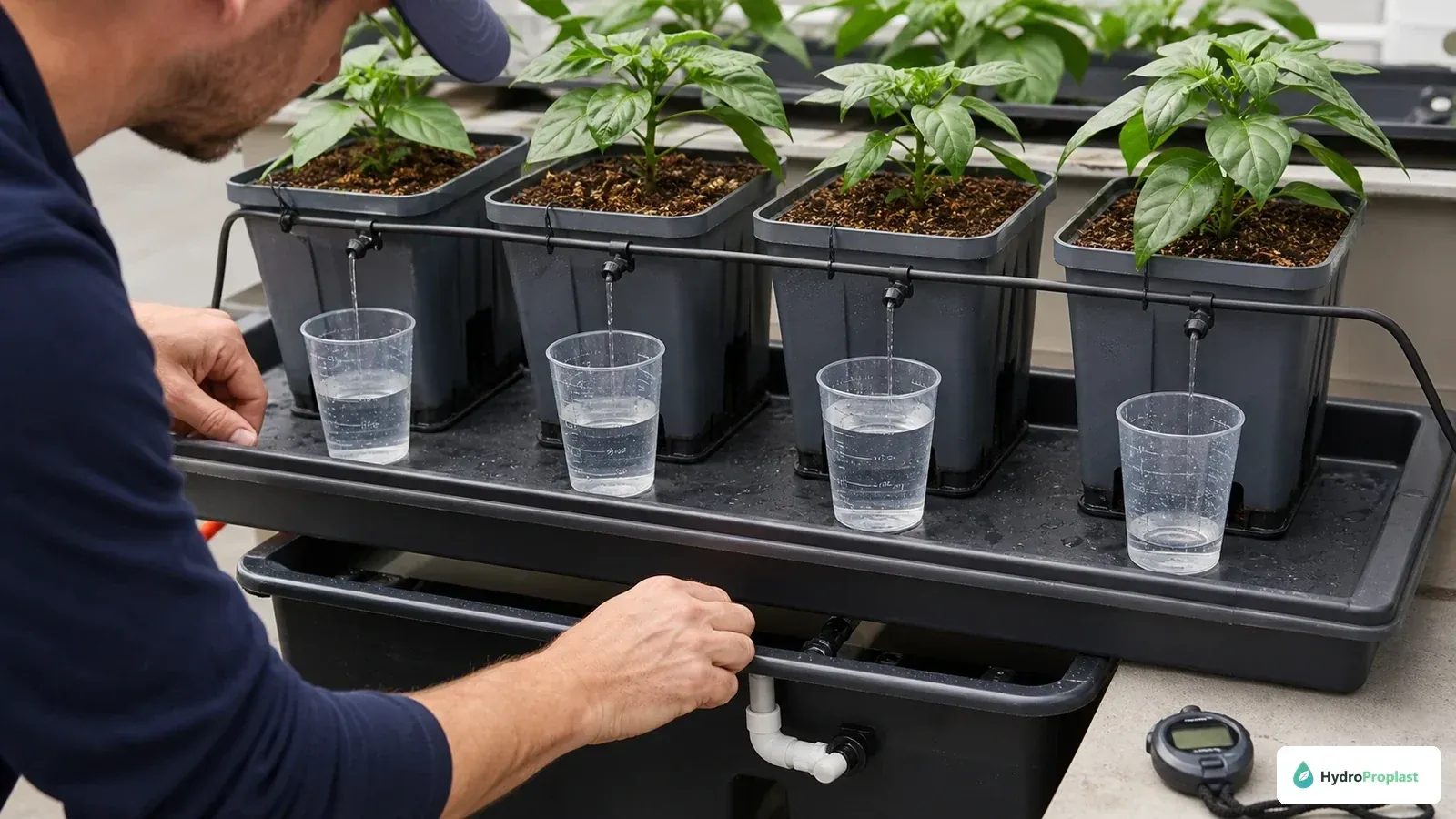
A timed catch-cup test can reveal a weak or blocked emitter affecting one plant or position.
Rank causes by evidence and urgency. Restore failed pumps or unsafe temperatures immediately. Otherwise choose the strongest supported issue—light, roots, pH, delivery, or recipe—and keep other variables stable.
Mark the newest leaf and photograph roots. Existing damaged tissue may remain. Recovery appears as fresh root tips, expanding leaves, normal internodes, and resumed water use.
Changing nutrients, pH, light, and temperature together prevents learning and may create a second stress.
Use a seven-day diagnostic log
Record morning and warm-period air and solution temperatures, water level, pH, EC, pump status, light schedule, root observations, and new growth. Include top-ups and maintenance.
Measure representative healthy and slow plants. At the end of the week, compare trends, positions, and changes. Escalate to a local extension service or diagnostic laboratory when growth remains stalled despite verified conditions.
University of Minnesota Extension’s small-scale hydroponics guide provides monitoring context. Slow growth becomes manageable when it is defined, mapped, measured, and corrected one cause at a time.
Run a controlled comparison
Choose one healthy and one slow plant of the same cultivar and age. Record system position, canopy PPFD, air and solution temperature, root appearance, water access, pH, EC, and recent top-ups. Measure the newest fully expanded leaf and mark the growing point. Avoid damaging either plant.
For seven days, photograph from a fixed distance and record new leaf count, canopy width, internode length, new root tips, and water use. Do not change the control. Correct only the strongest verified cause for the slow plant unless an urgent equipment failure affects the whole system.
At the end, classify the response. New roots without leaf expansion can indicate that the plant is rebuilding belowground. Expanded leaves without healthy roots may be temporary. No improvement after a verified correction suggests that another cause or permanent early damage remains.
Compare the correct crop stage
For seedlings, compare emergence date, plug moisture, stem compactness, and first true leaves. For leafy greens, compare new leaf area, head formation, and lower-canopy shading. For herbs, compare branching after harvest. For fruiting crops, separate vegetative growth, flower development, fruit set, and fruit filling.
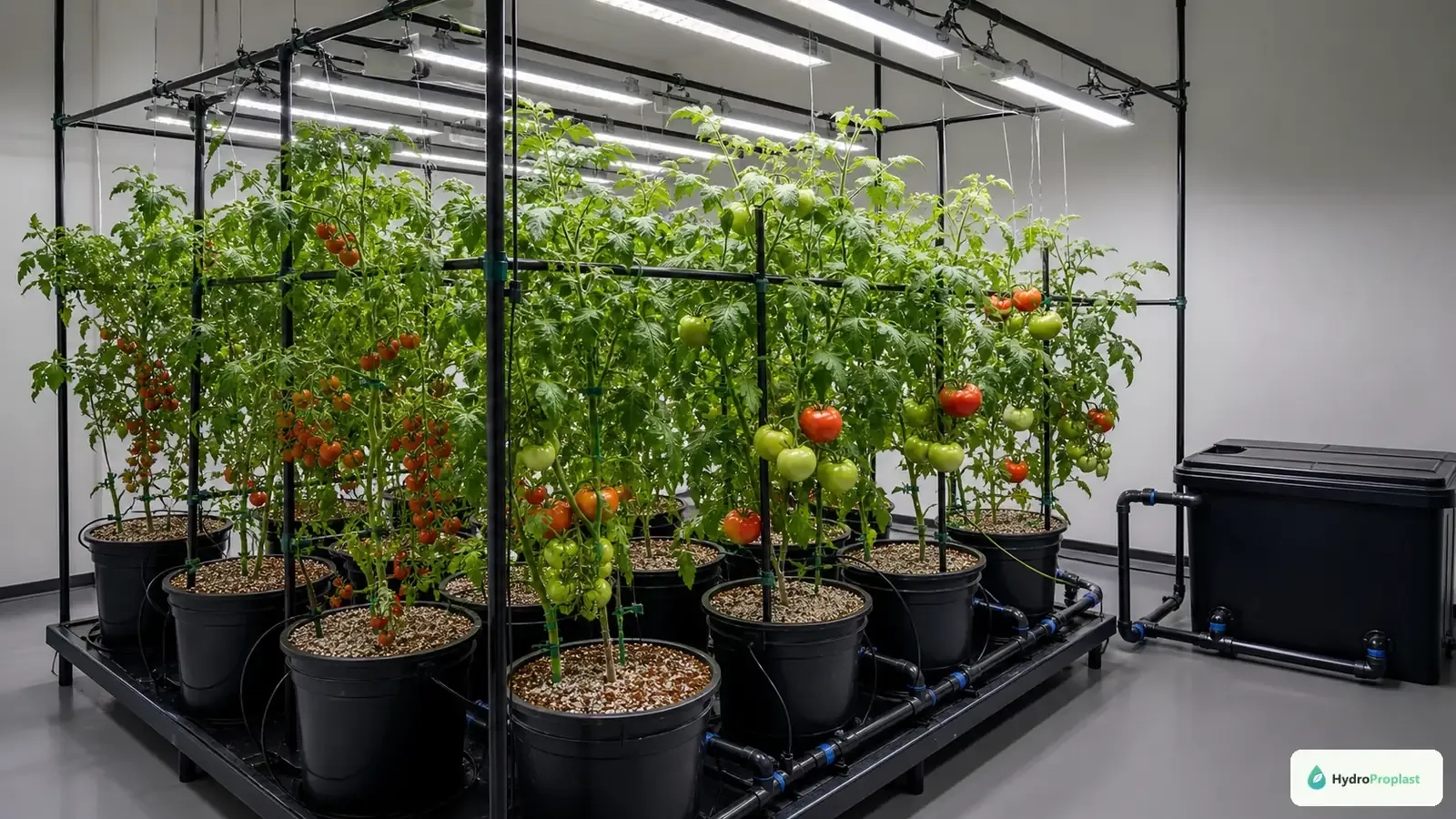
A tomato producing little new stem while supporting a heavy fruit load is not equivalent to a lettuce seedling that never expands. Define the intended output before labeling growth slow.
Review source water and nutrient formula
Obtain a water analysis when source EC is substantial or symptoms recur across fresh nutrient batches. Sodium, chloride, alkalinity, and hardness cannot be identified by EC. Confirm that the chosen nutrient program is intended for that baseline.
Check product storage, lot, expiration or manufacturer guidance, measuring tools, and final volume. Crystallized or incorrectly stored concentrate should be discussed with the manufacturer rather than corrected with supplements.
Find hidden environmental constraints
Inspect dark-period temperature and humidity, not only lights-on conditions. Cold nights can slow warm-season crops; warm nights can reduce quality in cool-season crops. Condensation and stagnant humidity can increase disease pressure.
Check whether a fan blasts one row, a door cools one shelf, or a driver heats the upper canopy. Move temporary sensors through the room and compare slow positions with productive ones.
Know when to replace a plant
Replace plants with collapsed crowns, extensive root decay, confirmed serious disease, or persistent failure that occupies a valuable production site. Keep reserve seedlings where uniform harvest matters.
For a valuable cultivar, seek diagnostic support before disposal. Provide the seed lot, timeline, water report, nutrient label, meter calibration, climate graph, root photographs, and interventions.
Oklahoma State University’s EC and pH guide explains why readings require context.
Complete the final diagnostic checklist
- The comparison uses the same cultivar and stage.
- Shared and local failure patterns are mapped.
- Root function and delivery are verified.
- PPFD and timer operation are measured.
- Air and solution temperature trends are known.
- pH and EC meters are calibrated.
- Mixing and source water are documented.
- Pests and disease are inspected.
- One supported correction is evaluated from new growth.
Slow growth is solved by finding the limiting process. More fertilizer, longer light, or warmer water can worsen the crop when the true limit is oxygen, heat, disease, or genetics.
Account for harvest and pruning
A growth-rate review should also account for harvest and pruning. Basil may appear stalled immediately after a large cut because leaf area was removed. Lettuce repeatedly harvested from outer leaves should be compared by new-leaf production, not total canopy size. Fruiting plants can direct resources toward flowers and fruit while stem extension slows.
Record every harvest, prune, fruit-thinning event, and damaged leaf removal. Compare recovery with an unharvested plant only when crop architecture and load are similar.
Measure gradual equipment degradation
Equipment degradation can be gradual. A worn pump may still move water but deliver less flow; an air stone may bubble unevenly; a dirty fixture may lose output; a pH probe may drift while still displaying stable numbers. Verify performance against measured output or standards rather than an on/off observation.
Review container and root capacity
Review container and root capacity. A long-lived pepper or tomato can remain visually healthy while roots fill the available volume, restrict circulation, and create rapid solution swings. A mature mint can invade neighboring channels. Root pruning is not a universal remedy; redesign or crop turnover may be safer.
Classify the limiting factor
At final review, classify the limiting factor as biological, environmental, nutritional, hydraulic, structural, pest-related, or measurement-related. Document the evidence and the response. If classification remains uncertain, do not keep adding products. Preserve samples and logs for professional diagnosis.
Turn the diagnosis into an operational change
A useful diagnosis ends with an operational change: a new spacing rule, larger reservoir, verified light map, different crop grouping, earlier turnover, meter-service schedule, or cleaner transplant standard. Without that change, the next crop repeats the same slow-growth investigation.