Indoor fruiting crops cannot rely on outdoor wind and insects. Tomatoes and peppers usually carry self-fertile flowers that may need vibration or air movement to release pollen. Cucumbers differ more: some cultivars require pollen transfer between male and female flowers, while parthenocarpic greenhouse types can set fruit without pollination and may perform poorly if pollinated. Identify the crop and cultivar before touching flowers.
Identify the reproductive system first
Read the seed breeder’s description for flower type, parthenocarpy, sex expression, and protected-culture guidance. Do not assume every cucumber behaves alike or that a technique used for tomatoes applies to peppers.
Tomato flowers contain male and female structures within one flower. Pepper flowers are also commonly self-fertile. Many cucumbers produce separate male and female flowers on the same plant, while some cultivars are predominantly female or parthenocarpic.
Recognize tomato flowers ready for vibration
A tomato cluster contains flowers at different stages. Work with fully opened flowers whose petals are expanded and pollen is mature under suitable conditions. Closed buds are not ready, and old fading flowers may already have completed or failed pollination.
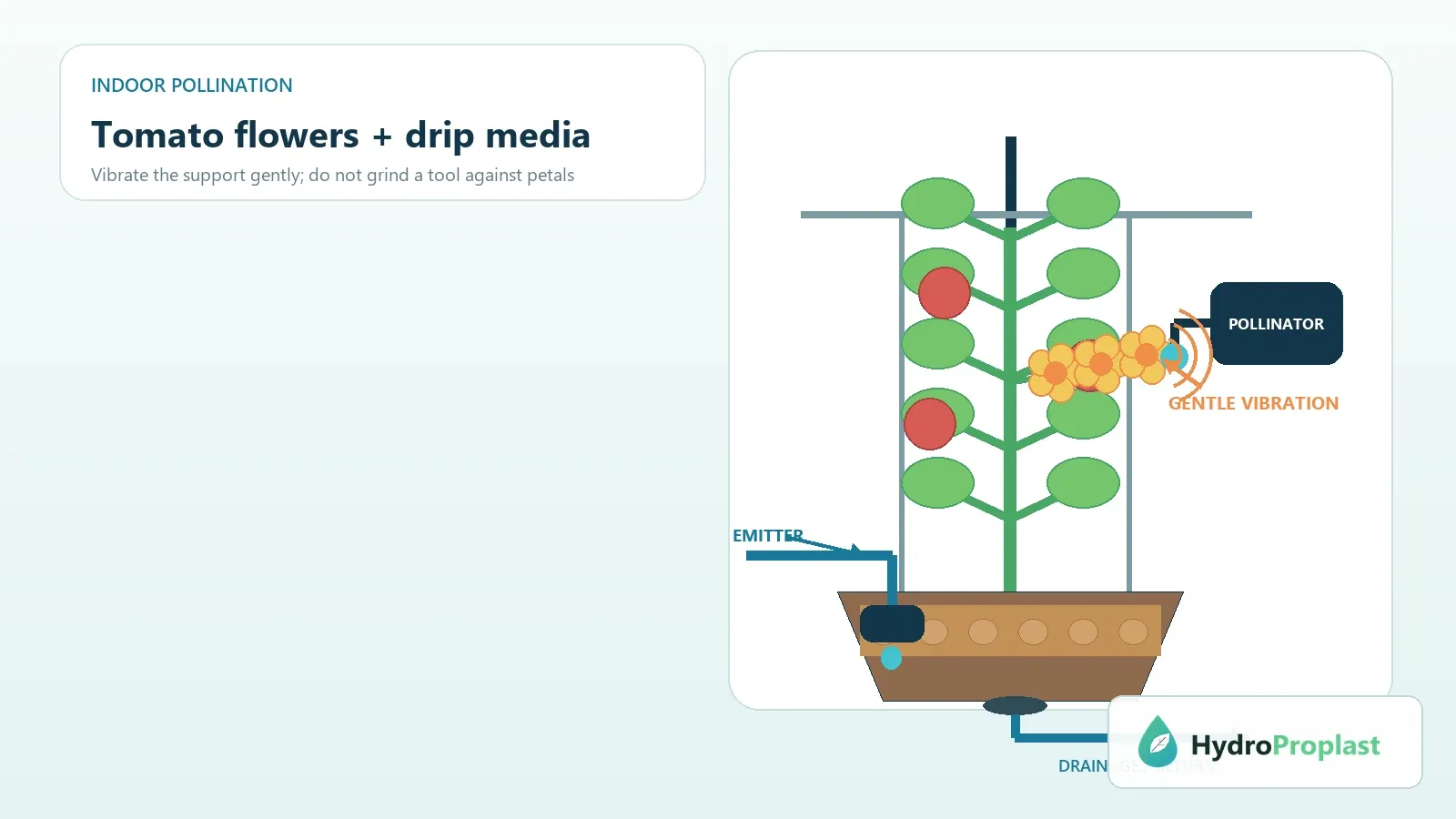
Gently vibrating the flower truss can release pollen inside the flower. Use a purpose-made pollinator, an electric toothbrush touching the support near the cluster, or a careful tap on the trellis. Do not grind a device against petals or stems.
The University of Minnesota Extension’s tomato growing guidance provides flower and crop context.
Pollinate tomatoes without damaging trusses
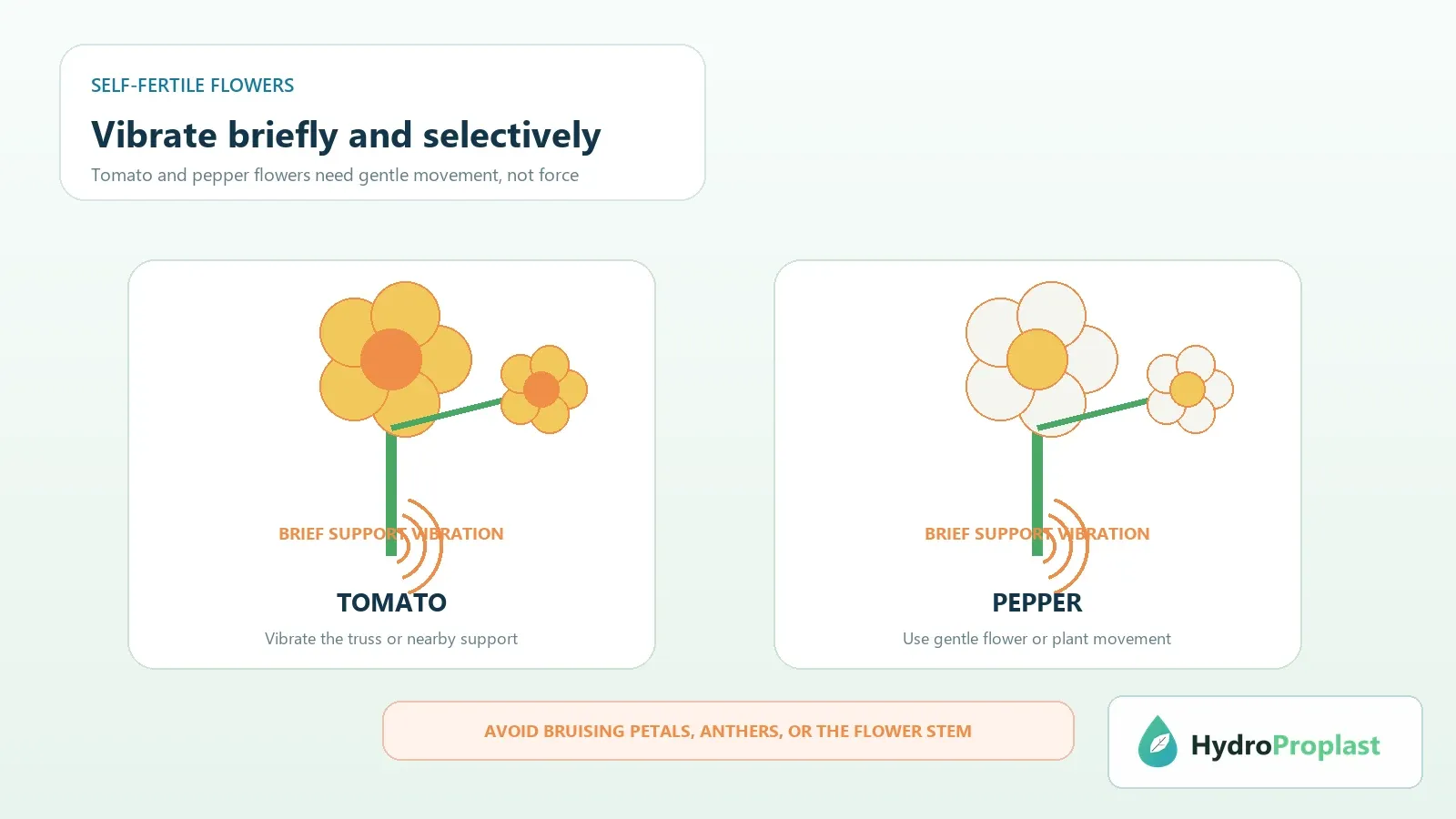
Tomato and pepper flowers respond to brief, gentle vibration rather than forceful handling.
Support the cluster with one hand only when needed and vibrate briefly. Move systematically through open clusters and mark the date on representative flowers. Avoid handling wet flowers or working during severe heat stress.
A fan may provide useful movement, but random airflow does not prove that every flower vibrated at the right stage. Observe flower motion and fruit set.
Clean reusable tools before moving between plants, especially when disease is suspected. Do not dip an electrical device into sanitizer; follow its cleaning instructions.
Understand pepper self-pollination
Pepper flowers can self-pollinate, and gentle air movement or vibration often helps pollen move. A light tap to a branch or support may be enough. Aggressive shaking can break flowers and young branches.
Pepper flowers may drop because of unsuitable temperature, humidity, weak light, root stress, water stress, or excessive crop load. Lack of hand pollination is only one possibility.
The indoor hydroponic pepper guide covers support, flower drop, and crop-stage management.
Vibrate pepper flowers selectively
Visit plants regularly while new flowers open. Gently move flowering branches without striking developing fruit. Mark a sample of flowers and compare set with untouched controls if the room already has effective airflow.
Do not apply foliar products to open flowers unless the product is specifically labeled for the edible crop, indoor use, and that growth stage. Observe harvest intervals and worker protection.
If flowers contain no visible viable pollen under repeated suitable conditions, investigate climate and plant condition rather than increasing vibration force.
Identify cucumber male and female flowers
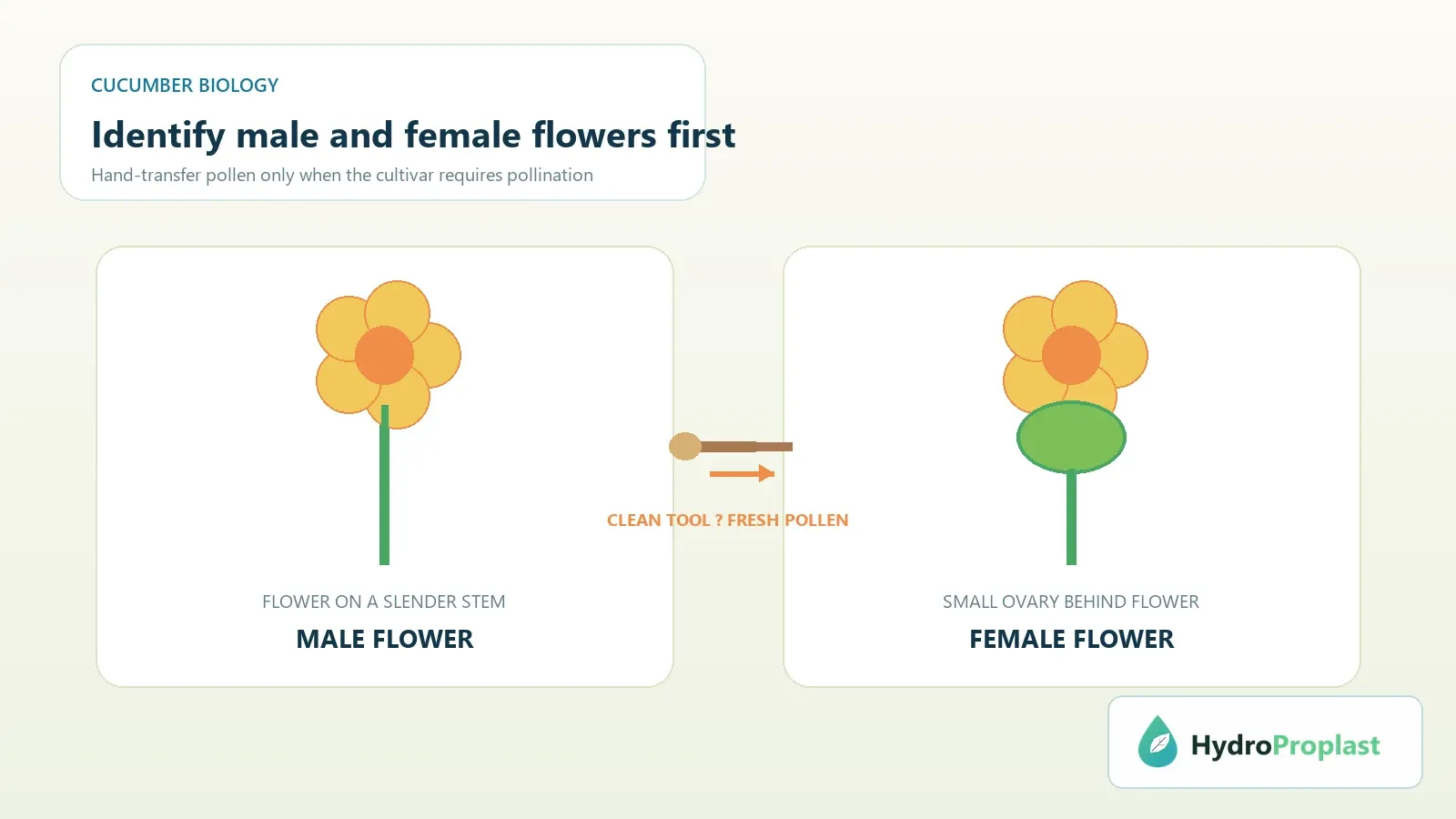
Identify cucumber flower sex and cultivar guidance before transferring pollen.
A female cucumber flower has an ovary resembling a tiny cucumber behind the petals. A male flower lacks that swollen base and produces pollen. Flower ratio and timing vary with cultivar and conditions.
For a cultivar that requires pollination, male and female flowers must be open at compatible times. For parthenocarpic types, fruit can develop without fertilization. Follow breeder instructions because unwanted pollination can create misshapen or seeded fruit in some greenhouse cucumbers.
The home hydroponic cucumber guide explains cultivar and trellis planning.
Hand-pollinate cucumbers that require it
Use a clean small brush to collect pollen from a freshly open male flower and apply it gently to the stigma of a receptive female flower. Alternatively, remove the male flower’s petals and touch the anther carefully to the stigma when crop guidance supports that method.
Label or mark pollinated female flowers with the date. Use a different clean brush when moving among cultivars if controlled pollination matters. Do not use the same brush on diseased flowers.
Pollinate more than once only when guidance and flower condition justify it. Repeated rough contact can damage the stigma.
Use time and climate records
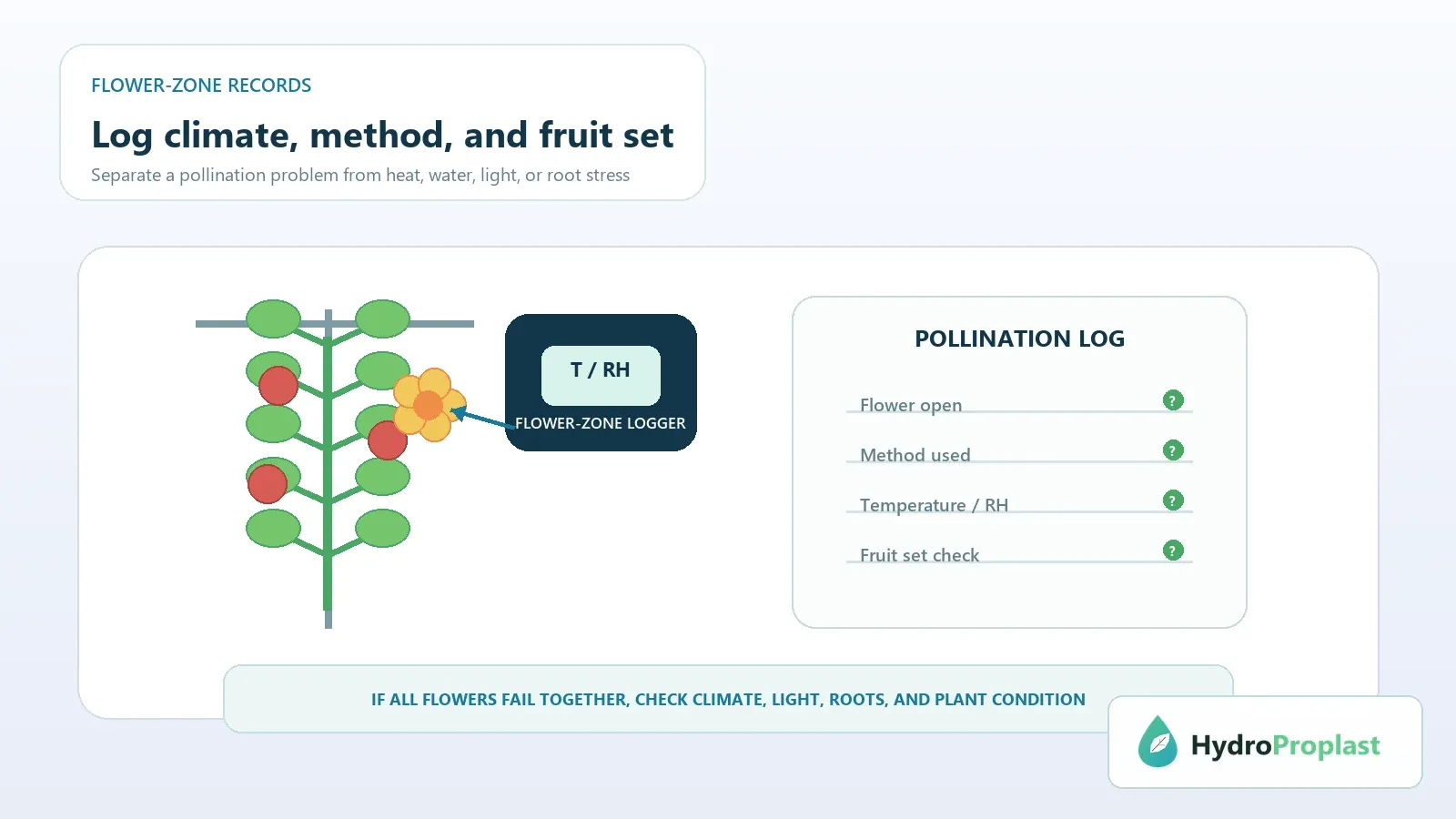
Use climate and pollination records to distinguish technique problems from wider crop stress.
Pollen release, viability, stigma receptivity, and fruit set depend on temperature and humidity. Record canopy conditions around the flowers, not only a wall thermostat. Heat or humidity extremes can explain low set despite careful technique.
Perform pollination during the part of the local light period recommended for the crop, when flowers are dry and conditions are suitable. There is no universal clock time for every room.
Cornell’s controlled-environment resources and extension crop guides can help establish crop-specific conditions. Use measured trends rather than one daily reading.
Distinguish pollination failure from fruit abortion
A female flower or tomato blossom may begin to swell and later abort because the plant cannot support the fruit, roots are stressed, light is inadequate, or climate becomes unsuitable. This is not automatically failed pollen transfer.
Map abortion by cluster, canopy height, and system position. All plants failing together suggests a shared environment. One shaded branch suggests local light or damage.
Inspect roots, irrigation, pH, EC, and leaf health before adding a bloom supplement. The yellow-leaf diagnostic guide provides a broader symptom process.
Diagnose misshapen fruit
Incomplete pollination can produce uneven cucumber or strawberry development, but misshapen fruit can also follow temperature, water stress, pests, disease, or physical injury. Record the flower date and conditions during early development.
Tomato catfacing, pepper distortion, and cucumber curvature have crop-specific causes. Do not apply one diagnosis across species. Consult a local diagnostic service when losses recur.
Support pollinated fruit
Successful set increases branch and trellis load. Check clips, strings, cages, and cluster support as fruit enlarges. Transfer load to a stable frame, not the reservoir lid or light fixture.
Thin fruit only when crop guidance, plant size, light, or support requires it. There is no universal number of fruit per hydroponic plant.
Avoid pruning heavily immediately after fruit set. Leaves supply carbohydrates and shade fruit; remove them only for a defined training, disease, or airflow reason.
Keep pollination tools sanitary
Assign brushes or vibrating tools to zones where practical. Remove flower debris and wash reusable non-electrical tools before applying any label-approved sanitation step. Cleaning removes pollen, sap, and organic material; sanitizing follows on a clean surface.
Never mix bleach, acids, ammonia, peroxide, or other cleaners. Follow labels for concentration, contact time, PPE, ventilation, rinsing, and storage.
Discard damaged brushes that cannot be cleaned. Keep tool handles off wet floors and nutrient-contact surfaces.
Build a pollination log
Record cultivar, flower or cluster number, opening date, technique, operator, canopy temperature, RH, and observed set. For cucumber, record whether flowers were male or female and whether the cultivar was intended to be pollinated.
After several cycles, calculate set for marked flowers. Compare positions and conditions rather than claiming success from one fruit.
A useful log separates pollination from root, climate, and light problems. It also prevents repeated work on the same flower.
Troubleshoot low fruit set systematically
First confirm cultivar biology and flower stage. Second verify temperature, humidity, light, and airflow around the flowers. Third inspect roots, water delivery, and plant vigor. Fourth review technique and timing. Change one supported factor and observe newly opened flowers.
Do not judge correction from old aborted flowers. New flowers formed under improved conditions provide the evidence.
Oklahoma State University’s hydroponics overview provides system context, while University of Minnesota Extension’s cucumber guidance explains cucumber flower biology.
Decide whether insects are appropriate
Commercial controlled environments sometimes use managed bumblebees or other pollinators. This requires expertise in hive placement, worker safety, pesticide compatibility, escape prevention, crop value, and local rules.
A small home system rarely needs managed insects when hand vibration or brushing is practical. Never release outdoor insects into a building without authorization and a management plan.
The right technique follows the flower: vibrate suitable tomato and pepper blossoms, transfer pollen only for cucumber cultivars that require it, and leave parthenocarpic flowers unpollinated when breeder guidance says so. Measure fruit set, then troubleshoot the complete crop rather than blaming pollen alone.
Run a three-week comparison trial
Select several similar flowers or clusters at comparable canopy positions. Assign them to the room’s normal airflow, a documented hand-vibration method, or a documented brush-transfer method only where the crop biology permits it. Leave enough flowers in each group to avoid drawing a conclusion from one fruit.
Keep irrigation, nutrient solution, pruning, and light stable. Record flower opening, intervention date, temperature and RH, visible pollen, initial swelling, confirmed continued growth, and abortion. Do not count a briefly swollen ovary as a successful mature set.
For tomatoes, compare trusses of similar age and height. For peppers, compare flowers on branches with similar vigor. For cucumbers, compare only female flowers of the same cultivar and confirm that male pollen was available when required. Parthenocarpic cucumbers belong in a separate no-pollination observation.
At the end, calculate the proportion that continued developing and note fruit shape. If all treatments fail together, technique is less likely than climate, light, roots, or plant condition. If only hand-treated flowers improve, refine the method without increasing force.
Audit climate at the flower zone
Place a small verified temperature/RH logger near representative flowers without shading them or touching wet foliage. Record the full lights-on and dark period for several days. Compare upper and lower clusters and locations near fans, doors, or fixture heat.
A wall sensor may miss a hot upper tomato truss or a stagnant cucumber corner. Adjust airflow or HVAC based on mapped conditions. Do not point a strong fan directly at tender flowers as a substitute for room mixing.
Pollen can behave differently when humidity is very high or low, but suitable ranges depend on species, cultivar, and temperature. Use authoritative crop guidance rather than one universal RH target.
Use a fruit-set checklist by crop
Tomato:
- Confirm the flower is fully open and dry.
- Vibrate the truss or nearby support briefly.
- Avoid bruising petals, anthers, or the stem.
- Mark representative clusters and revisit after several days.
Pepper:
- Confirm open self-fertile flowers and healthy branching.
- Use gentle plant movement or flower vibration.
- Investigate heat and water stress when blossoms fall.
- Protect newly set fruit with adequate branch support.
Cucumber requiring pollination:
- Identify male and female flowers correctly.
- Use fresh pollen while both flowers are receptive.
- Apply gently to the stigma with a clean tool.
- Record transfer and watch for even fruit development.
Parthenocarpic cucumber:
- Confirm breeder instructions.
- Do not import a pollen-transfer routine from field cucumbers.
- Monitor fruit shape and environmental stress.
Avoid common technique errors
Working on unopened buds wastes effort and may damage them. Shaking an entire unsupported plant can snap stems or dislodge young fruit. Using one contaminated brush throughout a room can move pests or pathogens. Pollinating without labels makes repeated effort impossible to evaluate.
Another error is changing nutrients immediately after poor set. Flowering supplements cannot correct a broken trellis, unsuitable temperature, dead roots, inadequate photons, or the wrong cucumber sex expression. Verify the production system first.
Know when to seek diagnostic help
Ask an extension educator or crop adviser when flowers repeatedly fail under measured suitable conditions, anther or stigma structures appear abnormal, fruit is consistently malformed, or disease symptoms accompany flower loss. Provide cultivar, seed source, photographs, climate logs, pH and EC trends, root observations, and the exact pollination method.
For commercial production, managed-pollinator use and pesticide compatibility require a written program. A product labeled for an edible crop can still harm bees or have restrictions around bloom. Follow the complete current label, local law, re-entry interval, preharvest interval, PPE, and pollinator-protection statements.
Write a final operating procedure
Write one method per cultivar. Specify flower identification, acceptable flower stage, intervention, frequency, tool cleaning, climate checks, marking method, set assessment date, and escalation triggers. Train anyone caring for the room to follow the same sequence.
Review the procedure after each crop. If set is already high under normal airflow, unnecessary handling can stop. If cucumber results vary, revisit breeder biology first. Pollination management succeeds when it produces repeatable well-shaped fruit without injuring flowers or masking a root, light, or climate problem.