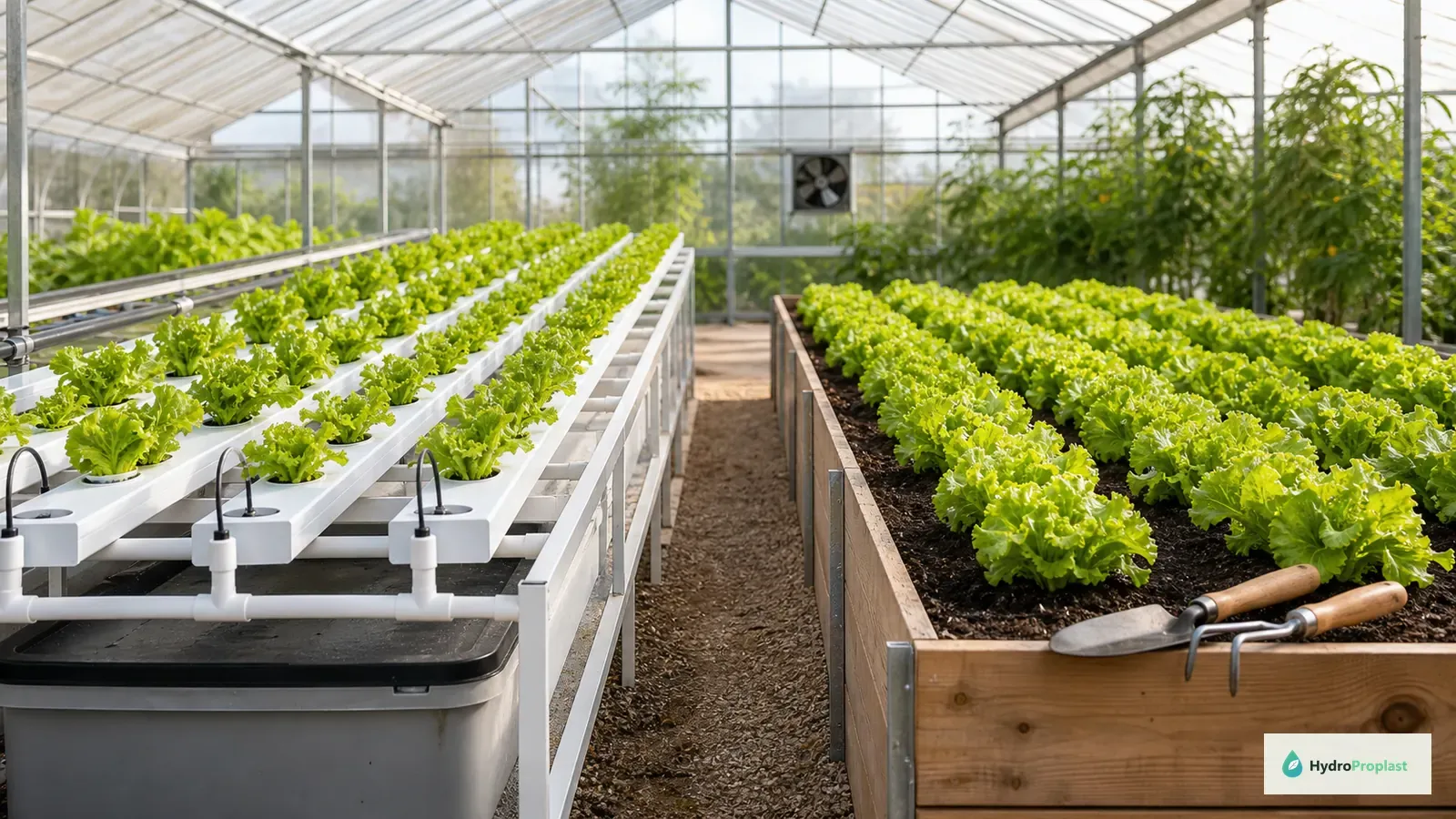
Neither method wins every comparison
Choose hydroponics when limited space, an accessible working height, a controlled root environment, or indoor production justifies the equipment and regular monitoring. Choose soil when you have healthy growing ground or room for containers, want biological buffering and lower technical dependence, and can work with local weather and soil conditions. Many households benefit from using both.
The plant does not know a marketing label. Roots absorb water, oxygen, and mineral nutrients in both methods. Soil stores and releases those resources through a complex physical and biological system. Hydroponics supplies mineral nutrients through water, with roots held directly in solution or in a soilless medium. The practical difference is who or what provides the buffering: soil processes, or the grower and equipment.
Oklahoma State University’s hydroponics guide explains that there is no physiological difference in how a plant ultimately takes up mineral elements from soil solution and hydroponic nutrient solution. That fact cuts through two myths at once: hydroponics is not “unnatural feeding,” and soil is not merely inert dirt.
Use the comparison below to match the growing method to your main priority.
Limited space or accessible height
Hydroponics: Stronger when you can support reservoirs, lighting, and routine monitoring.
Soil: Stronger when you have a sunny balcony or room for containers.
Lower technical dependence
Hydroponics: A passive system can work when it fits the crop and your absence risk.
Soil: Stronger when healthy soil, rainfall, and local weather already support the crop.
Precise root-zone control
Hydroponics: Stronger when you will measure pH, EC, temperature, and water level.
Soil: Stronger when you prefer biological and physical buffering.
Lowest energy use
Hydroponics: Competitive when sunlight supplies most crop light and pumping is modest.
Soil: Stronger when outdoor growing avoids electric lighting and climate control.
Year-round indoor greens
Hydroponics: Stronger when lighting, heat, humidity, and electricity fit the budget.
Soil: Viable when an indoor soil container receives enough natural light.
How the root zone works in each method
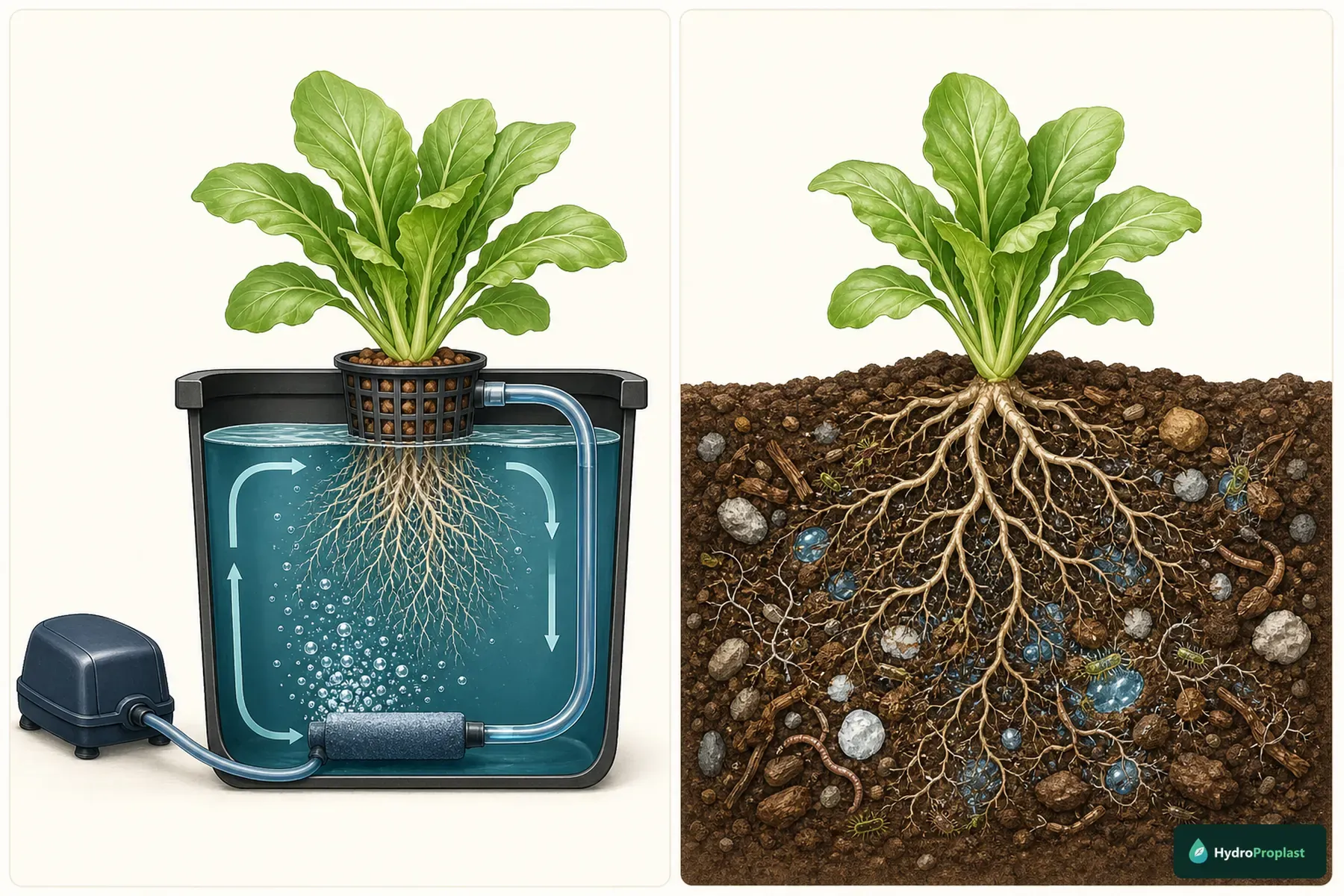
In productive soil, mineral particles, organic matter, pores, water, air, roots, fungi, bacteria, and other organisms interact. Soil texture and structure affect drainage and oxygen. Organic matter and clay can retain nutrients. Microbes transform some materials into plant-available forms. These properties can buffer short-term mistakes, but compacted, waterlogged, saline, contaminated, or nutrient-poor soil can restrict roots.
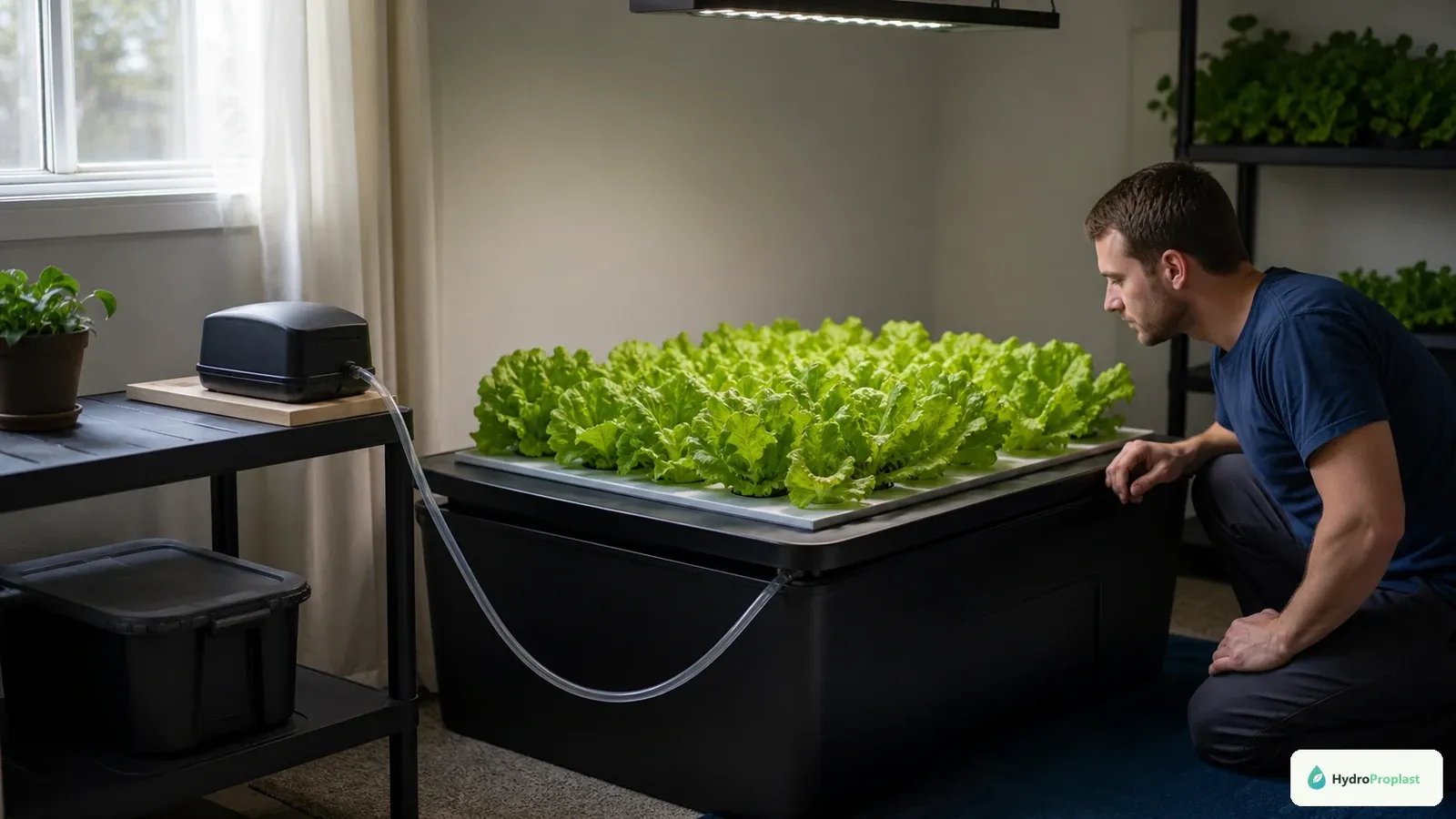
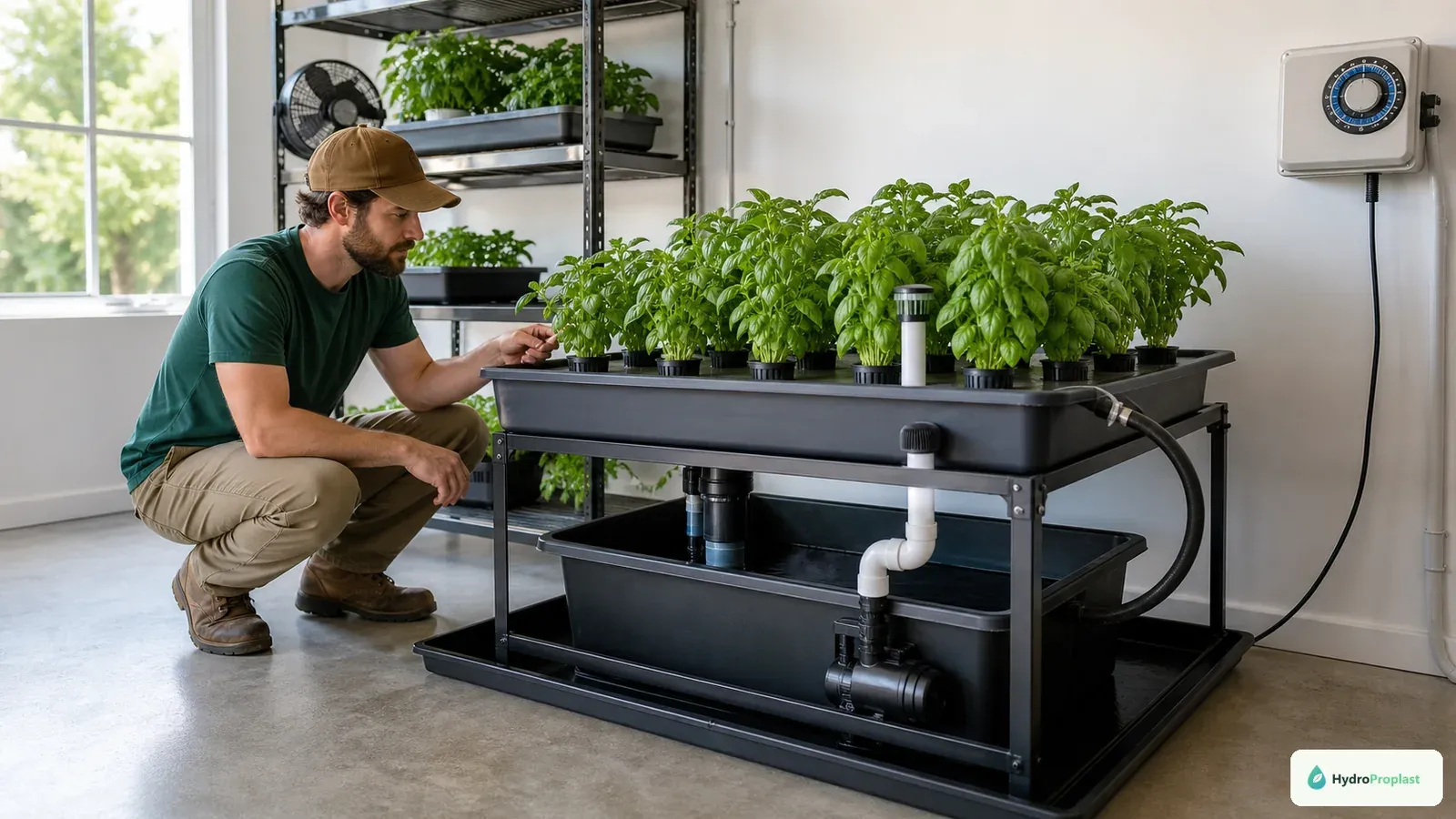
In hydroponics, the grower creates the root environment. A reservoir holds dissolved nutrients; pumps, air stones, drainage cycles, or an air gap provide oxygen; and a container or medium supports the plant. The system can respond quickly because roots have direct access to solution. It can also fail quickly if water stops moving, oxygen falls, temperature rises, or concentration drifts.
Soilless media make the boundary less tidy. Coconut coir, perlite, mineral wool, and expanded clay can hold moisture and air while nutrient solution supplies most fertility. The Oklahoma State University guide to soilless media notes that medium selection depends on plant, irrigation-water pH, cost, lifespan, and system. A media-based hydroponic tomato resembles container gardening physically, yet its nutrition is managed as a soilless system.
Water use depends on design and behavior
Closed hydroponic systems can collect and reuse nutrient solution, delivering water directly to roots and reducing losses to surrounding soil. This can be valuable where water is scarce or growing space is sealed. But an open drain-to-waste system, a leaking reservoir, frequent unnecessary solution changes, or poor climate control can weaken that advantage.
Soil irrigation can be efficient too. Mulch, drip irrigation, organic matter, correct timing, rain capture, and crop selection reduce loss. Outdoor soil crops may receive useful rainfall without pumps or manufactured reservoirs. Sandy soil can drain rapidly; heavy compacted soil may shed water or remain saturated. There is no responsible universal percentage comparing all hydroponics with all soil gardens.
Measure actual inputs. For hydroponics, record initial reservoir volume, top-ups, changes, cleaning water, and runoff. For soil, record irrigation and rainfall as well as area. Compare the same crop and harvest period. The USDA’s controlled-environment agriculture report describes potential reductions in water and agricultural chemical use while also cautioning that controlled systems are likely to require more energy.
Growth and yield claims need conditions attached
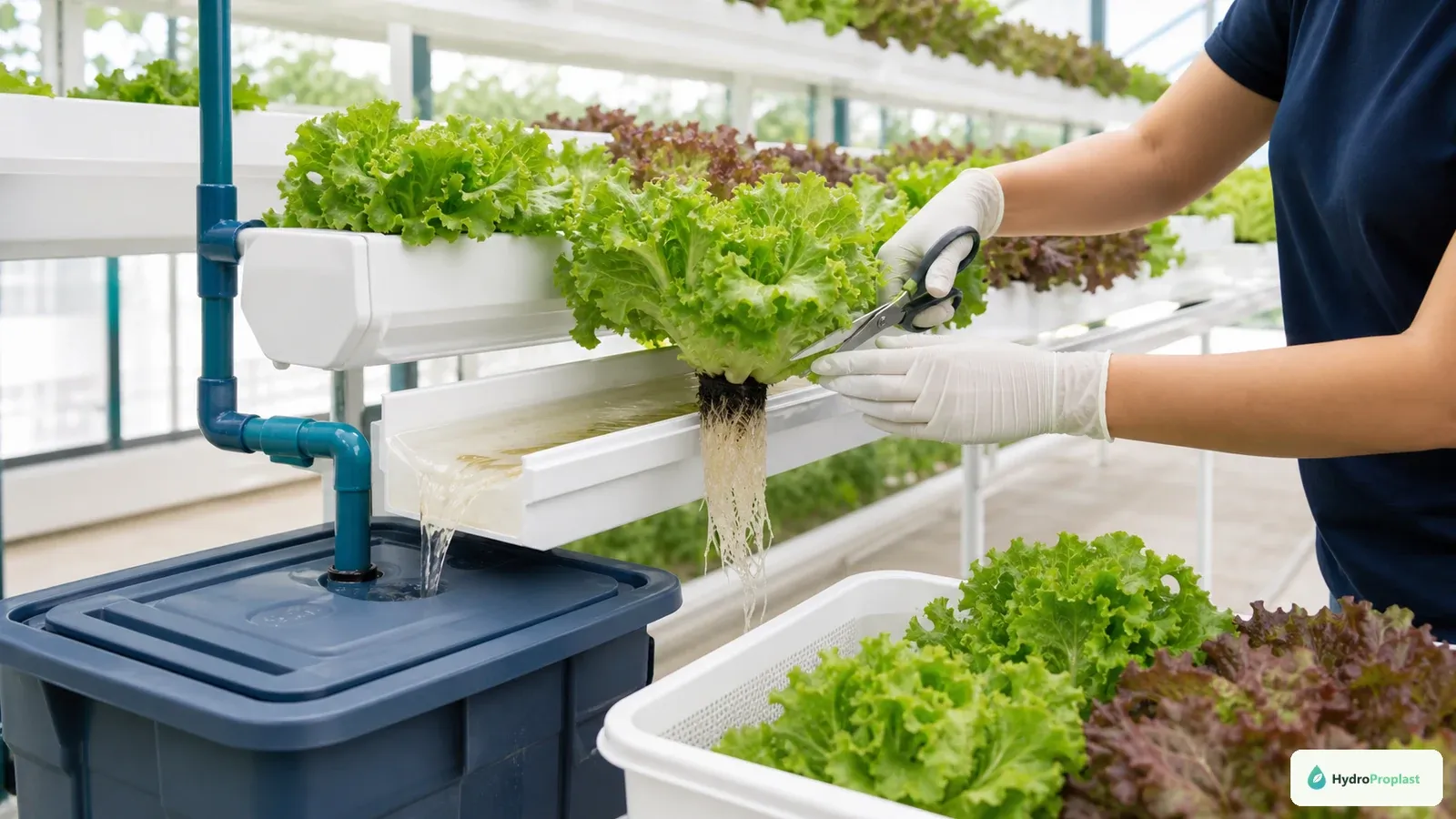
Hydroponics can support rapid, uniform growth when light, temperature, root oxygen, water, and nutrients stay near crop needs. Roots do not need to explore a large soil volume for resources, and indoor or greenhouse conditions can extend the growing season. Dense, repeatable production is one reason commercial growers use DWC and NFT for leafy greens and drip-fed substrates for fruiting crops.
That does not mean any hydroponic plant outgrows any soil plant. A lettuce under a weak indoor lamp may grow more slowly than one in fertile outdoor soil and mild sun. An undersized reservoir, warm roots, excessive nutrient concentration, or pump failure can erase the theoretical advantage. Yield comparisons also change with planting density, cultivar, crop duration, and whether energy and floor area are counted.
Soil can produce excellent yields when structure, fertility, water, weather, and pest management suit the crop. It also permits roots to explore a larger buffered zone without a container or power supply. Compare complete production environments, not roots in water with neglected soil.
The University of Minnesota Extension’s small-scale hydroponics resource reports potential for faster growth and higher yields while emphasizing uniform indoor lighting and continuing disease risks. The conditions are the important part of the claim.
Cost: equipment versus land, amendments, and labor
A simple outdoor soil bed may require little more than tools, seed, compost or fertilizer, mulch, and irrigation. Existing fertile soil and rainfall are valuable assets. Poor ground can require testing, raised beds, imported soil, drainage work, fencing, or years of amendment. The cost is location-specific.
Hydroponics shifts spending toward containers, pumps, lights, meters, nutrient, structures, and replacement parts. A passive outdoor container can be modest; a climate-controlled indoor rack is not. Electricity for lighting and temperature management may dominate ongoing cost. The system may save bending, weeding, or soil preparation while adding mixing, measurement, cleaning, and equipment checks.
Separate startup, recurring, and labor costs. Count tools and structures over multiple crop cycles rather than charging them all to one lettuce harvest. Count your time consistently in both methods. Soil weeding and bed preparation are work; reservoir changes and sanitation are work too.
If purchase decisions are the immediate concern, use How Much Does It Cost to Start Hydroponics at Home? to build a local worksheet. Do not assume grocery savings will repay equipment without records of energy, consumables, and usable harvest.
Control and forgiveness pull in opposite directions
Hydroponics offers direct control. A grower can measure pH, electrical conductivity, water temperature, and solution volume, then adjust the root environment without changing a whole soil bed. This is useful for repeatability and diagnosis. It also means the grower is responsible for making and checking those conditions.
Healthy soil often buffers changes. Nutrient storage and biological processes can smooth small fluctuations, and a larger root zone may remain moist after a missed watering. Buffering is not unlimited: too much fertilizer can create salt injury, waterlogging excludes oxygen, and pH problems can persist.
Hydroponic problems can spread through shared solution. A blocked line, contaminated reservoir, or incorrect mix may affect many plants. Soil problems can remain localized, but soil-borne pathogens and persistent weeds can be difficult to remove. The most forgiving method is the one whose likely failures you can detect and correct.
For beginners who want control without complex plumbing, What Is Hydroponics and How Does It Work? explains why a small DWC or Kratky setup makes a better learning system than a large network.
Pests, disease, and sanitation
Hydroponics removes weeds and many problems associated with field soil, but it is not sterile by default. Fungus gnats can live in moist media, algae grows where light reaches nutrient water, foliar pests arrive on plants or clothing, and root pathogens can move through recirculating solution. Warm, oxygen-poor roots are particularly vulnerable.
Soil supports both harmful and beneficial organisms. Crop rotation, drainage, resistant varieties, mulch, sanitation, and integrated pest management can reduce problems. Indoor soil containers can also bring gnats or pathogens into a room.
Hydroponic sanitation is equipment-centered: remove dead roots, block light from solution, clean reservoirs and tubing, avoid moving contaminated tools between systems, and inspect incoming plants. Soil sanitation emphasizes clean transplants, healthy amendments, tool hygiene, and avoiding movement of infested soil.
Neither method justifies routine pesticide use or claims of pesticide-free food. Pest pressure and management choices determine pesticide use. Diagnose the organism and follow locally applicable label and extension guidance.
Nutrition, flavor, and food-quality myths
A crop’s nutrient composition and flavor depend on genetics, maturity, light, temperature, water, nutrient supply, stress, harvest timing, and storage. Growing method influences some of those variables but does not determine quality by itself. A carefully grown ripe tomato in soil may outperform a prematurely harvested hydroponic tomato, and the reverse is also possible.
Oklahoma State University notes that there is no conclusive evidence that hydroponic produce is inherently more nutritious or healthier than produce from other methods. Avoid claims that “soil minerals” automatically make food superior or that precise hydroponic feeding guarantees extra nutrition.
Food safety also depends on water quality, handling, animals, workers, equipment, and post-harvest practices. Soil-free roots do not make leaves immune to contamination. Use clean water and equipment, follow nutrient and crop-safety guidance, and wash produce appropriately.
Evaluate quality by the actual crop: healthy growth, appropriate maturity, flavor, texture, and safe handling. Method labels are poor substitutes for evidence.
Environmental tradeoffs are wider than water
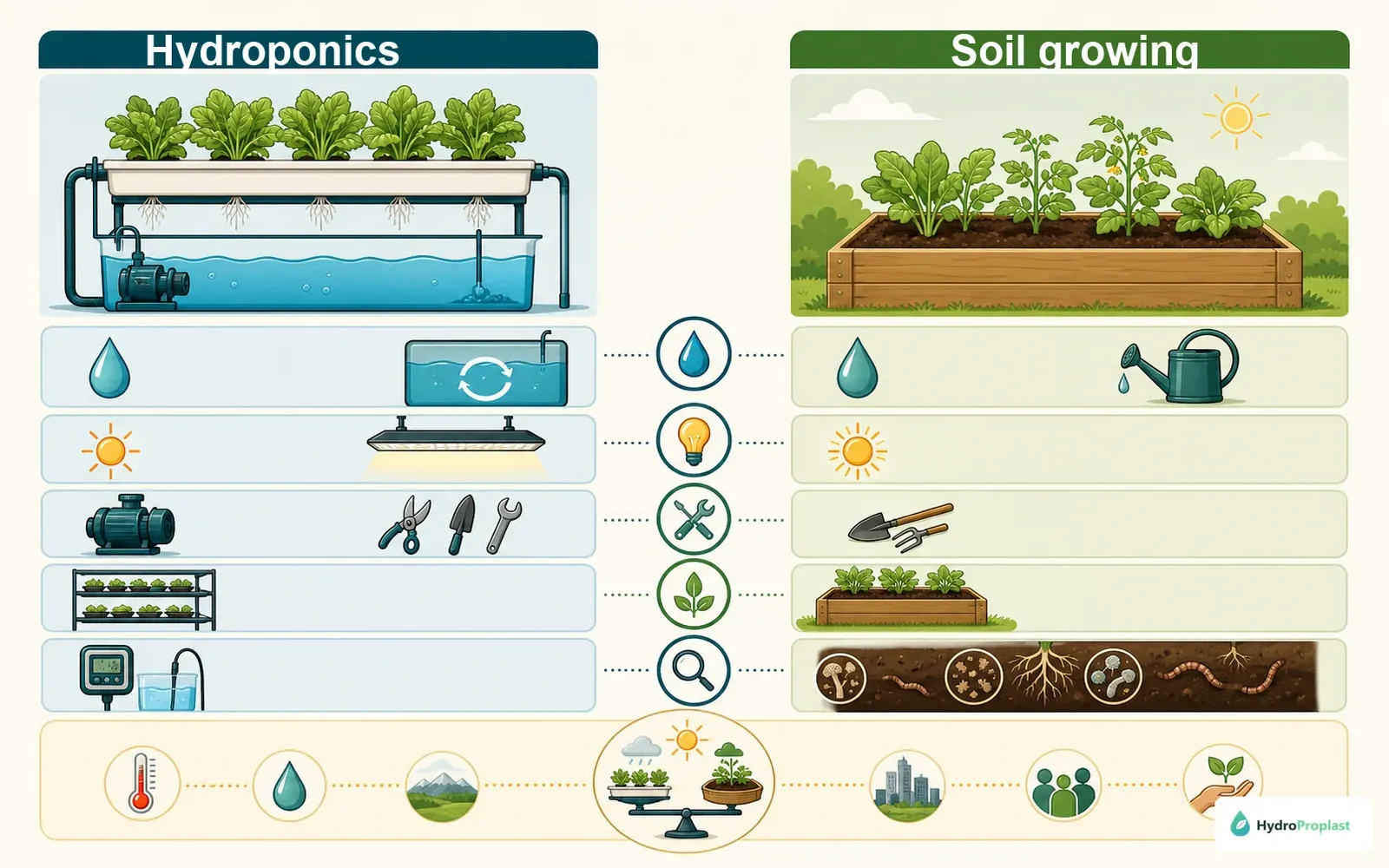
A fair comparison includes energy, materials, nutrient losses, land, water, transport, structures, and equipment lifespan. An outdoor soil garden can use sunlight and minimal manufactured hardware but may consume land and irrigation. An indoor hydroponic crop can grow close to consumers and use a compact footprint but require electric light, climate control, plastics, pumps, and manufactured nutrients.
Recirculating hydroponics can retain water and fertilizer inside the system. Responsible management still requires preventing leaks and disposing of spent solution appropriately. Soil can store carbon and support biodiversity when managed well; it can also erode or lose nutrients when bare, overtilled, or overfertilized.
Local conditions decide which impacts matter most. A greenhouse using abundant sunlight differs from a sealed vertical farm. A garden on fertile land differs from imported raised-bed soil. Electricity generation, climate, water scarcity, crop losses, and transport distance can reverse a simple comparison.
Avoid using one favorable metric to label either method sustainable. State the boundary: crop, location, season, energy source, and system type.
Space, accessibility, and lifestyle
Hydroponics can raise crops to wheelchair or standing height, fit production onto shelves, and bring gardening indoors where land is unavailable. Clean reservoirs and controlled media may suit apartments better than hauling soil. Pumps, fans, and lights introduce noise, heat, brightness, and cables, while reservoirs create spill risk.
Soil containers also fit balconies and windows, often with fewer powered devices. Outdoor beds can support large root systems and diverse planting but require suitable land and physical access. Weather and season set limits unless structures are added.
Daily habits matter. Hydroponic growers should notice pump sound, water level, root appearance, and plant response. Small reservoirs may need frequent top-ups. Soil gardeners inspect moisture, weeds, pests, and weather. Someone who enjoys instruments may prefer hydroponics; someone who travels and has a resilient mulched bed may prefer soil.
Choose a system you will maintain during the least exciting week, not only during setup.
Match common goals to the better starting method
For year-round indoor lettuce with no usable outdoor space, hydroponics is a strong candidate if lighting and energy fit the budget. Start with DWC, Kratky, or a suitably sized kit rather than complex aeroponics.
For tomatoes in a sunny yard with good soil, soil growing may be simpler and less energy-intensive. Hydroponics becomes attractive when disease history, accessibility, protected production, or precise root-zone control provides a specific benefit.
For kitchen herbs, compare a sunny soil pot, passive hydroponic container, and compact kit. The best choice depends on light and how much automation or measurement you want.
For experimenting and learning plant nutrition, hydroponics makes the root zone visible and measurable. Keep the first project small and use Best Hydroponic System for Beginners to choose a method.
For soil improvement, biodiversity, and an outdoor gardening ecosystem, soil offers benefits a reservoir is not designed to provide. Hydroponics need not replace it.
Run your own fair trial
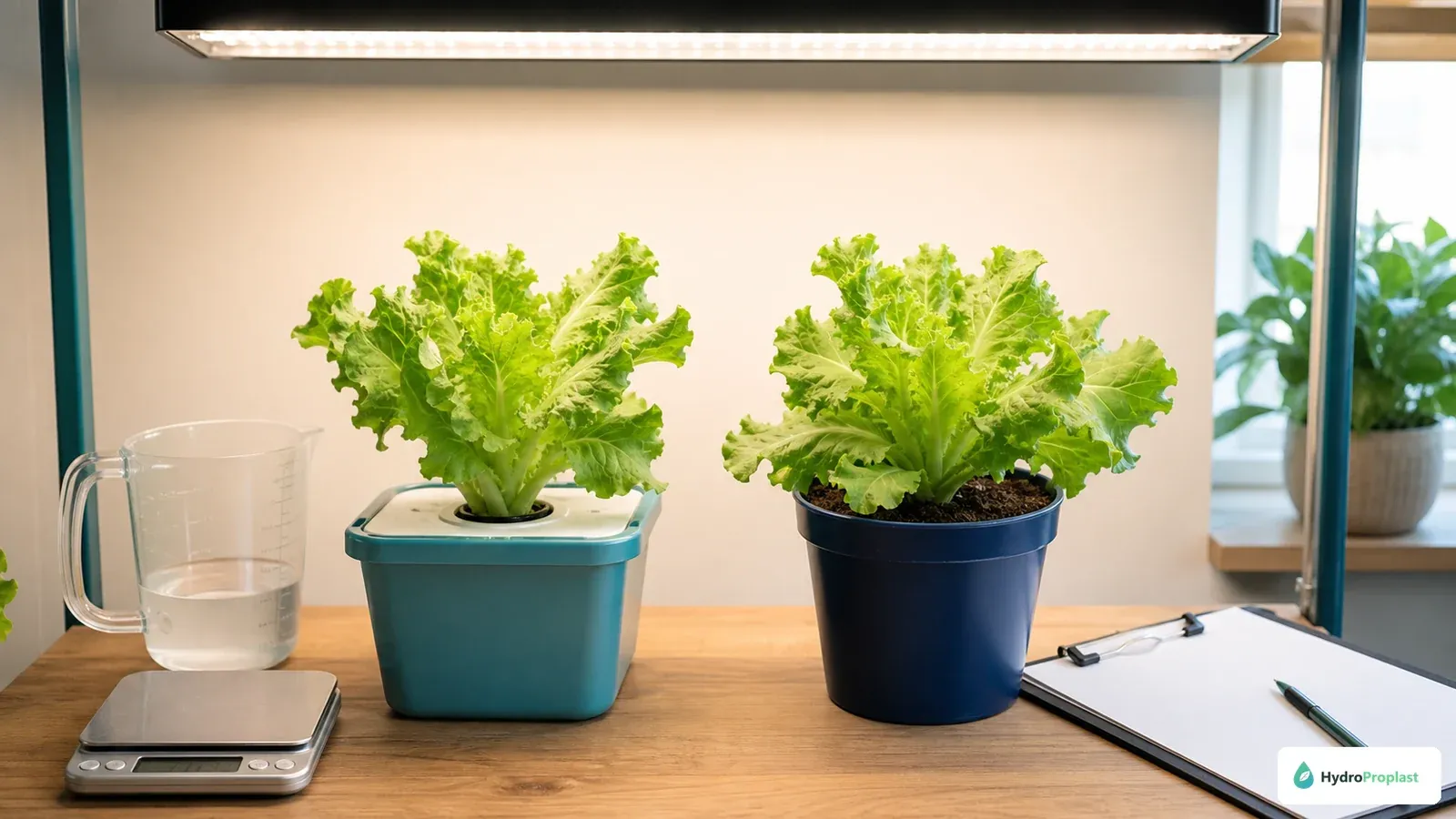
If both methods are possible, grow the same crop and cultivar at the same time. Start comparable seedlings. Record planting date, light exposure, water, fertilizer or nutrient inputs, energy, labor, pest treatments, harvest mass, and usable quality. Do not place one method in full sun and the other under a weak lamp and call the result a root-zone comparison.
The USDA Agricultural Research Service offers a simple hydroponic-versus-soil experiment built around using the same seed variety. A home trial can be more detailed, but the principle is sound: control what you can and document the conditions.
At the end, ask more than which plant was larger. Which method fit the space? Which demanded more attention? Which used more purchased inputs and energy? Which was easier to clean or reset? Which harvest did you enjoy?
Hydroponics and soil are tools, not teams. Choose based on a defined crop and constraint, and keep the option to use the other method where it performs better.