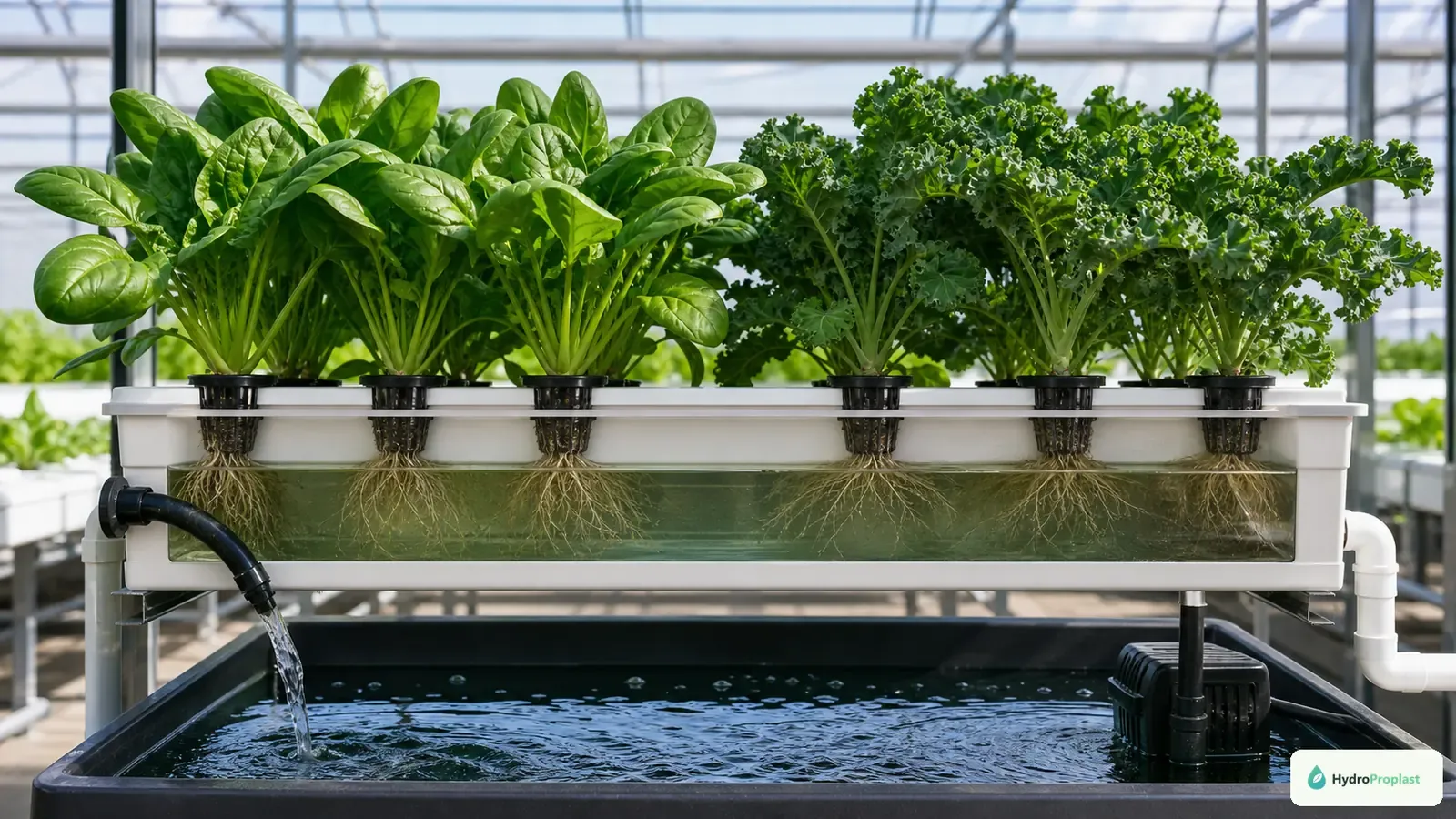
Spinach and kale are both nutritious leafy crops, but they behave differently in a home hydroponic system. Spinach stays compact and commands a high fresh-market value, yet germination and heat can be difficult. Kale is generally more vigorous and forgiving, but mature plants require more space, root volume, and harvest management. The better choice depends on room temperature, crop stage, and desired harvest.
Quick decision
Choose spinach when the room supports a cool-season crop, compact tender leaves are the goal, and the grower can manage careful germination and succession. Choose kale when stronger seedlings, repeated outer-leaf harvest, and greater tolerance of variable conditions matter more than compact size.
For the easiest first success, baby kale often provides clearer feedback. For a cool controlled room and a grower willing to test seed lots, spinach can be rewarding.
Compare mature size
Spinach forms a relatively low rosette. It can fit shelves with moderate vertical clearance, though mature leaves still need spacing and airflow. Kale cultivars range from compact to tall and broad. Curly leaves create a dense canopy that hides pests and traps moisture.
Read cultivar descriptions rather than planning from the seedling tray. Baby-leaf production uses closer spacing and shorter cycles than full-size repeated harvest.
Germination differences
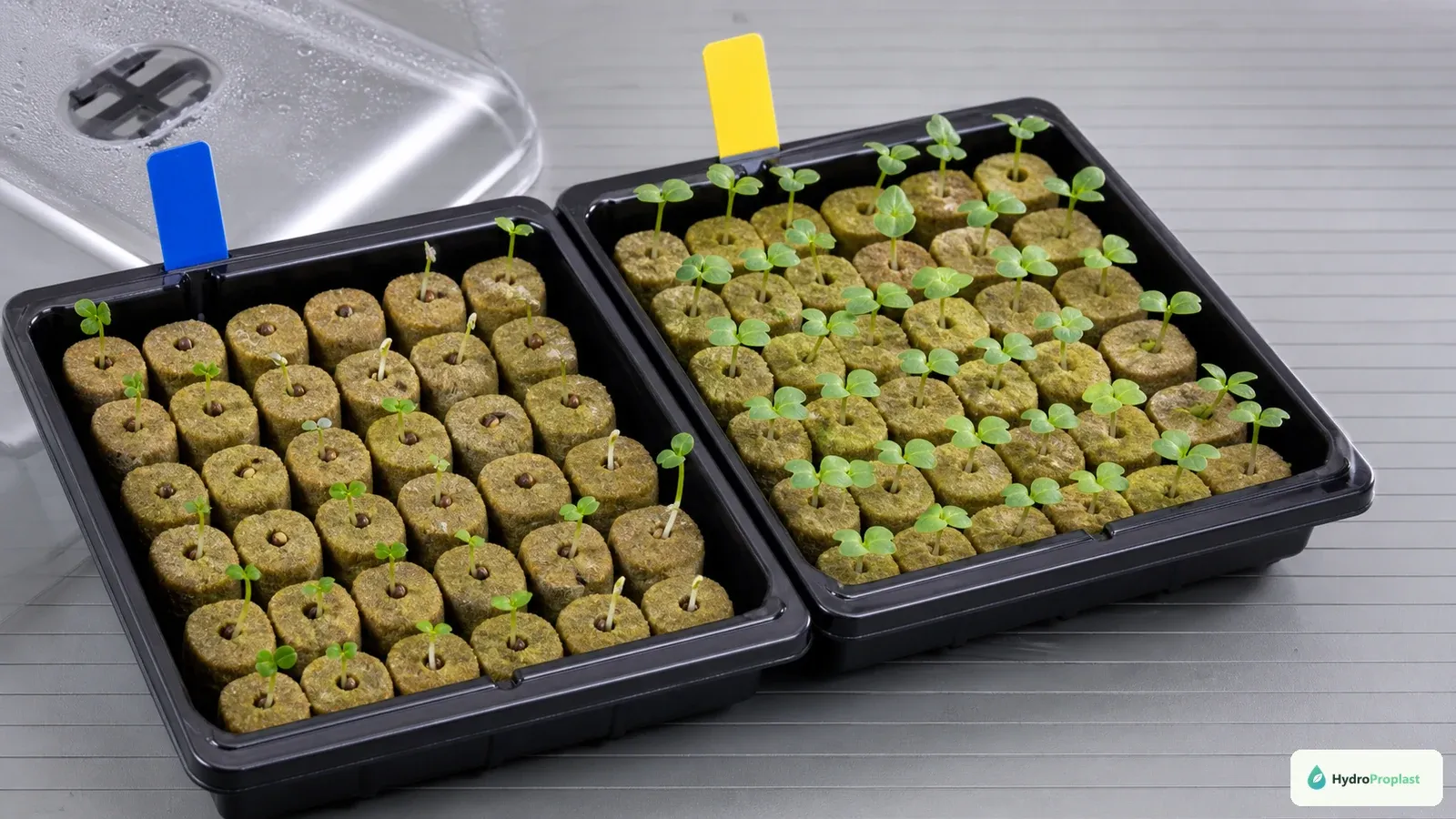
A small side-by-side germination test reveals how each seed lot performs before the main system is planted.
Spinach seed can germinate slowly or unevenly, particularly when seed is old or conditions are warm. Follow packet temperature and sowing guidance, keep plugs evenly moist, and test a counted sample before filling the system.
Kale usually emerges more readily under typical indoor propagation, but seedlings still stretch when light is weak. Provide light promptly and thin before stems compete.
Use how to germinate seeds for hydroponics for plug moisture, records, and transplant readiness.
Temperature strategy
Both are cool-season vegetables, but spinach is especially prone to poor germination, rapid maturity, or bolting under unsuitable warmth. Kale can often remain productive across a broader practical indoor range, though excessive heat still reduces quality and raises root-zone risk.
Measure air and solution across the full lighting cycle. Crop-specific cultivar guidance matters more than one universal temperature. Avoid sudden chilling as a correction.
Light and canopy response
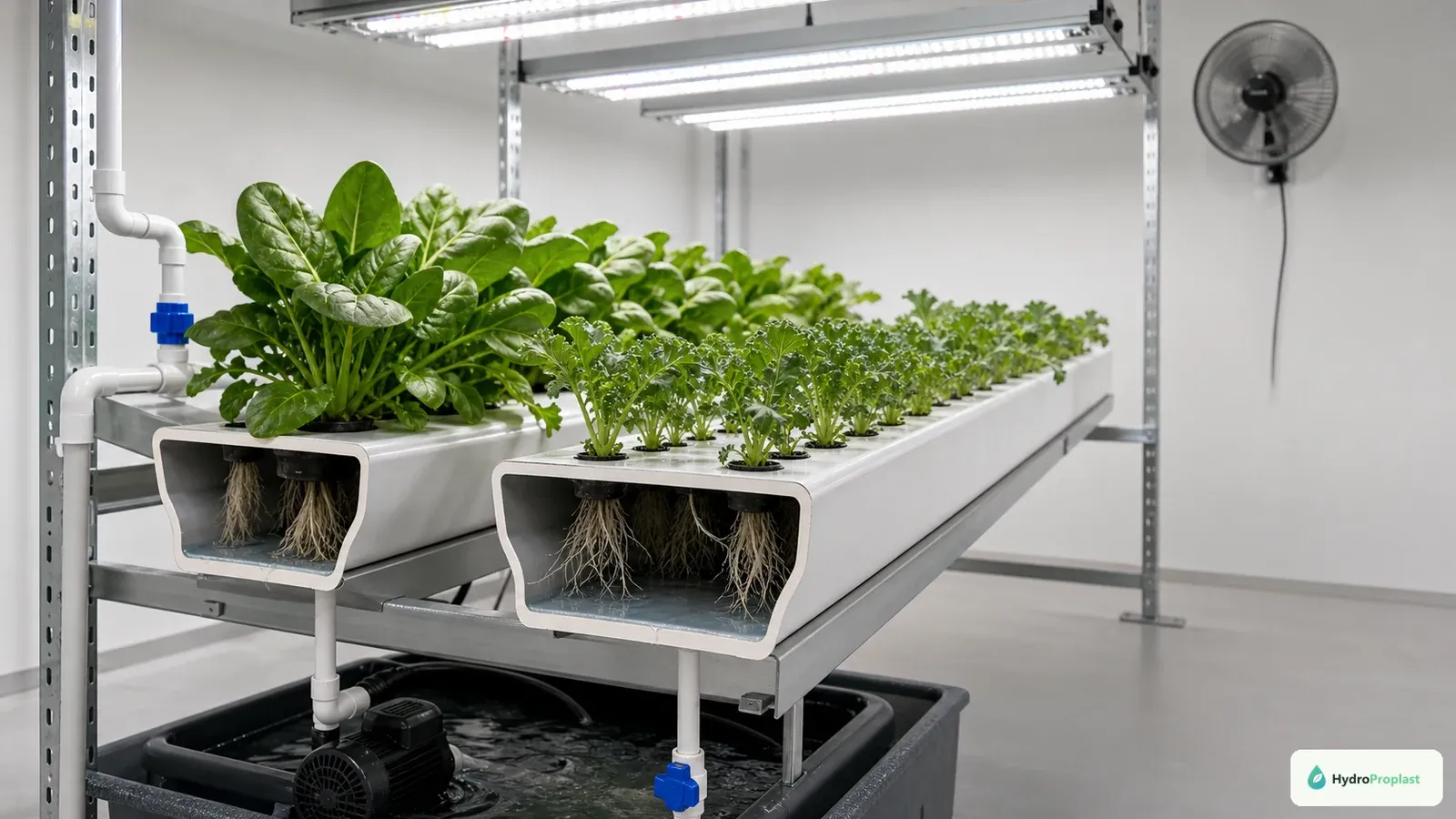
Use uniform light and a clearly shallow NFT film when comparing crop response rather than changing several variables at once.
Both need uniform daily light for compact growth. Spinach leaves can remain thin and elongated under weak delivery. Kale may stretch, produce large petioles, or shade itself when crowded.
A fixture must cover the mature canopy, not only central seedlings. Calculate daily light from measured PPFD and photoperiod where possible. The LED grow-light guide explains mapping and safe adjustment.
System choice
NFT and DWC can support spinach and baby kale. Long-lived full-size kale develops a larger root mass that can obstruct channels, making DWC or a suitably designed drip container easier to inspect. Passive methods can work if solution volume and air-gap development are managed.
Keep crowns above persistent moisture and provide access to remove old roots. Compare hardware in the beginner system guide.
Nutrient management
Use a complete hydroponic nutrient labeled or guided for leafy crops. Start seedlings appropriately mild and transition according to product and crop response. Record source water, final volume, pH, EC, temperature, and top-ups.
Spinach and kale may share a reservoir when stages and environmental needs align, but this does not prove that one fixed concentration is optimal for both. Interpret trends with water use and roots.
Do not add isolated supplements from leaf color alone. Verify meters, pH, formula, and root condition first.
Spacing for baby leaves
Baby spinach and baby kale can be planted closer because harvest occurs before full canopy development. Closer spacing still requires airflow, uniform light, and a clean harvest plan. Roots may become intertwined even when leaves look manageable.
Decide whether the tray is a one-cut crop or expected to regrow. Repeated cuts extend occupancy and sanitation requirements. Record actual edible yield per area and day rather than only plant count.
Spacing for mature harvest
Full-size spinach rosettes need room for leaf expansion and inspection. Mature kale requires substantially more width and often height. Plan for leaves after several outer harvests, not the first transplant week.
Cover unused openings to block algae. Leaving a position empty can improve airflow and final usable yield.
Harvesting spinach
Harvest outer leaves while preserving the center for regrowth, or take the whole rosette for a clean single harvest. Use clean tools and avoid damaging neighboring crowns. Young tender leaves and mature leaves serve different kitchen uses.
Spinach may not provide as many repeated harvests as a vigorous kale plant under the same schedule. Succession sowing can deliver more consistent quality than maintaining aging plants.
Harvesting kale
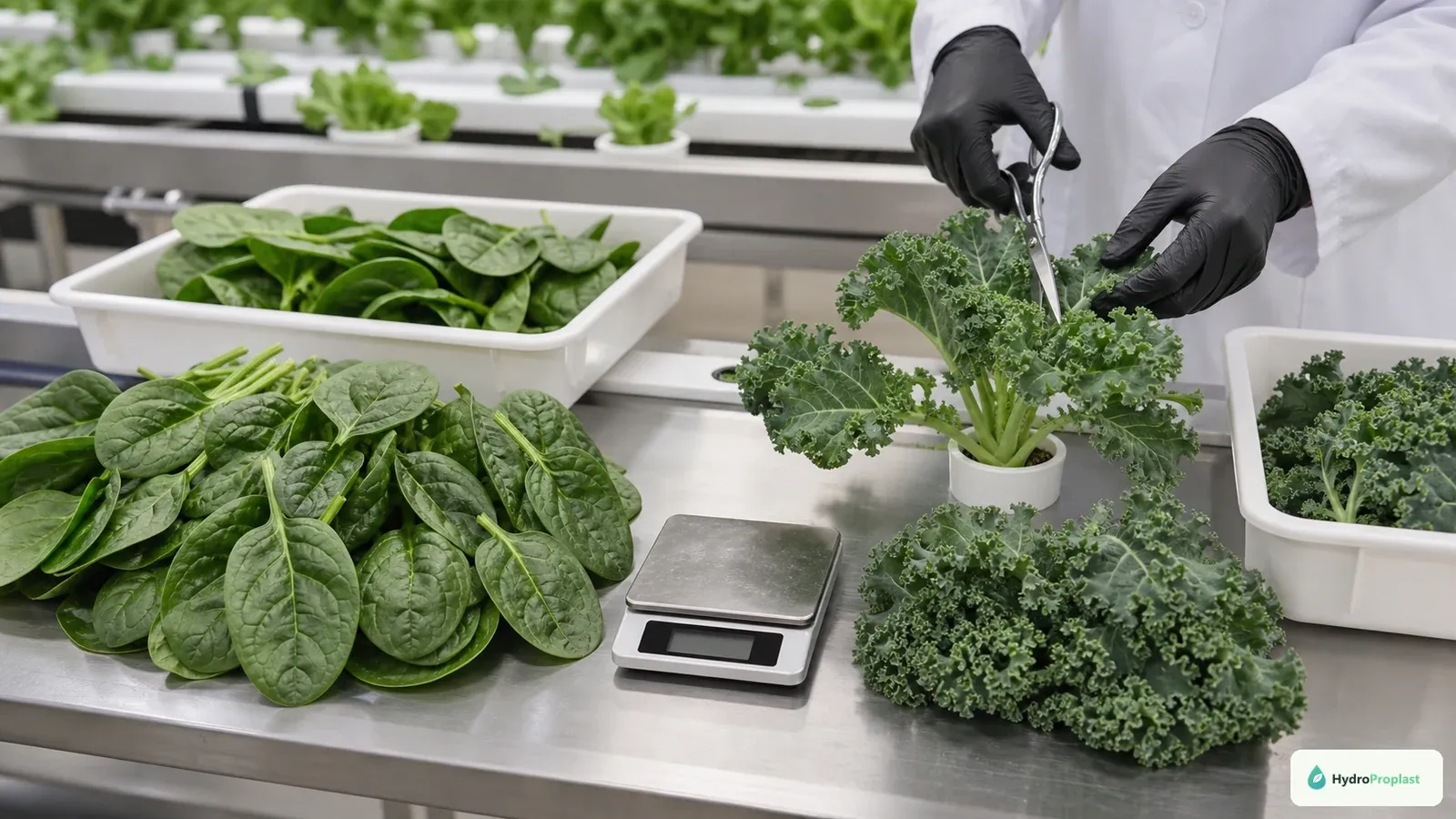
Harvest cleanly and compare usable yield, regrowth, texture, and crop time—not leaf size alone.
Remove mature outer leaves and leave the central growing point intact. Do not strip most foliage at once. Kale can produce repeatedly, but older stems and root systems eventually occupy space and complicate sanitation.
Baby kale can be cut as a short crop. Choose the harvest system before setting spacing because the same cultivar behaves like a different production crop at each stage.
Flavor and texture
Spinach is tender and commonly used raw or lightly cooked. Heat, age, and stress can change leaf quality. Kale is firmer, with cultivar-dependent curl and flavor, and may be preferred for cooking or smoothies.
Taste the actual cultivars at the intended harvest stage. Yield is wasted if the household does not use the crop.
Common spinach problems
Poor emergence deserves a seed-lot and temperature check before nutrient diagnosis. Pale or stretched seedlings need light review. Yellowing mature leaves requires checking age, shading, roots, pH, and EC.
Rapid vertical growth and changed leaf form may indicate bolting. Record temperature, photoperiod, cultivar, and plant age. Replacing the crop may be more useful than trying to reverse maturity.
Common kale problems
Kale seedlings stretch under weak light, while mature plants become top-heavy and shade neighbors. Dense curled leaves can conceal aphids and other pests. Inspect undersides and central growth regularly.
Lower leaves may age naturally, but rapid yellowing or marginal damage needs root-zone and nutrient diagnosis. Large roots can restrict NFT flow; compare channel inlet and outlet.
Pest and disease inspection
Both crops can host aphids and other leafy-green pests. Quarantine transplants, inspect both surfaces, and identify the organism before choosing any control. Use only products labeled for the edible crop and indoor setting, respecting harvest intervals.
Remove diseased or collapsing plants when they threaten a shared system. Keep tools clean and avoid moving wet roots between reservoirs.
Root-zone troubleshooting
Healthy roots are firm and may be white, cream, or nutrient-stained. Slime, odor, breakdown, or wilt despite water requires checking temperature, oxygen, flow, and debris. A warm small reservoir can change quickly as plants mature.
Use the root-rot guide for a full diagnosis. Do not pour an improvised chemical treatment around edible roots.
Cost and schedule comparison
Spinach may offer high value per compact harvest but uses more attention at germination and benefits from planned succession. Kale seedling establishment is often easier and plants can yield repeatedly, but each mature plant occupies more light and system time.
Track seed used, germination percentage, transplant survival, days to first harvest, total edible mass, energy, rejected leaves, and cleaning labor. Compare baby and mature versions separately.
A controlled side-by-side trial
Select one spinach and one compact kale cultivar. Sow counted seeds in the same propagation area, then give each adequate mature spacing. Keep nutrient, system, and measured light as comparable as practical.
Record emergence, temperature, compactness, root mass, first harvest, regrowth, taste, and pest pressure. Do not conclude from one failed spinach seed lot or one unsuitable kale cultivar.
University of Minnesota Extension provides growing guidance for spinach and kale. Its small-scale hydroponics guide adds system context.
For a warmer or less-controlled beginner room, kale is often the more forgiving test crop. For a cool setup where compact tender leaves justify careful propagation, spinach may be the better use of space. Choose by observed environment and desired harvest, then validate with one small trial.
Commissioning a fair comparison:
Use fresh seed from traceable lots and record storage history. Sow more counted spinach seeds than final positions require so low emergence is measured rather than hidden. Keep plugs labeled and avoid discarding spinach before the packet’s full expected window. Select transplants by root and crown health, not simply first emergence.
At transplant, place both crops within the verified light footprint and rotate positions only if the experimental plan accounts for it. If kale occupies the center and spinach the edge, crop and position effects cannot be separated.
Quality measurements:
For each harvest, weigh edible leaves and rejected stems or damaged tissue. Record tenderness, flavor, leaf size, and intended kitchen use. Measure time from sowing and from transplant, because slow spinach germination affects the whole schedule.
For repeated harvest, record regrowth interval and final root mass. A large kale yield may require more space and a longer crop. Compare usable grams per occupied area and day, not only grams per plant.
Bolting and maturity log:
Mark the first sign of center elongation or changed leaf shape. Record daily temperature range, light schedule, cultivar, and plant age. Do not assume bolting proves one isolated error; genetics and accumulated conditions interact.
When spinach or kale has clearly shifted away from the desired leaf stage, replace it from succession rather than holding it indefinitely. A planned younger batch protects continuity.
Mixed-reservoir cautions:
Watch whether one crop’s roots obstruct the other’s delivery or whether mature kale shades spinach. Compare inlet and outlet plants. If the shared compromise repeatedly favors one species, separate future crops by reservoir, shelf, season, or harvest stage.
Keep nutrient decisions based on verified solution trends and both crops’ roots. Do not raise or lower the whole reservoir because one old leaf changes color.
Final decision score:
Choose spinach if it achieves acceptable emergence, quality, and turnover in the measured cool environment. Choose kale if robust establishment and repeated harvest outweigh its space and root burden. Grow both only when the layout preserves light, flow, and clean access.
The result may change by season. Repeat a small trial after major room-temperature or lighting changes rather than treating one crop as permanently superior.
Propagation backup plan:
Because spinach emergence can be uncertain, keep a second small labeled sowing several days behind the first. Do not combine plugs of different age without records. If the primary batch succeeds, the reserve can become a later succession rather than being crowded into the same holes.
Kale backups are also useful, but avoid keeping seedlings in undersized cells until roots circle or crowns crowd. Transplant quality is more important than filling every position on schedule.
Cleaning comparison:
At final removal, note how easily each root mass leaves the net pot or channel. Record trapped debris, algae beneath the canopy, and time needed to restore components. A repeated kale crop may yield well yet require wider channels or earlier turnover. Spinach losses during germination may shift labor toward propagation instead.
Food-use comparison:
Plan at least three actual meals or uses before sowing. Record whether leaves were eaten raw, cooked, frozen, or discarded. A crop with slightly lower measured yield can be the better home choice when its texture and portion size match routine cooking.
After two complete cycles, compare cool and warmer periods separately. If spinach performance collapses as the room warms while kale remains acceptable, schedule spinach seasonally. If kale repeatedly outgrows the shelf, switch to baby harvest or a compact cultivar. The comparison should change the production plan, not merely declare a permanent winner.